Sabitlenmiş Tweet
Publication day for "Chasing Hope: A Reporter's Life"! Thanks to all who have helped it come together. It's available everywhere for purchase or download.


English
Nicholas Kristof
57.8K posts
@NickKristof
NY Times columnist, author and farmer of cider apples and wine grapes @KristofFarms

OPINION: The public is done with animal testing. So why isn’t the government? trib.al/XgNmOZe
A few observations on what has been reported as Iran’s three-phase proposal to the United States. I have been able to confirm some elements, though not all. ⏺️Overall, the Iranians appear to be pursuing a grand bargain—without labeling it as such. This is not merely a proposal aimed at securing a ceasefire, or even a formal end to the current conflict, but rather an attempt to resolve the broader U.S.-Iran antagonism that has persisted for the past 47 years. Implicit in this approach is an expectation that both sides would also restrain their respective regional partners and proxies (Israel, Hezbollah, etc.). In many respects, framing the proposal in this way may align more effectively with Trump’s instincts and psychology. ⏺️It is somewhat surprising that the proposal appears to frontload an end to the war before addressing the nuclear issue. If the conflict is fully de-escalated at the outset, Iran risks losing a significant source of leverage over Trump. Iran’s nuclear program alone has not been sufficient to extract meaningful concessions from Washington, as was evident during the recent ceasefire period. This sequencing may reflect a concession to China and other Asian countries, which have grown increasingly frustrated with bearing the economic costs of a conflict initiated by Trump and Israel. ⏺️The call for an international mechanism to guarantee a non-return to war suggests that any final agreement would, at a minimum, need to be codified in a UN Security Council resolution, with Russia and China serving as guarantors. From Tehran’s perspective, Trump’s personal assurances carry no credibility. ⏺️There is also mention of a revised compensation clause within a new framework, indicating that the fees Tehran might seek in the Straits could be modified or reframed. One potentially more acceptable approach for a broad range of states would be to characterize such charges not as tolls, but as maintenance fees shared with Iran and Oman. This could include oversight of environmental and navigational management, particularly given the high volume of maritime traffic that typically transits the Straits. ⏺️The reported proposal for a 15-year enrichment freeze is somewhat surprising. This would make more sense if it remains tied to a needs-based enrichment framework, as outlined in the earlier Geneva proposal. Under that approach, Iran would only enrich uranium sufficient to fuel two reactors: the Tehran Research Reactor (TRR) and another reactor not expected to come online for approximately seven years. Given that the TRR already possesses enough fuel for the next 5–7 years, Iran would not require additional enrichment during that period. This timeline could be extended—potentially to 15 years—either by downblending existing 60% enriched uranium and turning it into fuel pads now, or by securing external fuel supplies (from France or Russia, for example) to cover future needs. In that sense, the arrangement would technically not constitute a moratorium. ⏺️Iran’s proposal to negotiate a comprehensive regional security framework in phase three is not new. It dates back to UN Security Council Resolution 598, which ended the Iran-Iraq War. Tehran has pursued such an arrangement for decades. The United States should view this constructively: any framework that enables a reduction of U.S. military presence while encouraging regional actors to assume greater responsibility for their own security aligns with the stated objectives of the Trump administration. ⏺️What remains unclear in the reporting is the scope of sanctions relief Iran would seek in return. If Tehran is indeed aiming for a grand bargain, it will likely expect the lifting of all sanctions—primary and secondary U.S. sanctions, as well as UN-imposed measures. Let's see what happens.



🚨 URGENT: Nobel Peace laureate #NargesMohammadi is in critical condition following months of medical neglect in prison. She needs specialized care NOW. We call for immediate access to independent medical treatment and her release. Read more: nobelwomensinitiative.org/urgent-call-fo… #FreeNarges
“The United States’ blockade in the Strait of Hormuz is operating with full force and delivering the decisive impact we intended. We are inflicting a devastating blow to the Iranian regime’s ability to fund terrorism and regional destabilization. Our Armed Forces in the region will continue to maintain this unrelenting pressure." -Acting Pentagon Press Secretary @JoelValdezDOW
Trump on US Navy Seizing Ships: It’s a very profitable business. We’re like pirates.





This merits a response. JCPOA proponents always focus on the enriched uranium stockpile and not its underlying infrastructure, which the JCPOA freed up to expand — legally and massively — starting in 2024, following sunsetting arms and missile restrictions in 2020 and 2023. Under the JCPOA, Iran was always permitted to engage in R&D on advanced centrifuges and to deploy them starting in 2024. Just a few hundred advanced centrifuges are sufficient for a secret enrichment plant to go to weapons-grade uranium. At what point in this timeline would Iran diplomatically renegotiate? After Oct. 2025, when it would have been freed from the enrichment suspension and have no incentive to do so? That same year when it would be allowed to legally import anything it desired for its nuclear program? But let's say the JCPOA was still intact. In 2020 and 2023: • UN conventional arms embargo on imports to and exports from Iran lapsed (Oct. 2020); • Select UN-sponsored visa bans on Iranian officials lifted; • UN-sponsored ban on imports/exports of missile-related equipment and technology expired (Oct. 2023); • UN prohibition on Iranian ballistic missile launches ended; • U.S. and EU/UK sanctions on select proliferation-linked entities lapsed; • UN-sponsored asset freezes on select entities terminated; Iran's permitted activities from 2024-2026: • Up to 5,060 IR-1 centrifuges would have been allowed to enrich at Natanz; 1,044 IR-1s held idle at Fordow; • Tests with up to 30 IR-6 and 30 IR-8 centrifuges would have been permitted; manufacture of up to 200 IR-6 and 200 IR-8 per year - without rotors - would have been allowed; • JCPOA procurement channel would have dissolved, removing oversight of nuclear-related imports; • Past UNSC resolutions related to Iran's nuclear program would have terminated - in particular, the demand for a suspension of enrichment and reprocessing; • "Snapback" mechanism to restore international sanctions would have expired Oct. 18, 2025. From 2027-2029: • 2,500-3,500 IR-2m or IR-4 centrifuges would have been installed at Natanz - output potentially exceeding all 5,060 permitted IR-1s; • IR-8 infrastructure would have been installed at Natanz; rotors fitted to stockpiled IR-6 and IR-8 machines under IAEA monitoring; • Uranium tests in cascades of up to 150 IR-6 and 84 IR-8 would have been permitted. By 2029: • No further limits on advanced centrifuge manufacture or enrichment would have applied; • Up to 1,200 IR-6 and 1,200 IR-8 centrifuges could have been stockpiled by this date; • Breakout time would have been reduced to weeks or less - Iran would have been a de facto nuclear threshold state. By 2031: • No cap on enrichment purity level or enriched uranium stockpile would have applied; • Enrichment at Fordow Fuel Enrichment Plant would have been permitted; new enrichment plants permitted; • Plutonium reprocessing prohibition would have been lifted; heavy water reactors permitted; no cap on heavy water production or stockpiling; • No limits on centrifuge types or quantities would have remained; • Powered by a fully deployed fleet of advanced centrifuges, Iran would have faced near-zero breakout time - able to produce weapons-grade uranium within days In fact, the JCPOA was a very specific plan to progressively allow a state sponsor of terrorism and growing threat to the U.S., Israel, and their allies to enrich uranium legally and on an industrial scale with zero breakout time! Instead, thanks to military strikes: • These thresholds were never reached. • The JCPOA was formally terminated Oct. 18, 2025. • Iran is not enriching uranium for the first time in nearly 20 years. • No functioning enrichment facilities, feedstock production, or accessible enriched uranium stockpile currently exist. • Strikes have eliminated Iran's entire enrichment fuel supply chain: the Isfahan uranium conversion facility that produced UF6 feedstock has been destroyed; the Isfahan tunnel enrichment plant under construction has been struck and buried; the centrifuge manufacturing base that would have built the advanced machines has been demolished; and the enrichment facilities at Natanz and Fordow that would have run them have been severely damaged or rendered inaccessible. • Without UF6 feedstock, functioning centrifuges, or operational enrichment halls, Iran cannot produce the enriched uranium fuel required for a nuclear weapon. • The uranium metal conversion and fuel fabrication lines at Isfahan - essential for fashioning enriched material into weapon cores - have also been eliminated. • Iran's plutonium pathway has been closed by strikes on the Arak reactor. • UN resolutions once again prohibit enrichment and reprocessing. The near-zero breakout timeline has been foreclosed. • Snapback restored all UN prohibitions on Iran's imports of arms and missiles. And most importantly, the United States and its allies are no longer bribing Tehran with sanctions relief and other incentives to directly augment its threat capacity — they instead eliminated the great majority of these threats militarily.

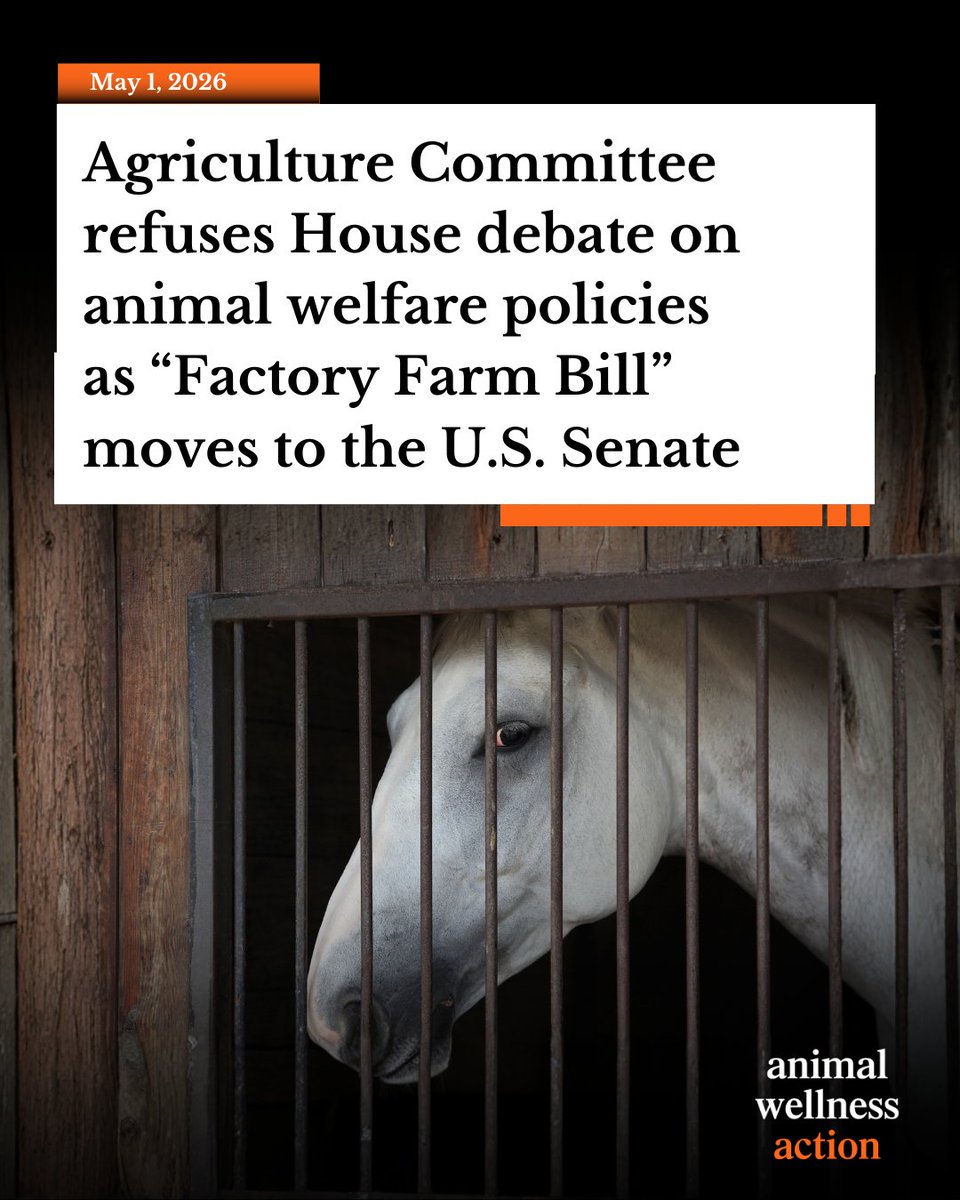
No, we don’t actually need to allow Chinese-owned factory farms to jam pigs into crates. The Farm Bill is bullshit. Spread the word. Full episode w/ @Lewis_Bollard youtu.be/F-xFUGmQIpI