Kris Barnes

135 posts

Kris Barnes banner
Kris Barnes

Kris Barnes

@KrisMBarnes

Neuroscience PhD and CEO at LentoBio -Life sciences -Future of medicine

Katılım Nisan 2022
162 Takip Edilen67 Takipçiler
Kris Barnes
Kris Barnes@KrisMBarnes·
@PeptideTrackApp Not super familiar with fine details of existing treatment protocol though. Otherwise: -Anti nausea would be game changing, maybe not in <5 years though -Combo therapies being tested (w/ anabolic agents or other metabolic drugs)
English
1
0
0
13
Kris Barnes
Kris Barnes@KrisMBarnes·
@PeptideTrackApp Hmm that's a good question. Semaglutide generic shift is on a set patent timeline, so pricing/access is a guaranteed eventual win. That could maybe lead to earlier treatments which would either "optimize" weight/biomarkers or lead to stronger patented drugs later on the formulary
English
1
0
0
17
Kris Barnes
Kris Barnes@KrisMBarnes·
Combined with the crazy retatrutide results, it’s exciting how many of these multipurpose anti-metabolic disease drugs are both cheap small molecules and are coming off patent. Ozempic and Jardience both generic in India now for example, and quite affordable
English
2
0
1
73
Kris Barnes
Kris Barnes@KrisMBarnes·
Imagine a (near) future where the metabolic disorders of aging that make up the majority of healthcare costs almost everywhere are 90% avoidable. And for essentially all of the world’s population, without breaking the bank.
English
0
0
0
18
Kris Barnes retweetledi
John Carmack
John Carmack@ID_AA_Carmack·
I loved the Project Hail Mary movie (and the book). Science, technology, competence, and openness – this is my culture.
English
134
217
4.9K
159.4K
Kris Barnes retweetledi
Karl Pfleger
Karl Pfleger@KarlPfleger·
The 2 Longevity Fields... New post on a topic of great importance. Long, but something I feel strongly about. Broadly Slowing Aging vs. Divide-and-Conquer Rejuvenation: How to tell the difference and why acknowledging both matters (link in next post)
Karl Pfleger tweet media
English
9
8
48
10.5K
VitaDAO 💛
VitaDAO 💛@vitadao·
Cyclarity Phase 1 of UDP-003 met all endpoints. First clinical evidence that humans can safely excrete 7-ketocholesterol, a root driver of atherosclerosis. Dose-dependent urinary excretion, no SAEs, ~3hr half-life. Phase 2 (plaque regression endpoint) planned later in 2026. VitaDAO-funded project. globenewswire.com/news-release/2…
English
10
22
185
82.3K
Kris Barnes
Kris Barnes@KrisMBarnes·
Real problem is most therapies don’t remove damage. 4 traditional pharma therapies for heart failure that give you 5 years extra total is like swiping at the barrel of one gun once. We are only now beginning to see good repair, rejuvenation and replacement good options arise
English
0
0
0
19
Kris Barnes
Kris Barnes@KrisMBarnes·
Crude metaphor and gets complicated when you consider that it can apply to hallmarks or diseases separately and that things have synergies. But generally, if aging is multiple risks at once, knocking out 1 risk at a time is 1 reasonable and tractable approach towards improvement
English
1
0
0
15
Kris Barnes
Kris Barnes@KrisMBarnes·
I think the argument that targeting individual aging diseases is less meaningful than targeting aging because “heart disease only gets you x years” or “heart disease + cancer only gets you x years” etc is flawed and kinda defeatist. Here’s why:
English
1
0
0
18
Kris Barnes
Kris Barnes@KrisMBarnes·
@Chandrika633 Very cool video and demo, excited for the launch! @Chandrika633 you are such a rigorous founder and so knowledgeable in your space
English
1
0
2
154
Chandrika Maheshwari
Chandrika Maheshwari@Chandrika633·
Customer Success as a function won't survive AI in its current shape. Most teams are still optimizing a job that's about to stop existing. Hiring more CSMs. Building more dashboards. Running more QBRs. The work that adds value to customers isn't the work they're staffing for. That's the shift we built @quivlyai for. The AI workforce for post-sales.
English
45
40
160
25.3K
Kris Barnes
Kris Barnes@KrisMBarnes·
I love the framing of this graphic. It may be the first time I’ve seen the aging hallmarks and tissue level aging diseases in one graphic. It feels tractable and makes you appreciate how much medicine is advancing in many of these areas.
American Aging Association@americanaging

Aging has gerogenes — molecular drivers of decline — just like cancer has oncogenes. New Cell paper reframes aging as a precision medicine target. 📄 Free: pmc.ncbi.nlm.nih.gov/articles/PMC12… @americanaging #Geroscience #AgingResearch #PrecisionMedicine

English
1
0
1
32
Kris Barnes
Kris Barnes@KrisMBarnes·
@MartinBJensen If AI+better data gathering techniques gives us anywhere near the level and precision of understanding for humans that we have of C elegans…well, that will be awesome
English
1
0
1
43
Martin Borch Jensen
Martin Borch Jensen@MartinBJensen·
Sydney Brenner’s 2010 essay feels like it was written for the current AI+Bio moment: "We should welcome with open arms everything that modern technology has to offer us but we must learn to use it in new ways. “AI needs more data” is true, but indefinite. Let's make it definite: define the problems to solve and the right data for those. Biggest question/data gap is understand how disease emerges and what changes when we intervene. Blog post soon.
Martin Borch Jensen tweet media
English
2
5
27
1.9K
Kris Barnes
Kris Barnes@KrisMBarnes·
@kaimicahmills Lots of promising chronic disease reversal strategies in the pipeline. Repair, rejuvenation, and replacement approaches, not lifestyle etc. Collectively they'll extend healthspan and lifespan. Negativity's only warranted if you believe there must be One Treatment to Rule Them All
English
0
0
0
38
Kai Micah Mills
Kai Micah Mills@kaimicahmills·
the truth is that the longevity field has failed it has failed to define or measure aging it has poured billons of dollars into companies that are black holes and accomplish nothing funding consistently flows to the wrong stewards of capital it has been co-opted by health & wellness influence through the rise of healthspan lifestyle, supplements and exercise are at the forefront of the field with nothing else to show grifters are in control real science that can save us is seen as pseudoscience, unimportant or unethical by the deathists that took over the field we wish for all to live, they wish for all to die; we have no common ground those who desire to work on the real problem at hand, the only problem - overcoming death - need to realize that this field is a dead end and a new field needs to rise from its ashes a field where the stated goal is to defeat death, a goal that is built into the very foundation - the constitution of it - that can never change immortality, nothing less health is the greatest distraction in the war against death - good health will not save us; this field needs to have no overlap in our activities next time we will not make the same mistakes as those who came before us we will not water down the mission, and with it the science, in a desperate effort to be accepted we will not fall down the slippery slope into deathism the only way forward is to forge a new path with those who wish to live, from scratch we have to go back to the beginning
English
17
4
63
4.3K
Kris Barnes retweetledi
Matthew D. Sacchet
Matthew D. Sacchet@MatthewSacchet·
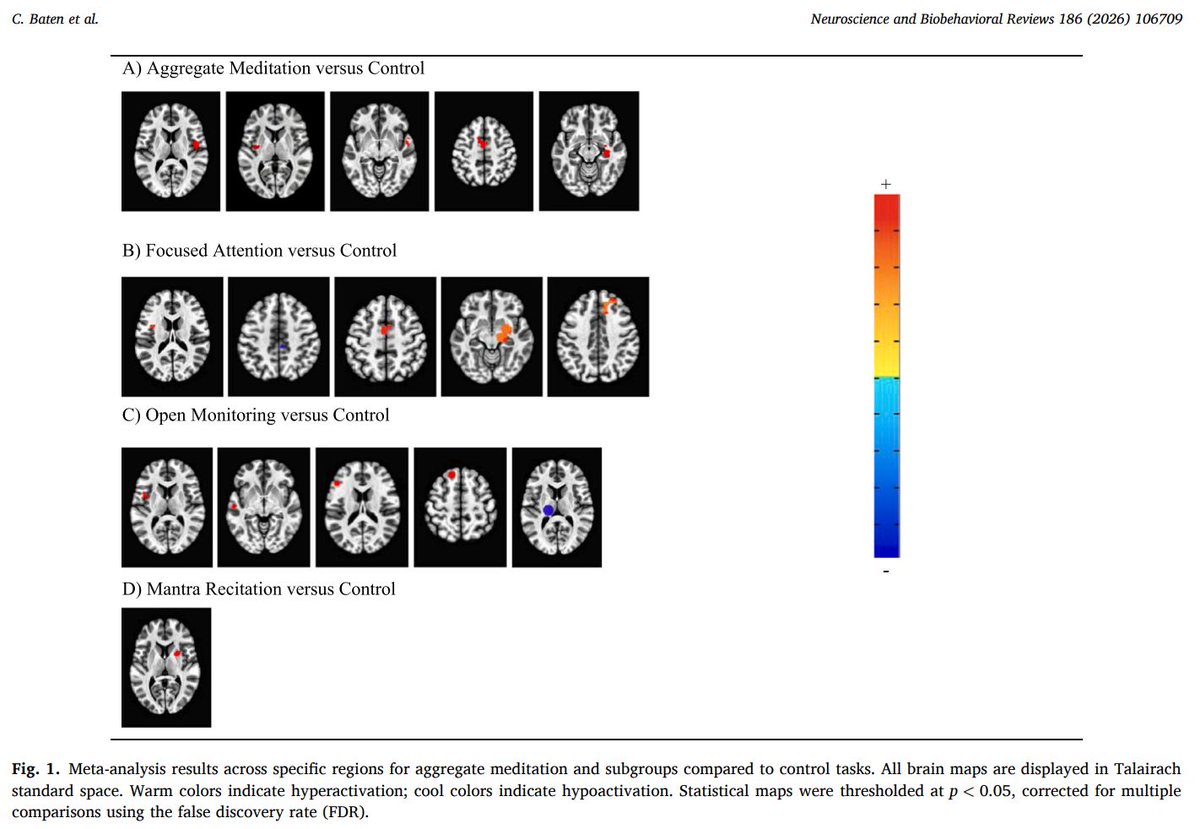
We have now mapped the most robust whole-brain characterization of meditation to date. Our new paper in Neuroscience and Biobehavioral Reviews, “The Functional Neuroimaging of Meditation: A Quantitative Whole-Brain Meta-Analysis and Systematic Review,” provides a systematic and rigorous whole-brain characterization of meditation and establishes a foundational reference for future research in this domain. Using quantitative whole-brain meta-analytic methods, we synthesized findings across the growing neuroimaging literature to move beyond individual experiments and identify the most reliable and reproducible brain activity common across meditation techniques as well as activity specific to different meditation techniques. From 34 studies and over 700 individuals, we assessed neuroimaging data during focused attention, open monitoring, mantra recitation, and loving-kindness meditation. We found that: – Across practices, meditation consistently recruits brain regions including the rolandic operculum, insula, superior temporal gyrus, supplementary motor area (SMA), and hippocampus. – Functional decoding further linked whole-brain activation patterns to self-monitoring, reappraisal, motivation, experience, and awareness states., highlighting meditation’s role in engaging domain-general cognitive processes that may develop through intentional training. Also, different meditation practices demonstrated dissociable neural signatures: – Focused attention meditation recruited brain regions implicated in attentional control and monitoring, including the insula, SMA, superior frontal gyrus, and hippocampus. – Open monitoring meditation engaged brain regions associated with salience, attentional awareness, and present-moment monitoring, including the insula, inferior frontal gyrus, middle temporal gyrus, and superior frontal gyrus. – Mantra recitation was linked to distinct activation in the putamen/insula, regions associated with sustained attentional and psychomotor integration. – Loving-kindness meditation activated aspects of prefrontal, cingulate, and affect-related brain systems associated with compassion and socioemotional processing. Together, these findings provide robust evidence that meditation is not a single, unitary brain state, but rather a family of practices that engage overlapping yet distinct neural systems, which highlights the need for greater specificity in how meditation is studied and interpreted. Our new research informs the personalization of clinical applications that seek to use meditation as an intervention to promote psychological well-being. In addition, it establishes a baseline for future research studying meditative development and advanced meditation. It also identifies promising neural targets for targeted clinical neuromodulation protocols. Congratulations and gratitude to first author Caitlin Baten and our co-authors Arielle Keller @ArielleKeller and Chris Miller! The full preprint is included below ⤵️ May our work benefit many 🙏
Matthew D. Sacchet tweet mediaMatthew D. Sacchet tweet mediaMatthew D. Sacchet tweet mediaMatthew D. Sacchet tweet media
English
5
48
205
12.7K