
Kurt Ackermann 🎙🎹🎸

12.9K posts

Kurt Ackermann 🎙🎹🎸 banner
Kurt Ackermann 🎙🎹🎸

Kurt Ackermann 🎙🎹🎸

@KurtAckermann

musician 🎙🎹🎸 #livemusic Substack Sessions 🎧🔊 daily YT livestream 🔁 means: have you seen this? NOT endorsing

Liechtenstein Katılım Kasım 2010
272 Takip Edilen405 Takipçiler
Kurt Ackermann 🎙🎹🎸 retweetledi
HOSTIS
HOSTIS@hostis_black·
On May 4th, a Swedish privacy lawyer caught Google Chrome silently installing a 4 GB AI model on every desktop computer it could reach. If you delete the file, Chrome treats the deletion as a temporary error and downloads it again at the next opportunity. The file is called weights.bin. It lives in a folder called OptGuideOnDeviceModel inside the Chrome user profile directory. It is the weights for Gemini Nano, Google's on-device large language model. Hundreds of millions of devices now carry it. Two thirds of every desktop browser in the world is Chrome. Alexander Hanff, the Swedish privacy lawyer, installed a clean copy of Chrome on a fresh Mac, ran a script that visited a hundred webpages with no human input, and watched the system logs as Chrome silently wrote 4 GB to his disk. Chrome 147 ships with an "AI Mode" pill rendered in the address bar. A reasonable user, knowing Chrome just installed an on-device AI model, would assume that visible AI Mode feature uses the model sitting on their hard drive. Local query. Local processing. Local privacy. Every part of that assumption is wrong. The visible AI feature ships your queries to Google's servers. The 4 GB file on your hard drive does nothing visible. It powers obscure features buried in right-click menus that almost no Chrome user has ever clicked. The invisible binary sits on your disk and waits for the version that does. Chrome is the most-installed surveillance product of all time. Two billion users. Every URL you visit, every search you type, every form you fill out, every site you stay on, every site you leave. The advertising model that pays for Chrome requires every one of those signals. Chrome holds 64% of the global desktop browser market. Two-thirds of every reader of this sentence is reading it through software that just took 4 GB of their hard drive without asking. Until last year, Chrome's surveillance ended at what you typed into the address bar and what your activity log showed. The model can now read the page you have open, the text you have selected, the draft you are writing inside a Gmail tab before you have decided whether to send it. Google's "Help me write" feature requires that capability by definition. Help me write means read what I am writing. Locally. In real time. Pre-send. It's time to switch browsers. The cartel cannot watch the screen it is not running on.
HOSTIS tweet media
English
130
1.5K
2.8K
166.4K
Kurt Ackermann 🎙🎹🎸
Kurt Ackermann 🎙🎹🎸@KurtAckermann·
That’s what I call: He‘s got the groove!
VisionaryVoid@VisionaryVoid

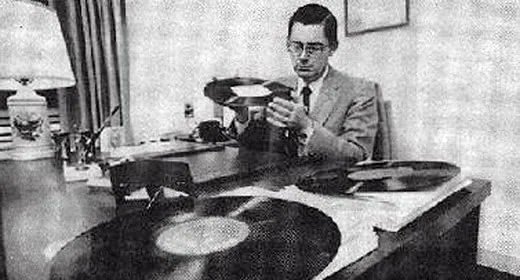
The Doctor Who Could Read Music Like a Book. In 1977, a Philadelphia physician named Dr. Arthur Lintgen was at a party when a colleague dared him to identify a vinyl record with the label covered. He had never tried it before. He held it up, tilted it toward the light, studied the grooves for a few seconds, and got it right. Then he kept getting it right, every time. Lintgen discovered he could decode a record's structure from the physical grooves alone. Loud passages looked silvery and jagged. Soft passages appeared dark and smooth. By reading groove density and spacing, essentially scanning the music's dynamics the way others might scan a bar graph, he could match what he saw against his encyclopedic knowledge of classical compositions and identify the piece, often within seconds. Word spread. In 1982, Time magazine asked skeptic and magician James Randi to design a controlled test. Randi covered all labels and matrix numbers, had a disinterested aide shuffle the records, and added several controls: two different versions of Stravinsky's Rite of Spring, a spoken word record, and an Alice Cooper album. Lintgen had no list of what was in the pile. He identified every classical record correctly. When he reached the two Stravinsky records, he not only recognized they were the same piece performed by different orchestras, he pointed out that one had a Deutsche Grammophon edge, and since DG only recorded German orchestras for their digital pressings at the time, he could narrow down the conductor. The Alice Cooper record, he declared, was "disorganized and gibberish." Randi confirmed: no tricks, no supernatural power, just an extraordinary convergence of musical memory and perceptual attention. On one occasion, someone showed Lintgen Beethoven's Fifth Symphony. He identified it correctly without even glancing at it. The man didn't read minds. He read grooves.

English
0
0
0
3
VisionaryVoid
VisionaryVoid@VisionaryVoid·
The Doctor Who Could Read Music Like a Book. In 1977, a Philadelphia physician named Dr. Arthur Lintgen was at a party when a colleague dared him to identify a vinyl record with the label covered. He had never tried it before. He held it up, tilted it toward the light, studied the grooves for a few seconds, and got it right. Then he kept getting it right, every time. Lintgen discovered he could decode a record's structure from the physical grooves alone. Loud passages looked silvery and jagged. Soft passages appeared dark and smooth. By reading groove density and spacing, essentially scanning the music's dynamics the way others might scan a bar graph, he could match what he saw against his encyclopedic knowledge of classical compositions and identify the piece, often within seconds. Word spread. In 1982, Time magazine asked skeptic and magician James Randi to design a controlled test. Randi covered all labels and matrix numbers, had a disinterested aide shuffle the records, and added several controls: two different versions of Stravinsky's Rite of Spring, a spoken word record, and an Alice Cooper album. Lintgen had no list of what was in the pile. He identified every classical record correctly. When he reached the two Stravinsky records, he not only recognized they were the same piece performed by different orchestras, he pointed out that one had a Deutsche Grammophon edge, and since DG only recorded German orchestras for their digital pressings at the time, he could narrow down the conductor. The Alice Cooper record, he declared, was "disorganized and gibberish." Randi confirmed: no tricks, no supernatural power, just an extraordinary convergence of musical memory and perceptual attention. On one occasion, someone showed Lintgen Beethoven's Fifth Symphony. He identified it correctly without even glancing at it. The man didn't read minds. He read grooves.
VisionaryVoid tweet media
English
15
49
269
15.3K
Kurt Ackermann 🎙🎹🎸
Kurt Ackermann 🎙🎹🎸@KurtAckermann·
37 years later I thought I try that Joe Satriani melody again that I recorded for my @mihollywood audition tape back in 1989. Weirdly enough that year redirected me into being able to carry a tune by singing and playing more rhythm guitar than lead. With that package I made a living as a working musician in the last 36 years. But I have to confess that nowadays I suck playing licks, themes and solos because I rarely do it. But still, it’s amazing what a human brain can memorise!
English
0
0
1
22
Kurt Ackermann 🎙🎹🎸
Kurt Ackermann 🎙🎹🎸@KurtAckermann·
Heyheyhey, gratuliere Amik Guerra & Renate Feger für die Lancierung der Internationalen Jazztage Liechtenstein heute bei der Pressekonferenz im Giessen Hotel & Coffeehouse in Vaduz / Liechtenstein. Das wird eine feine Sache im Juli auf der Burg Gutenberg in Balzers! #livemusic jazztageliechtenstein.com
Kurt Ackermann 🎙🎹🎸 tweet media
Deutsch
0
0
0
21
Kurt Ackermann 🎙🎹🎸
Kurt Ackermann 🎙🎹🎸@KurtAckermann·
My dad was a math teacher too!
Ihtesham Ali@ihtesham2005

An MIT professor taught the same math course for 62 years, and the day he retired, students from every country on earth showed up online to watch him give his final lecture. I opened the playlist at 2am and ended up watching three of them back to back. His name is Gilbert Strang. The course is MIT 18.06 Linear Algebra. Every machine learning engineer, every data scientist, every quant, every self-taught programmer who actually understands how AI works learned the math from this one man. Most of them never set foot on MIT's campus. They just opened a free playlist on YouTube and let him teach. Here's the story almost nobody tells you. Strang joined the MIT math faculty in 1962. He retired in 2023. That is 61 years of standing at the same chalkboard teaching the same subject to 18-year-olds. The interesting part is what he did when MIT launched OpenCourseWare in 2002. Most professors were skeptical. They worried that putting their lectures online would make their classrooms irrelevant. Strang did not hesitate. He said his life's mission was to open mathematics to students everywhere. He filmed every lecture and gave it away. The decision quietly changed how the world learns math. For decades linear algebra was taught the wrong way. Professors started with abstract vector spaces and proofs about field axioms. Students drowned in the abstraction. Most never recovered. They walked out believing they were bad at math when they had simply been taught in an order that nobody's brain is built to absorb. Strang inverted the entire curriculum. He started with matrix multiplication. Something you can write down on paper. Something you can compute by hand. Something you can see. Then he showed his students that everything else in linear algebra eigenvectors, singular value decomposition, orthogonality, the four fundamental subspaces was just a different lens for understanding what the matrix was actually doing under the hood. His rule was strict. If a student could not explain a concept using a concrete 3 by 3 example, that student did not actually understand the concept yet. The abstraction was supposed to come last, not first. The intuition was the foundation. The proofs were just confirmation that the intuition was correct. The second thing Strang changed was the classroom itself. He said please and thank you to his students. Every single lecture. He paused mid-derivation to ask "am I OK?" to check if anyone was lost. He never used the word "obviously" or "trivially" because he knew exactly what those words do to a student who is one step behind. He treated 19-year-olds learning math for the first time the way he treated his own colleagues. With patience. With respect. With the assumption that they belonged in the room. For 62 years. The result is something that has never happened in the history of education. A single math professor became the default teacher of his subject for the entire planet. Universities in India, China, Brazil, Nigeria, every country with a computer science department, started telling their own students to just watch Strang's lectures. The University of Illinois revised its linear algebra course to do almost no in-person lecturing. The reason was honest. The professor said they could not compete with the videos. His final lecture was in May 2023. The auditorium was packed with students who had never met him before. He walked to the chalkboard, taught for an hour, and at the end the entire room stood and applauded. He looked confused for a moment, like he genuinely did not understand why they were cheering. Then he smiled and waved them off and walked out. His written comment under the YouTube video of that final lecture was four sentences long. He said teaching had been a wonderful life. He said he was grateful to everyone who saw the importance of linear algebra. He said the movement of teaching it well would continue because it was right. That was it. No book promotion. No farewell speech. No legacy management. The man whose teaching is the foundation of modern AI just thanked the audience and went home. 20 million views. Zero ego. The entire engine of the AI revolution sits on top of math that millions of people learned for free from one quiet professor in Cambridge. The course is still on MIT OpenCourseWare. Every lecture, every problem set, every exam, every solution. Free. The most important math course of the 21st century is sitting one click away from you. Most people will never open it.

English
0
0
0
7
Kurt Ackermann 🎙🎹🎸 retweetledi
Ihtesham Ali
Ihtesham Ali@ihtesham2005·
An MIT professor taught the same math course for 62 years, and the day he retired, students from every country on earth showed up online to watch him give his final lecture. I opened the playlist at 2am and ended up watching three of them back to back. His name is Gilbert Strang. The course is MIT 18.06 Linear Algebra. Every machine learning engineer, every data scientist, every quant, every self-taught programmer who actually understands how AI works learned the math from this one man. Most of them never set foot on MIT's campus. They just opened a free playlist on YouTube and let him teach. Here's the story almost nobody tells you. Strang joined the MIT math faculty in 1962. He retired in 2023. That is 61 years of standing at the same chalkboard teaching the same subject to 18-year-olds. The interesting part is what he did when MIT launched OpenCourseWare in 2002. Most professors were skeptical. They worried that putting their lectures online would make their classrooms irrelevant. Strang did not hesitate. He said his life's mission was to open mathematics to students everywhere. He filmed every lecture and gave it away. The decision quietly changed how the world learns math. For decades linear algebra was taught the wrong way. Professors started with abstract vector spaces and proofs about field axioms. Students drowned in the abstraction. Most never recovered. They walked out believing they were bad at math when they had simply been taught in an order that nobody's brain is built to absorb. Strang inverted the entire curriculum. He started with matrix multiplication. Something you can write down on paper. Something you can compute by hand. Something you can see. Then he showed his students that everything else in linear algebra eigenvectors, singular value decomposition, orthogonality, the four fundamental subspaces was just a different lens for understanding what the matrix was actually doing under the hood. His rule was strict. If a student could not explain a concept using a concrete 3 by 3 example, that student did not actually understand the concept yet. The abstraction was supposed to come last, not first. The intuition was the foundation. The proofs were just confirmation that the intuition was correct. The second thing Strang changed was the classroom itself. He said please and thank you to his students. Every single lecture. He paused mid-derivation to ask "am I OK?" to check if anyone was lost. He never used the word "obviously" or "trivially" because he knew exactly what those words do to a student who is one step behind. He treated 19-year-olds learning math for the first time the way he treated his own colleagues. With patience. With respect. With the assumption that they belonged in the room. For 62 years. The result is something that has never happened in the history of education. A single math professor became the default teacher of his subject for the entire planet. Universities in India, China, Brazil, Nigeria, every country with a computer science department, started telling their own students to just watch Strang's lectures. The University of Illinois revised its linear algebra course to do almost no in-person lecturing. The reason was honest. The professor said they could not compete with the videos. His final lecture was in May 2023. The auditorium was packed with students who had never met him before. He walked to the chalkboard, taught for an hour, and at the end the entire room stood and applauded. He looked confused for a moment, like he genuinely did not understand why they were cheering. Then he smiled and waved them off and walked out. His written comment under the YouTube video of that final lecture was four sentences long. He said teaching had been a wonderful life. He said he was grateful to everyone who saw the importance of linear algebra. He said the movement of teaching it well would continue because it was right. That was it. No book promotion. No farewell speech. No legacy management. The man whose teaching is the foundation of modern AI just thanked the audience and went home. 20 million views. Zero ego. The entire engine of the AI revolution sits on top of math that millions of people learned for free from one quiet professor in Cambridge. The course is still on MIT OpenCourseWare. Every lecture, every problem set, every exam, every solution. Free. The most important math course of the 21st century is sitting one click away from you. Most people will never open it.
Ihtesham Ali tweet media
English
547
8.3K
32.1K
2.4M
Kurt Ackermann 🎙🎹🎸
Kurt Ackermann 🎙🎹🎸@KurtAckermann·
Im Giessen - Hotel & Coffeehouse in Vaduz / Liechtenstein 🇱🇮 : selbstgemachte Meringues 😋
Kurt Ackermann 🎙🎹🎸 tweet media
Deutsch
0
0
0
16
Kurt Ackermann 🎙🎹🎸
Kurt Ackermann 🎙🎹🎸@KurtAckermann·
@aakashgupta I also had such a SONY walkman with great stereo mics back in the early nineties. Somewhere in my basement is a suitcase with a ton of cassettes. It looks like I have to dig up these gems and bring them back to life. #livemusic
English
0
0
25
4.9K
Aakash Gupta
Aakash Gupta@aakashgupta·
The math on this collection should mass-humble every streaming service on the planet. One guy. A Sony cassette recorder. 10,000 concerts over 40 years. 30,000 individual sets from 3,000+ artists. R.E.M., The Cure, Nirvana, Björk, Depeche Mode, Sonic Youth, Phish, Tracy Chapman, Boogie Down Productions. His first recording of Nirvana was July 8, 1989 at a tiny club called Dreamerz. Kurt Cobain was 20 years old. The band introduced themselves by saying they were from Seattle. This was two full years before Nevermind existed. That tape is now cleaned up and streaming for free. The digitization operation alone is wild. One volunteer drives to Jacobs' house monthly, picks up 10-20 boxes of 50-100 tapes each, runs them through 10 simultaneous cassette decks he repaired himself. 5,500 tapes digitized since late 2024. Dozens more volunteers across the US and Europe do mastering, metadata, and setlist verification. Sometimes they contact the actual artists to confirm what songs were played. The collection went from 171 recordings in January 2025 to over 2,300 by April 2026. At this rate it'll take years to upload everything. Spotify has 100 million tracks. Apple Music has 100 million. Neither has a recording of Nirvana's first Chicago show. A guy with a tape recorder in his pocket does.
Dexerto@Dexerto

Famed "Chicago Tape Guy," who recorded over 10,000 live concerts, is uploading them online for free The collection spans four decades, with volunteers now digitizing and uploading the tapes to the internet

English
114
3.1K
22.1K
1.3M