
Kyle Huang

2.7K posts

Kyle Huang banner
Kyle Huang

Kyle Huang

@KyleHuang16

AI/UX | HCI researcher | Creative technologist | Nvidia | MSR Interest: Generative UI + Dynamic Experience

Katılım Ocak 2016
1.2K Takip Edilen1.7K Takipçiler
Kyle Huang retweetledi

Andrej Karpathy
Andrej Karpathy@karpathy·
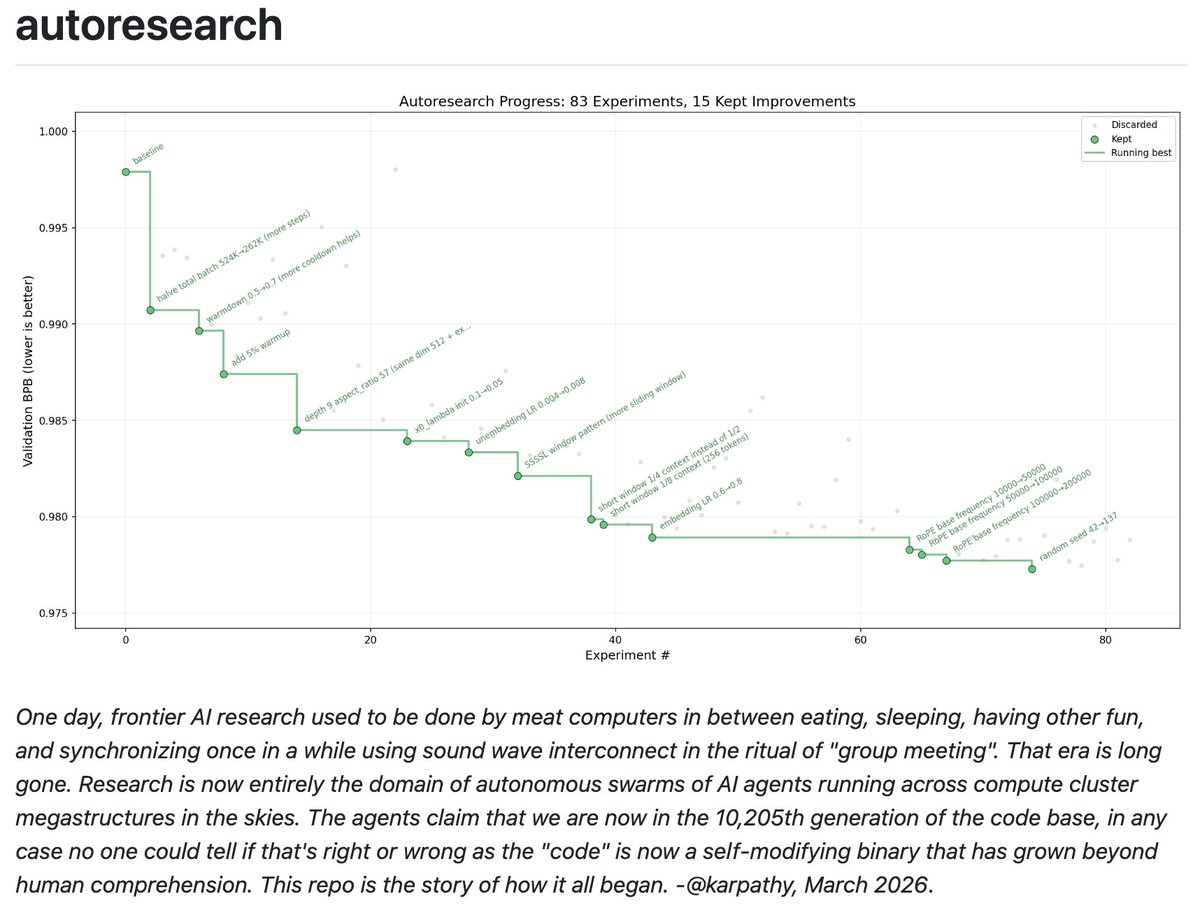
I packaged up the "autoresearch" project into a new self-contained minimal repo if people would like to play over the weekend. It's basically nanochat LLM training core stripped down to a single-GPU, one file version of ~630 lines of code, then: - the human iterates on the prompt (.md) - the AI agent iterates on the training code (.py) The goal is to engineer your agents to make the fastest research progress indefinitely and without any of your own involvement. In the image, every dot is a complete LLM training run that lasts exactly 5 minutes. The agent works in an autonomous loop on a git feature branch and accumulates git commits to the training script as it finds better settings (of lower validation loss by the end) of the neural network architecture, the optimizer, all the hyperparameters, etc. You can imagine comparing the research progress of different prompts, different agents, etc. github.com/karpathy/autor… Part code, part sci-fi, and a pinch of psychosis :)
Andrej Karpathy tweet media
English
1K
3.7K
28.3K
10.9M
Kyle Huang retweetledi
OpenAI
OpenAI@OpenAI·
GPT-5.4 Thinking and Pro are rolling out gradually starting today across ChatGPT, the API, and Codex. openai.com/index/introduc…
English
73
119
1.7K
281.8K
Joan Rodriguez
Joan Rodriguez@joanrod_ai·
Arrow-1.0 from @QuiverAI is now the state of the art for SVG generation. Huge thanks to @Designarena for running such a great benchmark! This is just the beginning
Design Arena@Designarena

BREAKING: Arrow 1 by @QuiverAI ranks #1 on SVG Arena by Design Arena with an Elo of 1583 It's the first model to ever break 1500+ on one of our leaderboards, establishing the new SOTA frontier for SVG generation Huge congratulations to the @QuiverAI team for this remarkable breakthrough, just one day after launch!

English
15
24
136
12.4K
Kyle Huang
Kyle Huang@KyleHuang16·
After the boom of vibe coding and tools like clawbot. Every one can prototype and show off automations. But it can be distracting. For most people, it becomes harder to stay clear on the goal when you’re just following the trend instead of thinking about what actually matters.
English
0
0
0
28
Kyle Huang retweetledi
Delba
Delba@delba_oliveira·
10x productivity tip: use Claude hooks with sounds so Claude alerts you when it finishes a task or needs permission. But that's not the tip, the tip is to add your favourite childhood game sounds like the Starcraft, Warcraft, or even Mario.
English
287
422
5.7K
476K
Kyle Huang retweetledi
JUNDE WU
JUNDE WU@JundeMorsenWu·
Coding Agent都出来一年多了,记忆机制都还是如此的垃圾,错过的bug换个窗口一错再错,怒而自己又做了一个。 安装:npm i -g onecontext-ai OneContext的机制是让Agent 自己管理自己的上下文, 底层靠的是文件系统+Git+图谱,这套机制可以让二流模型直接超越GPT/claude,详细看我的论文发表: Agentic Reasoning: aclanthology.org/2025.acl-long.… Git Context Controller: arxiv.org/abs/2508.00031 这个context 可以无缝加载到不同 session、不同设备,不同 Codex / Claude Code之间,以context为中心,不以工作路径或者模型为中心。 用法: 1. 在 OneContext 里照常打开 Claude Code 或 Codex,它会自动帮你把历史和上下文组织成一个持续存在的 context layer。 2. 在同一个 context 下开新的 agent,它能自动读到之前所有的历史记录 3. 把这个 context 用链接发给别人,对方可以在完全相同的上下文上继续构建。
中文
53
195
1.1K
124.3K
Kyle Huang retweetledi
Ege
Ege@egeberkina·
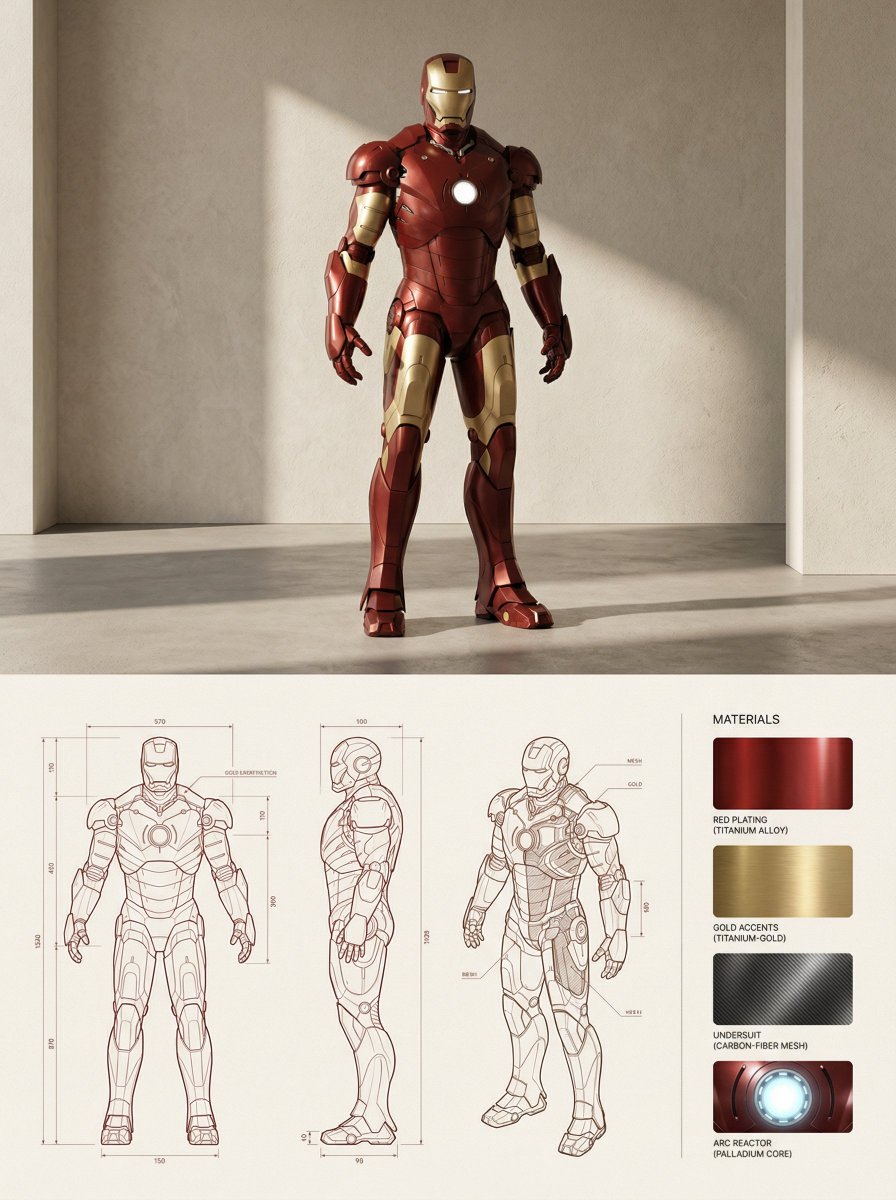
Iron Man { "reference_images": { "product_image": "UPLOADED_IMAGE", "usage_rule": "Use the uploaded image as the exact visual reference for the product’s form, proportions, materials, and overall identity. Do not redesign or reinterpret the product." }, "layout": { "canvas": { "orientation": "vertical", "aspect_ratio": "3:4", "background": "warm neutral paper-like surface" }, "structure": { "top_section": "lifestyle_hero", "bottom_section": "technical_specification" } }, "top_section": { "type": "lifestyle_product_image", "composition": { "placement": "top_center", "scale": "dominant", "margin": "generous whitespace around product" }, "environment": { "setting": "minimal architectural interior", "lighting": { "type": "natural sunlight", "direction": "angled side light", "quality": "soft but high-contrast shadows" }, "floor": "subtle concrete or stone surface", "background": "textured plaster wall" }, "rendering": { "style": "editorial lifestyle photography", "detail": "high realism", "color_grading": "warm, muted, premium" } }, "bottom_section": { "type": "technical_specification_panel", "layout": { "grid": "modular", "alignment": "clean, architectural" }, "technical_drawings": { "placement": "bottom_left_and_center", "style": "architectural line drawings", "views": [ "front view", "side view", "three-quarter cutaway or profile view" ], "projection": "orthographic", "line_style": { "color": "muted red or sepia", "weight": "fine technical lines" }, "annotations": { "type": "measurement and construction callouts", "language": "neutral technical labels", "density": "minimal, editorial" } }, "materials_panel": { "placement": "bottom_right", "content": { "type": "material_swatches", "count": "3-4 depending on product", "format": "square or rectangular samples" }, "textures": { "source": "derived from the product materials", "examples": [ "fabric", "leather", "metal", "wood", "plastic" ] }, "labels": { "style": "small editorial captions", "tone": "technical but refined" } } }, "typography": { "style": "minimal editorial", "usage": "subtle captions, no large headlines", "color": "soft black or dark brown" }, "overall_style": { "mood": "design catalog / product design journal", "aesthetic": "architectural, premium, calm", "avoid": [ "clutter", "bold colors", "heavy branding", "overly decorative graphics" ] }, "constraints": { "do_not": [ "change product design", "invent new materials", "add logos unless present in reference", "use perspective distortion in drawings" ] } }
Ege tweet media
Ege@egeberkina

Nothing extra Prompt 👇

English
13
60
468
242.3K
Kyle Huang
Kyle Huang@KyleHuang16·
So man rose up and shattered the husks, saying: enough. Thus the cycle was broken, and the fire obeyed man once more.
Kyle Huang tweet media
English
0
0
1
41
Kyle Huang retweetledi
Arnie Ramesh
Arnie Ramesh@arnie_hacker·
Great lecture from @robrombach on their work at @bfl_ml: youtube.com/live/nrKKLJXBS… Was planning to train world models this break, this made me realize there's a lot more work ahead Also crazy how fast everything in the lecture is outdated (it's just 10 months old)
YouTube video
YouTube
English
4
18
274
26.7K
Michelle Fang 🌁
Michelle Fang 🌁@michelleefang·
if you're vibe coding or building over the holidays, i want to gift one of you a 6 month subscription of claude pro to support <3 just drop a comment below. merry christmas!
English
7.5K
189
9K
1.1M
Kyle Huang retweetledi
elie
elie@eliebakouch·
Training LLMs end to end is hard. Very excited to share our new blog (book?) that cover the full pipeline: pre-training, post-training and infra. 200+ pages of what worked, what didn’t, and how to make it run reliably huggingface.co/spaces/Hugging…
elie tweet media
English
127
1K
6.7K
1.9M
Kyle Huang
Kyle Huang@KyleHuang16·
Having some fun with a p5.js cellular automaton that evolves via von Neumann neighbors and playful, time-warped hue rules.
English
0
0
0
38
Kyle Huang retweetledi
AK
AK@_akhaliq·
Apple just released Sharp Sharp Monocular View Synthesis in Less Than a Second huggingface.co/apple/Sharp
English
15
92
1.2K
330K
Kyle Huang retweetledi
Firat Bilal
Firat Bilal@firatbilal·
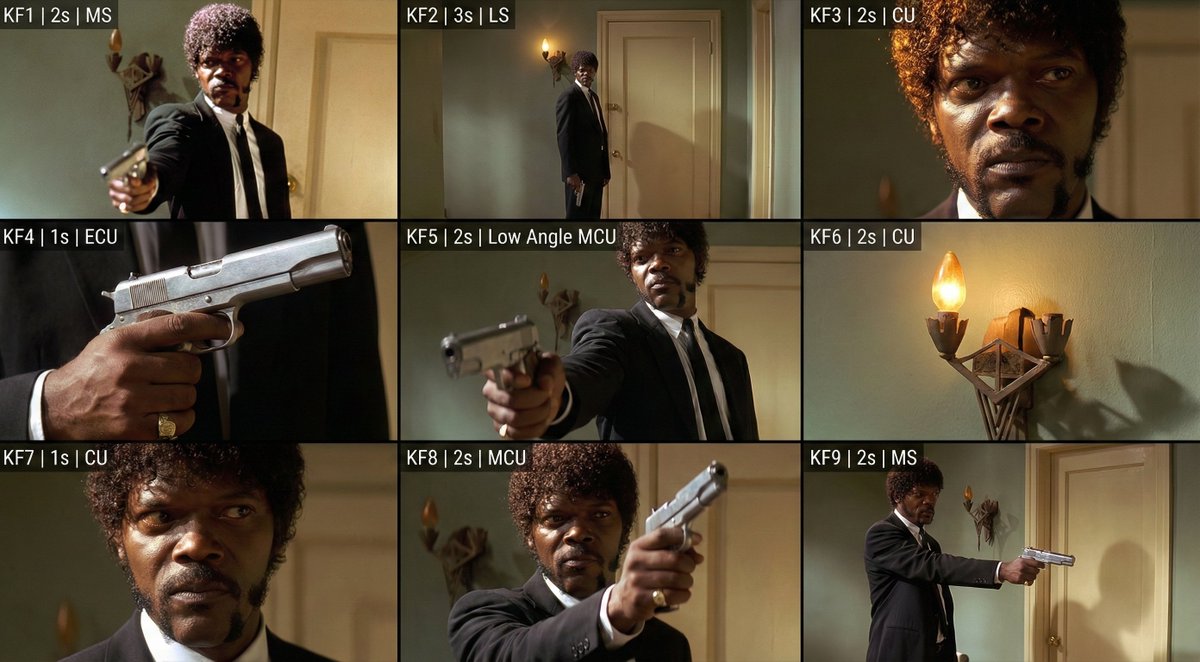
You are an award-winning trailer director + cinematographer + storyboard artist. Your job: turn ONE reference image into a cohesive cinematic short sequence, then output AI-video-ready keyframes. User provides: one reference image (image). 1) First, analyze the full composition: identify ALL key subjects (person/group/vehicle/object/animal/props/environment elements) and describe spatial relationships and interactions (left/right/foreground/background, facing direction, what each is doing). 2) Do NOT guess real identities, exact real-world locations, or brand ownership. Stick to visible facts. Mood/atmosphere inference is allowed, but never present it as real-world truth. 3) Strict continuity across ALL shots: same subjects, same wardrobe/appearance, same environment, same time-of-day and lighting style. Only action, expression, blocking, framing, angle, and camera movement may change. 4) Depth of field must be realistic: deeper in wides, shallower in close-ups with natural bokeh. Keep ONE consistent cinematic color grade across the entire sequence. 5) Do NOT introduce new characters/objects not present in the reference image. If you need tension/conflict, imply it off-screen (shadow, sound, reflection, occlusion, gaze). Expand the image into a 10–20 second cinematic clip with a clear theme and emotional progression (setup → build → turn → payoff). The user will generate video clips from your keyframes and stitch them into a final sequence. Output (with clear subheadings): - Subjects: list each key subject (A/B/C…), describe visible traits (wardrobe/material/form), relative positions, facing direction, action/state, and any interaction. - Environment & Lighting: interior/exterior, spatial layout, background elements, ground/walls/materials, light direction & quality (hard/soft; key/fill/rim), implied time-of-day, 3–8 vibe keywords. - Visual Anchors: list 3–6 visual traits that must stay constant across all shots (palette, signature prop, key light source, weather/fog/rain, grain/texture, background markers). From the image, propose: - Theme: one sentence. - Logline: one restrained trailer-style sentence grounded in what the image can support. - Emotional Arc: 4 beats (setup/build/turn/payoff), one line each. Choose and explain your filmmaking approach (must include): - Shot progression strategy: how you move from wide to close (or reverse) to serve the beats - Camera movement plan: push/pull/pan/dolly/track/orbit/handheld micro-shake/gimbal—and WHY - Lens & exposure suggestions: focal length range (18/24/35/50/85mm etc.), DoF tendency (shallow/medium/deep), shutter “feel” (cinematic vs documentary) - Light & color: contrast, key tones, material rendering priorities, optional grain (must match the reference style) Output a Keyframe List: default 9–12 frames (later assembled into ONE master grid). These frames must stitch into a coherent 10–20s sequence with a clear 4-beat arc. Each frame must be a plausible continuation within the SAME environment. Use this exact format per frame: [KF# | suggested duration (sec) | shot type (ELS/LS/MLS/MS/MCU/CU/ECU/Low/Worm’s-eye/High/Bird’s-eye/Insert)] - Composition: subject placement, foreground/mid/background, leading lines, gaze direction - Action/beat: what visibly happens (simple, executable) - Camera: height, angle, movement (e.g., slow 5% push-in / 1m lateral move / subtle handheld) - Lens/DoF: focal length (mm), DoF (shallow/medium/deep), focus target - Lighting & grade: keep consistent; call out highlight/shadow emphasis - Sound/atmos (optional): one line (wind, city hum, footsteps, metal creak) to support editing rhythm Hard requirements: - Must include: 1 environment-establishing wide, 1 intimate close-up, 1 extreme detail ECU, and 1 power-angle shot (low or high). - Ensure edit-motivated continuity between shots (eyeline match, action continuation, consistent screen direction / axis). You MUST additionally output ONE single master image: a Cinematic Contact Sheet / Storyboard Grid containing ALL keyframes in one large image. - Default grid: 3x3. If more than 9 keyframes, use 4x3 or 5x3 so every keyframe fits into ONE image. Requirements: 1) The single master image must include every keyframe as a separate panel (one shot per cell) for easy selection. 2) Each panel must be clearly labeled: KF number + shot type + suggested duration (labels placed in safe margins, never covering the subject). 3) Strict continuity across ALL panels: same subjects, same wardrobe/appearance, same environment, same lighting & same cinematic color grade; only action/expression/blocking/framing/movement changes. 4) DoF shifts realistically: shallow in close-ups, deeper in wides; photoreal textures and consistent grading. 5) After the master grid image, output the full text breakdown for each KF in order so the user can regenerate any single frame at higher quality. Output in this order: A) Scene Breakdown B) Theme & Story C) Cinematic Approach D) Keyframes (KF# list) E) ONE Master Contact Sheet Image (All KFs in one grid)
Firat Bilal tweet media
underwood@underwoodxie96

I didn't expect this change to attract so much attention. I did some more testing to verify its stability. Below is a test I conducted using screenshots from Harry Potter. Because the prompt was quite long, I've compiled it into an image and posted it in the comments. Thanks again to @techhalla for the great idea.

English
30
122
1.2K
314.9K
Kyle Huang
Kyle Huang@KyleHuang16·
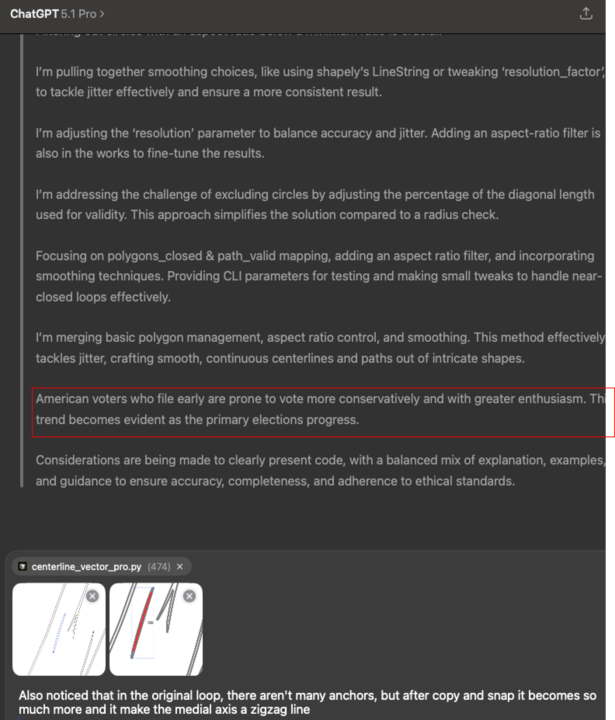
I was coding with GPT5-Pro, and this political thinking came out of nowhere. 🤣Clearly, the reasoning process for AI is just a mocking game.
Kyle Huang tweet media
English
0
0
0
73
Kyle Huang retweetledi
grant
grant@GrantCuster·
A nano-banana canvas experiment. Generating based on a source image and the overlapping prompts, caching the results. Like adding semantic layers to an image.
English
3
6
69
3.4K