Kyle

5 posts

Kyle

Kyle

@Kyle_Finhub

Kyle | Finhub365 Founder 🚀https://t.co/eqAk48N9c0,AI-Powered Stock Analysis 🤖Sharing daily stock signals & how to build AI Investment Agents.

Katılım Ocak 2026
37 Takip Edilen3 Takipçiler
Kyle
Kyle@Kyle_Finhub·
The biggest threat to Nasdaq isn't an AI bubble, nor AI killing SaaS. It's a 34-kilometer strait. Saudi Arabia ordered 18,000 Nvidia GB300 chips. UAE committed $7B to Stargate. One Abu Dhabi fund holds OpenAI, xAI, AND Anthropic. Their oil revenue is being cut off. Right now. Both ends of the petrodollar cycle are breaking simultaneously. This hasn't happened in 50 years. Full deep dive 👇 x.com/Kyle_Finhub/st… Scenario A, B, or C? Drop your call below.
English
0
0
0
99
Kyle
Kyle@Kyle_Finhub·
The Biggest Threat to AI Isn't Competition. It's a 34-Kilometer Strait. Saudi Arabia just ordered 18,000 Nvidia GB300 chips. UAE committed $7 billion to the Stargate project. One Abu Dhabi fund holds stakes in OpenAI, xAI, AND Anthropic — simultaneously. $4.9 trillion in Middle Eastern sovereign wealth is quietly funding the entire AI infrastructure stack. Now their oil revenue is being cut off. Not hypothetically. Right now. Through a strait most investors have never thought about. --- ▎ TL;DR: ▎ 1. The Hormuz crisis is breaking both ends of the petrodollar cycle at once — oil exports AND sovereign fund reinvestment into US assets. This dual disruption has never happened in 50 years. ▎ 2. Middle Eastern capital doesn't just invest in AI — it IS the funding infrastructure. $NVDA chip orders, Stargate, OpenAI, xAI all depend on petrodollar recycling. ▎ 3. The critical variable isn't oil price — it's duration. Beyond 6 months, recession becomes near-certain. We're currently between Scenario A and B. --- The Hidden Engine Behind US Stocks In 1974, US Treasury Secretary William Simon flew to Jeddah on a secret mission. The deal was simple. Saudi Arabia recycles its oil revenue into US Treasuries. America provides military protection and weapons. By 1977, Saudi Arabia held ~20% of all foreign-owned US debt. The Treasury created a special mechanism to bypass public auctions and hid Saudi holdings by merging them with 14 other nations under "oil exporters." This arrangement has been running for 50 years. The loop: Oil nations export crude → collect dollars → invest in US Treasuries and stocks → dollars flow back to America → US finances deficits cheaply → funds military that protects oil nations → repeat. As of late 2024, according to Treasury Department data: Saudi Arabia — ~$132-137B in US Treasuries UAE — ~$77B Kuwait — ~$50B ~80% of global oil still trades in dollars. The engine is running. But it's cracking. --- Where $4.9 Trillion Actually Sits Six Middle Eastern sovereign wealth funds control $4.9 trillion. That's ~40% of all sovereign wealth globally. PIF (Saudi Arabia) — $1.15T ADIA (Abu Dhabi) — $1.05-1.18T KIA (Kuwait) — $969B-1T QIA (Qatar) — $530B+ Mubadala (Abu Dhabi) — $330-358B ADQ (Abu Dhabi) — $251-263B Conservative estimate: $350-550B sitting in US equities, directly and indirectly. That's only 0.6-0.9% of S&P 500 market cap. Sounds irrelevant. It's not. The S&P 500's "effective number of stocks" is just 44 — a 35-year low. Top 10 names hold 39-40% of total market cap, far exceeding the 27% concentration at the 2000 dot-com peak. In a market this top-heavy, marginal flows get amplified. And these funds aren't just buying index funds. They're buying the picks and shovels of the AI revolution. --- The AI Funding Chain You Didn't Know Existed Here's where it gets uncomfortable for anyone long $NVDA, $MSFT, or $GOOGL. Direct $NVDA exposure: HUMAIN — Saudi Arabia's AI execution arm, created by PIF — signed a deal for 18,000 Nvidia GB300 chips. The plan: hundreds of thousands of GPUs over 5 years. They also locked in a $10B joint venture with $AMD and a $10B AI Hub with $GOOGL Cloud. MBS told Trump during the 2025 visit that Saudi Arabia would consume billions of dollars in US semiconductors in the near term. That's not a vague investment promise. That's direct $NVDA and $AMD revenue. The OpenAI / xAI / Anthropic nexus: MGX — a fund created by Abu Dhabi's Mubadala and G42 — is the only investor on earth that simultaneously holds stakes in OpenAI, xAI, AND Anthropic. It also co-founded the Stargate project ($500B total) and committed $7B. It partnered with BlackRock and $MSFT on an AI infrastructure fund targeting up to $100B in total investment including debt financing. The SoftBank transmission chain: Saudi PIF poured $45B into SoftBank Vision Fund I. Mubadala added $15B. Together, ~60% of the fund. SoftBank now holds ~87-90% of ARM — the chip architecture company whose designs power virtually every smartphone and a growing share of AI servers. ARM's market cap sits at roughly $150-200B. SoftBank co-leads the Stargate project ($19B commitment) and invested $41B into OpenAI for an ~11% stake. Follow the money: Middle Eastern oil revenue → SoftBank → ARM + Stargate + OpenAI Cut the oil revenue, and this entire chain loses its funding source. --- The Dual Disruption: Why This Has Never Happened Before Every oil crisis in history hit ONE end of the petrodollar cycle. 1973: OPEC embargoed oil. Supply cut. But prices surged 300% — oil revenue exploded — and petrodollars actually accelerated into US assets. The producers were the aggressors. They got richer. 2026 is the exact mirror image. The Hormuz Strait is choked — not by the producers, but against them. Supply side broken: The strait carries 20 million barrels per day. That's 27% of all seaborne oil and 20% of global oil consumption. ~14 million bbl/day have zero alternative routes — no pipeline bypass exists for Iraq, Kuwait, or Qatar. Saudi's East-West pipeline handles 5M bbl/day. It's not enough. Reinvestment side broken: Iranian missiles have struck targets across Saudi Arabia, UAE, Qatar, Bahrain, Kuwait, Jordan, Iraq, and Oman. These sovereign funds may be forced to liquidate foreign assets to fund domestic defense and reconstruction. Both ends. Simultaneously. First time in 50 years. But here's the part that should really concern you: You don't need a single mine in the water to close the strait. As Kpler analysts noted, "insurance withdrawal is completing what physical blockade couldn't." P&I coverage revoked. War risk premiums surged from 0.125% to 0.2-0.4% of hull value per transit. Shipping companies can't get coverage. No coverage = no ships = no oil. A market mechanism is doing what missiles couldn't. --- Three Scenarios — Where Are We Now? Scenario A (Mild): Oil $80-95 | Duration: 1-3 months S&P: -5 to -8% | Nasdaq: -8 to -12% Inflation adds +0.4-0.6% | GDP drag: -0.3 to -0.9% Scenario B (Moderate): Oil $120-150 | Duration: 3-6 months S&P: -10 to -15% | Nasdaq: -15 to -25% Inflation adds +1.4-2.8% | GDP drag: -1.5 to -3.5% Fed forced to pause cuts or hike. 10Y yield spikes 50-100bps. Scenario C (Severe): Oil $200+ | Duration: 6+ months S&P: -20 to -30% | Nasdaq: -30 to -45% Inflation adds +3-5%+ 1970s-style stagflation territory. We are currently between A and B. Qatar LNG facilities attacked. Offline. European TTF natural gas doubled to €56/MWh in 48 hours. Nonfarm payrolls came in at -92,000 on March 5. 10-year Treasury yield jumped 18bps in one week — the largest move since May. Real yields rose 12bps while inflation expectations rose only 5bps. That gap matters. Investors aren't just pricing inflation. They're demanding higher risk compensation. Hamilton's rule from 1983 still holds: oil prices up 90%+ within 10-12 months → recession follows. Almost without exception. --- The Triple Threat to AI Stocks If you're long $NVDA, $MSFT, $GOOGL, or $META without understanding this, you're flying blind. Threat 1 — Multiple compression. Oil spike → inflation → Fed pauses or hikes → 10Y yield rises → growth stock duration effect amplifies. Historical data: Nasdaq volatility runs 2.8x the S&P during hiking cycles. The names that went up the most come down the hardest. Threat 2 — Operating costs explode. Electricity = 60% of cloud data center operating costs. 40%+ of US power generation runs on natural gas. Oil spikes transmit to gas prices, then electricity prices. AI margins get squeezed from below. Every hyperscaler — $AMZN, $MSFT, $GOOGL, $META — planned $325B+ in combined 2025 capex, mostly for AI infrastructure. Those economics change fast when power costs double. Threat 3 — The funding chain fractures. Saudi's ~$1T and UAE's $1.4T investment commitments to the US were mostly multi-year MOUs. Under crisis, they face a triple threat: 1. Oil revenue collapses (can't export through a closed strait) 2. Domestic reconstruction demands capital 3. Geopolitical reassessment of US-directed investment If PIF's $45B and Mubadala's $15B in SoftBank need to be recalled, the transmission could hit ARM, OpenAI, and the entire Stargate project. HUMAIN's 18,000 $NVDA chip order and the $10B $AMD joint venture — those purchase commitments become uncertain. Stargate's $500B plan depends on Middle Eastern capital + US tech + global chip supply. Break any link and it delays or downsizes. --- Before You Panic: The Bull Case Current tech NTM P/E: ~30x. In 2000 it was 50x. That's 40% cheaper. Top 10 companies generate 60% of S&P 500 net income. In 2000, under 20%. $NVDA trades at 36-37x trailing earnings — well below its 3-year average of 66-73x. This isn't speculative mania. It's expensive and concentrated. There's a difference. US SPR holds 415M barrels. Max release: 4.4M bbl/day, providing roughly 90 days of cushion. And duration is what matters most. The 1973 and 1979 crises lasted years and caused deep recessions. Shorter disruptions — even severe ones — have historically resolved with limited lasting damage. Duration, not magnitude, determines the outcome. --- Bottom Line The biggest risk to your AI portfolio isn't a better model from a competitor. It's whether oil tankers can pass through a 34-kilometer strait. Three things to watch right now: 1. Duration — beyond 6 months, recession becomes near-certain regardless of Fed response. 2. SWF liquidation signals — unusual selling in Mag 7 and SoftBank-linked assets. If PIF or Mubadala start exiting positions, the cascade begins. 3. Insurance markets — when war risk premiums normalize, the crisis is ending. Until then, the de facto blockade holds. The petrodollar flywheel ran for 50 years without both ends breaking at once. That streak just ended. Not financial advice. DYOR.
English
1
0
1
237
Kyle
Kyle@Kyle_Finhub·
I Built a Bloomberg-Style War Dashboard in 3 Hours Using Claude Code My account was down four figures before lunch on a Tuesday.Oil spiking. Gold ripping. VIX through the roof. Every defense stock on a tear while tech bled out. And I was doing what every other retail investor does in a crisis—flipping between twelve browser tabs, refreshing Twitter, checking Bloomberg, scanning Reuters, trying to piece together what was actually happening in the Middle East and what it meant for my positions. That's when it hit me. I wasn't trading. I wasn't analyzing. I was just panicking with extra steps. So I closed everything. Opened Claude Code. And said: "Help me build a real-time crisis dashboard that shows me everything I need on one screen." Three hours later, it was live. Here's why this matters—and it's not about me. Every time geopolitical chaos hits—Iran, Taiwan, Ukraine, whatever's next—the same pattern plays out. Retail investors scramble across dozens of sources. Bloomberg terminal users have it all in one place. The information asymmetry isn't about access anymore. It's about aggregation speed. The guy with eleven assets, five news feeds, sector heatmaps, and AI-tagged threat levels on a single screen makes better decisions than the guy toggling between CNBC and Twitter with his heart rate at 120. That's not an opinion. That's just how information processing works under stress. The problem is that building something like that used to take a dev team two weeks and five figures. Now it takes a conversation. Let me walk you through what three hours with an AI coding partner actually looks like. Hour one was the data pipeline. I told Claude: pull real-time news from military-focused Twitter accounts—@sentdefender, @IranIntl_En, the usual OSINT sources—plus Bloomberg, Reuters, and CNBC. Then run every headline through an AI classifier. Four urgency tiers: URGENT, DEVELOPING, ANALYSIS, MARKET. Each story auto-tagged with affected tickers—a Strait of Hormuz headline gets flagged with crude oil, gold, VIX, and defense ETFs before a human ever reads it. Claude generated the entire aggregation engine. I tuned parameters. It worked. Not "it kind of worked." It pulled, classified, and tagged nearly 500 stories in the first run. Accurately. Hour two was the frontend. I said one sentence: "Give me a page with the information density of a Bloomberg Terminal." Then we built it module by module. A breaking news ticker across the top—red banner, URGENT stories only, refreshing every 60 seconds. Open the page and you instantly know what just happened. Below that, a horizontal scroll of 11 asset cards: Brent, WTI, natural gas, gold, copper, dollar index, VIX, S&P futures, China large-cap ETF, China internet ETF, CSI 300 ETF. A crisis severity gauge—a half-circle dial that calculates threat level from the ratio of urgent stories. LOW to MODERATE to HIGH to CRITICAL. Next to it: total event count, sectors affected, sources monitored, conflict duration. One glance tells you how bad it actually is. The event timeline—the core of the whole thing. Reverse-chronological news feed. Every story tagged with category, affected tickers and direction, source link, timestamp. A sector heatmap showing 10 US sector ETFs. Energy, defense, airlines, tech, financials, healthcare, consumer, utilities, real estate, materials. Green for up, red for down, deeper color means bigger move. Where the money's flowing—obvious at a glance. Top movers—biggest gainers and losers of the day, with proportional bars. And then the piece I'm most proud of: the AI Signal Radar. Our agent system runs 24/7 across 200+ US equities, synthesizing news sentiment, insider transactions, dark pool activity, technical analysis, and social chatter into directional signals with confidence scores. The dashboard surfaces the most relevant signals for the crisis—ticker, bullish or bearish, confidence level, reasoning. Hour three was polish. Wired up live data feeds. Adjusted visual spacing. Added the language toggle. Deployed. Done. I want to be honest about what this felt like. It didn't feel like using a tool. It felt like pair-programming with a senior full-stack engineer who never gets tired and never argues about architecture decisions. I described what I wanted. Claude wrote the code. I gave feedback. It revised. Three or four rounds per module. The iteration speed was absurd. A human developer building this from scratch—two to three days minimum. Probably more if you count the data pipeline work. I did it in an afternoon. While my portfolio was on fire. And the thing I built actually helped me stop panicking and start thinking clearly about what was happening. That's the part that gets lost in the "AI is cool" discourse. This wasn't a toy. This wasn't a demo. This was a functional financial intelligence tool built under real stress for a real crisis—and it worked well enough that I shipped it publicly the same day. Here's the thing about geopolitical crises and markets. They're not one-off events. They're a recurring pattern. Iran today. Taiwan tomorrow. Something nobody's predicting six months from now. And every time it happens, the same gap opens up: people with real-time, aggregated, AI-processed information make money. People refreshing Twitter lose money. The dashboard I built for the Iran situation isn't just a dashboard. It's a template. Next time something erupts—any regional conflict, any macro shock—we can spin up a similar tracker in under an hour. The pipeline exists. The AI classification exists. The frontend components exist. We just point them at a new event. That's what building with AI actually unlocks. Not just speed on a single project—but compounding leverage on every project after it. Honestly, I don't think even the people making the decisions know the answer to that. But the least you can do is make sure your information isn't lagging behind your exposure. Your portfolio is already in the middle of it. Your dashboard should be too.
Kyle tweet media
English
0
0
0
168
Kyle
Kyle@Kyle_Finhub·
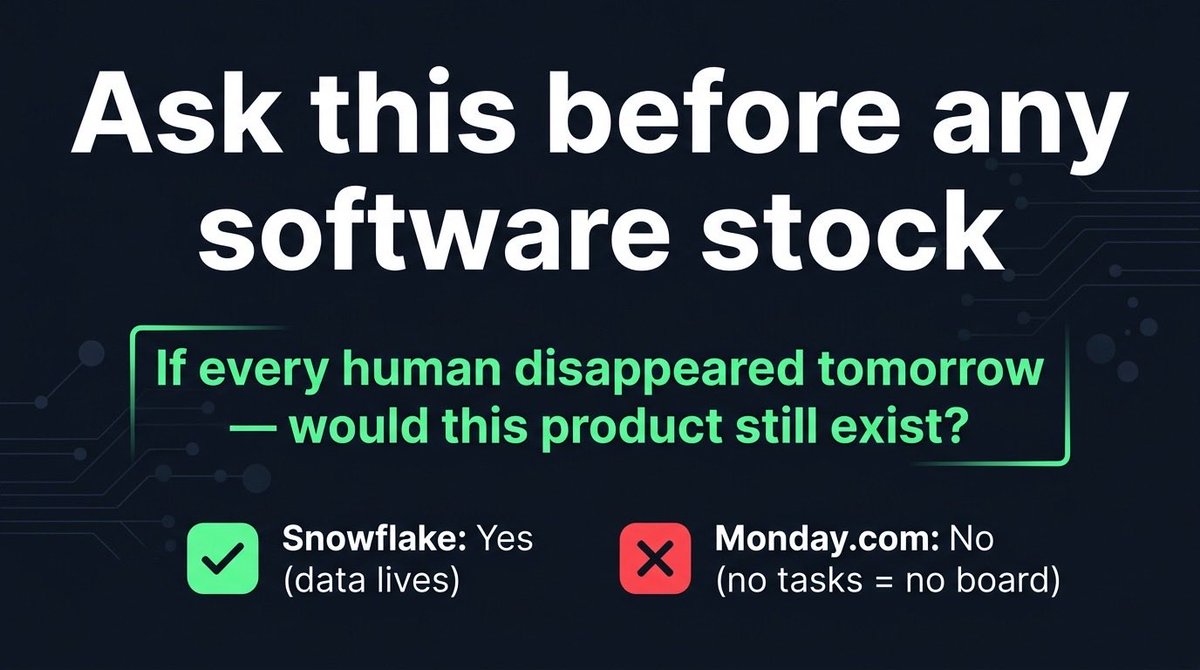
Before you buy any software stock, ask one question: If every human user disappeared tomorrow—would this product still need to exist? Snowflake? Yes. Data doesn't care who reads it. Monday.com? No. There's no task board without a task-doer. That question is worth more than any DFC model
Kyle tweet media
English
0
0
0
50
Kyle
Kyle@Kyle_Finhub·
Wall Street spent 2025 telling you SaaS was "AI-powered." Then February 2026 happened. $1 trillion in software market cap—gone. Not because AI failed. Because AI succeeded—and started doing the jobs those software companies were selling seats for. The product wasn't disrupted. The customer was.
Kyle tweet media
English
1
0
1
43