
Sabitlenmiş Tweet

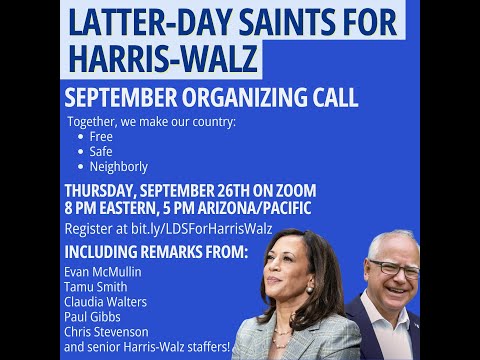
Now available! Our September National Organizing Call can be viewed here!
youtube.com/watch?v=oNv5MM…
YouTube
English
Latter-day Saint Democracy Network
3.1K posts

@LDSDemocracy
We're Latter-day Saints who believe that together we make our democracy strong. (Not affiliated with or endorsed by @Ch_JesusChrist)
Two senior Republican appropriators agree it doesn't make any sense for Democrats to agree to a government funding deal unless Trump actually adheres to the deal. The Democratic alternative CR had language that would address this, but the White House came out strongly against.
As gutting as today was, I need some of my fellow saints to cool it re: "most hated religion" like Tree of Life, Dar Al-Farooq, the Oak Creek gurdwara, Mother Emanuel AME, Burnette Chapel, and many more attacks on houses of worship haven't happened in the past 15 years.

🔗: bit.ly/42eQMWE Multiple people are injured and the building is on fire after a shooting at a meetinghouse of The Church of Jesus Christ of Latter-day Saints in Grand Blanc, Michigan. An active shooter fired on church members attending Sunday meetings at the chapel, according to Grand Blanc police. The shooter is down but the church is in flames, police said in a Facebook post. Read more at the link above.
After reading Tulsi Gabbard's report, and days of reading the commentary that followed it, I've got some fleshed out thoughts that I hope are helpful. But I want to pre-empt some criticisms, too: From the left, I’ll be told that this story is old news, that I’m falling for misinformation Gabbard is willfully spreading to distract from more important stories, and that Trump is an obvious Russia stooge. From the right, I’ll be told that I can’t see the generational scandal in front of me, that I’m protecting a nameless cabal of Democratic politicians and officials, and that I hate Trump so much I can’t see how obvious it is that his presidency was sabotaged by Democratic officials. So let me start by asking you to try to abandon the emotional attachment you may have to your preferred narrative and honestly evaluate the facts and events at hand. For the left: Yes, these are events from nearly a decade ago. Yes, they are still relevant because the new report alleges a generational scandal that (if true) demands accountability and investigation. They’re also relevant because the alleged target, Donald Trump, is sitting in the White House and promising to launch an investigation to hold the accused accountable. For the right: No, I’m not personally invested in downplaying purported scandals that implicate the Obama administration. No, I am not blind to the failings of the Russia investigation that dominated Trump’s first term — in fact, in 2023, I wrote a deep dive about everything the media got wrong on the Trump–Russia story. And no, I don’t hate President Trump, and I’m not incapable of applauding his achievements or acknowledging when he’s been wronged. As simply as I can, I’m going to tell you exactly what we knew about this story before Gabbard’s report and exactly what we know now after its release, so you can see for yourself whether you think the report is meaningful. Before the release: We knew that the Obama administration believed Russia was trying to influence the 2016 election. We knew that they did not think Russia penetrated our voting infrastructure or changed any votes. We knew that they determined Russia was influencing the election to help Trump and hurt Clinton. We knew that intelligence officials inside the Obama administration had different assessments of the threat that sometimes diverged, and that they ended up relying on a lot of shoddy intelligence (like the Steele dossier) to surveil the Trump campaign. We knew that Obama’s intelligence agencies regularly leaked materials to the press that produced alarming and increasingly breathless coverage tying Trump to Russia’s meddling campaign. We knew that Obama and his top intelligence officials were worried their assessment would be buried by the incoming Trump administration, so they did everything they could to leave a paper trail of what they found. After the release: We know that the Obama administration believed Russia was trying to influence the 2016 election. We know that they did not think Russia ever penetrated our voting infrastructure or changed any votes. We know that they determined Russia was influencing the election to help Trump and hurt Clinton. We know that the day before the FBI was going to deliver a private intelligence report to Obama assessing that Russia had not hacked our election infrastructure, the bureau withdrew that report. We know Obama then requested that several agencies collaborate on a public intelligence report explaining their assessment that, while Russia was not trying to hack our voting system, they were trying to influence the election via the hacking of DNC emails and the promotion of anti-Clinton messaging. We know that a rough outline of that report, detailing Russia’s efforts to influence the election, immediately leaked to the press. We know that Obama and his top intelligence officials were worried this assessment would be buried by the incoming Trump administration, so they did everything they could to leave a paper trail of what they found. You can read those paragraphs a few times to be sure, but to me, the second paragraph adds a miniscule detail to a story we already understood quite well. Matt Taibbi, who has been one of the foremost journalists covering the media’s mishandling of “Russiagate” and the scandalous way in which the intelligence community hobbled Trump, published a series of detailed pieces following the release that overtly implied Obama could be in the crosshairs of an investigation and senior members of his team may actually end up in prison. Yet even in his own reporting, many paragraphs in, Taibbi gets down to brass tacks: “Some of this timeline was known, but the sudden ditching of a tepid PDB and ordering of a new report ‘per the President’s request,’ with emails conspicuously invoking ‘POTUS tasking’ never surfaced before.” That really is the whole story, right there, in one sentence — though I’d argue that almost all of this timeline was already known. I don’t say that to denigrate Taibbi, whose original and critical reporting over the last nine years has unearthed a lot of information that has helped me better understand this timeline. Unlike the mainstream media, which often conflated election meddling with vote alteration or intrusion of election infrastructure, Taibbi has long been more precise in his description of what happened in the lead-up to the 2016 election. But I wonder if he might be so tied to telling a particular narrative that his own writing is now veering off into sensationalism and enthusiastically trying to prove this story is the huge scandal he has long suggested it was. Andrew McCarthy, who literally wrote one of the seminal books on this time period (titled "Ball of Collusion: The Plot to Rig an Election and Destroy a Presidency") saw Gabbard’s mountain for the molehill it is. His lengthy response to Gabbard is worth reading in full, but here’s the thrust of it: “No new light is shed on this episode by Gabbard’s email disclosures last Friday, which, unsurprisingly, were accompanied by an overwrought and misleading press release rather than an analytical report.” Gabbard sees this one directive following a single meeting as the root cause of countless smears against Trump, a years-long Mueller investigation, two congressional impeachments, the arrests of high-level officials, and heightened U.S.–Russia tensions. In the real world, as McCarthy noted, neither of Trump’s impeachments had anything to do with Trump–Russia collusion allegations (one impeachment was for his call with Zelensky, the other was for January 6); the Mueller probe did, actually, conclusively find no actionable evidence of Trump–Russia collusion, though it also assessed Russia interfered in the election (a conclusion affirmed by Senate and House Republican investigations, as well as Trump’s current CIA director earlier this month); no Trump officials have been prosecuted or thrown in jail for any information in the January 2017 intelligence report or the Steele dossier; and U.S.–Russia relations were plenty strained already — by Russia annexing Crimea and hacking DNC emails. This is not to say that the intelligence community and the press treated Trump fairly in 2016 — it’s just to say Gabbard’s report tells us almost nothing new. Again, I’ve written in detail about what we now know from that period, and the Trump–Russia collusion theory was vastly overstated and veered into mania. It was fed by a circular information ecosystem between reporters and intelligence leakers, became a scandal of its own that shoddy intelligence and bad journalism compounded, and led to a soon-to-be elected president getting spied on by the U.S. government. At the same time, the Trump administration did invite much of that scrutiny by opening its doors to Russian actors who wanted to help the campaign. Also, our intelligence community did assess Russia meddled in the election, Russia did leak DNC emails, Trump did egg a lot of it on, and some of Trump’s top campaign aides (like Paul Manafort) were indeed some of the shadiest, most corrupt people in U.S. politics (who were charged and convicted for genuine crimes). All of those things can be true at once. Gabbard’s report, to the degree that it tells us anything, reinforces that intelligence officials in the Obama administration disagreed about how successful Russia’s efforts were, and about how to communicate its information to the public. Ultimately, the report reads like a screed of old grievances bundled into a scandal-sounding intelligence report designed to get Trump’s attention, which it has. Given how much Gabbard has fallen out of favor with Trump recently, maybe folks like Aaron Blake are right that this was all an effort to get back in his good graces and distract from the Epstein drama; maybe it is also the product of her being unqualified for the job and conspiracy-minded; or maybe it is a willful misrepresentation for other purposes I don’t quite understand. Whatever the actual motivation behind the release of this insubstantial report, none of them reflects well on Gabbard — or her office.
Harry Enten on Trump's big bill: "The amount of disapproval for this bill -- holy cow, my goodness gracious! We're talking about 29 points underwater on the net favorable rating ... we're talking about a negative 41 net favorability rating among independents. You rarely ever see proposed pieces of legislation as unpopular as this ... no good."
