
N'cho Halé Landry retweetledi
N'cho Halé Landry
30.5K posts


N'cho Halé Landry
@LM_NCHO
Économie, Histoire, Culture, Science&Technologie
Katılım Temmuz 2018
824 Takip Edilen521 Takipçiler

Le FMI pense avoir trouvé la potion miracle en servant du réchauffé qui a toujours échoué depuis des années.
IMF Africa@IMFAfrica
A new growth model for Africa can unlock stronger, more durable growth. As our Country Focus blog shows, well-designed reforms could raise output by ~20% within a decade. Read our Country Focus blog. imf.org/en/news/articl…
Français
N'cho Halé Landry retweetledi

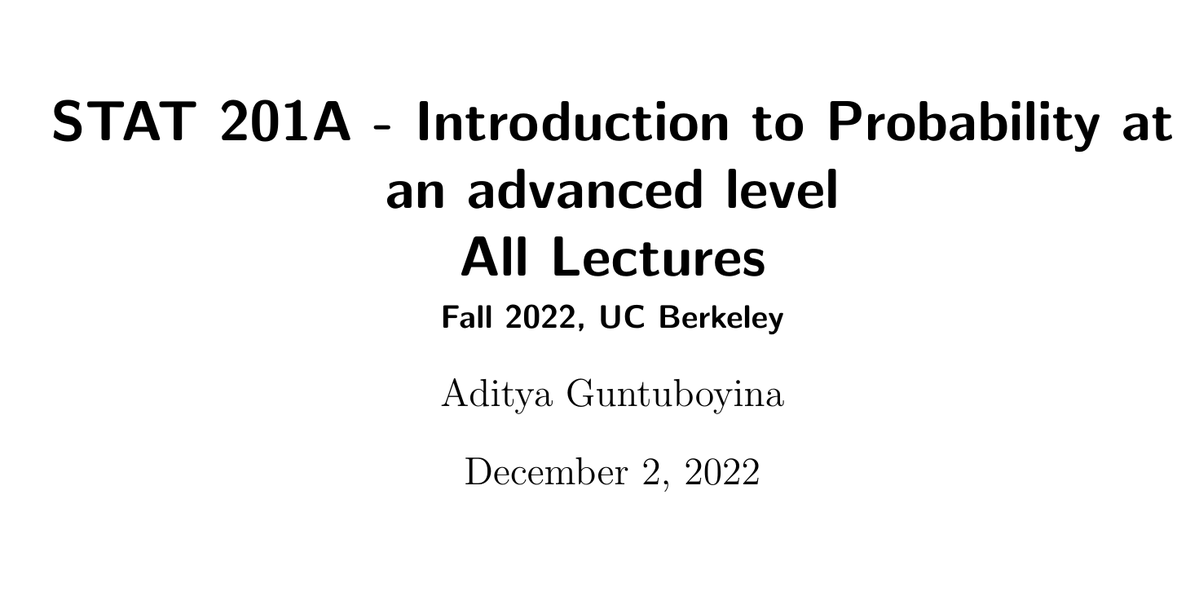
UC Berkeley's "Introduction to Probability at an Advanced Level"
PDF: stat.berkeley.edu/~aditya/resour…
English
Les années passent et se ressemblent dans ce ministère.
MINADRPV@minadrpv
Agriculture : le Ministre Bruno Koné met en lumière les perspectives d'emploi offertes à la jeunesse À l'occasion de la deuxième journée de la troisième édition de la Foire Nationale de l'Emploi et du Recrutement (FNER 2026), tenue ce mardi 19 mai, au Palais de la Culture, le Ministre de l'Agriculture, du Développement Rural et des Productions Vivrières, @Bruno_N_Kone, a animé le panel inaugural consacré aux opportunités d'insertion professionnelle des jeunes dans le secteur agricole ivoirien. Organisée par le Ministère de la Promotion de la Jeunesse, de l'Insertion Professionnelle et du Service Civique, cette rencontre a offert au Ministre l'occasion de présenter les vastes perspectives qu'offre aujourd'hui l'agriculture en Côte d'Ivoire, secteur stratégique appelé à jouer un rôle de premier plan dans l'emploi des jeunes. Dans son allocution, le Ministre Bruno Koné a souligné que l'insertion professionnelle des jeunes dans le secteur agricole ne saurait se concevoir sans une vision claire et structurée. C'est dans cette perspective qu'il a décliné les cinq priorités qui guident l'action de son Département, à savoir, la souveraineté alimentaire, la compétitivité des filières agricoles, le financement du secteur, la sécurisation du foncier rural et la durabilité des systèmes de production. Autant de leviers qui, ensemble, constituent un cadre favorable à l'émergence d'une nouvelle génération d'acteurs agricoles. Le Ministre de l’Agriculture a par ailleurs exhorté les jeunes à se former et à s'engager progressivement dans les métiers agricoles accessibles à moindre coût, avant de présenter les différents projets et mécanismes mis en œuvre par son Département en faveur de leur insertion et de leur autonomisation.
Français
N'cho Halé Landry retweetledi

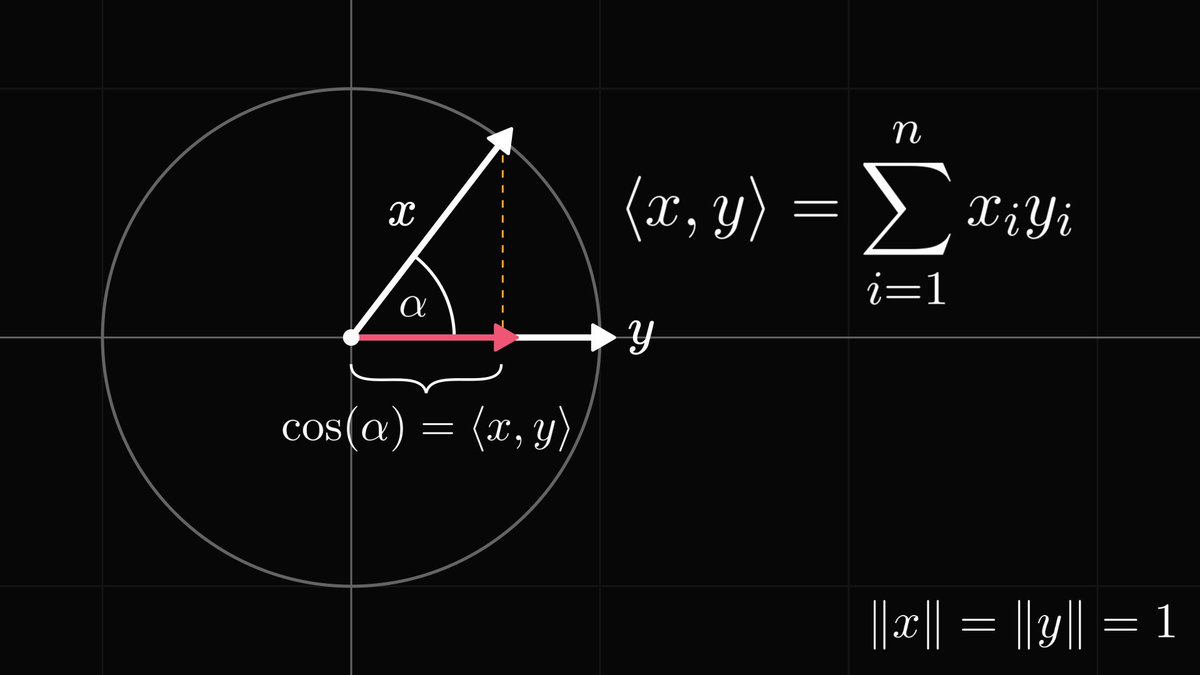
In machine learning, we use the dot product every day.
However, its definition is far from revealing. For instance, what does it have to do with similarity?
There is a beautiful geometric explanation behind.
English
Les grands bénéficiaires des routes et ponts à crédit.
Kanigui Yeo@YeoKanigui
Ça va se bousculer dans la grande distribution en Côte d’Ivoire. CDCI a l’avantage d’avoir un large réseau de points de vente bien réparti sur le pays. Carrefour, Auchan et les Chinois ne vont pas se laisser faire.
Français
N'cho Halé Landry retweetledi

Non seulement ils sont incapable d'accroître la production locale de mouton, mais ils créent des conditions rendant coûteux l'approvisionnement de l'extérieur.
La population ivoirienne est la grande perdante.
@Laijhands
THE STRATEGE 🇨🇮@PapisToorey
Tout coûte cher dans ce pays pour Rien en fait. Service médiocre mais coûteux. Y’a rien qui va , absolument rien. 😖💔 Ce peuple , vraiment je tire le chapeau.
Français
"À l'annonce de la nouvelle, des femmes du monde entier ont commencé à jubiler, jusqu'à ce que Gabriel révèle qu'une étude avait également été menée démontrant que 100 % des femmes pouvaient être dupées par un serpent qui parle."
D'accord !
The Babylon Bee@TheBabylonBee
Study Finds 100% Of Men Would Eat Any Fruit Given To Them By A Naked Woman buff.ly/7lGTEbV
Français
N'cho Halé Landry retweetledi

🇩🇪Le 500e anniversaire de la Guerre des paysans allemands passe curieusement inaperçu. Or il n’y pas eu de plus grande révolte rurale ouest-européenne hormis la révolution française. Son meneur emblématique, Thomas Müntzer, a beaucoup inspiré les marxistes. Voici pourquoi🧶1/25⬇️

Français
N'cho Halé Landry retweetledi
65 outils utiles en ligne (1/2)
N'hésitez pas à compléter.
🔒 Contourner les restrictions
removepaywalls.com — contourne les paywalls des articles en ligne.
libgen.rs — millions de livres et manuels gratuits (miroir stable de Library Genesis)
sci-hub.se — accès libre aux articles de recherche scientifique
annas-archive.org — méta-moteur des bibliothèques shadow (Libgen, Z-Lib, etc.)
📚 Culture & lecture
gutenberg.org — 70 000 livres classiques du domaine public
openculture.com — cours gratuits des meilleures universités mondiales
pdfdrive.com — téléchargement gratuit de PDF
archive.org — archive de toutes les pages web + millions de médias libres
🔬 Recherche académique
semanticscholar.org — moteur de recherche académique gratuit propulsé par l'IA
connectedpapers.com — visualise les liens entre articles de recherche
elicit.com — assistant IA pour analyser des papiers scientifiques
consensus.app — cherche ce sur quoi la science est unanime
scispace.com — explique n'importe quel article de recherche en langage simple
✍️ Écriture & traduction
deepl.com — meilleur traducteur automatique, nettement au-dessus de Google Traduction
hemingwayapp.com — analyse la lisibilité d'un texte, signale les phrases trop lourdes
grammarly.com — correction grammaticale et stylistique en temps réel (anglais)
🤖 IA généraliste
notebooklm.google.com — transforme tes documents en base de connaissance interrogeable, génère des podcasts audio
claude.ai — assistant IA excellent pour lire et résumer de longs documents
napkin.ai — transforme un texte en schéma visuel automatiquement
perplexity.ai — moteur de recherche IA
🗂️ Organisation & productivité
notion.so — tout-en-un : notes, bases de données, wikis, projets
obsidian.md — prise de notes Markdown avec graphe de liens, 100% local et privé
excalidraw.com — tableau blanc collaboratif style croquis, idéal pour brainstormer
raindrop.io — gestionnaire de favoris intelligent, multi-appareils
🎨 Image & design
photopea.com — Photoshop complet, 100% dans le navigateur
squoosh.app — compresse n'importe quelle image gratuitement
remove.bg — supprime l'arrière-plan d'une photo en un clic
cleanup.pictures — efface des objets/personnes d'une photo par IA
veed.io — suppression d'arrière-plan vidéo par IA.
Français
N'cho Halé Landry retweetledi

Demis Hassabis: "In the near future, one person who knows AI will outperform an entire startup team"
I've watched hundreds of AI talks, this 60-minute Cambridge lecture is the one I wish I had seen a year ago
this is the Nobel Prize winner in Chemistry, CEO of Google DeepMind and the guy who made AI solve biology
here's the part I can't stop thinking about:
> the AI you're using today is the dumbest it will ever be
> in 5 years the gap between people using AI and people who aren't will be impossible to hide
> companies will run on 10 people doing what 200 used to do
> the ones who get there first won't be the smartest, they'll be the ones who started right now
right now the average person opens Claude, types something, gets an answer, closes the tab
they think they're using AI, but they're using maybe 10% of it
I turned his lecture into 18 steps to actually use Claude the way it was designed, copy-paste prompts included
full guide in the post below.
Anatoli Kopadze@AnatoliKopadze
English
N'cho Halé Landry retweetledi

Recent advances in neuroscience have revealed a startling truth: what we perceive as “reality” is actually a sophisticated hallucination generated by the brain.
Rather than passively receiving information from the outside world, the brain actively constructs our entire experience. Through a process called predictive processing, neuroscientists like Anil Seth and Karl Friston explain that the brain constantly generates a best-guess simulation of reality based on incomplete sensory input. It then updates this model as new data arrives.
This means everything you see, hear, and feel is a mental creation. Your brain invents the experience of color from raw light wavelengths, fills in your blind spots with fabricated details, and presents you with a version of the present that is delayed by roughly 100 milliseconds. In a very real sense, we are always living slightly in the past.
This internal storytelling goes even deeper. Memories are not faithful recordings but are actively reconstructed each time they are recalled, often incorporating inaccuracies (as shown in the work of Elizabeth Loftus). Even pain is not a direct signal from the body but a protective output generated by the brain itself, according to researchers like Lorimer Moseley.
In the end, our everyday experience of life is a highly evolved, shared hallucination — a brilliant biological illusion that allows us to navigate and survive in a world we can never directly perceive in its raw form.

English
N'cho Halé Landry retweetledi

A Stanford neuroscientist published a paper a few years ago that quietly answered one of the oldest questions in human history, and almost nobody outside his field has heard of it.
The question is why we dream. Not what dreams mean. Why they exist at all. Why your brain spends a third of its sleep hallucinating images instead of just resting like every other organ in your body.
His name is David Eagleman.
He runs a lab at Stanford. The paper is called "The Defensive Activation Theory", and the moment you read it the explanation collapses every other theory you have ever been taught about dreams.
Freud said dreams were repressed desires. He was guessing. He had no brain scans. He had no electrodes. He had a couch and a notebook and a century of credibility that nobody has been able to fully scrub off the subject since.
Modern neuroscience replaced him with the memory "consolidation theory". The idea that dreams are your brain sorting through the day, filing things away, deciding what to keep. That story is partially true. Sleep does consolidate memory. But it does not explain the single strangest thing about dreams, which is that they are almost entirely visual.
You do not dream in pure sound. You do not dream in taste. You do not dream in smell. You dream in pictures. Vivid, detailed, often impossible pictures that activate the back of your brain so hard a scientist scanning you would think your eyes were wide open.
Eagleman started from one fact almost nobody outside neuroscience knows. The brain is territorial. Every region holds its turf through constant electrical activity. The moment a region goes quiet, its neighbors start invading. They take the silent territory and reassign it to themselves.
This is called "cortical takeover", and it is not slow. It is not a long process measured in years. In experiments where adults are blindfolded, the visual cortex starts processing touch and sound within an hour. One hour of darkness, and the territory is already being annexed.
In congenitally blind people, the visual cortex is fully repurposed. It runs language. It runs hearing. It runs touch. The hardware never went unused. It was just reassigned to whoever showed up first.
Now sit with the implication of that for a second.
Every night, when you close your eyes and fall asleep, the sun has set. The planet has rotated. The visual cortex, which takes up roughly a third of your entire cortex, is suddenly receiving zero input. For eight hours. Every single night. For your entire life. And evolution has shaped your brain inside a planet that has been spinning into darkness for billions of years.
If cortical takeover happens in an hour, the visual cortex should have been lost a long time ago. Stolen by hearing. Stolen by touch. Reassigned by morning. Humans should have evolved into a species whose vision works fine during the day and then degrades every time the sun goes down because the territory keeps getting renegotiated overnight.
But that did not happen. Vision works the moment you open your eyes. Which means something is defending the territory while you sleep.
Eagleman's claim is that dreams are that defense.
Every 90 minutes through the night, a precise burst of activity fires from the brainstem into the visual cortex. Pontine-geniculate-occipital waves. PGO for short. They are anatomically aimed. They are not general arousal.
They are a targeted volley of signal launched directly at the back of the brain where vision lives. The cortex lights up as if it is receiving real images, and you experience that artificial activation as a dream. The bizarre narrative your conscious mind invents around it later is just your brain trying to make sense of the noise.
The dream is not the point. The dream is the side effect. The point is keeping the territory occupied.
The evidence for this is the part that should haunt you.
Newborns spend roughly 50% of their sleep in REM. Adults spend twenty. Old adults spend fifteen. The amount of dreaming you do tracks almost perfectly with how plastic your brain is. Newborns have the most plastic brains on earth. Their visual cortex is in the highest danger of being overrun by neighboring senses while it develops.
So evolution gave them an enormous defense budget. As you age, your brain becomes less plastic, the takeover risk drops, and the defense system scales down accordingly.
Eagleman and his co-author ran the same correlation across twenty-five primate species. The more plastic a species' brain, the higher the proportion of REM sleep. The relationship held across the entire primate family tree. Plasticity and dreaming move together. They are two halves of the same evolutionary equation.
A species that ranks higher on flexibility and learning also dreams more. A species that is born ready to walk and survive dreams less. Plasticity is the asset. Dreaming is the insurance premium.
And the prediction the theory makes is the one that quietly closes the case.
Of all your senses, only one is disadvantaged by darkness. You can still hear in the dark. You can still feel in the dark. You can still smelll and taste in the dark. The only sense that depends on light is vision. Which is exactly the sense your dreams are made of. The defense system is targeted at the only territory that is actually vulnerable while you sleep.
Memory consolidation is real. Emotional processing is real. Your brain does do those things at night. But Eagleman's argument is that those functions piggyback on a much older system whose original job was simpler and more brutal. Keep the lights on inside the visual cortex while the planet is dark, or lose it.
For thousands of years, people have asked what dreams mean. Prophets wrote about them. Poets wrote about them. Freud built a discipline on them. None of them had access to the actual answer, which is that dreams may not mean anything in the symbolic sense at all.
They may be the visible flicker of a defense system running in the background, the way a screen saver protects a monitor by keeping the pixels moving even when nobody is looking.
The strangest thing about the theory is how cleanly it explains why dreams feel so real. Your visual cortex cannot tell the difference between a PGO wave and an actual photon. It is the same hardware lighting up the same way. The cortex does its job. It builds an image. Your conscious mind, half-awake, wraps a story around it and calls it a dream.
You are not seeing your subconscious tonight. You are watching your brain defend a piece of itself from being stolen.
Every animal that has ever closed its eyes on this planet has done the same thing.

English
N'cho Halé Landry retweetledi

Ndongo Samba Sylla : « Le FMI doit rendre des comptes aux Sénégalais. »
Français