
hache retweetledi
hache
76 posts



hache retweetledi

We evaluate coins all wrong.
We love to talk about protocol revenue like we’re analyzing stock market tickers.
“Look at the fees.”
“Look at the revenue.”
“Look at the fundamentals.”
Cool.
But these are not shares of a company.
Most protocols do not pay dividends. Most tokens do not entitle holders to cash flow. Most “governance” is an illusion of shareholder rights, except without the shareholder rights.
So why are we larping as TradFi analysts?
If a token captures no revenue, controls no meaningful value, and gives holders no enforceable economic claim, then protocol revenue may be great for the protocol, great for insiders, great for validators, great for market makers…
But what exactly is it doing for the token holder?
That is the question nobody wants to ask.
“Utility” gets thrown around the same way.
Utility for whom?
Utility for the average holder?
Utility for the protocol?
Utility for the team?
Utility for liquidity providers?
Utility for insiders who already own the supply?
Utility only for the scarce few B2B customers?
Because "utility" without broad usage is not a scaleable argument for adoption.
A protocol can be useful while its token is structurally useless.
A chain can have activity but yet gas fees are so low it doesn't even matter if everyone uses that chain. Not when a $50 purchase of the native coin can be a lifetime of gas fees for the average user.
A governance token can have billions in FDV while giving holders the sacred right to vote on proposals that insiders, foundations, delegates, and whales already effectively control.
That is not ownership.
The real question is not, “Does this protocol make money?”
The real question is:
Does the token own anything?
Does it control anything?
Does value actually flow back to the asset?
Is there a structural reason the token must appreciate if the protocol succeeds?
Or are you just donating exit liquidity to people who figured out token design better than you did?
The next phase of crypto valuation needs to move past surface-level “revenue” hype and start asking harder questions about ownership, control, value capture, dilution, supply structure, and who actually benefits when the machine works.
Because in crypto, the protocol can win while the token holder loses.
And once you see that, you stop asking, “What does this protocol do?”
You start asking, “What does this token own?”
If a token:
Does not act as a scarce store of value
Does not have a case for mass-market utility
Does not share revenue with holders
Then:
Be aware you are only bidding on the belief that other bidders will come after you to make the price go up.
If you find yourself doing mental gymnastics about what a token actually is in order to justify your bullish posture, it may be time to reevaluate your trade thesis.
🫡 From the depths —
The White Whale 🐋
English


Stop praising SBF for his investments.
He invested with stolen funds in every deal that came across his desk. Zero risk, playing with stolen money and an endless piggy bank to steal more.
Zero skill, just fraud.
x.com/i/status/20473…
Yahoo Finance@YahooFinance
Sam Bankman-Fried is being praised for investments ... but should he be? @scottmelker explains:
English
@ClaudeDevs damn. my usage limit was already reset today. plug me with a reset in 3 days plz.
English

Over the past month, some of you reported Claude Code's quality had slipped. We investigated, and published a post-mortem on the three issues we found.
All are fixed in v2.1.116+ and we’ve reset usage limits for all subscribers.
English
@mdudas @KyleSamani Even less trivial, is implementing it in combination with Frequent Batch Auctions.
Orders must be able to clear in accordance with margin limits. Orders that fill the account bellow margin limits needs to be cancelled and the batch must run again.
English



@aaronjmars building trustless and verifiable real world data sources will be a big industry
English

holy fuck, a hair dryer at a Paris airport broke Polymarket weather markets & made someone $34,000 richer
- polymarket was settling Paris temperature bets on a single Météo France sensor sitting near the Charles de Gaulle runway perimeter - basically unguarded
- the guy bought the long-shot outcome (like "22°C" when everyone expected 18°C) for pennies, since nobody thought it'd hit
- then he walked up to the probe and briefly heated the air around it with a portable heat source, spiking the reading just long enough to register as the daily max
- temperature snapped back to normal in minutes, the market resolved in his favor, and he cashed out - twice, on April 6 and April 15, before Météo France caught on and filed charges
hyperstitions.

English


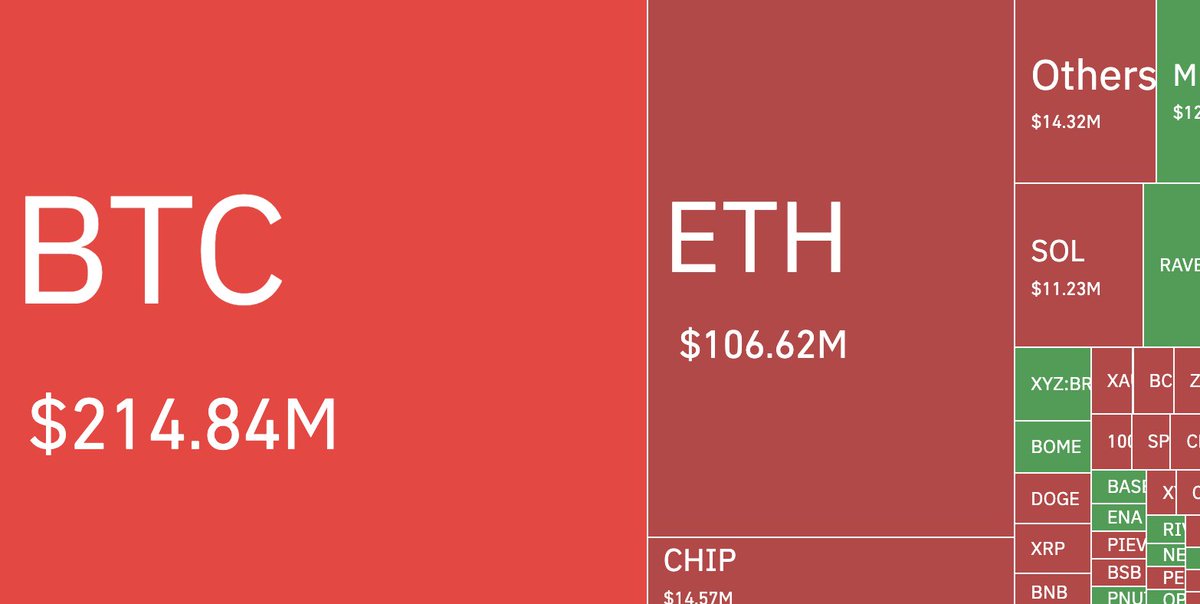
🚨 ALERT: Crypto liquidations totaled $423 million over the past 24 hours, with $357 million in shorts and $66 million in longs wiped out.
English
@scottmelker trading can be too... whats your point
its all a matter of how you do it.
English
hache retweetledi

the strategy builder is meant to harness the power of your imagination. it has been awesome to see so much reaction since we came out of stealth mode yesterday. my apologies if i haven't responded to you yet.
wanted to respond to three repeated questions we’ve received:
how does clearing work?
@SynchronicityHQ uses a frequent batch auction mechanism first proposed by Eric Budish in 2015 which eliminates the vast majority of the negative effects of latency arbitrage.
incredibly, on the same day we launched @toly was posting about FBA. What synchronicity! We are firm believers in the game theory of FBA to make markets more efficient and are excited to put it out into the wild. looking forward to participating in more discussion about on-chain market microstructure.
what data can be used by the strategy builder?
the strategy builder is set up to be highly generalized with respect to oracle data so our users can be in sync with everything. we have market data set up already and will be expanding the types of data supported to social media data, world news and other data.
PLEASE let us know what data you would most like to be able to trade off of. we will prioritize new data based on demand. what is the craziest data you would want to build a trading strategy off of?
how are orders and strategies kept private?
we at Synchronicity hold strong conviction that privacy radically improves market efficiency. effectively implementing fba AND traders feeling comfortable uploading their strategies (expressing themselves) require it.
everything on Synchronicity runs on TEEs (hardware based privacy) which provide high quality privacy guarantees for users without introducing significant computational overhead or costs.
at the start, Synchronicity will still be able to look inside the TEEs to ensure everything is running smoothly and fix bugs, but we have laid the ground work to have verifiable privacy, even from us.
we will be publishing more on our privacy roadmap in the coming weeks.
there are lots more questions to cover, but want to keep this post relatively short. please don’t hesitate to reach out with questions, feedback or anything else.
let your imagination guide your strategy. comment for early access.
ben weintraub (1≈1)@bwein_
Modern markets are fundamentally extractive We've spent three years rewiring them from scratch One core feature is everyone deploying their own bots without code or infra Here's a first look @SynchronicityHQ We're looking for strategists to test drive. Reply for early access
English


Most traders do not care about how quick their orders clear as long as it’s within a reasonable time frame shown by people’s willingness to take 500ms latency for no fees as seen on Lighter.
This demonstrates BFBA does not hurt the UX of trading as it’s a worthwhile wait to clear at best price and allow liquidity to post as close as they can to their fair price without fear of any type of latency arbitrage.
English
@baronvonspread The other solution was the simple and now classic "cancel before fills" in batches but still clear in serial. But this only protects you to the point you can cancel "in time"
English
@baronvonspread FBA existed but we had not heard of it yet.
There were some other thins we tried designing like maker-only only books and pro/retail books (a design used often used in tradfi), but generally result in liquidity fragmentation and needing some permissioned mechanisms as well.
English
2 years ago, my colleagues and I were discussing the optimal way to clear orders. From first principles thinking we found clearing orders in discrete batches provided the fairest and best price to all users. No prioritization and no latency advantages.
A month later we found Budish's 2014 FBA paper (funny enough 3 of us studied Economics at UChicago) reiterating the exact mechanisms we had designed for Synchronicity exchange.
Seeing this all come together full loop and seeing the discovery become more public is so exciting. I cannot wait for everyone to use Synchronicity and get the best price execution across the industry, and allow real strategists with real alpha to win rather than wining with low latency alpha only available to people with a lot of resources (money and exchange connections)
English