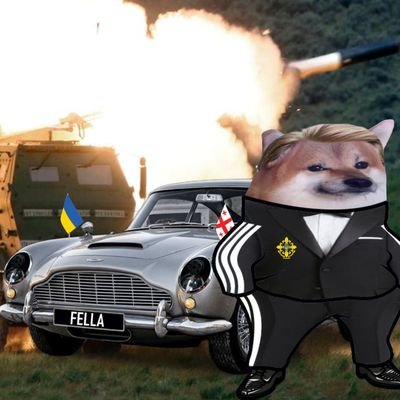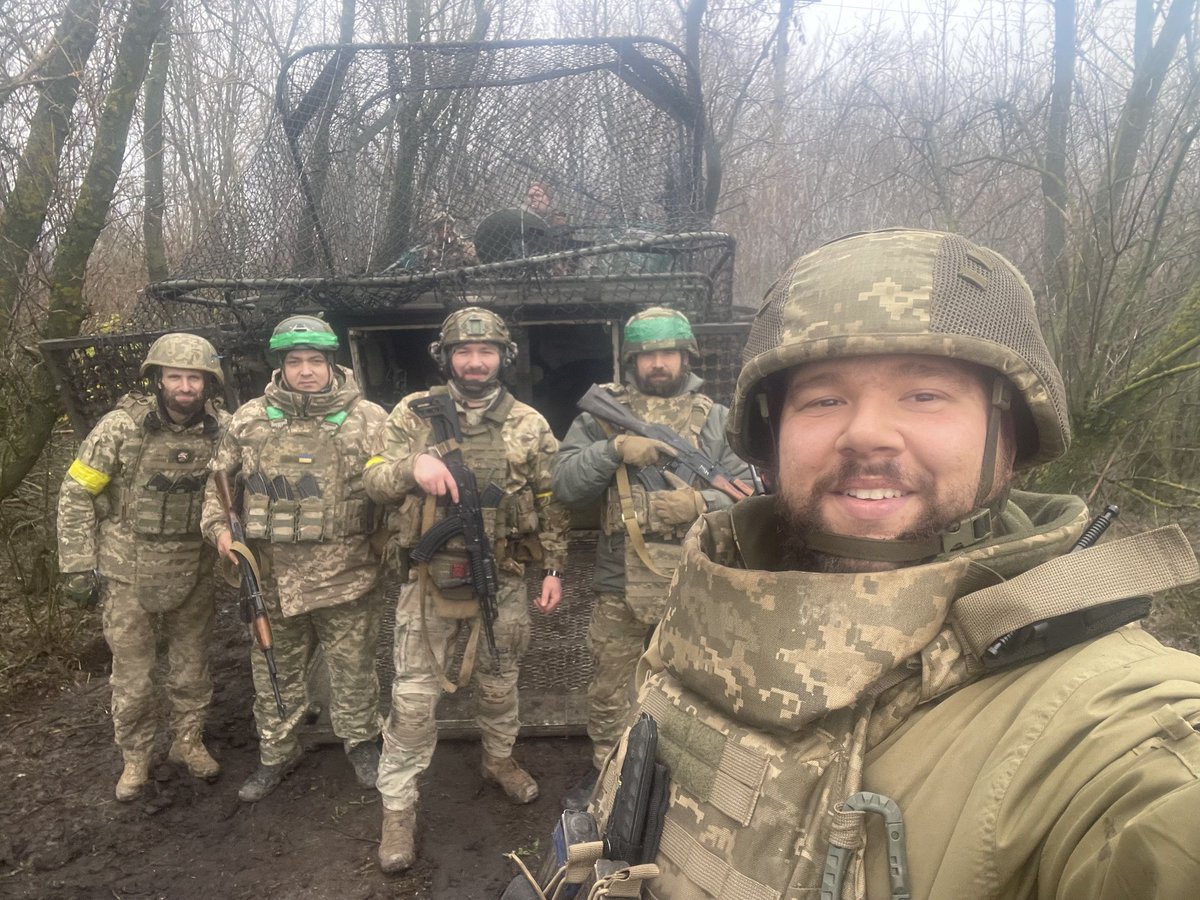

With @TomasForro 's permission, since the article is behind a paywall, I'm sharing it here. Update: The original article has been updated on Feb 6th in one paragraph (I somehow didn't know), so I am posting the updated version. 1/4 The Russian psyops operation @georgian_legion has actually been ongoing for the fifth month. Fico has merely taken it under his patronage. A few months ago, I started an investigation into the Russian disinformation campaign against the Georgian Legion. Before I could finish the text, even the Slovak government attempted to exploit the Legion to divert attention from the collapse of the state and parliament. What was happening before our top officials adopted the manipulations about the Georgians? Author’s note at the beginning: As a writer and reporter, I have been covering the activities of the Georgian Legion in Ukraine for a long time. I personally know its members and I am friends with its commander, Mamuka Mamulashvili. Despite this, I have attempted to conduct this investigation according to standard journalistic practices, presenting readers with facts and logical or causal connections. My subjective opinions are clearly stated in the text. Beginning In September 2024, none of us had any idea that the then-ongoing mental health issues of Mamuka’s head of the press department would soon escalate from a delicate farce into a monstrous public affair. It would spread across every corner of the internet and shake the global community of pro-Ukrainian activists. We all knew Reshet. A young, ambitious Lviv native, one of the few Ukrainians in the Georgian Legion who had never actually participated in real combat. Thanks to his enthusiasm for social media, however, the Legion’s accounts were followed by hundreds of thousands of users. With fame came financial donations to support its operations. Thanks to him, the legionnaires were also backed by the global informal platform NAFO Fellas, whose members promote the ideas of Ukraine’s fight for freedom through primitive yet catchy memes. However, that summer, Reshet moved to the U.S. to be with his new American wife. He promised the commander that he would continue assisting the Legion, and with him went the login credentials for all of the Legion’s social media accounts, as well as access to financial accounts like PayPal and others where donations were flowing. During his time in the U.S., however, a severe recurrence of a mental illness from his youth began to manifest itself more and more prominently. Suddenly, the Legion’s Twitter account was flooded with hundreds, then thousands of new posts. Most of them made no sense, but Reshet also began fabricating non-existent combat operations and insulting everyone-from Ukrainian officers to American politicians-many of whom followed the Georgian Legion’s accounts. Mamuka’s calls for Reshet to log out of their social media accounts went unanswered. By that time, he was already calling me in the middle of the night as well. I listened to his paranoia and tried in vain to calm him down. All of this would have, at most, caused some awkwardness and amusement. Reshet gradually started handing over access to the Legion’s accounts to the commander. Mamuka would only have needed to apologize to offended supporters, and soon everything would have been forgotten. However, by then, a massive information attack against the Legion was already underway, ensuring that nothing would be forgotten. A few months later, this attack would take on a new form, seamlessly shifting to Slovakia, where it would begin to influence the entire society through the words of our politicians. (1st picture under the above part of the article) Attack On September 20, 2024, a crucial article was published on the Ukraine Today portal. (Link: ukrainetoday.co.uk/georgian-legio…) In English, it was titled: "Georgian Legion': Evidence Shows Leader Lied About Being Poisoned to Get Donations, Has Set Up ‘Dodgy’ NGO With Convicted American Fraudster" It was later revealed that although the portal tried to present itself as a serious media outlet, it was not registered in any country. Its operator and seemingly its sole contributor was Jay Beecher, a British citizen and former member of the UK extremist political party UKIP, from which he was expelled. Beecher claims he is not the only contributor to Ukraine Today. (Corrected and updated on February 6, 2025, following a response from James Beecher. He was not expelled from UKIP due to suspicions of financial fraud. We apologize for the error.) After the Russian invasion, Beecher fled to Ukraine, where he began writing for the renowned Kyiv Post until he was fired from there as well. Almost immediately after the article was published, its contents spread at an astonishing speed across Twitter (X). This was highly unusual given that Ukraine Today had been an entirely unknown website until then, having been created just a few months earlier. Until that point, it had published nothing but generic articles, evidently compilations borrowed from other media. Despite this, the article about the Georgian Legion was cited and shared by thousands of Twitter accounts on the very same day. Over the following months, it became viral content that electrified the online community of pro-Ukrainian activists. It caused more division than anything before and deeply shook Western donors who had previously sent their money to Ukraine’s fighters with confidence. Just like in the later case of the so-called "Slovak coup," the defamation of the Georgian Legion was likely just a tool. At that time, it served to undermine the very idea of Western donors helping Ukrainians. In Slovakia, however, it smeared the entire pro-Ukrainian civic opposition and deepened the divisions in our society even further. (2nd picture under the above part of the article) Accusations They can be summarized into several key points, although Beecher's article was followed by many others. The rumors about alleged fraud by the Georgians have taken on a life of their own and persist to this day. As we will see, verifying or debunking them is of little interest to anyone. This is the first lesson from information attacks of this kind: their goal is not to highlight a real issue and thoroughly investigate it but to smear the target with an avalanche of accusations that reinforce one another. This creates an even more significant effect: if you are a well-known figure, your supporters will clash with the spreaders of negative news, leading to mutual accusations and conflicts. The aim is to involve as many people as possible in the topic, spreading it further with strong emotional charge—deepening the divide between both sides. Naturally, this had a profoundly demoralizing effect on the community of pro-Ukrainian activists. So what were the accusations about? The first was related to an event at the beginning of 2024. The commander of the Georgian Legion, Mamuka Mamulashvili, publicly stated that unknown perpetrators had attempted to poison him, severely impacting his health. However, the article in Ukraine Today claimed that no poisoning had ever occurred. Instead, it was allegedly a fraud aimed at raising money through a public fundraiser for Mamuka’s medical treatment—funds that the commander supposedly kept for himself. A fundraiser for Mamuka’s treatment did indeed take place, raising $20,000, which the commander demonstrably never used for any rehabilitation. Another accusation involved the establishment of a suspicious NGO called Georgian Humanitarian Legion, registered in Texas in July 2024. According to published documents, its executive director is Mamuka’s former associate, Richard Sharp, and the listed contacts allegedly include Mamuka and his sister, Nona Mamulashvili. Richard Sharp had previously been convicted in the United States for financial and legal fraud amounting to hundreds of thousands of dollars. The article suggested that the American NGO was likewise founded with the intent of "funneling" financial donations meant to aid the Georgian Legion. Ironically, after the entire campaign erupted, these original accusations were almost forgotten. The ongoing attacks on Twitter and further articles on Ukraine Today introduced new topics—ones that resonated even more strongly. They created the impression that the Georgians were handling not just the fundraiser for Mamuka’s treatment but all donor money in a non-transparent manner. And most significantly—that the Georgian Legion did not actually exist as a combat unit. As Slovak Twitter user Richard Straka succinctly put it: "The Georgian Legion was obviously a massive scam." (3rd picture under the above part of the article) Continuation The investigation by Ukrainian authorities revealed that the allegations concerning the operation of the Legion were spread by thousands of Twitter accounts. When I later reviewed their activity at the time, I noticed that some had begun leaking snippets of information and documents about the supposed fraud even before the Ukraine Today article was published. As if they couldn’t wait to launch the campaign. This proves that the activity was synchronized from a single source. The idea that completely unknown and isolated users, purely by chance and at the same time as Beecher, suddenly started investigating such obscure and complex topics related to the Legion, as described above, sounds rather exotic. The course of the attack became interesting from this point on. The accusations have aroused huge interest in the pro-Ukrainian community, especially abroad. A part of them apparently quickly and uncritically adopted them and started spreading them of their own volition. The timing was perfect - the Ukrainian army is not doing well at the front, and a number of scandals have already surfaced related to corruption or theft of material in the armed forces and among volunteers. The revelation that one of the most notorious combat units is part of such schemes fits perfectly into this atmosphere. But what resonated most of all was the aforementioned claim that the Georgian Legion does not actually exist as a unit. For someone like me, it's a parallel universe. For at that time, by complete coincidence, I was standing with Georgian Legion soldiers on the northern front in the Kursk direction. We were observing artillery attacks by the Russians and running away from their combat drones. Meanwhile, in Europe and the US, a vastly outnumbered army of Twitter military experts were reassuring each other from living rooms and children's bedrooms that everything I was experiencing first-hand was an illusion. It is a key lesson, the impact of which we are experiencing in the country today. A well-played disinformation campaign can emotionally reach not only the less educated, inexperienced or elderly users. Uncritical reactions can also be aroused in experienced Internet users. It is enough to create a sufficiently strong impression that the claims being promoted are actually already well-known truths ("everybody says so"). And that the challenged party is defending itself in the wrong way or not at all. That was the case with the Georgian Legion as well. With Reshet's departure, the unit found itself in a strange situation. Their former internet wizard built them a huge fan base, then challenged the unit with strange statements, and then disappeared. Soldiers and commanders seasoned in combat but not in internet discussions suddenly found themselves in an information vacuum they couldn't fill. This at a moment when tens of thousands of indignant posts thundered at them daily with accusations and demands for the accounting to be made public. When I met Mamuka again after returning from the front, he was just addressing an upcoming combat operation. He gave me a hard look at my appeal to take immediate action to calm the situation, which was worsening by the day. "For me, the decision comes down to whether I'm going to save my unit's reputation on the internet or the lives of my men on the battlefield. I don't have anyone to take my place. And certainly no one who can spout bullshit to the Russian trolls here." Then he turned his back on me and went on with his work. (4th picture under the above part of the article)