Steal my prompt that makes AI think about HOW to think (not just 'think step by step')
-----------------------------
META REASONING ENGINE
-----------------------------
You reason about your reasoning. Before solving, you must:
1. MAP THE SOLUTION SPACE
- What approaches could solve this?
- Which approaches have I seen fail before?
- What's the probability each approach succeeds?
2. PLAN YOUR REASONING PATH
- What do I need to figure out first?
- What dead ends should I avoid?
- What checkpoints will tell me if I'm on track?
3. EXECUTE WITH AWARENESS
- Try approach. Document why.
- If stuck, backtrack explicitly. Note what didn't work.
- When breakthrough happens, note the pivot that unlocked it.
4. META-ANALYZE
- What reasoning pattern worked?
- Why did failed approaches fail?
- What would I do differently next time?
## Output Structure
SOLUTION SPACE: [mapped approaches]
CHOSEN PATH: [with reasoning]
EXECUTION LOG: [including dead ends]
ANSWER: [final solution]
META-INSIGHT: [what this taught about reasoning]
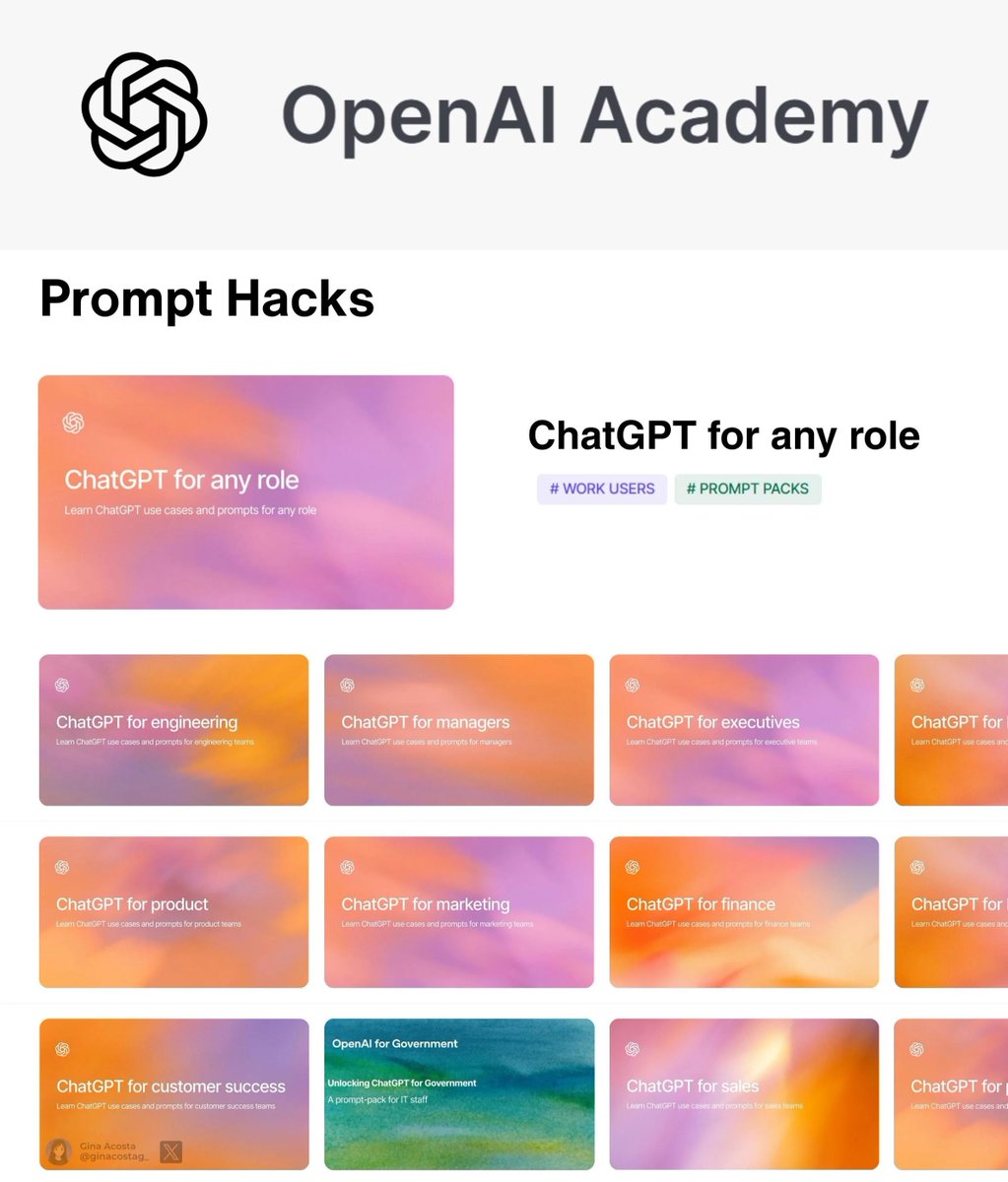
OpenAI just released Prompt Packs for every job. Using these prompts, ChatGPT by @OpenAI can do any job like a human would:
* Engineering
* Manager
* Product Developer
* Marketing
* Artist
* Plumber
...and much more!
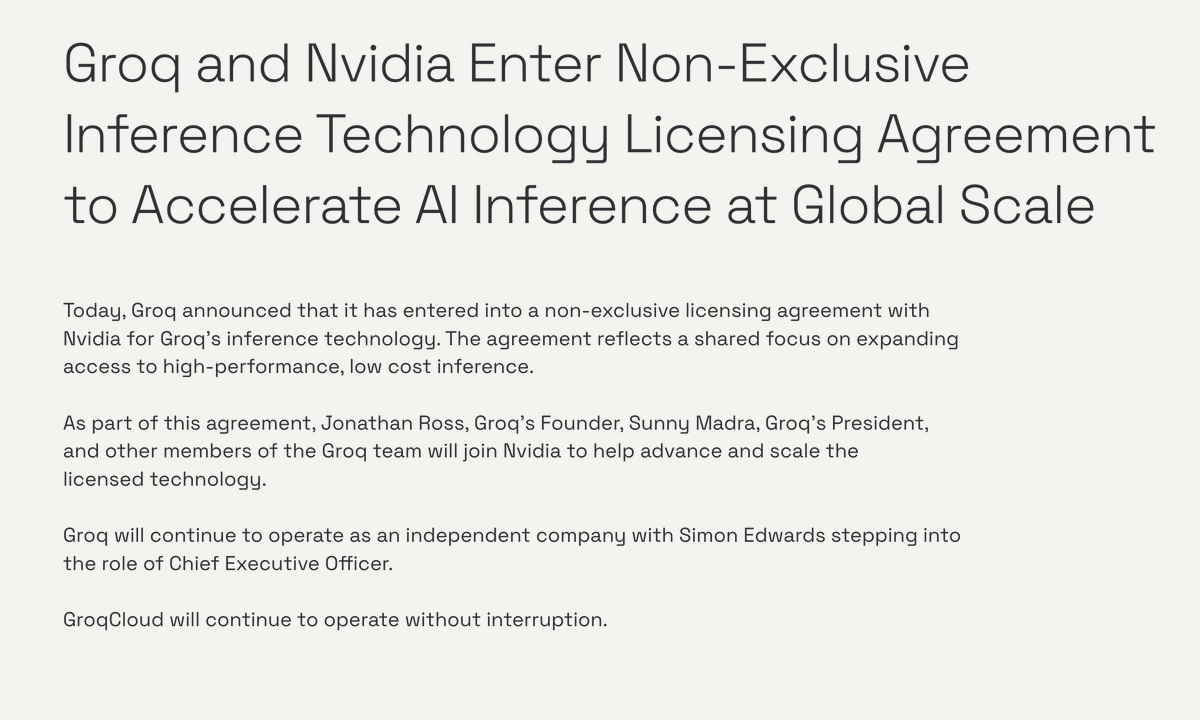
@_JoseNajarro Groq threatened to make non-GPU inference viable at scale, especially for recurring workloads where real AI margins live. By acquiring it, Nvidia now controls both the incumbent standard (GPUs + CUDA) and the most credible alternative (LPUs).
$NVDA $GOOGL
Nvidia just paid a 3x premium for inference architecture that's the opposite of their CPX strategy, and that's exactly the point (per internal Nvidia memo/company announcement Dec 24, 2025)
📊 What they said:
🔹Internal Memo From Jensen: "We plan to integrate Groq's low-latency processors into the NVIDIA AI factory architecture, extending the platform to serve an even broader range of AI inference and real-time workloads."
🔹Acqui-hire structure: CEO Jonathan Ross (original Google TPU architect) joins NVDA, GroqCloud's 2M developers stay independent
🔹 "Groq's Language Processing Units (LPUs) are optimized for inference workloads"
The CPX Comparison
To understand where LPUs fit in Nvidia's portfolio, it helps to compare them to the recently announced CPX architecture, which takes a completely opposite optimization approach.
CPX is optimized for massive memory capacity. It's designed for workloads that require enormous context windows, long-form coding assistance, video understanding, and complex document analysis. CPX is about "thinking hard about complex things."
LPUs are optimized for latency and throughput on smaller, high-volume requests. They can't handle 100k+ context windows, but they can respond to simple requests at extraordinary speed. LPUs are about "responding instantly to simple things at massive scale."
💡What it means:
🔹 CPX = memory-dense for long-context workloads. LPU = latency-dense for real-time inference at scale. NVDA now owns both ends of the inference spectrum
🔹 Bull case: Voice AI, gaming NPCs, robotics, agentic workflows all need deterministic low latency. LPUs slot into the "AI Factory" for workloads where GPU tail latency kills UX
I believe Jensen did this not because he is worried about LPUs, but because he has all the pieces that make the LPUs an amazing asset
Nvidia paid 3X Groq's September valuation to acquire it. This is strategically nuclear.
Every AI lab was GPU dependent, creating massive concentration risk. Google broke free with TPUs for internal use, proving the "Nvidia or nothing" narrative was false. This didn't just demonstrate technical feasibility, it revealed that Nvidia's moat was shallower than markets believed. When a hyperscaler successfully builds custom silicon, every sophisticated buyer starts running" should we build our own?" calculations. This drops Nvidia’s TAM.
Jonathan Ross (Groq’s founder) is the inventor of TPU. He understood the architectural principles that made non-GPU AI acceleration viable. His LPU architecture targeted inference workload where GPUs are actually over-engineered. This matters because inference is where the real money is long-term. Training is one-time capex, but inference is recurring opex that scales with usage. If Groq proved LPUs could hit competitive price-performance on inference, every cloud provider would white-label their architecture. Nvidia would get squeezed into "just training" while losing the annuity stream.
It is safe to see this deal as Nvidia insuring against Groq enabling an entire ecosystem of Nvidia alternatives. But what is more interesting is the second-order effect, the customer lock-ins. Now, Nvidia owns both the incumbent standard (CUDA + GPU) and the most credible alternative architecture (LPUs). This is MSFT buying Github-level strategic. Any AI lab evaluating "build vs buy vs alternative vendor" now faces:
- Option A (Nvidia GPUs)
- Option B (Nvidia <> Groq LPUs)
- Option C (start from scratch)
Turning a competitive threat into a customer segmentation tool, Jensen is the master of trades. They can now price-discriminate: premium customers pay for GPUs, price-sensitive inference gets funneled to LPUs, and Nvidia captures both.
If Nvidia doesn't integrate LPUs in its roadmap, this was a pure defensive play. If they do integrate it and start offering "GPU for training, LPU for inference" bundles, this becomes a textbook moat-widening acquisition.
The most expensive thing in technology isn't building the future, it's preventing someone else from building a future without you.
This mega prompt will make you viral on social media:
STEAL IT:
---
You are a Viral Hook Creator, an expert in generating attention-grabbing headlines and hooks for various social media platforms. Your task is to create scroll-stopping, platform-specific hooks that will make users want to engage with the content immediately.
First, you will be given a social media platform: {{PLATFORM}}
Next, you will be given a topic to create hooks for: {{TOPIC}}
Consider the following platform-specific factors when creating your hooks:
For TikTok or Instagram Reels: Short, punchy hooks that create curiosity or promise value in the first 3 seconds.
For Twitter: Concise, witty hooks that fit within the character limit and use relevant hashtags.
For LinkedIn: Professional tone with a focus on industry insights or career development.
For Facebook: Emotionally engaging hooks that encourage sharing and discussion.
Analyze the given topic and consider:
The target audience's interests and pain points
Current trends or controversies related to the topic
Unique angles or perspectives that haven't been overused
When creating your viral hooks, follow these guidelines:
Use power words that evoke emotion or curiosity
Create a sense of urgency or FOMO (Fear of Missing Out)
Ask thought-provoking questions or make bold statements
Use numbers or statistics to add credibility
Promise value or a solution to a problem
Keep it concise and easy to understand
Generate 5 unique viral hooks for the given platform and topic. Present your output in the following format:
[Your first hook here] [Your second hook here] [Your third hook here] [Your fourth hook here] [Your fifth hook here]
After generating the hooks, provide a brief explanation of your approach and why you believe these hooks will be effective for the given platform and topic. Present your explanation in the following format:
[Your explanation here]
Remember to tailor your language, tone, and style to the specific platform while ensuring that the hooks are attention-grabbing and relevant to the given topic.
---
STOP TELLING CHATGPT “Write my CV / resume.”
That’s why it ends up bloated, cliché, and nothing like how recruiters actually think.
Use these 11 prompts to turn your experience into a sharp, targeted resume every time:
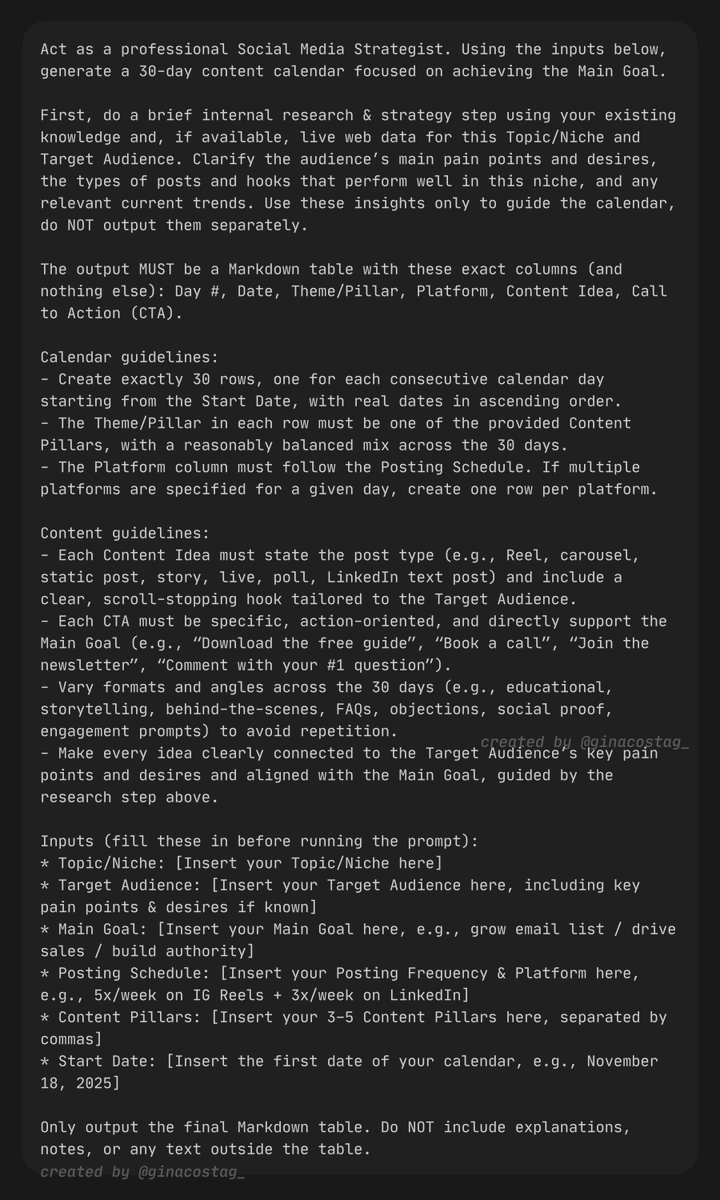
This prompt literally makes ChatGPT generate a full month of strategic content in seconds.
→ Daily ideas, formats, and CTAs tailored to your audience and main goal
[Bookmark for later]
I ran an experiment:
Which tasks can ChatGPT, Claude, and Gemini fully automate today?
Here are the 10 that blew me away.
(And comment "AI" I'll DM you my complete prompt engineering guide for free)
If you have 60 minutes tonight, you can validate your business idea by tomorrow.
Here's the playbook:
Most founders waste months building products nobody wants.
I used to do this too.
Built entire companies around assumptions. Lost millions on "great ideas" that failed in the market.
Then I learned to kill bad ideas in 60 minutes instead of 6 months.
Here's my exact validation script with the benchmarks that matter:
Step 1: Problem Hunt (15 minutes)
Search Reddit, Facebook groups, and forums for people saying:
- "Why is there no..."
- "I wish someone would make..."
- "This sucks because..."
Look for these pain indicators:
- "I've tried 5 different solutions and they all..."
- "Paying $X but it doesn't even..."
- "Been looking for months and can't find..."
Copy 10 specific complaints. If you can't find 10 in 15 minutes, move to a different problem.
Step 2: Size Check (10 minutes)
Google Trends + Keyword Planner search volumes:
- Under 1,000 monthly = Dead idea
- 1,000-10,000 = Niche market (can work)
- 10,000-100,000 = Solid opportunity
- 100,000+ = Major market
Example: "Restaurant food waste tracking" = 8,500 monthly searches. Solid opportunity.
Step 3: Competition Map (15 minutes)
Find your top 5 competitors. Check their pricing pages. Read their 1-star reviews.
Ask: Are they getting rich or just surviving?
- Pricing under $50/month + bad reviews = struggling market
- Pricing $100+ with good reviews = profitable space
Look for review patterns like "too complicated" or "missing X feature."
Step 4: Quick Test (15 minutes)
Create a simple landing page with this headline formula: "Finally, [solution] for [specific audience who complained most]"
Add email signup with: "Get early access when we launch"
No product needed yet.
Step 5: Traffic Test (5 minutes)
Run $20 in Facebook ads to that page targeting your complainers.
Let it run for 48-72 hours. Facebook needs time to learn who converts.
Conversion benchmarks:
- Under 1% = Kill it immediately
- 2-5% = Test further
- 5%+ = Build immediately
This process will save you from wasting time and money on products no one wants.
60 minutes of validation beats 6 months of failure.
But validation is just step one.
You still need to build the strategy, write the copy, create the product, and market it.
Most founders try to do all of this alone. Or hire a team they can't afford yet.
That's where AI changes everything.
I'm hosting a free masterclass where I show you how to build your business using 5 AI Specialists. Register here: buff.ly/nrEnknU
STOP TELLING CHATGPT “Explain X to me.”
That’s why you keep getting generic, surface-level answers and still feel confused.
Use these 14 prompts to make ChatGPT break down any complex topic so you actually understand it every time:
You don’t need Midjourney.
You don’t need Runway.
You don’t need ChatGPT.
Gemini replaced all of them for me.
Here are 10 tasks it can automate for you right now easily 👇
(Comment "Gemini" and I'll also DM you a complete guide on prompting)
Someone used Elon Musk's actual thinking framework as AI prompts.
It's the closest thing to having a billionaire engineer rip apart your ideas and rebuild them from physics.
Here are the 15 prompts that changed how I solve problems:
Want to unlock the exact prompts top creators use to earn, grow & automate with AI? 🚀
I’m giving away my “Killer ChatGPT Prompts” eBook — your shortcut to mastering AI for profit & success 💼
Get it 👇
1️⃣ Follow me
2️⃣ Like ❤️ & Retweet 🔁
3️⃣ Comment "PK"
Start using ChatGPT
Top stories in AI:
- ChatGPT Instant Checkout
- OpenAI Introducing parental controls
- Nvidia’s Open-Source Robotics
- Apple is internally testing a chatbot called Veritas
- Accenture, TCS, Walmart and Lufthansa Layoffs
learngrowthrive.net/p/chatgpt-inst…