Les

13.4K posts

Les banner
Les

Les

@LesterJMilton

Non-union talent. Education. Addiction. Hasenpfeffer Incorporated.

Bellingham, WA Katılım Nisan 2013
2.7K Takip Edilen653 Takipçiler
Sabitlenmiş Tweet
Les
Les@LesterJMilton·
@JasonJAnger The value one has for reading is deeply personal. The goals of literacy instruction should depend on the context of the instruction and the desires/interests/abilities of the unique individuals being instructed. What we would prefer for our kids is often made irrelevant by them.
English
0
2
31
9.9K
Les
Les@LesterJMilton·
@decadimitry @loomdoop Don't know why asking for evidence &/or clarification spurs you to reply like a petulant tween. Life's too short to engage w/ people who lack the discipline & courtesy to disagree politely, so I'll mute you now. Best of luck in learning how to disagree w/ people like an adult!😃
English
2
0
0
188
Dimitry Yakoushkin
Dimitry Yakoushkin@decadimitry·
@LesterJMilton @loomdoop I literally just said that the supply is for wealth hoarders and not renters, and you still ask me (another) bad faith question - can you step back and objectively look at the way that yimbys argue and see why we think you're the most insufferable motherfuckers on the planet?
English
1
0
5
31
Les
Les@LesterJMilton·
@decadimitry It was a sincere question. I'm trying to understand the reasoning for opposing more housing being built. Is it the way it's built? Is it the source of the funding? I'm honestly curious!
English
1
0
0
18
Dimitry Yakoushkin
Dimitry Yakoushkin@decadimitry·
"yOU'Re jUSt SayiNG wE mAKe ArgUMenTs iN BaD FaiTH!" [then proceeds to make argument in bad faith]
Les@LesterJMilton

@loomdoop @decadimitry But you're not making an argument against YIMBY policies. You're just saying they're made in bad faith. Are you against building more housing or specifically the people who are spending money trying to get YIMBY policies passed? Do you oppose SB 35?

English
1
0
3
87
Les
Les@LesterJMilton·
@loomdoop @decadimitry Nothing exists without funding. I think more housing is worthwhile.
English
1
0
0
58
Y Disassembler
Y Disassembler@loomdoop·
@LesterJMilton @decadimitry It is bad faith. It's bad faith money funding bad faith people at bad faith PACs and lobbying firms. None of it would exist without the funding. And nothing that comes from it is worthwhile. Association with it is either ignorance or guilt, and I don't care which it is.
English
2
1
4
83
Les
Les@LesterJMilton·
@decadimitry @loomdoop But when supply is increased, prices go down, don't they? Often landlords fight to limit supply so they don't go down. Are there examples of places where supply increased and prices went up? Also, in your opinion, are there any good-faith arguments for YIMBY policies?
English
3
0
0
41
Dimitry Yakoushkin
Dimitry Yakoushkin@decadimitry·
@LesterJMilton @loomdoop this is how supply and demand works: Renters need lower cost housing. (demand.) Landlords and developers want wealth. (demand.) Housing is built. (supply.) Guess who the supply is for? If you guessed Renters, you're a yimby making a bad faith argument.
English
1
0
6
45
Les
Les@LesterJMilton·
@loomdoop @decadimitry But you're not making an argument against YIMBY policies. You're just saying they're made in bad faith. Are you against building more housing or specifically the people who are spending money trying to get YIMBY policies passed? Do you oppose SB 35?
English
3
0
0
201
Y Disassembler
Y Disassembler@loomdoop·
@LesterJMilton @decadimitry Because we live in the place that spawned the whole yimby (I hesitate to use the word ... movement), and the tech money from which it originates, and have had endless experience with it for many years. It is very bad faith.
English
2
1
9
114
Les
Les@LesterJMilton·
@decadimitry @loomdoop Doing what for free? Advocating for policies that I genuinely think will lower housing costs and decrease homelessness? I mean, I'm old enough to have changed my mind on several issues as I've learned more about them. Why not make an argument instead of simply insulting people?
English
1
0
0
79
Les
Les@LesterJMilton·
@ReddDrift @jkelovuori @P_H_S_Official Minus the chemicals created via combustion, nicotine is about as dependence-forming as caffeine. x.com/ClovisSangrail…
Clovis Sangrail@ClovisSangrail4

@celsius @weedtortoise @artbyallysont Rats disagree. Exaggerating the dependence-forming aspect of nicotine is an anti-smoking tactic, not truth. Rats press the lever: - 60 times/hour for cocaine - 4 times/hour for nicotine - 4 times/hour for saline control jneurosci.org/content/26/6/1…

English
0
0
1
9
RedDrift
RedDrift@ReddDrift·
@jkelovuori @P_H_S_Official Quitting an addiction with a replacement addiction is a step but its still an addiction. Its why patch + NRT is so deceiving while varenicline and hopefully soon psilocybin are under represented. Because those are tracked using the sane metric but with very different end states
English
4
0
2
37
Les
Les@LesterJMilton·
@loomdoop Support for increasing the housing supply by making it easier for people to build housing seems different from having "zero principles." Some YIMBYs make money from it, but lots of people are YIMBYs and make no money from it. Same with NIMBYs, but one movement creates housing.
English
1
0
1
23
Y Disassembler
Y Disassembler@loomdoop·
@LesterJMilton These are people whose entire business is to take billionaire and industry money to manufacture consent for those interests. It's a living, I guess, for people who have zero principles. And has zero validity as anything beyond that.
English
1
0
1
21
Paul Hill
Paul Hill@PastPaulitics·
No they wouldn't have. Leaving aside the fact that the ancient Greeks didn't have female actors, they did find dark skin to be an absolute shame and black Africans in particular were often thought of as demonic creatures. The absolute revulsion towards black Africans in the Greco-Roman period shows that racist attitudes towards blacks by Europeans is anything but new and has a very, very long history. And we can even look at medieval Greek history for examples between the ancient Greeks and modern times. The Byzantine Emperors often married women from barbarian European kingdoms. In this mosaic you can see John Komnenos and his wife Eirene flanking the Virgin with Child. Eirene, as you can see, has reddish blond hair. She was the daughter of the King of Hungary and his wife, a princess from a German kingdom. Their son was Manuel Komnenos. Of a more swarthy appearance, when his imperial flagship was seized by his Venetian allies during a campaign against Norman invaders on the island of Corfu, the Venetian sailors, to mock the Byzantine emperor, dressed up a black African slave in his imperial garb to parade him along the ship in view of their Byzantine allies. There were very few blacks ever in Greece throughout its history, until recent years, and almost 100% of them were slaves. There are no examples of high status blacks, let alone ones that married into the nobility, let alone royalty. And the evidence shows a remarkable uniformity of how they were considered by the local Greeks, no matter what era, and it wasn't pleasant. This idea that the ancient Greeks didn't care about race is simply modern leftist activists trying to project their ideals into the past in order to serve as precedent for the radical transformations of society that this ideology envisions. But it actually has no such precedent, unlike the racist attitudes that are far better documented than most modern Classicists are willing to admit.
Paul Hill tweet media
ᴱᵁᴳᴱᴺᴱ ɪᴘᴀᴠᴇᴄ@EugeneIpavec

@le_moutongris @B_Goodness @sentantiq Greeks would have probably found casting a black Helen in a play to be a strange choice, but if she spoke Greek and was conversant with Greek culture and worshipped the Greek gods, they would have considered her a more acceptable Helen than a blonde Scythian barbarian lady

English
22
45
274
23.3K
Les
Les@LesterJMilton·
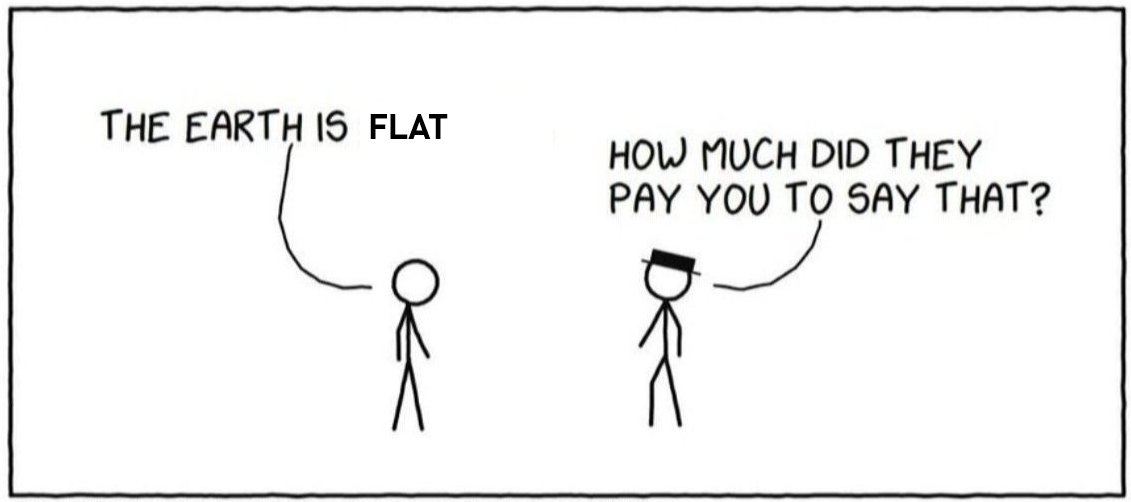
@loomdoop The point of the cartoon is that it's much easier to accuse people of financial motivations than it is to address their specific arguments. Your "fix" doubles down on that point.
English
2
0
1
29
Les
Les@LesterJMilton·
@rpondiscio I don't think it's either/or. People should be free to build, sustain, and improve whatever institution they like. When it comes to public schooling though, it's much harder to get a share of tax dollars to even build an institution if it isn't traditional in its structure.
English
0
0
0
12
Robert Pondiscio
Robert Pondiscio@rpondiscio·
@LesterJMilton It’s not about yuck vs. yum. It’s about institutions and whether one seeks to build, sustain, and improve them. Or lay siege and destroy them.
English
2
0
0
18
Robert Pondiscio
Robert Pondiscio@rpondiscio·
Tip for would be education reformers: take your lead from those who see value in the institutions you are trying to improve--not those for whom school (and childhood itself) was a misery, and whose aim is not to improve but to discredit and destroy.
Naomi Fisher@naomicfisher

This time of year, we put our 16-year-olds through a coming-of-age ritual. We make them sit in rows and write down things they have spent the last two years trying to memorise. We pit them against the clock, and prevent them from talking to each other. We tell them that this is the most important thing that they will ever do and their future life depends on it. We don’t just do this once. For most of them, we make them sit in rows and write things down between twenty and thirty separate times in the space of about six weeks. Maths, English, History, French, Biology….Again and again, they have to keep at it. Each time, we tell them how important it is and they better not have an off-day or be ill. Then we take their papers and we rank them. For some, the result will be accolades and glory. For others, failure and retakes. We know for sure that this will always be true, because these rituals that we call exams are designed to rank them. A third will always fail. There would be no top grades if we didn’t also have the bottom. It isn’t possible for them all to pass. And yet, every year, we talk as if this was not true. We pretend that it would be possible for them all to succeed, if only they and their teachers worked harder. Politicians talk about raising standards and accountability. We pretend that the problem is them not working hard enough, not an exam system designed so that hundreds of thousands fail. We blame them, not the exams. For the truth is that we have a coming-of-age ritual for our teenagers which involves a third of them being told they haven’t met the grade, that they are not good enough. We launch them into adult life telling them that they will carry the stigma of not understanding quadratic equations for ever. We put them all through intense stress, and then when some of them cave in we say they have anxiety and send them to see a therapist. And then we’re surprised when many of them say they just can’t carry on, that they don’t see the point. They don’t see potential in the future for themselves. We need to take a step back and ask ourselves why we do this to our teenagers. For the problem isn’t our young people. It’s not their fault that a third of them fail and many are chronically stressed. The problem is what we make them do. We’ve designed a coming-of-age system with a very high cost in human misery. Every year a new crop of teens will come of age, and despite their distress we just push them harder. We need to ask ourselves whether this is really the best we can do for our teenagers. We urgently need to think again.


English
11
1
49
4.5K
Y Disassembler
Y Disassembler@loomdoop·
YIMBY is a totally fake astroturf thing, a huge percentage of it is funded by two billionaires from Meta and Stripe, who fund every think tank, lobbyist, PAC, campaign fund, that they see as representing deregulation, empowering capital, and anti-human. #grants-abundance-and-growth" target="_blank" rel="nofollow noopener">coefficientgiving.org/funds/abundanc…
Y Disassembler tweet media
English
2
19
53
1.1K
Les
Les@LesterJMilton·
@rpondiscio If choices are available, I agree. I don't like to yuck anyone's yum! But I think the contempt comes from the compulsion & the prohibition of choice. That combination often creates a kind of trickle-down contempt that can then target the beneficiaries of a contemptible system.
English
1
0
1
29
Robert Pondiscio
Robert Pondiscio@rpondiscio·
@LesterJMilton Sure, but I've never cared for choice advocacy that runs on contempt for other peoples' choices. If your preferred flavor of choice depends on the failure of traditional public schools to be attractive to students and parents, it doesn't inspire confidence.
English
1
0
0
29
Les
Les@LesterJMilton·
@educator4ever36 Parents do have the responsibility of making sure their kids are participating in activities that will improve their lives. But it's not *always* necessary to force those things. In fact, I would argue that w/ a good relationship forcing those things is usually unnecessary.
English
0
0
4
82
The Principal’s Office
The Principal’s Office@educator4ever36·
Kids should be unwilling participants in much of their upbringing. I mean they aren’t going to elect into chores, vegetables, bedtimes, and hard work in school if given the choice. That’s why they are kids and that’s why parents need not worry about willing or unwilling participation and instead make their child do what’s best for them.
K.M.R.@Industry3D

@jenteach13 Kids are pretty much unwilling participants in their own education.

English
5
12
82
2.9K
Les
Les@LesterJMilton·
@doctorjesss983 I'm sure you value the importance of lifelong learning as a doctor. This is a great opportunity to learn about this subject & to correct this mistake, which scares smokers from switching to a safer form of nicotine delivery. I look forward to your humble, inspiring correction!
English
1
1
10
71
Dr. Jess
Dr. Jess@doctorjesss983·
Popcorn lung (bronchiolitis obliterans) can be a serious, irreversible lung disease caused by inhaling chemicals—specifically diacetyl—often found in flavored e-cigarettes. It causes scarring and inflammation in the smallest airways (bronchioles), le...
English
32
2
3
2.6K
Les
Les@LesterJMilton·
@rpondiscio 100%! Those perspective matter & school as it is should always be available to the kids for whom it's evidently valuable. The problem is (I think we agree more, here) is the lack of choice in schools & educational choices for the many kids who do better in different settings.
English
1
0
5
59
Robert Pondiscio
Robert Pondiscio@rpondiscio·
@LesterJMilton Shouldn’t we consider the perspectives of those — also many and also successful — for whom school was *not* a miserable waste of time? Why privilege one view and not the other?
English
1
0
0
178
Les
Les@LesterJMilton·
@rpondiscio Granted, but those characterizations are accurate reflections of the institution's impacts on far too many of the kids it's supposed to serve. When so many successful adults look back at school as a miserable waste of their time, we should try to figure out why that is.
English
1
0
4
213
Robert Pondiscio
Robert Pondiscio@rpondiscio·
@LesterJMilton When you characterize the institution in cartoonish terms or with sneering contempt, it doesn’t land as a wish for improvement.
English
2
0
0
46
Les
Les@LesterJMilton·
@rpondiscio In that arguing for some popular practices to be discredited and destroyed is an argument for improving institutions. You can want to see dramatic changes within institutions w/out wanting to destroy the institution.
English
1
0
5
48
Les
Les@LesterJMilton·
@ShineboxHukster @naomicfisher If you have a good counter-argument, you shouldn't have to misrepresent the argument you're countering. It would be good to have a system that creates intellectual rigor & prepares children for the real challenges of adulthood. We don't have that.
Les tweet media
English
0
0
0
16
Culpability Jones
Culpability Jones@ShineboxHukster·
@naomicfisher Yes, let’s abandon all forms of intellectual rigor & prepare our children for a world of guaranteed comfort. When things don’t work out for their professional lives as adults they can always just go on SSRI’s.
English
1
0
9
268
Naomi Fisher
Naomi Fisher@naomicfisher·
This time of year, we put our 16-year-olds through a coming-of-age ritual. We make them sit in rows and write down things they have spent the last two years trying to memorise. We pit them against the clock, and prevent them from talking to each other. We tell them that this is the most important thing that they will ever do and their future life depends on it. We don’t just do this once. For most of them, we make them sit in rows and write things down between twenty and thirty separate times in the space of about six weeks. Maths, English, History, French, Biology….Again and again, they have to keep at it. Each time, we tell them how important it is and they better not have an off-day or be ill. Then we take their papers and we rank them. For some, the result will be accolades and glory. For others, failure and retakes. We know for sure that this will always be true, because these rituals that we call exams are designed to rank them. A third will always fail. There would be no top grades if we didn’t also have the bottom. It isn’t possible for them all to pass. And yet, every year, we talk as if this was not true. We pretend that it would be possible for them all to succeed, if only they and their teachers worked harder. Politicians talk about raising standards and accountability. We pretend that the problem is them not working hard enough, not an exam system designed so that hundreds of thousands fail. We blame them, not the exams. For the truth is that we have a coming-of-age ritual for our teenagers which involves a third of them being told they haven’t met the grade, that they are not good enough. We launch them into adult life telling them that they will carry the stigma of not understanding quadratic equations for ever. We put them all through intense stress, and then when some of them cave in we say they have anxiety and send them to see a therapist. And then we’re surprised when many of them say they just can’t carry on, that they don’t see the point. They don’t see potential in the future for themselves. We need to take a step back and ask ourselves why we do this to our teenagers. For the problem isn’t our young people. It’s not their fault that a third of them fail and many are chronically stressed. The problem is what we make them do. We’ve designed a coming-of-age system with a very high cost in human misery. Every year a new crop of teens will come of age, and despite their distress we just push them harder. We need to ask ourselves whether this is really the best we can do for our teenagers. We urgently need to think again.

English
36
99
437
47.5K