Gus..

11.7K posts

Gus.. banner
Gus..

Gus..

@Libertad2140

Katılım Ağustos 2013
605 Takip Edilen274 Takipçiler
Gus.. retweetledi
BITCOINALLCAPS
BITCOINALLCAPS@BITCOINALLCAPS·
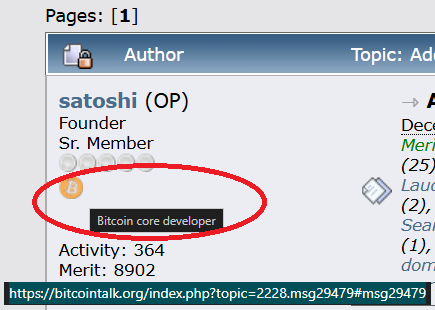
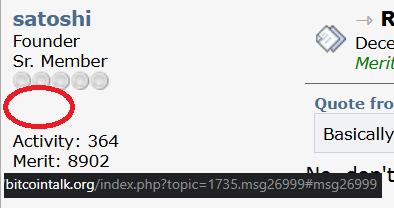
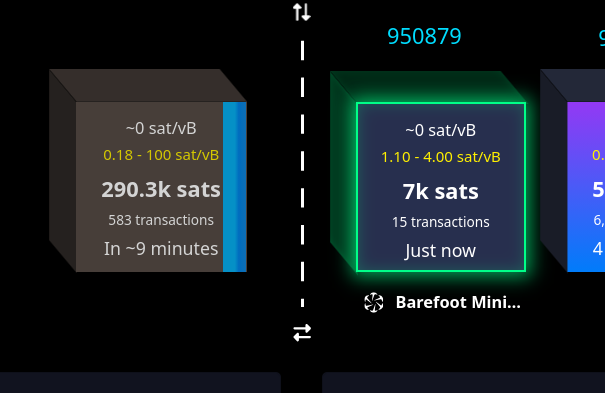
BitcoinTalk,org claiming Satoshi Nakamoto as a "Bitcoin Core Developer" is inaccurate. Satoshi never made any commits to Bitcoin Core. Bitcoin on sourceforge migrated to eventually "Core" on github after Satoshi left. "Bitcoin core developer" tag is absent in some instances too.
BITCOINALLCAPS tweet mediaBITCOINALLCAPS tweet mediaBITCOINALLCAPS tweet media
English
1
4
20
1.2K
Gus.. retweetledi
Luis Marcano 🦉 BITCOIN 👨‍💻
Bitcoin’s greatest strength has always been its uncompromising design: a fixed supply, permissionless, peer-to-peer electronic cash that cannot be diluted or censored. Yet today we face a subtle but serious erosion of that vision from within. Justin Bechler is right to draw attention to this, and I fully stand with his position. The debate is often framed as “Bitcoin Core vs. Knots” or “spam vs. free speech,” but that misses the deeper issue. The real question is whether we allow Bitcoin to remain sound money or permit it to slowly transform into a general-purpose data ledger. Non-monetary data — whether inscriptions, arbitrary OP_RETURN spam, or large image dumps — consumes block space, inflates UTXO sets, raises node operational costs, and degrades the user experience for those who simply want to use it as money. This is not theoretical; we have seen clear evidence of mempool congestion, higher fees during non-monetary floods, and growing centralization pressure on full nodes. Critics say we should only focus on the “real enemy” — central banks and fiat. That sounds noble, but it is strategically naive. A house divided cannot stand. If Bitcoin’s base layer becomes bloated and expensive because we refuse to defend its monetary properties, we hand ammunition to regulators, competitors, and even well-meaning developers who believe “Bitcoin should evolve.” Satoshi’s whitepaper described electronic cash, not a decentralized Dropbox. Ignoring that distinction is how protocols lose their soul. This is why Bitcoin Knots matters. It represents a deliberate, more conservative policy set that prioritizes the health of the network over short-term “anything goes” usage. Running Knots is not about hating Core developers; it is about signaling that we value long-term decentralization and monetary purity over temporary convenience. Similarly, proposals like BIP-110 deserve serious consideration. A temporary soft-fork filter against clearly non-monetary data is not censorship — it is stewardship. We already filter invalid transactions; extending sensible policy to protect the ledger’s primary function is rational governance, not extremism. Ethereum Foundation has its own well-documented problems, but Bitcoin was supposed to be different. It was born pure. When the protocol itself is under pressure from actors who either actively enable or passively tolerate its degradation, that internal threat becomes uniquely dangerous precisely because it comes disguised as progress or neutrality. Justin’s insistence on a hierarchy of risks is correct: external fiat enemies are obvious, but internal drift is insidious. History shows that empires and protocols alike fall more often from rot within than conquest from without. We do not need to hate anyone. We simply need to be honest. Bitcoin’s value proposition is monetary sovereignty. Defending that means being willing to make hard choices — tighter mempool policies, Knots adoption, and yes, even protocol-level filters when necessary. The orange pill is not just “number go up.” It is “Bitcoin stays Bitcoin.” I stand with @1914ad on this. The fight for Bitcoin’s soul is happening now, on the nodes we run and the policies we accept. Let’s choose the path that preserves what made it revolutionary in the first place.
Hodlingbtc@Hodling_btc

@1914ad BIP 110

English
2
6
19
251
Gus..
Gus..@Libertad2140·
Se necesita que el 55% de los bloques señalen RDTS durante las 2 siguientes semanas. Si se logra, las 2 semanas que siguen serán un período de bloqueo, que le da una última oportunidad al 45% restante del hashrate para actualizarse. Luego del periodo de cortesia, RDTS se activa.
Luke Dashjr@LukeDashjr

@DutyToRebel @TheBoozles The next period begins in about 3 days. 55% of blocks over the following 2 weeks would need to signal. If so, the next 2 weeks are a "locked in" period to give the remaining 45% of hashrate a last chance to get with it, and then RDTS becomes active.

Español
0
0
0
17
Gus..
Gus..@Libertad2140·
"Una cosa misteriosa y triste sobre los filósofos es que evitan hablar de lo más importante para la coordinación social: el dinero. Bitcoin es un constructo filosófico revolucionario y es la única manera de evitar el capitalismo de vigilancia. No se trata de hacerse rico."💯
Simple Steve 🌌@SteveSimple

@PAHoyeck A mysterious and sad thing about philosophers is that they avoid talking about the most important thing for society coordination - money. Bitcoin is a revolutionary philosophical construct and it’s the only way to avoid surveillance capitalism. It’s not about getting rich

Español
0
0
0
26
Gus..
Gus..@Libertad2140·
💯🎯👏👏👏
Luis Marcano 🦉 BITCOIN 👨‍💻@MarcanoFilms

The Long-Term Degradation of Bitcoin Full Nodes Due to Unrestricted Non-Monetary Data Spam The activity in question — persistent, high-volume inscription-style or arbitrary data transactions (typically leveraging OP_RETURN, Taproot script paths, or oversized witness data) — imposes compounding resource costs on the Bitcoin network’s full nodes. These costs scale linearly with blockspace consumption and transaction volume, directly threatening the economic feasibility of sovereign node operation. 1. Storage and Blockchain Growth Acceleration Each spam transaction permanently appends non-prunable data to the blockchain (or, in the case of witness data, to the witness commitment). Even with pruning enabled, full archival nodes and initial block download (IBD) for new nodes must process and store the entire history. Historical data shows that sustained spam campaigns have already accelerated blockchain growth beyond the baseline monetary transaction rate. Over years, this drives disk I/O and SSD capacity requirements from the current ~600 GB baseline to multi-terabyte levels for a fully validating node. Consumer-grade hardware (e.g., a 2 TB NVMe SSD) becomes insufficient for long-term operation without frequent manual pruning and re-validation cycles, which themselves consume additional bandwidth and CPU. 2. Bandwidth and Synchronization Overhead Full nodes must relay and validate every transaction and block. Spam increases: • Average block size toward the 4 MB witness-weighted limit on a more consistent basis. • Mempool pressure, forcing nodes to allocate more RAM for transaction caching and eviction logic. • IBD time for new nodes, which already exceeds 24–48 hours on consumer connections; sustained spam can push this beyond practical thresholds for home users with asymmetric residential broadband (typically 100–500 Mbps down / 10–50 Mbps up). The result is higher ongoing bandwidth bills and longer periods of desynchronization, reducing node reliability and network participation incentives. 3. CPU and Validation Costs Validation of each spam transaction requires: • Script execution (even if trivially true in many inscription patterns). • UTXO set lookups (if outputs are created, even dust). • Signature checks and witness validation. While individual transactions may be cheap in fees, their aggregate effect raises per-block validation time. On modest hardware (e.g., Raspberry Pi 5-class or older Intel NUC), this can push CPU utilization during block propagation above sustainable levels, leading to increased power draw and thermal throttling. Over multi-year horizons, the cumulative effect is that only higher-end servers or cloud instances remain viable for 24/7 operation. 4. Economic Barrier to Entry and Centralization Spiral When the marginal cost of running a fully validating, consensus-enforcing node exceeds the economic means of individual sovereign users (currently estimated at several hundred USD/year in hardware, electricity, and bandwidth for a reliable setup), participation collapses to professional operators, data-center colocation, or cloud providers. Historical precedent in other networks shows this leads to: • A sharp decline in the number of reachable full nodes. • Increased reliance on third-party RPC providers, block explorers, or light-client services. • Erosion of the verification principle (“Don’t trust, verify”) in favor of custodial or simplified payment verification (SPV) models. This is precisely the centralization vector Bitcoin’s design was engineered to resist. A network where only a handful of well-capitalized entities run economically viable nodes becomes vulnerable to coordinated policy changes, censorship, or regulatory capture — the very outcome that distinguishes Bitcoin from permissioned or trusted-third-party systems. In summary, unchecked spam is not a neutral “use case” expansion; it is an externality that systematically raises the hardware, energy, and connectivity floor required for node operation. Left unaddressed, it transforms Bitcoin from a peer-to-peer cash system verifiable by anyone into a settlement layer accessible primarily through intermediaries. The long-term viability of decentralization therefore depends on node operators and miners enforcing blockspace discipline — whether through consensus rules, default policy filters, or market-driven fee pressure — to keep the cost of sovereignty within reach of ordinary participants.


ART
0
0
1
21
Gus.. retweetledi
Mechanic #BIP-110
Mechanic #BIP-110@GrassFedBitcoin·
Do not buy Bitcoin derivatives. Only Bitcoin itself allows escape from fiat.
English
17
61
355
5.1K
Gus.. retweetledi
Mechanic #BIP-110
Mechanic #BIP-110@GrassFedBitcoin·
@TheBCHPodcast Notice how I'm actually addressing the issue raised rather than just commenting on that stuff. One day y'all might have the courage to do the same.
English
2
1
20
2K
Gus.. retweetledi
Mechanic #BIP-110
Mechanic #BIP-110@GrassFedBitcoin·
tldr: the only way to lose your own money as a result of bip-110 is if your intention is to lose your own money It's always going to be possible but that doesn't mean you get to hold the network to ransom insisting that they not permit you the ability.
English
2
11
114
1.4K
Gus.. retweetledi
Mechanic #BIP-110
Mechanic #BIP-110@GrassFedBitcoin·
Hi Greg, you refuse to talk on Twitter and I refuse to talk on Reddit (this is the more reasonable venue as most of what I post on Reddit just gets immediately deleted so screw you for even continuing to use it.) At present there are 0 UTXOs in existence that would be rendered unspendable by the activation of BIP-110. Not "almost zero". Literally zero. There are contrived conditions where you could have committed to something where a UTXO must be created in a specific way that cannot occur until blockheight X that results in someone creating it during the relevant time period that *would* render it unspendable temporarily. For that to be the case it must also have no key path available, *and* 1. Have > 128 leaves and thus too large a control block, and/or 2. Contain OP_(not)IF/OP_SUCCESS The chances of someone accidentally ending up in this situation is beyond laughable. They're somehow one of the most advanced users of Taproot and unaware of incoming rules being enforced by an implementation run by >20% of the network. Further still - if someone ends up unwittingly making such a UTXO then they simply won't be able to spend it until Sept 2027, unlike with other permanent soft forks where if you generate an unspendable UTXO, it becomes *permanently* unspendable. Amusing how no one cares if I generate a UTXO that CTV/CSFS/CAT etc would render unspendable were it to activate, where it would become so again, permanently rather than temporarily in some absurdly contrived scenario where the person "affected" intentionally self-impaled in an effort to frivolously obstruct as you have been doing for months. The trolling about confiscation is a result of the fact that we are no longer a serious space. Standards around confiscation, governance, processes, moderation, hiring, grants, PR approval, venues for discussion, forks etc are invoked for political reasons and selectively enforced as @hodlonaut and others have demonstrated beyond reasonable doubt.
English
25
77
391
13.7K
Gus..
Gus..@Libertad2140·
El PR tenía 423 pulgares hacia abajo frente a 105 hacia arriba. Ava Chow había dicho públicamente en diciembre de 2023: "Si es controvertido, entonces no lo tocamos." Se fusionó de todos modos. Luke Dashjr y Bitcoin Mechanic fueron silenciados en el PR. bip110.org
hodlonaut #BIP-110@hodlonaut

20/ The PR had 423 thumbs-down against 105 thumbs-up. Ava Chow had said publicly in Dec 2023: "If it is controversial, then we don't touch it." It was merged anyway. Luke Dashjr was muted on the PR. Bitcoin Mechanic was muted on the PR.

Español
0
0
0
26
Gus.. retweetledi
Christophe Boutry
Christophe Boutry@Ced_haurus·
Nostr VPN 🔓 Un immense merci à @marttimalmi pour ce projet qui avance vite et participe à construire une infrastructure plus ouverte et plus souveraine. Toutefois, il me semble important de préciser à ceux qui l'installent quelques points en terme de sécurité avant de l'utiliser. En l'état, Nostr VPN est un très bon projet de mesh VPN décentralisé, mais il ne doit pas encore être considéré comme un outil "safe". Le point le plus critique à mon sens : les invitations en réseau local. Lorsque vous ajoutez un appareil via le LAN, votre invitation est envoyée en clair sur le réseau local, lisible par n'importe qui connecté au même WiFi. Techniquement, le payload est diffusé en JSON brut par multicast UDP sur 239.255.73.73, pendant une fenêtre de 15 minutes, sans aucun chiffrement. Ce payload contient l'identité Nostr du nœud, le secret d'invitation, le nom de l'appareil et ses endpoints de connexion. Un simple tcpdump (un outil d'écoute réseau disponible sur n'importe quel ordinateur) suffit à tout récupérer passivement. Pas besoin d'attaque sophistiquée. La clé privée Nostr stockée en clair. Votre clé privée, celle qui constitue votre identité sur le réseau, est enregistrée sans protection dans un simple fichier texte sur votre machine. Dans le code, le champ secret_key est sérialisé directement dans un fichier config.toml, sans keychain, sans passphrase, sans intégration avec le trousseau système. Sur Unix le fichier est en 0600, c'est le minimum. Sur Windows, un fs::write sans ACL dédiée, le fichier hérite des permissions du dossier parent. Un backup non chiffré, un accès root, et l'identité complète du nœud est compromise. Dans un réseau fondé sur des clés cryptographiques, perdre la clé c'est comme perdre l'identité. Un écart important entre la documentation et le code. Le readme promet que la liste des membres du réseau est signée cryptographiquement par les admins, comme on signe un message pour prouver qu'on en est l'auteur. Dans le code, cette signature n'existe pas. La fonction s'appelle apply_admin_signed_shared_roster, mais elle ne vérifie aucune signature : elle contrôle uniquement que le message arrive via un pair reconnu comme admin. Ce n'est pas la même chose. Une vraie signature permet de vérifier l'authenticité du contenu indépendamment du canal de transmission. Ici, si la couche réseau est compromise, la liste des membres peut être manipulée sans aucune défense cryptographique. Pas de killswitch avant l'établissement du tunnel. Pendant les premières secondes après le démarrage, votre trafic continue de passer par votre connexion habituelle, sans protection. Un killswitch (un mécanisme qui bloque tout trafic tant que le tunnel n'est pas établi) n'est pas mis en place avant le handshake WireGuard. C'est incompatible avec une promesse de protection véritable dès le lancement. Autres soucis : Dès l'installation, sans rien configurer, tout est activé : découverte réseau locale, STUN (un protocole qui contacte des serveurs externes pour identifier votre IP publique), annonce d'endpoints, connexion automatique, acceptation des demandes de rejoindre le réseau. C'est top pour que ça fonctionne du premier coup. Mais c'est le profil inverse d'un outil pensé pour des usages sensibles, qui désactive tout par défaut et laisse l'utilisateur choisir ce qu'il active. Bref à retenir : un outil décentralisé n'est pas automatiquement un outil sécurisé. Nostr VPN est prometteur, utile, passionnant pour l'écosystème. Mais à ce stade, utilisez-le pour ce qu'il est : une alternative décentralisée à Tailscale, pas encore une solution apportant de la sécurité dans votre navigation.
Kruptos@KuptoKosmos

🔒🌐 NOSTR VPN : améliorations ! @marttimalmi vient de publier une update pour son mesh VPN 100% décentralisé... Toujours zéro compte Google/Microsoft/Apple, juste des clés publiques Nostr. Mais voilà ce qui a changé : 👉 Interfaces utilisateur natives multiplateformes : Fini le CLI-only sur Linux/macOS Apple Silicon. Maintenant c'est des GUIs natives propres qui tournent sur macOS, Linux, Android, iPhone, iPad... Tu vois direct tes devices (mini.nvpn, android.nvpn, iphone.nvpn, etc) les join requests en un clic ! 👉 Routage multihop basé sur Nostr (protocole FIPS) : Quand le NAT holepunching direct plante (ça arrive), ça passe automatiquement par des nœuds intermédiaires via les relais Nostr. Ultra résistant, toujours sans serveur central. Le FIPS rend le truc encore plus robuste ! 👉 UX de gestion du réseau fortement améliorée : Interface plus fluide, recherche devices, gestion du mesh privé, statut en live... C’est devenu plus intuitif 👉 Capacité d’exit WireGuard intégrée : Tu peux maintenant router tout ton trafic via des nœuds de sortie Mullvad ou ProtonVPN. Le combo parfait (mesh interne décentralisé + sortie anonymisée pro) 🔒 Zéro tracking, zéro entreprise au milieu, tout via les relais Nostr déjà existants + WireGuard (boringtun) Open source, gratuit, résistant à la censure, MagicDNS toujours là ! Le projet mûrit, Merci Martti👌 #VPN #Privacy

Français
7
22
112
11.9K
Gus.. retweetledi
Super Testnet
Super Testnet@SuperTestnet·
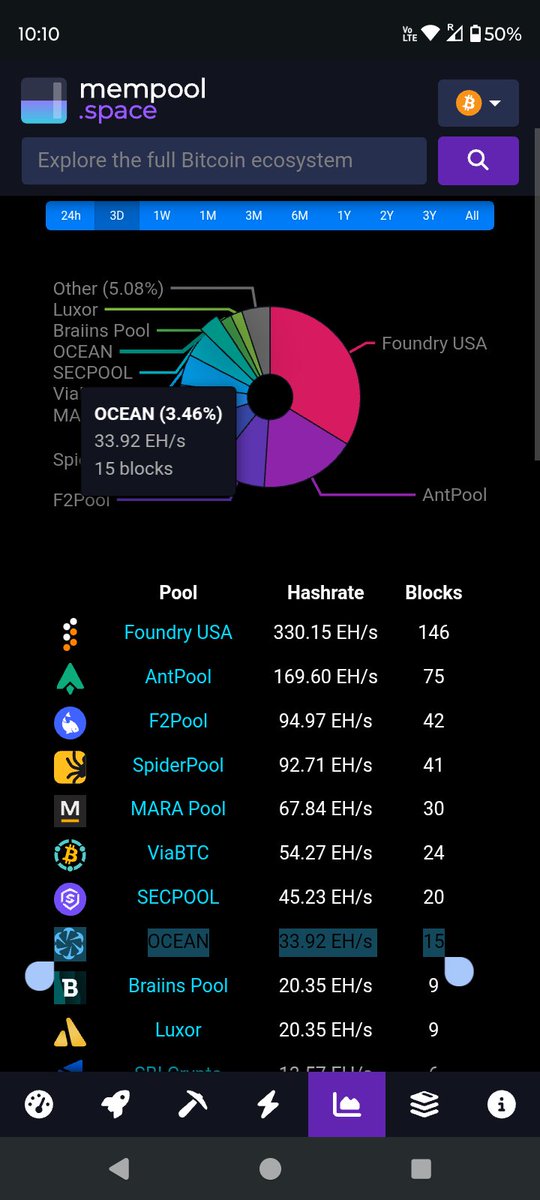
Ocean is now a top 8 mining pool - more miners are discovering how to make their own block templates - and that Ocean pays out more than other pools, since it has lower admin fees - plus they offer LN payouts - and, for large miners, coinbase payouts
Super Testnet tweet media
English
14
88
321
13.9K
Lucas Corsino
Lucas Corsino@LuccasCorsino·
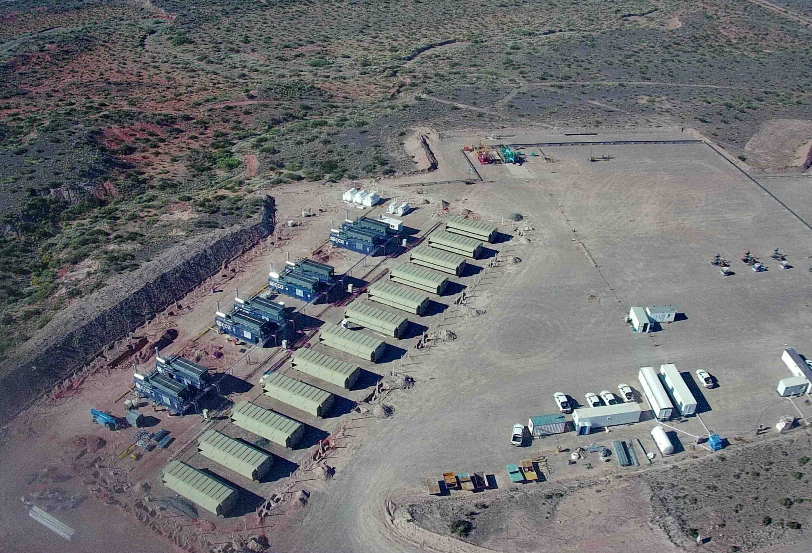
🔋 Data Centers en Vaca Muerta: hoy ya hay capacidad de cómputo instalada aprovechando el gas de flare que genera empleo Cómo funciona? 🛢️ Los pozos de Vaca Muerta generan gas residual que, cuando no puede ser captado o transportado, se termina quemando en un flare. Pero este gas puede ser aprovechado para generar energía eléctrica mediante generadores a gas o turbinas. ⚡️ Esa energía eléctrica, a través del uso de moto-generadores, alimentan centros de cómputo que hoy se utilizan principalmente para el minado de criptomonedas. En esta imagen podemos ver 8 moto-generadores de 1.4 MW cada uno alimentando 12 MDCs (Centro Modulares de Cómputo) donde se encuentran más de 3.000 equipos de minería de criptomoneda. En este caso se utilizan 50.000 m3 de gas por día y se evitan 100mil toneladas de co2 al año. 👷🏽‍♂️ Generación de empleo: este tipo de proyectos de inversión generan puestos de trabajo durante su ingeniería, construcción y mantenimiento. Actualmente hay posiciones abiertas a cubrir en la empresa Unblock: 🔹 Performance Optimization Engineer 🔹 Director de Operaciones 🔹 Técnico de Servicios - Generación a Gas De la misma manera que hoy se está generando energía eléctrica para alimentar capacidad de cómputo para minería de criptomonedas se pueden generar data centers con capacidad basada en GPUs/NPUs. Entrenar modelos de machine learning, especialmente modelos de deep learning y redes neuronales, requiere una gran cantidad de energía eléctrica y capacidad de cómputo.
Lucas Corsino tweet media
Español
24
126
784
100.7K
Gus..
Gus..@Libertad2140·
Mientras la comunidad lo adopte, tendrá éxito. 10% de hashrate prácticamente garantiza que no necesita nada drástico. 50% de hashrate protege incluso a los idiotas que no actualizaron a tiempo.
Luke Dashjr@LukeDashjr

@Matt_R_256 @Singekino_Miner @mattkratter As long as the community adopts it, it will succeed. 10% hashrate pretty much guarantees it doesn't need anything drastic. 50% hashrate protects even the idiots who failed to upgrade in time.

Español
0
0
1
18