
Delmar Larsen

3.4K posts

Delmar Larsen banner
Delmar Larsen

Delmar Larsen

@LibreTexts

Professor of Chemistry, Ultrafast Laser Spectroscopist, Founder and Director of LibreTexts, father of two daughters, two apathetic cats, and two dumb dogs.

Davis, CA Katılım Ekim 2009
698 Takip Edilen1.6K Takipçiler
Sabitlenmiş Tweet
Delmar Larsen
Delmar Larsen@LibreTexts·
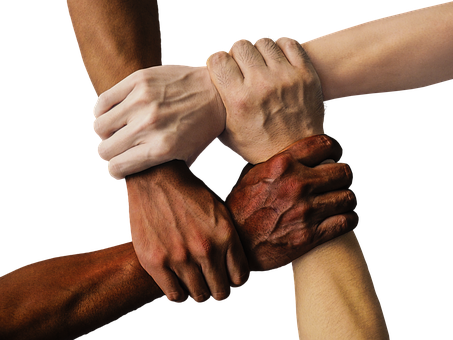
LibreTexts knows that we must first listen to and acknowledge how our colleagues and students have endured discrimination and the profound and lasting effects on them. We cannot let this time pass without change. See a fuller statement at our blog: blog.libretexts.org/2020/06/11/lib…
Delmar Larsen tweet media
English
0
5
17
0
Delmar Larsen
Delmar Larsen@LibreTexts·
Nice! Many believe stronger protections are needed for intellectual property, including OER content hosted online. Cloudflare serves as a content delivery intermediary for LibreTexts and has implemented a new policy that may significantly curb AI scraping. gizmodo.com/free-lunch-is-…
English
0
0
2
125
Paesani Lab
Paesani Lab@PaesaniLab·
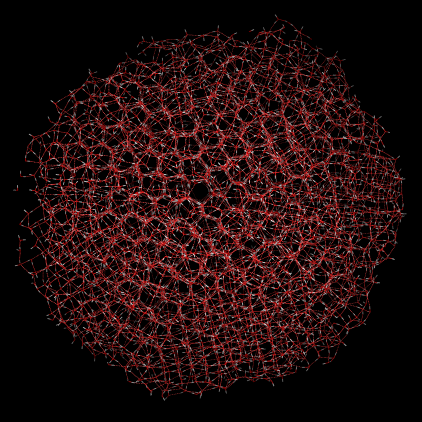
🚨 New paper alert! 🚨 How do halide ions really shape water’s structure and dynamics? 🌊 Find it out here 👉 doi.org/10.1021/acs.jp… In our latest study (part of the Thanos Panagiotopoulos Festschrift in @JPhysChem), we use our #datadriven #manybody MB-nrg potentials to provide a molecular-level view of ion hydration across the halide series (F⁻, Cl⁻, Br⁻, I⁻). From structural and dynamical features to infrared spectral shifts, our simulations show that: 🟢 Fluoride forms short, directional H-bonds and strongly perturbs the water network (more soon 😎). 🟠 Heavier halides (Cl⁻, Br⁻, I⁻) have weaker interactions and minimal impact beyond the first shell. 📉 Common force fields and DFT models still struggle to match these trends without empirical (fine?) tuning. Our #datadriven #manybody MB-nrg potentials once again sets a benchmark by predicting experimental observables with CCSD(T)-level accuracy. ✨ This work lays the foundation for tackling aqueous interfaces, solutions in confinement, and biomolecular hydration. Stay tuned! 🏄‍♀️ @UCSanDiego @UCSDPhySci @UCSDChemBiochem @HDSIUCSD @SDSC_UCSD
Paesani Lab tweet media
English
1
3
34
1.9K
Paesani Lab
Paesani Lab@PaesaniLab·
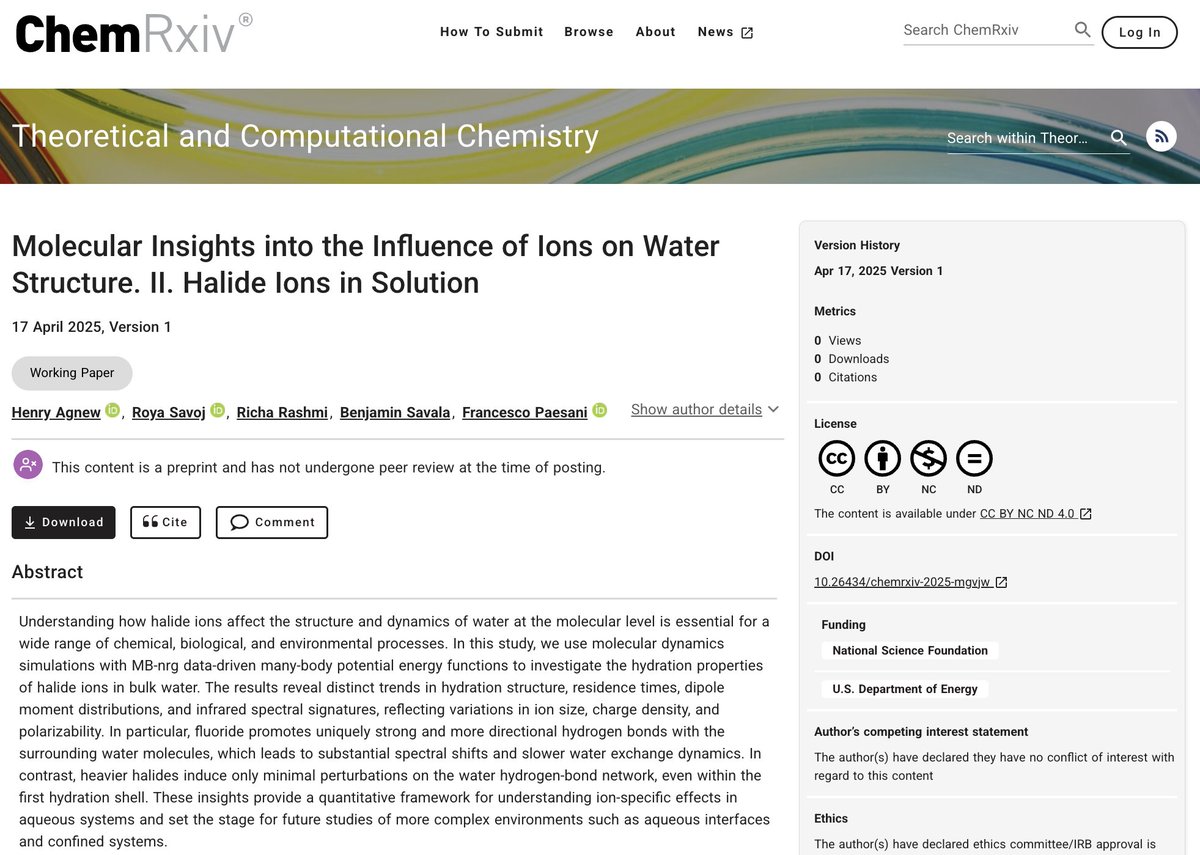
🚨 New paper alert! 🚨 What do halide ions really do to #water? Find out on @ChemRxiv: 👉 doi.org/10.26434/chemr… In our latest study, we use our MB-nrg data-driven many-body potentials to unravel how F⁻, Cl⁻, Br⁻, and I⁻ reshape the structure and dynamics of liquid water — from hydration shells to IR spectra. 🖥️ Fluoride stands out: strong, directional H-bonds, slow water exchange, major spectral shifts. 🖥️ Heavier halides? Minimal disruption, even in the first shell. These insights not only challenge the classic “structure maker/breaker” view but also set a new benchmark for modeling ion hydration at the molecular level — all without empirical fitting. 🏄‍♀️ Big thanks to @NSF for funding and to @ACCESSforCI and @NERSC for computational resources! @UCSanDiego @UCSDPhySci @UCSDChemBiochem @HDSIUCSD @SDSC_UCSD
Paesani Lab tweet media
English
2
2
21
2.6K
Delmar Larsen
Delmar Larsen@LibreTexts·
@nanophononics Did they at least address the letter to you personally or just "Dear Professor"?
English
0
0
1
46
Davide Donadio
Davide Donadio@nanophononics·
Dear random postdoc applicant, I can see from your CV that you are an accomplished experimentalist, but in my group, we do only theory and computer simulations. Why should I spend time replying to you?
English
1
0
4
456
Delmar Larsen
Delmar Larsen@LibreTexts·
@dncs0_l1 Not sure I understand. We are using month/day/year format; it is understandable if you favor a day/month/year (which makes more sense). This was compiled Feb. 11th, 2025 (last month).
English
0
0
0
12
Brett McCollum
Brett McCollum@McCollumBrett·
There was a time when I was quietly proud to be a member of the 1000 lbs club. A few life events happened. It felt great to recently get back into power lifting. Today was the day. Bench Press 245 Squat 340 Deadlift 415 10 reps, 3 sets per
GIF
English
1
0
6
388
Mαtt Thomαs
Mαtt Thomαs@mattthomas·
@AnnaRMills My students and I have’t been able to access *How Arguments Work* all day because human.libretexts.org appears down. I figured I’d ask you whether you’ve heard anything.
English
1
0
1
33
Delmar Larsen
Delmar Larsen@LibreTexts·
@danmcguirempls @mattthomas @AnnaRMills I must have missed the import options on our LMS. They can accept XML files instead of Common Cartidge. Which whos XML file since they are quite varied? LibreTexts has one too, but it isn't designed for import to LMSs.
English
0
0
1
29
Delmar Larsen
Delmar Larsen@LibreTexts·
@mattthomas @AnnaRMills We are acutely aware of the implications of being down (my inbox especially). Operating at 1M pageviews a day comes with some societal responsibility, which we take seriously.
English
2
0
1
12
Delmar Larsen
Delmar Larsen@LibreTexts·
@AnnaRMills @mattthomas Did you see Antecedent in the LibreVerse options now? I have been using it for my Chemistry labs (so it isn't just for composition courses).
English
0
0
1
8
Delmar Larsen
Delmar Larsen@LibreTexts·
@mattthomas @AnnaRMills The servers has an issue for our libraries that negatively impacted access to them for about 18 hours. This was the first time we had issues like this for so long in the 11 years since we went to the cloud. We don't have a post-mortum yet about the specifics of the issue.
English
1
0
1
19
Mαtt Thomαs
Mαtt Thomαs@mattthomas·
@AnnaRMills @LibreTexts Thank you! I actually already had the PDF and shared it with them but it was weird. I can’t remember it ever going down before!
English
2
0
1
8
Delmar Larsen
Delmar Larsen@LibreTexts·
@opencontent I agree 100%. Too often in these efforts (big and small), there is a missing or poorly thought out part of sustainability. It just took time, maturity, and the "need to know" in order to make that clear to me (vs. who I was seven years ago).
English
1
0
1
45
David Wiley
David Wiley@opencontent·
25 years ago, when I was a young firebrand, I didn't appreciate it either. But many long and deep conversations with Gary Lopez, who was an incredible mentor and way more generous and patient with me than I deserved, helped me finally understand. Regardless of whether your org is a non-profit or a for-profit, revenue earned from related services IS going to be a critical part of your #OER sustainability model. And if you're not willing to take that step - offering and charging for services - you're simply not going to be sustainable over the long-term. Full stop. Everyone who dedicates themselves to doing OER work full-time eventually learns this lesson - whether they want to or not. But people who work with OER as a small part of a different full-time job are never forced to learn this lesson, and have the luxury of criticizing from the sidelines. What should worry all of us is when people who haven't learned the lesson (either directly or vicariously) start driving departmental, institutional, system-wide, state-wide, or national policies and strategies. For all the good they're really, truly, and sincerely trying to do, they end up shooting all of us in the collective foot as you say. Sadly, I think last month's CCC announcement falls into this category. cccco.edu/About-Us/News-… While the quote at the top talks about "making textbooks and other instructional materials affordable and accessible to all of our students," which is completely compatible with OER sustainability, the new policies are to include language that is VERY different: "developing and implementing degrees that don’t require students to pay for textbooks." This has become commonplace in the OER community - switching back and forth between "affordable" and "free" as if they're the same thing. They're NOT. Policies and strategies requiring "free" completely undermine the sustainability models of orgs who create and maintain OER, while policies and strategies requiring "affordable" create enough space for the orgs to survive and even thrive.
English
1
0
0
63
David Wiley
David Wiley@opencontent·
Last year there was a series of meetings held by SPARC and others orgs discussing whether or not the US needs a national open education strategy. I attended one of the meetings and blogged my concerns about it afterward. opencontent.org/blog/archives/… Now a new job posting from SPARC includes this responsibility: "Serve as part of the staff leadership team of the new national open education coordination initiative that will be incubated at SPARC." linkedin.com/jobs/view/4118… For all the reasons I outlined in my blog a year ago (and many more reasons I've written about since), I'm deeply concerned about how an effort like this might advance the "zero textbook cost" agenda while harming the OER movement and, ultimately, student learning. Super curious to see where this goes.
English
3
2
1
328
Delmar Larsen
Delmar Larsen@LibreTexts·
@opencontent The discussion was a sort of monoculture. Obvious issues that faculty would point out were ignored (or publishers in your concerns). I understand the difficulties in motivating a diverse group of people, but if they want a successful national thrust, a different tact is needed.
English
0
0
0
48
Delmar Larsen
Delmar Larsen@LibreTexts·
@opencontent I also attended several of these meetings and I share your concerns. I personally felt some of the wayward discussions would have been more on target if there were more diverse perspectives in the room (i.e., faculty, publishers, administrators, etc.).
English
0
0
0
39