UCSD Chem Biochem

1.3K posts

UCSD Chem Biochem banner
UCSD Chem Biochem

UCSD Chem Biochem

@UCSDChemBiochem

Welcome to UC San Diego Chemistry & Biochemistry

San Diego, California Katılım Mayıs 2011
311 Takip Edilen2.1K Takipçiler
UCSD Chem Biochem retweetledi
UC San Diego School of Physical Sciences
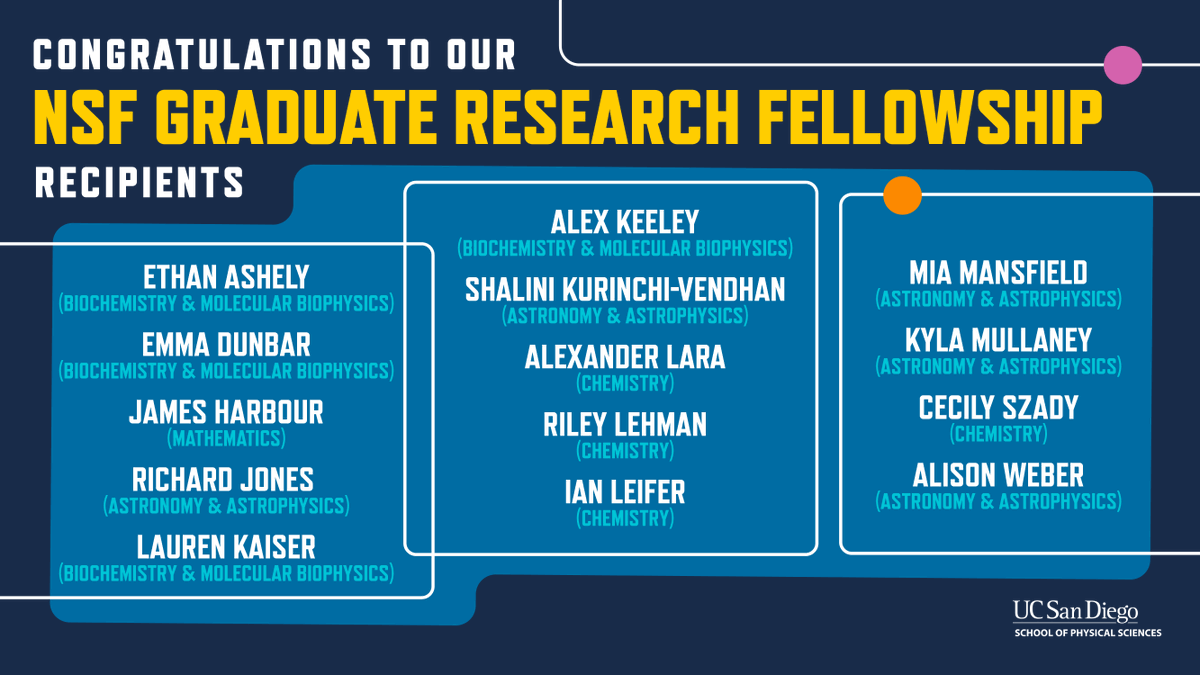
Congratulations to all of our outstanding graduate students who received a Graduate Research Fellowship from the National Science Foundation! @NSF 🎉
UC San Diego School of Physical Sciences tweet media
English
0
1
3
141
UCSD Chem Biochem
UCSD Chem Biochem@UCSDChemBiochem·
🎉 Congratulations to Prof. Shaowei Li on receiving an @NSF #CAREER Award! 🎉 This prestigious recognition supports his work on controlling single-molecule reactivity, which opens new possibilities for directing chemical processes with atomic precision. @UCSanDiego @UCSDPhySci
UCSD Chem Biochem tweet media
English
0
0
3
181
UCSD Chem Biochem
UCSD Chem Biochem@UCSDChemBiochem·
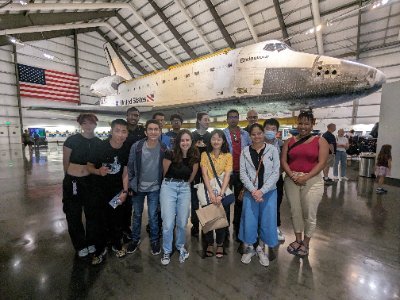
Congratulations to Prof. Seth Cohen on his appointment as Dean of Physical Sciences at @UCIrvine! 🎉 We are proud to see one of our own take on this important leadership role. While we will miss him at @UCSanDiego, we look forward to seeing the impact he will have at @UCIrvine.
UC Irvine@UCIrvine

Seth Cohen has been appointed dean of UC Irvine's School of Physical Sciences. Cohen, an internationally recognized inorganic chemist, comes to UC Irvine from UC San Diego. @UCIPhysSci 🔖 bit.ly/4bwzJmS
English
0
1
8
868
UCSD Chem Biochem retweetledi
Paesani Lab
Paesani Lab@PaesaniLab·
🚨 Our Perspective on #supercooled #water is now out in @ScienceMagazine! 👉 science.org/doi/10.1126/sc… More than 10 years ago, we introduced our #datadriven #manybody formalism to develop transferable potentials with chemical accuracy, starting with #water and leading to MB-pol. Since then, MB-pol has been used to model #water across all phases, from the gas-phase dimer 🫧 to the liquid 🌊 and ice 🧊, consistently reproducing experimental data. But our goal was never just agreement with experiment. We wanted to make predictions that experiments could test. Last year, we predicted the location of #water. ⚡️ Today, new measurements infer a location remarkably close to our prediction. 😎 A very exciting moment for #datadriven #manybody potentials! 🚀 Big thanks to @NSF, @ENERGY, and @AFOSR for supporting the development and applications of MB-pol over the years! @UCSDPhySci @UCSDChemBiochem @HDSIUCSD @SDSC_UCSD 1/2
English
1
3
13
1K
UCSD Chem Biochem
UCSD Chem Biochem@UCSDChemBiochem·
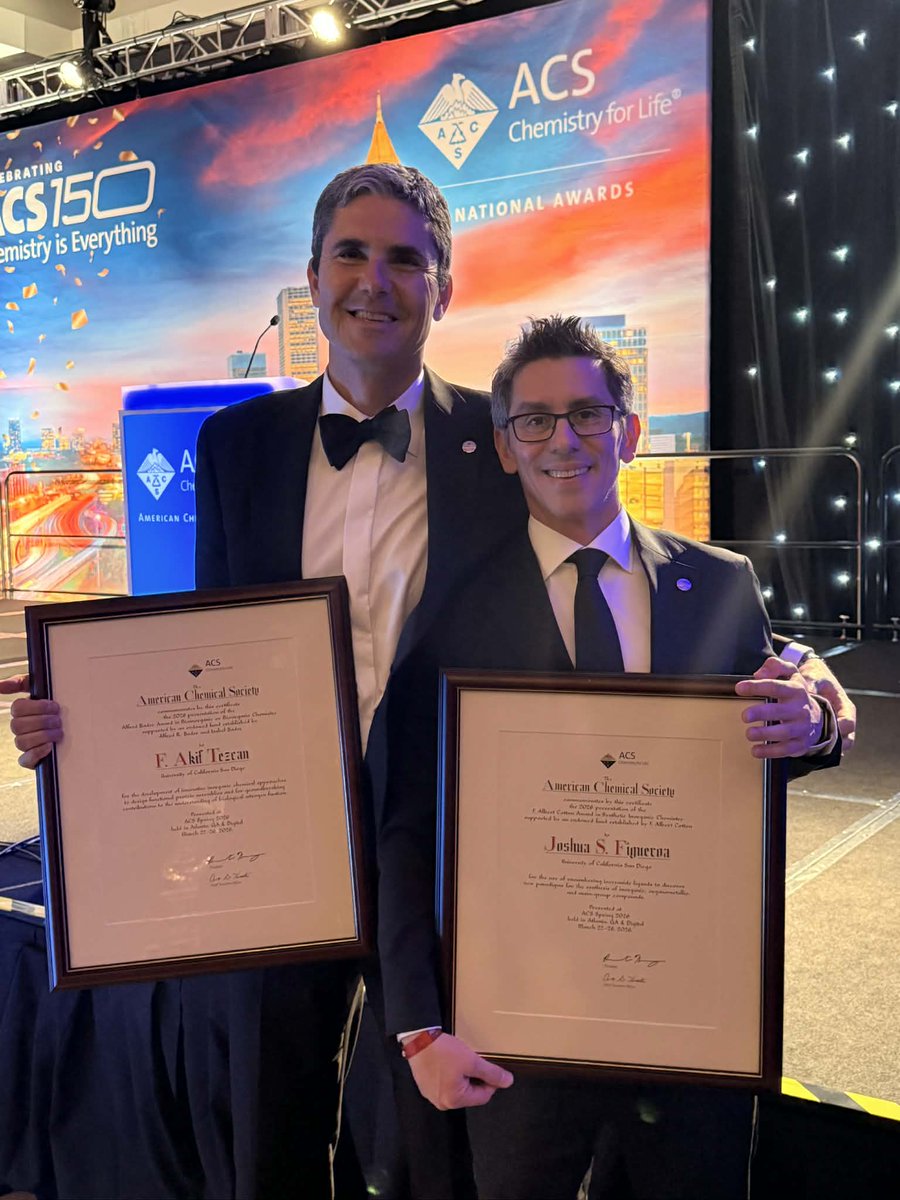
A great night at the @AmerChemSociety National Meeting in Atlanta! 🎉 Congratulations to Prof. Tezcan (Bader Award) and Prof. Figueroa (Cotton Award) on these well-deserved honors. Proud to see their work recognized at the highest level of our field! 👏 @UCSanDiego @UCSDPhySci
UCSD Chem Biochem tweet media
English
0
0
9
1.1K
UCSD Chem Biochem retweetledi
UC San Diego School of Physical Sciences
Congrats to Fleur Ferguson on receiving the Medicinal Chemistry Emerging Investigator Lectureship from the Royal Society of Chemistry. She was recognized for making significant contributions in the fields of medicinal chemistry and drug discovery. bit.ly/3NbDTbL
English
0
1
5
174
UCSD Chem Biochem retweetledi
Paesani Lab
Paesani Lab@PaesaniLab·
🚨 New paper out in @JPhysChem Lett.! 🚨 We're excited to share our latest work (a collaboration with @BonnMischa's group at @mpi_polymer): 👉 pubs.acs.org/doi/10.1021/ac… At the #air/#water interface, "free" (dangling) O–H groups are responsible for a sharp peak at ~3700 cm⁻¹ in the vibrational sum-frequency generation (#vSFG) spectrum.⚡️ Because it’s so narrow, it’s often treated as spectrally #homogeneous. But is it really? 🌊 In this study, we combine: ✅ Three distinct polarization‑resolved heterodyne‑detected #vSFG measurements, reporting the first #SPS spectrum. ✅ Our #datadriven #manybody MB-pol potential for predictive simulations. ✅ Path‑integral-based quantum dynamics (Te‑PIGS) simulations to capture #NuclearQuantumEffects. Our key findings: 🎯 The free O–H peak shifts with polarization by ~13–15 cm⁻¹ → direct evidence that *orientation matters* even for “free” O–H. 🎯 Free O–H bonds tilted toward the interfacial plane are systematically red‑shifted compared to more upright O–H. 🎯 Mechanism: orientation‑dependent *local electric fields* from neighboring water molecules. Stronger projected fields along the O–H axis correlate with lower (red‑shifted) fundamental frequencies. Take‑home message: 🔎 A sharp peak ≠ a uniform interface. The #water surface is intrinsically heterogeneous, and polarization‑resolved spectroscopy + quantum many‑body simulations can read out that heterogeneity in terms of local electric fields. Huge congrats to #Richa for leading this project! 🙌 🙏 Big thanks to @NSF for funding and to @ACCESSforCI and @NERSC for providing computational resources! @UCSanDiego @UCSDPhySci @UCSDChemBiochem @HDSIUCSD @SDSC_UCSD
English
0
1
10
669
UCSD Chem Biochem retweetledi
Paesani Lab
Paesani Lab@PaesaniLab·
🚨 New paper out in @JPhysChem Lett.! 🚨 We are excited to share our latest work: 👉 pubs.acs.org/doi/10.1021/ac… Interfacial #water behaves very differently from bulk #water. 🌊 At charged interfaces, interpreting vibrational sum-frequency generation (#vSFG) spectra becomes particularly challenging. ⚡️ The key question is: 🤔 What is truly “surface-specific” (χ²), and what originates from bulk field-induced contributions (χ³)? In this study, we combine: ✅ Our #datadriven #manybody MB-pol potential ✅ Temperature-elevated path-integral coarse-graining (Te-PIGS) to include #NuclearQuantumEffects ✅ Layer-resolved heterodyne-detected #vSFG simulations to provide a molecular-level separation of χ² and χ³ contributions at charged graphene oxide/water (#GO/#water) interfaces Our findings: 🎯 The prominent ~3200 cm⁻¹ band observed experimentally is not primarily surface-specific. It is dominated by field-induced bulk χ³ mixing associated with the electrical double layer. 🎯 In contrast, the strictly interfacial structure is encoded in χ². 🎯 This explicit χ²/χ³ decomposition clarifies how surface and bulk responses combine to shape measured #vSFG spectra at charged aqueous interfaces. Beyond #GO, this framework provides a general strategy to interpret vibrational spectra at charged and nanoconfined aqueous interfaces, with implications for: • Membrane science • Electrochemical systems • Sensing platforms • Interfacial reactivity Congratulations to #Toheeb and #Richa for leading this exciting collaboration between our groups at @UCSanDiego and @LSU! 🙌 Excited to see how heterodyne #vSFG experiments will further test these predictions. 🚀 @UCSDPhySci @UCSDChemBiochem @HDSIUCSD @SDSC_UCSD @LSU_Chemistry
English
0
2
7
550