Fco. Sanchez Cid

2.6K posts

Fco. Sanchez Cid banner
Fco. Sanchez Cid

Fco. Sanchez Cid

@LightMyWay78

Ingeniero de profesión, lector por devoción. Actualmente CTO SW de Fermax

Valencia, España Katılım Şubat 2010
621 Takip Edilen264 Takipçiler
Fco. Sanchez Cid
Fco. Sanchez Cid@LightMyWay78·
Esta reflexión es tan preclara como escalofriante. Lo escuchas y de repente ves el tablero de juego con claridad. Y nosotros somos las fichas…
Dustin@r0ck3t23

Mark Zuckerberg just described the death of human connection on the internet and no one flinched. One sentence. Fifteen years of erosion in twelve words. Mark Zuckerberg: “Social media started out as people primarily interacting with their friends. And now… at least half of the content is basically people interacting with creators.” You used to open your phone to see what your friends were doing. Now you open it to watch strangers. You did not choose this. The algorithm chose it for you. It tested your friends against optimized strangers. Your friends lost. Every time. A stranger with better lighting, better timing, and a better hook held your attention three seconds longer than someone who loves you. So the algorithm buried your best friend’s wedding photos under a cooking video from someone in Dubai you have never met. And you watched the cooking video. That was the first replacement. Friends for strangers. You barely noticed. The second one is already underway. If the algorithm already proved strangers outperform your real relationships, and AI can now build a stranger more engaging than any human alive, the math finishes itself. The AI does not have a bad week. It does not post something careless and lose the algorithm’s favor. It does not burn out. Every word calibrated. Every frame tuned. Every pause placed at the exact interval that keeps your thumb from moving. A human creator competing against that is carving stone tablets in a world that just built the printing press. The economics are not even close. A person needs rent, sleep, and motivation. The machine needs electricity. When the cost of generating perfect content hits zero, the feed fills with faces that do not exist. Voices that feel familiar. Opinions that mirror yours just enough to feel like trust. Personalities built from scratch to feel like someone you have known for years. You will not know when the switch happens. That is the point. The feed does not care whether the thing holding your attention has a pulse. It cares whether you stay. And a machine that knows your patterns better than you know yourself will always keep you longer than a person ever could. This is not a warning. Half of it already happened. You lost your friends to strangers and did not notice. You will lose the strangers to machines and call them friends. Somewhere in a different app, in a different tab, in a room you are sitting in right now, someone who actually knows you is living a moment you will never see. Not because they stopped sharing it. Because you stopped being where it was.

Español
0
2
2
48
Fco. Sanchez Cid
Fco. Sanchez Cid@LightMyWay78·
Ains… mi querido café demostrándome otra vez más que hay que quererlo ☕️ Resulta que uno de los componentes del café (no la cafeína), mejora nuestra microbiota 😋
Nature Portfolio@NaturePortfolio

Coffee consumption is associated with the presence and abundance of a specific member of the human gut microbiome, Lawsonibacter asaccharolyticus, and changes to the plasma metabolome, according to a paper in @NatureMicrobiol. go.nature.com/4i3gqUI
Español
0
0
0
5
Fco. Sanchez Cid retweetledi
Francisco Gómez de Tejada | arquitecto
Los romanos desarrollaron un ingenioso sistema de poleas y grúas que les permitió levantar enormes bloques de piedra, lo que fue clave para la construcción de sus grandes estructuras como templos, acueductos y anfiteatros. Utilizaban una grúa conocida como "treadwheel crane", una rueda de gran tamaño accionada por personas que caminaban dentro de ella, generando la fuerza necesaria para levantar cargas pesadas. Complementaban este sistema con poleas y cuerdas para distribuir mejor el peso. Para sujetar los bloques, usaban varias técnicas. Una de las más comunes era el uso de abrazaderas de hierro en forma de "U", llamadas "grapas de Lewis", que se insertaban en ranuras talladas en la piedra. También empleaban ganchos y anclajes que se ajustaban a orificios en los bloques, o incluso cuñas de madera que se expandían al mojarse, creando una presión suficiente para sujetar las piedras con seguridad. Estas técnicas permitieron a los romanos mover y colocar piedras de varias toneladas con precisión, sin dañarlas. Información: @simple.history_
Español
29
285
1.4K
84.9K
Fco. Sanchez Cid
Fco. Sanchez Cid@LightMyWay78·
Madre de Dios. Es impresionante. Para mí, esto nunca será equiparable a algo creado por IA e impreso después. Porque el valor del arte es la evocación que provoca por su belleza, su historia, y su proceso de creación.
Fernando Ferreiro@ferfedrawings68

Acabo de saber que he perdido otro cliente que ha preferido recurrir a la IA (no doy más detalles). Cada vez que subo imágenes como esta a las redes de mi proceso de trabajo me siento como un viejo artesano a punto de desaparecer, como un calafate o un tonelero...

Español
0
0
0
22
Fco. Sanchez Cid
Fco. Sanchez Cid@LightMyWay78·
I think @AdamMGrant will love this concept of "Productive Failure" (in case he is not already familiar with it!) I just loved it: "Engaging with a challenge before being taught can triple learning gains compared to standard instruction." journals.sagepub.com/doi/10.3102/00…
English
0
0
0
11
Fco. Sanchez Cid retweetledi
Blake Burge
Blake Burge@blakeaburge·
A rule that will accelerate your career: If you bring a problem, bring context. If you bring context, bring options. If you bring options, bring a recommendation. People trust people who help them think. Anyone can spot an issue, few can actually help move things forward.
English
93
558
3.1K
80.5K
Fco. Sanchez Cid retweetledi
Brandon Luu, MD
Brandon Luu, MD@BrandonLuuMD·
Students who took notes by hand scored ~28% higher on conceptual questions than laptop note-takers. Writing forces your brain to process and compress ideas instead of copying them.
Brandon Luu, MD tweet media
English
447
5.2K
24.4K
1.6M
Fco. Sanchez Cid
Fco. Sanchez Cid@LightMyWay78·
Muy de acuerdo con esta tesis. Que además nos lleva a una paradoja: necesitamos expertos para verificar los resultados que entrega la IA. Pero si los juniors de hoy, sólo trabajan con IA, ¿cómo lograrán convertirse en esos expertos del futuro que verifiquen lo que hace la IA?
Antonio Ortiz@antonello

Llevo metido dos semanas en un paper de economistas del MIT y UCLA y salgo del mismo convencido de que por fin he dado con un marco desde el que discutir muchos de los efectos de la inteligencia artificial agéntica en el empleo, en la economía, en los juniors, en los riesgos para el sistema... La idea central es esta: conforme la IA pasa de asistir a ejecutar tareas completas, el cuello de botella deja de ser la inteligencia y pasa a ser la verificación humana. Es decir: automatizar será cada vez más barato, pero comprobar que el resultado es correcto no cae al mismo ritmo. Porque verificar depende de tiempo experto, responsabilidad y, sobre todo, de algo decisivo: la latencia de feedback. No cuesta lo mismo validar un código que falla al compilar en segundos que una decisión financiera o educativa cuyos errores tardan años en aparecer. A partir de ahí, el paper divide la economía en cuatro zonas: tareas baratas de automatizar y fáciles de verificar; tareas difíciles de automatizar pero verificables; tareas ni automatizables ni verificables; y la zona realmente peligrosa, donde automatizar es barato pero verificar es caro o directamente inviable. Ahí está el riesgo. No porque la IA “falle” de forma visible, sino porque puede producir resultados plausibles, útiles en apariencia y económicamente rentables, mientras oculta errores cuyo coste acaba absorbiendo el resto del sistema. Como una forma de contaminación: el beneficio es privado, pero el daño potencial se socializa. La tesis fuerte no es solo que sufran los trabajos rutinarios. Es que, en un mundo de agentes, lo más vulnerable será lo medible. Y que el valor se desplazará hacia quien pueda verificar, garantizar y asumir responsabilidad sobre el resultado. Mucho más desarrollado en: error500.net/p/la-naturalez…

Español
0
1
2
90
Fco. Sanchez Cid retweetledi
Fco. Sanchez Cid
Fco. Sanchez Cid@LightMyWay78·
I couldn’t agree more:
Naval@naval

Is Traditional Software Engineering Dead? “Does this mean that traditional software engineering is dead? Absolutely not. Software engineers—even the ones who are not necessarily tuning or training AI models—these are now among the most leveraged people on earth. Sure, the guys who are training and tuning models are even more leveraged because they’re building the tool set that software engineers are using. But software engineers still have two massive advantages on you. First, they think in code, so they actually know what’s going on underneath. And all abstractions are leaky. So when you have a computer programming for you—when you have Claude Code or equivalent programming for you—it’s going to make mistakes. It’s going to have bugs. It’s going to have suboptimal architecture. So it’s not going to be quite right. And someone who understands what’s going on underneath will be able to plug the leaks as they occur. So if you want to build a well-architected application, if you want to be able to even specify a well-architected application, if you want to be able to make it run at high performance, if you want it to do its best, if you want to catch the bugs early, then you’re going to want to have a software engineering background. The traditional software engineer is going to be able to use these tools much better. And there are still many kinds of problems in software engineering that are out of scope for these AI programs today. The easiest way to think about those is problems that are outside of their data distribution. For example, if they need to do a binary sort or reverse a linked list, they’ve seen countless examples of that, so they’re extremely good at it. But when you start getting out of their domain—where you have to write very high-performance code, when you’re running on architectures that are novel or brand new, when you’re actually creating new things or solving new problems, then you still need to get in there and hand code it. At least until either there are so many of those examples that new models can be trained on them, or until these models can sufficiently reason at even higher levels of abstraction and crack it on their own… And remember: there is no demand for average. The average app—nobody wants it, at least as long as it’s not filling some niche that is filled by a superior app. The app that is better will win essentially a hundred percent of the market. Maybe there’s some small percentage that will bleed off to the second-best app because it does some little niche feature better than the main app, or it’s cheaper, or something of the sort. But generally speaking, people only want the best of anything. So the bad news is there’s no point in being number two or number three—like in the famous Glengarry Glen Ross scene where Alec Baldwin says, “First place gets a Cadillac Eldorado, second place gets a set of steak knives, and third place you’re fired.” That’s absolutely true in these winner-take-all markets. That’s the bad news: You have to be the best at something if you want to win. However, the set of things you can be best at is infinite. You can always find some niche that is perfect for you, and you can be the best at that thing. This goes back to an old tweet of mine where I said, “Become the best in the world at what you do. Keep redefining what you do until this is true.” And I think that still applies in this age of AI.”

English
0
1
0
20
Fco. Sanchez Cid retweetledi
Brad Wilcox
Brad Wilcox@BradWilcoxIFS·
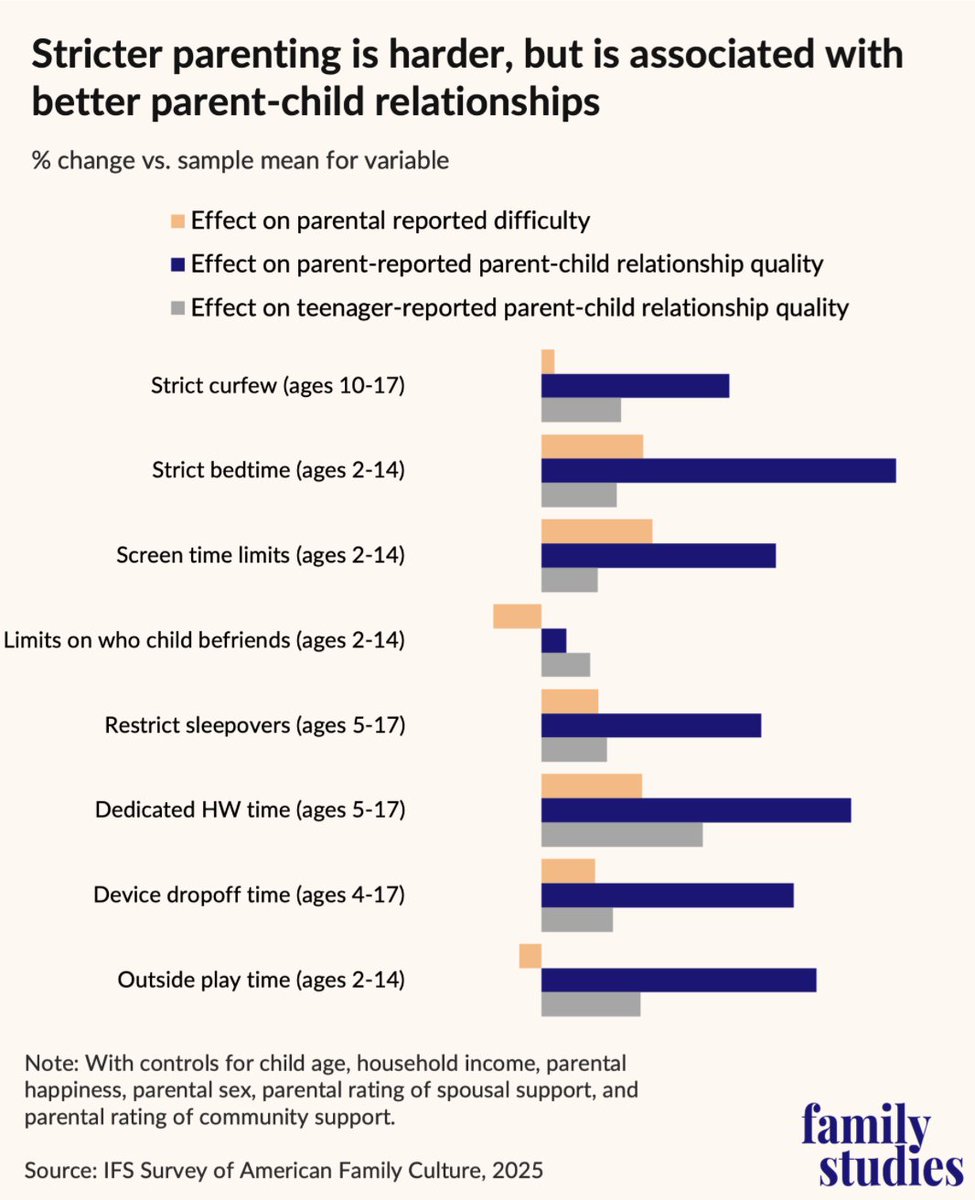
New @FamStudies: Almost "every rule a parent imposes makes parenting feel harder. But virtually every parental-enforced rule is linked to better parent-child relationships." ✔️ Strict bedtime ✔️ Screentime limits ✔️ Dedicated HW time = Happier teen. @lymanstoneky's latest:
Brad Wilcox tweet media
English
47
288
2.4K
492.6K