Linxiao Zhu

57 posts

Linxiao Zhu

Linxiao Zhu

@Linxiao_Zhu

Geopolitics and energy analyst, previously @IEA/@TheEIU, @georgetownmsfs alum.

London, England Katılım Ocak 2013
961 Takip Edilen129 Takipçiler
Linxiao Zhu
Linxiao Zhu@Linxiao_Zhu·
@confinedape Good call. I expect another leg up this quarter. But this kinda geopolitical-driven spike is unsustainable and can be easily washed off by TACO.
English
0
0
2
33
confinedape
confinedape@confinedape·
Since I started this account I maintain what is likely the most impressive #Oil track record on this app. No one even dares to post the setups I take, and each of them since May has played out to perfection. I love this game. #oott
confinedape@confinedape

$CL #Oil up more than 6% since quoted post, which marked the precise bottom. A very clean trade, clear reaction with expected, bullish news flow tailwind. Derisking here into 73. 3-2-1 crack spread remains extremely interesting. Also interesting that we tapped into contango, though now back in backwardation. #oott

English
3
0
14
1.2K
Linxiao Zhu
Linxiao Zhu@Linxiao_Zhu·
If the stock market is a silicon bubble built on AI hype, the global economy is fundamentally a Jenga tower built on hydrocarbons. The popping of the bubble may only be the prelude. What markets still haven’t priced in is the quiet loosening of the carbon-based foundation underneath it all. #OOTT
English
0
0
0
52
Linxiao Zhu retweetledi
Melissa Chen
Melissa Chen@MsMelChen·
Hong Kong was long the main place where large-scale, open remembrance of the events of Tiananmen Square in 1989 was possible. It drew hundreds of thousands. In mainland China, it is snuffed out to a degree that is shocking. Steadily, this has been eroded by the authorities. In 2020, under the premise of covid19 restrictions, there was a clamp down. Many defied it; arrests followed for unlawful assembly. This coincided with Beijing imposing the National Security Law (NSL) in June 2020, which broadly targeted secession, subversion. In 2021, Tiananmen memorials, museums, and statues (like the "Pillar of Shame") were removed from universities. Arrests and detentions continued throughout the years for the mere crime of bringing flowers, wearing black clothing, or even just social media posts in commemoration of the Tiananmen massacre. Just a few weeks ago, the trial of the former organizers of the yearly Tiananmen vigil concluded. They await the verdict, which is almost certain to be a jail sentence. This year, the authorities have banned family and relatives of the victims from visiting their graves in Beijing. The ruthless efforts of intensifying censorship by the CCP has swallowed the truth in the land where it happened and now, Hong Kong which was the keeper of its memory. But this role is no longer, even if it still exists in the hearts and minds of Hong Kongers. To those of us overseas, this is a duty. We are the keepers of a memory the powerful wish to bury. In our living rooms, across time zones, through late-night conversations and quiet tears, we hold the history to which there are no more monuments, to which there are blank pages in the history books. We remember the students with their hunger strikes and hopeful banners. We remember the ordinary citizens who stood beside them. We remember Tank Man. We remember the mothers who lost children and were told their grief was unpatriotic. We remember because forgetting would betray not just history, but the very humanity we share. We honor the courage of those who stood in the square and the quiet strength of those who still mourn in private. We keep alive the dream that was crushed but never fully extinguished. I hope those of us overseas will post the images, share the news and tell the stories. In this act of fidelity, we become a bridge between what was lost and what may yet be reclaimed. The CCP may control the narrative within its borders, and now increasingly, well beyond them, but we in the West with an open information ecosystem have a duty to not let this memory die. As long as we remember, they have not won. June 4th, 2026 37th Anniversary
Melissa Chen tweet media
English
78
331
1.1K
24.5K
Linxiao Zhu
Linxiao Zhu@Linxiao_Zhu·
@laurimyllyvirta Thank you! Agreed, think it's either inventory or SPR, otherwise the maths doesn't add up.
English
0
0
0
11
Lauri Myllyvirta
Lauri Myllyvirta@laurimyllyvirta·
@Linxiao_Zhu I just know inventories must have been drawn down. Just stopping inventory buildup, increasing imports of ethane and some other things can make a difference but obviously can't cover a 40%+ drop in seaborne crude imports.
English
1
0
1
40
Lauri Myllyvirta
Lauri Myllyvirta@laurimyllyvirta·
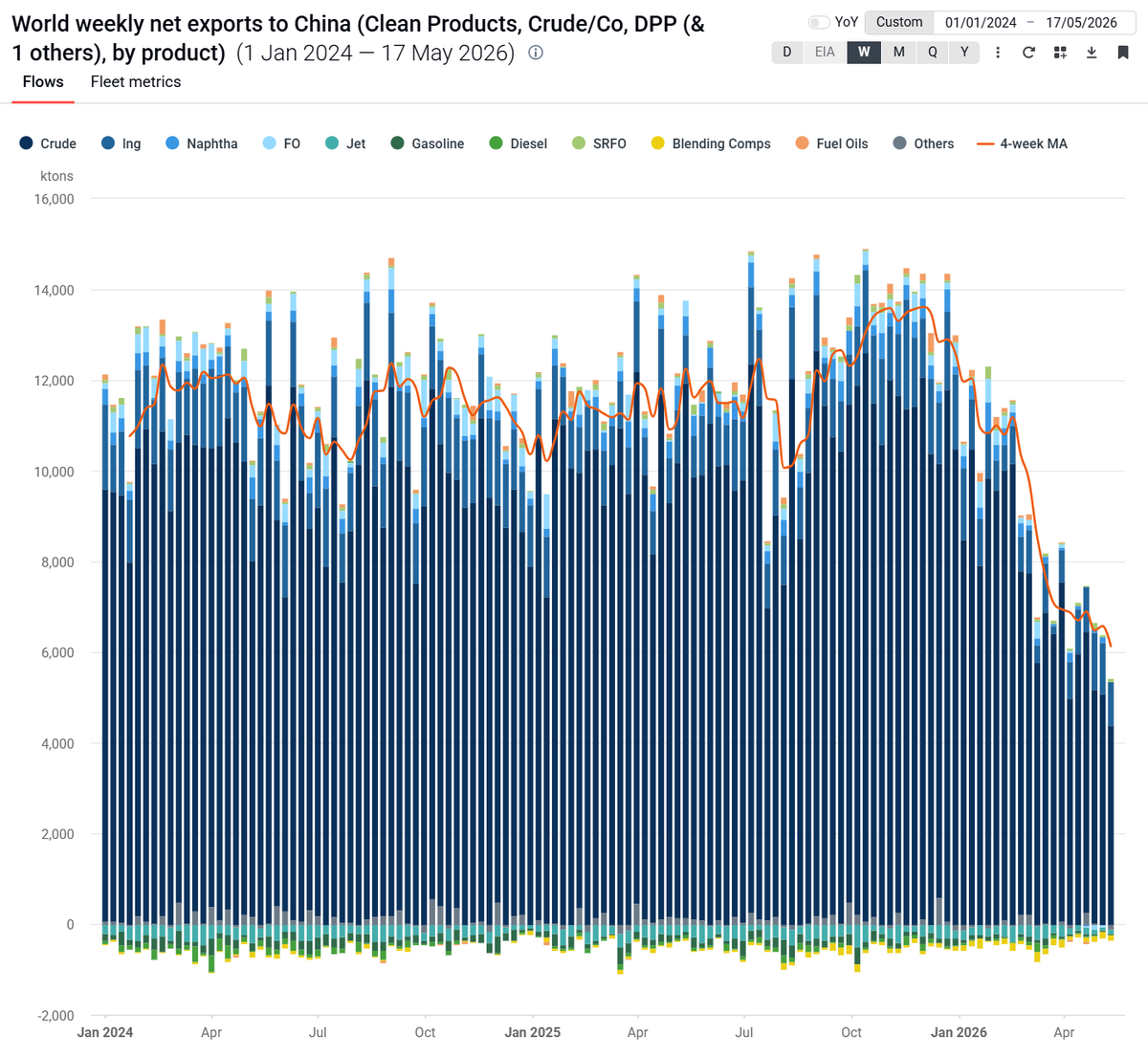
Global seaborne oil supply rebounded in April, due to increased shipments from the U.S., Russia, Norway and some other smaller producers. That rebound seems to have played out now. China has continued to cut imports very sharply, now down 45% on year, which provides relief.
Lauri Myllyvirta tweet mediaLauri Myllyvirta tweet media
English
4
4
27
2.7K
Linxiao Zhu
Linxiao Zhu@Linxiao_Zhu·
Well, if you don’t even dare to threaten during market hours, it’s hard to convince the counterpart who holds the bargaining chips. axios.com/2026/05/22/tru…
English
0
0
0
29
Linxiao Zhu
Linxiao Zhu@Linxiao_Zhu·
The world’s fastest oil tanker moves at ~20 knots. A medium-range ballistic missile at Mach 10 can strike a moving tanker in the Strait of Hormuz in minutes if not seconds. Oil and gas production in the gulf takes months to years to recover once shut or damaged. Diplomacy between multiple warring parties takes months—if we’re lucky. Yet the market is sleepwalking into what is already the most significant energy crisis in modern history. #OOTT #IranWar
English
0
0
0
58
Linxiao Zhu
Linxiao Zhu@Linxiao_Zhu·
The oil market is now the world’s largest prediction market, if not the largest casino. #OOTT #Iran
English
1
0
1
350
Linxiao Zhu
Linxiao Zhu@Linxiao_Zhu·
Turned out that after decades of sanctions and wars over it, the Islamic Republic didn’t need nukes. It already has one: closing the Strait. #OOTT #IranWar #StraitOfHormuz
English
0
0
0
239
Linxiao Zhu
Linxiao Zhu@Linxiao_Zhu·
Exactly four years ago, I was counting Russian barrels in the very early days of a looming global energy crisis. It is enlightening to draw parallels between the “special military operation” then and the current “major combat operation,” and reflect on the epic fury in today's energy markets. The two moments, sitting at different ends of a commodity supercycle, offer some important insights: 1.     While oil price surged in March 2022 on fears that sanctions would permanently remove part of a major supplier from the market (~5 mb/d), today’s market is reacting to the risk of losing a much larger volume of global oil flows (~20 mb/d transiting Hormuz, plus potential regional production outages) for what could be a short—but highly uncertain—period. The former premium depended on sustaining Western cohesion and sanctions momentum; the latter hinges on sustaining meaningful regional disruption. 2.     The Islamic Republic never needed to formally “close the Strait.” There is a far cheaper and easier route: flying $50,000 drones across the region. Economics does the rest—surging tanker rates and insurance pullbacks can effectively deter passage and de facto “close” Hormuz. 3.     Naval escorting and drone intercepting become a costly war of attrition. CENTCOM’s experience in the Red Sea showed that escorts with limited naval capacity struggled to neutralise Houthi attacks. It would be no easier to defend the Persian Gulf with much higher traffic volume against a rogue state that shares extensive coastlines. 4.     Moscow planned to finish its operation for a few weeks, and the war is still ongoing. If sustained, this may be another defining moment for the global economy and geopolitics: structurally higher energy bills, global competition for remaining molecules, de-industrialisation in import-dependent economies, weakened climate ambition, and a different rate-cutting path for central banks… #OOTT #OperationEpicFury
English
0
0
1
71
Linxiao Zhu
Linxiao Zhu@Linxiao_Zhu·
@dennisw5 This may be some media prep work to broadcast China may enter the negotiation, on an invitation. It could also be showing a position of strength to domestic audiences.
English
0
0
1
63
Dennis Wilder偉德寧
Dennis Wilder偉德寧@dennisw5·
What do we make of this on CCTV's website? Very Odd. 📷 Yuyuan Tantian 📷 7 hours ago from Weibo web version [Exclusive disclosure: #The US has taken the initiative to contact China through multiple channels and hopes to discuss tariffs# ] #China can force out the US's intentions through contact# Tan Zhu learned from sources that in recent times, the US has taken the initiative to contact China through multiple channels, hoping to negotiate with China on tariffs. Recently, US President Trump and his economic and trade team have also frequently leaked that the US is conducting economic and trade negotiations with China. International economic and trade negotiation experts analyzed with Tan Zhu that the more frequently the US releases news, the more it shows its eagerness to promote negotiations. From the perspective of negotiations, the United States must be the more anxious party at present. At present, the Trump administration is facing multiple pressures, the first of which is economic pressure, and the second is public opinion pressure. Tan Zhu believes that before the United States takes any substantive action, China has no need to talk to the United States. However, if the United States hopes to contact China, it will not be bad for China at this stage. China needs to observe and even force out the true intentions of the United States and take the initiative in negotiations and fighting.
English
1
0
1
397
Linxiao Zhu
Linxiao Zhu@Linxiao_Zhu·
as that could sustain oil prices and inflation significantly above its comfort zone. So far, the answer seems to be yes for now, given how quickly POTUS is floating this idea for Russian and Iranian oil. #oott #secondarytariffs
English
1
0
0
221
Linxiao Zhu
Linxiao Zhu@Linxiao_Zhu·
Secondary tariffs go a lot more beyond tariffs—they may end up more like embargoes on targeted commodity exports, particularly if strictly enforced. The key question is whether the administration will go all-in,
English
1
0
0
116