ThinKingTwice
699 posts

ThinKingTwice
@LivedSelfPraise
Gesellschaftskritik, Blockchain, Ökonomie, Technik und so ein Zeug ...
Katılım Kasım 2021
59 Takip Edilen173 Takipçiler
Sabitlenmiş Tweet

@TimoKing21 Und wo ist jetzt der Unterschied zu bitcoin. Sehr viel Vertrauen aber nicht Politiker und Banken sondern in Hype und Narative
Deutsch

@CoinImpulse Wenn man eine deflationäre Währung wie btc als einziges Zahlungsmittel etabliert, dann sinkt mit der Zeit der Konsum und die Wirtschaft geht langsam zu Grunde. Als sekundäres Zahlungsmittel bei einer hohen Inflationsrate könnte btc tatsächlich stabilisierend wirken.
Deutsch

Wenn man Bitcoin in das bestehende Finanzsystem integrieren würde, würde es der Menschheit helfen (Geld kann nicht einfach gedruckt werden etc., ihr kennt ja die ganzen Argumente).
Ethereum, XRP, Solana und wie sie sonst noch alle heißen, würden einfach nur ein paar Unternehmen reich machen.
Der Menschheit würden sie nichts bringen.
Welche Use Case haben eigentlich Altcoins?
Viele Transaktionen pro Sekunde oder was?
Es revolutioniert nichts. Bitcoin schon.
Deutsch
ThinKingTwice retweetledi

JUST IN: The UAE announced Friday it will double its Hormuz-bypass pipeline capacity to 3 million barrels per day by 2027. Modi landed in Abu Dhabi the same day with an F-16 escort. India and the UAE signed petroleum, LPG, and defence pacts plus $5 billion in UAE investment. Trump and Xi exchanged rose seeds in Beijing. The true winner of the Iran war is the UAE.
ADNOC's Executive Council briefed Crown Prince Khaled bin Mohamed Friday on accelerating the West-East 1 pipeline, a pre-planned parallel line that has been on the books since 2024. The existing ADCOP pipeline runs 406 kilometers from Habshan to Fujairah, carrying 1.5 to 1.8 million barrels per day since 2012. The new line will roughly double total capacity to 3 million barrels per day by 2027. The UAE exited OPEC production quotas effective May 1, 2026, freeing it to ramp output toward its 5 million barrel per day target. Bloomberg's Javier Blas broke the pipeline story Friday morning citing the Abu Dhabi Media Office.
The Fujairah terminal sits on the Gulf of Oman coast, east of the Strait of Hormuz. Tankers loaded there sail directly into the Arabian Sea and the Indian Ocean without ever entering the Persian Gulf or the strait. The strait itself is 21 nautical miles wide between Iran and Oman. UAE crude bypasses it entirely via overland pipeline.
Saudi Arabia's East-West Petroline, commissioned in 1982, carries up to 7 million barrels per day across 1,200 kilometers from Abqaiq to Yanbu on the Red Sea. Aramco maxed the line to full capacity in March 2026 during the Hormuz crisis. The Yanbu route exits via the Bab el-Mandeb strait between Yemen and Djibouti, exposing Saudi cargoes to Houthi attacks. Roughly 4 million barrels per day transit Bab el-Mandeb. Houthi forces have threatened closure if the war escalates further.
Modi's Air India One was met by UAE F-16 fighters as it entered Emirati airspace Friday. MBZ greeted him personally on the tarmac. The UAE was the first stop of Modi's five-nation tour. UAE supplies roughly 11 percent of Indian crude imports and 40 percent of Indian LPG. 4.5 million Indians live in the UAE. Reuters reported the agenda included long-term crude contracts, strategic petroleum reserve cooperation, and Fujairah terminal access.
By Friday afternoon Beijing time the two governments had announced a strategic petroleum reserve memorandum, an LPG agreement, and a defence cooperation framework. The UAE pledged $5 billion in Indian investment including RBL Bank and Sammaan Capital. The pipeline announcement and the energy pacts shared the same news cycle. India and the UAE were coordinating supply security in real time.
A Fujairah terminal tanker was struck by drones on May 4. The ADNOC Barakah, owned by Abu Dhabi National Oil Company, was hit while empty at anchor. No injuries were reported. The incident demonstrated that the bypass infrastructure remains a target. UAE oil revenue itself has taken a meaningful hit during the crisis. The geography functions but the terminal endpoint is exposed.
Trump's Beijing trip produced a 200 Boeing jet announcement, a "double-digit billion" annual agricultural framework, a White House September 24 invitation, and one Chinese supertanker called the Yuan Hua Hu that sailed through Hormuz with 2 million barrels of Iraqi crude. ADNOC produced a 1.5 million barrel per day capacity addition. Modi produced $5 billion in UAE investment and three signed pacts. The Iran war's diplomatic mediator is now Beijing. The Iran war's strategic beneficiary is Abu Dhabi. The UAE post-OPEC exit, the Fujairah doubling, and the Modi lock-in compounded in a single 72-hour window. The Gulf's structural winner moved while Washington watched.
open.substack.com/pub/shanakaans…

English

XRP braucht keine Bank dieser Welt mehr.
Stablecoins erfüllen 1:1 denselben Zweck, nur ohne Volatilität.
Warum sollte eine Bank 100 Millionen US-Dollar mit XRP um die Welt schicken und das Risiko eingehen, dass der Kurs in dieser Zeit einbricht? Auch wenn es nur ein paar Sekunden sind, ist es ein unnötiges Risiko für Banken.
„Es ist aber Brückenliquidität!“ Na und?
Am Ende erfüllt es exakt denselben Zweck wie Stablecoins (grenzüberschreitende Zahlungen, schnell und zu niedrigen Kosten). Nur mit Volatilität.
Mittlerweile kann man auf Börsen auch US-Dollar- und Euro-Stablecoins umwandeln.
XRP macht also null Sinn. Aus irgendeinem Grund investieren vor allem Anfänger in Shitcoins.

Deutsch
ThinKingTwice retweetledi

BREAKING 🇺🇸 Senate Banking Committee markup of the Clarity Act is now LIVE:
x.com/i/broadcasts/1…
English
ThinKingTwice retweetledi

🚨NEW: In remarks given at an event today, SEC Chair @SECPaulSAtkins laid out a handful of areas where the agency is considering modernizing securities rules for onchain markets, including potential rulemakings around what qualifies as an exchange, broker, dealer and clearing agency in crypto.
Atkins said the @SECGov is considering a framework for onchain trading systems through ‘notice and comment’ rulemaking, including around how the definition of “exchange” applies to crypto markets. He also said the agency is reviewing how broker and dealer rules apply to onchain activity and software interfaces, potentially through exemptive rulemaking.
On clearing, Atkins said the SEC is considering whether the traditional clearing agency model still fits onchain systems where settlement is near instant and counterparty risk is managed algorithmically.
He also signaled the agency is looking at how to regulate crypto vaults that generate onchain yield, particularly around the Securities Act and Investment Advisers Act issues.

English
ThinKingTwice retweetledi

Ondo, Kinexys by @jpmorgan, @Mastercard, & @Ripple successfully completed a landmark pilot transaction connecting the XRP ledger with interbank settlement rails.
This milestone marks the first time tokenized U.S. Treasuries have settled across borders and banks in near real time and outside traditional banking windows.
1. Ondo processed Ripple’s OUSG redemption on XRP Ledger
2. Mastercard's Multi-Token Network routed instructions to Kinexys by J.P. Morgan
3. J.P. Morgan delivered USD to Ripple's Singapore bank account
Tokenized assets are no longer separate from the global financial system. For the first time, a public blockchain and global banking infrastructure settled a cross-border transaction of a tokenized fund together in real time.
Together, we’re laying the groundwork for 24/7 global markets that never close.

English

@DE_Compounder Der Preis von Btc wird aber auf Börsen ermittelt und genau da findet ja auch das steuerrelevante Event statt. Das Protokoll ist aus dieser Sicht irrelevant
Deutsch

In der aktuellen Debatte um Bitcoin-Besteuerung wird oft ein grundlegender Punkt übersehen: Innerhalb des Bitcoin-Protokolls zählt ausschließlich, ob eine Transaktion durch eine gültige digitale Signatur autorisiert ist. Mehr gibt es auf Protokollebene nicht zu prüfen.
Bitcoin selbst kennt keine Steuersysteme, keine Staaten und keine äußeren Rahmenbedingungen. Alles, was außerhalb des Netzwerks passiert, existiert aus Sicht des Protokolls schlicht nicht.
In diesem Sinne ist Bitcoin ein geschlossenes Regelwerk: ein eigener digitaler Kosmos, der nur seine eigenen Regeln kennt – und nichts außerhalb davon bewertet.
Deutsch

@fpbuilds Ein Staat der sein eigenes Geld drucken kann hat finanzielle Souveränität. Er muss Geld leihen können um flexibel reagieren zu können. Bitcoin ist gut und deflationär und daher auch der tot für eine Wirtschaft die vom Geldfluss abhängig ist. Weil es deflationär ist
Deutsch

Der Staat braucht deine Zustimmung nicht.
Er druckt einfach Geld. Finanziert Kriege, die du ablehnst. Projekte, die du nicht willst. Und nimmt sich die Mittel dafür still aus deiner Kaufkraft.
Du gehst auf die Straße. Egal.
Du wählst eine andere Partei. Egal.
Er bricht seine Versprechen. Egal.
Das Gewaltmonopol bleibt. Der Drucker läuft.
Bitcoin ändert das. Zum ersten Mal in der Geschichte gibt es Geld, das kein Staat kontrollieren kann. Langsam, Schritt für Schritt, trennt es Geld und Staat – wie ein trojanisches Pferd.
Es zwingt den Staat, wieder Rechenschaft abzulegen. Seine Bürger als Souverän zu behandeln, nicht als Finanzierungsmasse.
Keine Revolution mit Gewalt. Eine mit Code.
Die friedliche Revolution.
Deutsch

@mitodoc Wenn der Staat weniger Schulden aufnimmt, dann entzieht er damit Geld aus der Privatwirtschaft, wodurch die Kaufkraft wiederum sinkt. Der Effekt verstärkt sich
Deutsch

Nein, 100.000€/Jahr sind definitiv nicht „reich“.
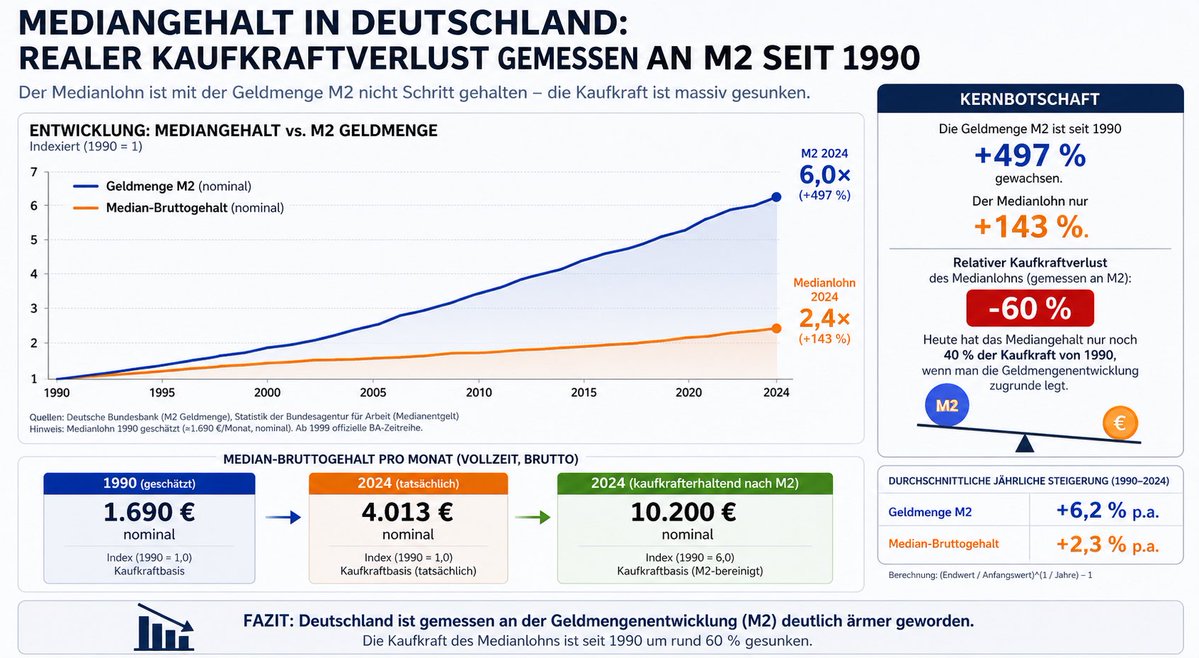
Es ist definitiv viel mehr Geld als die meisten Deutschen heute verdienen, aber Deutschland ist seit 1990 als Ganzes auch 60% ärmer geworden.
In 1990 war man mit 100.000€ noch reich.
Heute nicht mehr.
Um den gleichen Lebensstandard zu halten, den man 1990 mit 100.000€/Jahr hatte, braucht man heute 600.000€/Jahr.
Das liegt daran, dass die Politik seit 1990 die Geldmenge ver-SECHS-facht hat!
In der Folge werden alle Preise im Schnitt um das 6-fache teurer.
Problem dabei: Das neue Geld gibt die Politik (der Staat) nicht dem Bürger, sondern den staatsnahen Institutionen (Cantillon Effekt).
Und während das Kanzleramt renoviert wird, die Politikergehälter jedes Jahr ein fettes Lohnupgrade bekommen und neue Straßen in Timbuktu gebaut werden, freut sich Michel über eine jährliche Lohnerhöhung von 2%.
Die Realität ist aber, dass eine 2,3%ige Lohnerhöhung pro Jahr in einem Umfeld was die Geldmenge pro Jahr um 6,2% erhöht einer 3,9%igen Verarmung pro Jahr gleichkommt.
3,9% ärmer pro Jahr über 35 Jahre macht eine Verarmung von etwa 60% aus.
Und das ist genau die Verarmung, die das deutsche Durchschnittsgehalt über die letzten 35 Jahre erlebt hat.
Das ist genau die Verarmung, die du spürst, obwohl dein Gehalt die letzten Jahre vielleicht gewachsen ist.
Die Geldmenge ist um den Faktor 6 angestiegen, die Löhne aber nur um den Faktor 2,4.
In 1990 war das Mediangehalt in Deutschland bei 20.280€ (Brutto)
Heute ist das Mediangehalt bei 48.156€ (brutto).
Für den gleichen Lebensstandard wie die 20.280€ in 1990 bräuchte man aber heute 122.400€ brutto.
Mit 100.000€ liegt man also unter dem Wohlstandsdurchschnitt im Vergleich zu den 1990ern.
Hinzu kommt noch, dass das netto vom
Brutto in den 1990ern noch etwa 65-70% waren, und heute im Schnitt nur 52% übrig bleiben.
Um den netto Medianschnitt von 1990 zu erreichen müsste man heute also etwa 140.000€ brutto verdienen.
„Und was mit „den Reichen“? Ich dachte die sind schuld?“
„Die Reichen“ sind nicht doof. Die checken diesen Betrug!
Die nehmen sich das neu gedruckte politische Geld sofort als steuerfreien Kredit, kaufen sich davon Immobilien, Aktien oder gründen davon Firmen und schützen sich so vor dem Lohnverfall und dem Fakt, dass Inflation alle Güter teurer macht.
Nein, sie könnten NICHT „einfach die Gehälter erhöhen“. Denn dann verliert ihr Unternehmen gegen Konkurrenten, es geht pleite, und sie müssen Arbeitsplätze abbauen. Dabei verlieren sie ihr eigenes Geld und die Arbeiter ihren Job.
Die Reichen sind nicht schuld daran, dass sie sich vor diesem politischen Diebstahl in Deckung begeben.
Die Wurzel des Übels ist das politische Gelddrucken und ihre Folge: Die Inflation!
Jedesmal, wenn ein Politiker davon spricht, dass er irgendwas finanzieren wird, Schulden aufnimmt, Unterstützungspakete schnürt, dann wisse:
1) der Staat hat kein Geld. Er klaut es von Dir als Steuer oder von deiner Zukunft als Inflation
2) Er treibt damit sehr direkt einen Keil in die Schere von Arm und Reich, denn alle, die nicht mit der Geldmengenerhöhung mithalten können, die werden ärmer.
Und aktuell musst du jedes Jahr 6% Lohnerhöhung erhalten und den Erspartes muss 6% wachsen pro Jahr, damit du nicht ärmer wirst.
Was ist der „Way out“?
1) lerne wie die Reichen wirklich operieren anstatt sie undifferenziert und kindisch zum Schuldigen zu machen. Lerne wie sie sich vor dem staatlichen Betrug in Deckung begeben und adaptiere ihre Strategien.
2) setze dich dafür ein das politische Gelddrucken zu unterbinden! Stelle dich gegen JEDE Form der Steuererhöhung und der Schuldenaufnahme.

Deutsch

ThinKingTwice retweetledi

It’s not that the government just suddenly decides to hand everyone money because things are “rocky.” It shows up when the system can’t keep people earning through normal channels at the same pace anymore.
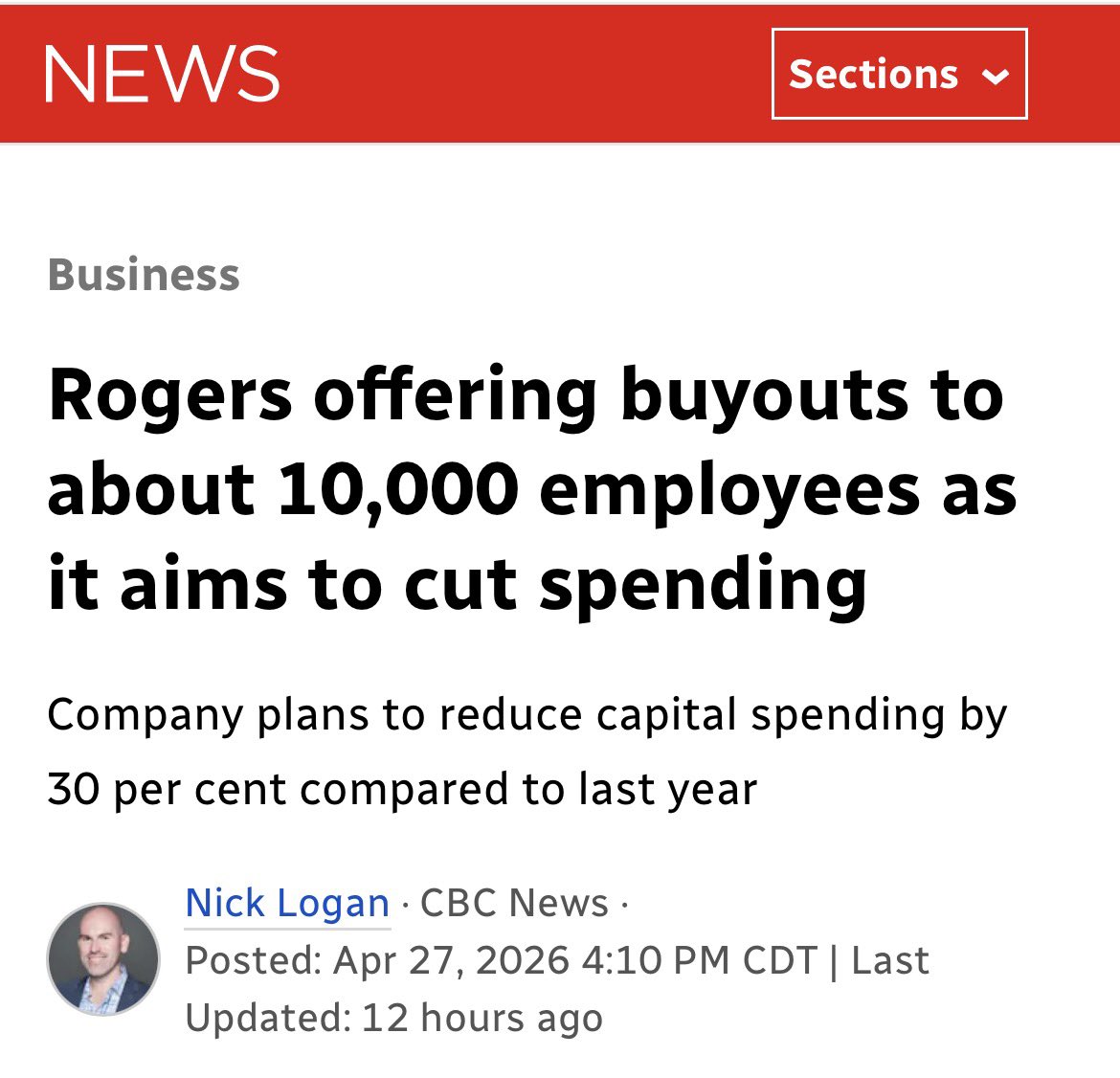
What you’re seeing with Rogers is a small version of that. A large employer tightens, cuts people, and slows hiring. Multiply that across telecom, banking, insurance, tech, retail. You don’t get a collapse all at once, you get a steady reduction in stable income sources.
At the same time, costs don’t fall in the same way. Housing, food, energy, debt servicing all stay sticky or rise. That gap is what creates pressure.
Governments have two choices when that gap widens across enough of the population.
They either let consumption fall, which hits tax revenue, corporate earnings, and asset prices, or they step in and stabilize income at the household level.
Universal basic income, or anything that looks like it, sits in that second path.
In practice, it usually doesn’t start as a clean “everyone gets paid monthly” system. It comes in pieces.
You see targeted payments first. Cost of living rebates, energy credits, housing supplements, tax credits that turn into cash, unemployment extensions. Over time those programs start to overlap and look more like a base layer of income support.
When private sector balance sheets tighten, like Rogers cutting costs, the government is effectively replacing some of that lost income flow. They fund it through deficits, borrowing, or indirectly through central bank liquidity.
That money then cycles back into the system as consumption. People pay rent, buy food, keep services running. That stabilizes the broader economy even while companies are cutting internally.
Now layer in the digital rails.
If payments move toward realtime systems, digital wallets, or tokenized distribution channels, it becomes much easier for governments to deliver money directly and frequently.
Instead of tax refunds once a year or benefits that take weeks, you can push funds instantly, conditionally, and track how they move.
That changes behavior.
Income support becomes more flexible, but also more controlled. It can be adjusted quickly based on policy goals. It can be targeted by region, income level, or even spending category.
Corporate tightening reduces earned income.
Government transfers fill the gap to maintain system stability.
Digital payment infrastructure makes those transfers faster, more direct, and easier to manage.
If this continues, you don’t get a sudden flip into a single universal basic income program. You get a gradual shift where a growing portion of household income comes from state distributed flows instead of employer wages.
That’s the direction this setup naturally pushes toward if the constraints you’re tracking keep tightening.
cbc.ca/news/business/…

UBI Works 🇨🇦@ubi_works
Mark Carney makes the case for basic income ('social supports') to help workers impacted by AI. "New jobs will be created, but old jobs will be lost... What happens to the people in those jobs - are they ready for the new jobs?"
English
ThinKingTwice retweetledi

@Adam_Xrp_ I suspect it's because XRP has been challenging Bitcoin's media dominance for years. Bitcoin investors become so irrational when it comes to XRP
English