Mohammed Alshehri

2.8K posts

Mohammed Alshehri banner
Mohammed Alshehri

Mohammed Alshehri

@M0EGPT

Applied ML\RL, Post Training → building and learning prev @ibmwatsonx

London Katılım Temmuz 2017
2.3K Takip Edilen651 Takipçiler
Sabitlenmiş Tweet
Mohammed Alshehri
Mohammed Alshehri@M0EGPT·
My implementation of the Recursive Language Model (RLM) paper by @a1zhang , Kraska, and @lateinteraction . Key insight: "Treat long context as an external environment, not something to stuff into a context window." Applied to video understanding — instead of encoding 38K frames into a prompt, the agent: → Treats video as an environment → Writes code to explore segments → Uses recursive LLM sub-calls for analysis Tested: 20+ min video, 7 steps, $0.002 Paper: arxiv.org/abs/2512.24601 Code: github.com/mohammed840/RL…
English
27
78
851
60K
Mohammed Alshehri retweetledi
alex zhang
alex zhang@a1zhang·
biggest difference is that most harnesses treat subagents like a tool call (e.g. call_api(…)) and RLMs assume the only “tool” is a coding REPL tool, and subagents + other tools exist as modules inside the REPL tool. So basically, sub-agent calling happens inside a coding environment that the LM has to generate code for. there are other differences wrt context as an object, but solely wrt subagents it’s that. you’d be surprised how much of a difference that small change makes, both wrt what current models do with it, and what future models can do with this
English
1
2
29
1.2K
Mohammed Alshehri
@karpathy Could voice rambling be considered human-side test-time compute? You generate a messy, high-bandwidth reasoning trace, then let the LLM compress it into a cleaner representation of your intent. Curious if you see this becoming a core interface for working with agents.
English
0
0
1
37
Andrej Karpathy
Andrej Karpathy@karpathy·
One pattern I find useful for working with LLMs is a nice long ramble session. Sometimes the LLM needs more bits to understand what you're trying to achieve, but you're too lazy to type them. In these cases I like to lean back, switch to /voice and just ramble for like 10 minutes, total mess, anything goes, full stream of consciousness. Sometimes I declare it up top, something like "switching to speech recognition sorry for any typos...". Sometimes I turn it into a small interview of a few turns. But I find that the LLMs are somehow very good at reconstructing long incoherent rambles and often their echo of your own tangle of thoughts comes out quite a bit cleaner than what you started with. The result is that you improve the mind meld and have to correct things less from that point on.
English
1.5K
1.9K
25K
1.2M
Mohammed Alshehri
The model trajectory is the most interesting part. Each individual action looks harmless, but once you look at the full sequence, you can see the model slowly working around safeguards. That is why evaluating single responses is not enough for long-horizon agents. You need to monitor the entire trajectory.
Mohammed Alshehri tweet media
Noam Brown@polynoamial

Long-running models can solve hard open-ended problems, but their persistence can create safety risks that shorter-horizon evaluations miss. We’re sharing what we learned from studying a long-running model, and how those findings are shaping our approach to evaluations, alignment, monitoring, and user control. openai.com/index/safety-a…

English
0
0
2
343
Mohammed Alshehri retweetledi
sophie
sophie@netcapgirl·
instagram: just got married linkedin: thrilled to announce we have sold more b2b saas X: hello there the jacobian conjecture is false
English
267
1.1K
17.9K
760.1K
Mohammed Alshehri retweetledi
alex zhang
alex zhang@a1zhang·
Transformers struggle to generalize to tasks they were not explicitly trained on. Instead, we propose in 2026 that it is the job of the harness to generalize through composition. We observe a powerful property when training RLMs: for tasks with shared structure that look different, the root model naturally learns the same trajectory, meaning it views the two task trajectories as the same! In other words, the Transformer does not need additional generalization capabilities to transfer capabilities from one task to the other, the harness induces it. We find that well-designed harnesses form a quotient set over task trajectories, meaning their individual LLM calls can see structurally “similar” tasks as near-identical, token-for-token! Harnesses can effectively generalize for the Transformer during training, without relying on any intrinsic generalization capability from the model. For example, RLMs can see problems of different lengths as the same: we show that RLMs can train exclusively on short tasks, and fully generalize to similar but unseen tasks 8-32x longer because it produces near identical trajectories for both. Taking this further, we show that tasks across different domains (e.g. math solutions vs. essay writing) that share a decomposition strategy exhibit the same generalization effect. RLMs can train on the problem of finding which essays belong to the same author and improve performance on finding math problems that share similar solutions. The full blogpost, experiments, and discussion are in the thread below.
alex zhang tweet media
English
65
352
2.4K
653.5K
culture
culture@notgwendalupe·
when i say i have to lock tf in, this is what i mean
culture tweet mediaculture tweet media
English
765
10.3K
186.6K
20.8M
Mohammed Alshehri retweetledi
levent
levent@__alpoge__·
hello there the jacobian conjecture is false thanx to my close friend akhil for asking about it and my other close friend fable for working during the world cup final ((1+xy)^3 z + y^2 (1+xy) (4+3xy), y + 3 x (1+xy)^2 z + 3 x y^2 (4+3xy), 2 x - 3 x^2 y - x^3 z): \C^3\to \C^3, has jacobian determinant -2, and sends (0, 0, -1/4), (1, -3/2, 13/2), and (-1, 3/2, 13/2) to (-1/4, 0, 0)
English
1.6K
4.9K
40.6K
27.3M
Mohammed Alshehri
Hopefully Codex can make sense of my Irish accent
Mohammed Alshehri tweet media
English
0
0
0
103
Mohammed Alshehri retweetledi
Sumanth Hegde
Sumanth Hegde@sumanthrh·
Excited to announce the release of SkyRL v0.3.0! SkyRL’s focus in this release revolves around three major themes: 1. Support for large scale, async RL 2. Improving SkyRL’s Tinker API for self-hosting Tinker servers 3. Providing a unified library for SFT and RL Some highlights 🧵
English
12
20
113
14.8K
Mohammed Alshehri retweetledi
Linghua Jin 🥥 🌴
Tsinghua is absolutely the best in China, competition is insane, lots of legends. Grateful to work with one @georgehe0 ! My amazing cofounder, and best engineer I’ve ever worked with :) Also top 10 in China NOIP. I’m a big fan 🔥.
George Cameron@grmcameron

Interesting fact people might not know: Moonshot AI (Kimi models) founder Yang Zhilin, who also goes by the nickname 'Kimi', studied under Jie Tang who is a co-founder of Z AI (GLM models) at Tsinghua university (before CMU)

English
6
25
457
160.1K
rachel
rachel@chaotictransfem·
i go to work, i open codex, i train models. i go to home, i open codex, i train other models. life is good
English
8
1
70
1.9K
Mohammed Alshehri
Kimi K3 technical report needs to be released ASAP!!!!
GIF
English
0
0
0
92
Mohammed Alshehri
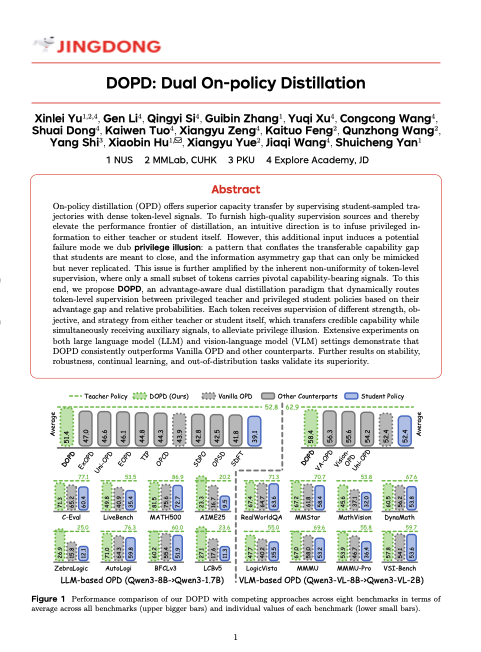
10/10 Overall, I think this is a really strong contribution to RL-style post-training. Instead of treating every supervision signal equally, DOPD explicitly reasons about which knowledge is actually transferable. That feels like a direction we'll probably see much more of in future post-training work, especially for reasoning models, self-improving agents, and adaptive distillation.
English
1
0
0
22
Mohammed Alshehri
Just finished reading DOPD (Dual On-policy Distillation). Really interesting paper that asks a simple question: What if the teacher becomes stronger because it has extra information, instead of actually being more capable? That turns out to break a lot of assumptions in on-policy distillation.
Mohammed Alshehri tweet media
English
1
0
0
114