Omar Khattab

14K posts

Omar Khattab banner
Omar Khattab

Omar Khattab

@lateinteraction

asst professor @MIT CSAIL @nlp_mit. https://t.co/VgyLxl0VZz, https://t.co/ZZaSzaRIOF (@DSPyOSS), GEPA, RLMs, Pedagogical RL

Cambridge, MA Katılım Aralık 2022
3.5K Takip Edilen36.4K Takipçiler
Omar Khattab retweetledi
Maithra Raghu
Maithra Raghu@maithra_raghu·
Excited to be releasing FrontierFinance, the largest and most challenging open benchmark for evaluating AI agents across the full investment workflow! FrontierFinance is substantially harder than current finance benchmarks: Existing benchmarks like FinanceBench and Finance Agent focus almost entirely on data extraction. FrontierFinance spans diverse use cases across the full investment process: Screening & Discovery, Company Research, Sector/Industry/Macro, Earnings & Events, and Coverage & Catalyst Monitoring. Created for ambiguous, long-horizon agents: 220 examples paired with 11,543 expert-crafted rubrics, following Samaya's Criteria Eval methodology. The rubrics are what let us evaluate the reasoning and steps behind a true expert-level output, not just a plausible-looking one. Evaluations: We evaluated Claude Fable 5, Claude Opus 4.8, GPT 5.5, Gemini, open-source models including GLM and DeepSeek, and others. We used the same public rubric and a standard harness for financial tasks. Samaya's AI system reached state-of-the-art accuracy at 50.8%, at 4x lower inference cost than Fable 5. Next best was Fable 5 (49.2%), then Opus 4.8 (45%) and GPT 5.5 (43.5%). We're releasing the benchmark, methodology, and full evaluation results - see link in comments. Future releases: FrontierFinance was curated from Samaya's larger internal set of ~5,000 examples, and we plan to release subsequent, harder benchmarks as well as a more detailed technical report!
Maithra Raghu tweet media
English
28
25
186
71.2K
Omar Khattab
Omar Khattab@lateinteraction·
If you're at ICML, go find Jacob today and tomorrow if you want to discuss his work on interp and Machine Studying!!
Jacob X. Li@jacobli99

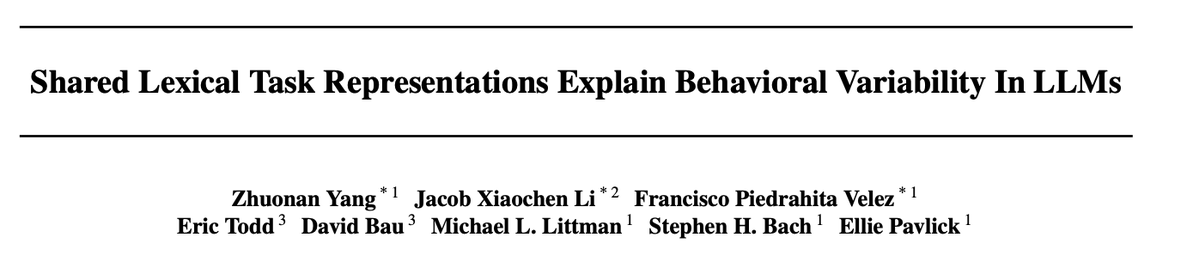
I will share two works at #ICML2026!  Shared Lexical Task Representations Explain Behavioral Variability In LLMs > Thu, Jul 9, 5 – 6:45 PM (Hall A) Machine Studying: A System-Level Reframing of Continual Adaptation from Declarative Corpora > Fri, Jul 10, 3:30 – 5 PM (Hall A)

English
2
5
44
8.2K
Omar Khattab retweetledi
Sumit
Sumit@_reachsumit·
Quantifying and Expanding the Theoretical Capacity of Late-Interaction Retrieval Models @Julian_a42f9a et al. prove MaxSim exactly replicates non-negative inner products and extend it for exact real-valued products, improving negation queries. 📝 arxiv.org/abs/2607.05803
English
0
3
24
2.4K
Omar Khattab retweetledi
Julian Killingback
Julian Killingback@Julian_a42f9a·
Why does MaxSim work so well for retrieval? Late-interaction models like ColBERT often outperform single-vector retrievers, but there is little theory explaining what MaxSim can actually represent.
Julian Killingback tweet media
English
3
11
86
12.1K
Omar Khattab retweetledi
Jacob X. Li
Jacob X. Li@jacobli99·
I will share two works at #ICML2026!  Shared Lexical Task Representations Explain Behavioral Variability In LLMs > Thu, Jul 9, 5 – 6:45 PM (Hall A) Machine Studying: A System-Level Reframing of Continual Adaptation from Declarative Corpora > Fri, Jul 10, 3:30 – 5 PM (Hall A)
English
1
6
37
10.7K
Omar Khattab retweetledi
Jacob X. Li
Jacob X. Li@jacobli99·
Prompt sensitivity remains a basic problem in using and evaluating LLMs. In our ICML paper, we study one mechanism behind this problem, and find features that help explain some model failures.
Jacob X. Li tweet media
English
3
19
86
18.8K
Omar Khattab retweetledi
Samad Syed
Samad Syed@SamadSyed·
I put together my full notes on Machine Studying after spending time trying to really understand the framework, the math, and the bigger implications. This feels like an early subfield, not just a paper. I want to keep studying it, building around it, and hopefully contribute to pushing it forward. Artifacts like StudyBench are just getting started. Huge congrats to @jacobli99 and @lateinteraction for laying out the vision for some of the most promising continual learning work I’ve seen so far. github.com/samadasyed/mac…
English
1
4
18
2.4K
Omar Khattab
Omar Khattab@lateinteraction·
@dbreunig Definitely not Claude-specific at all. I think all current LLMs exhibit this in their argumenation. They display a shocking lack of ability to model the reader rather than only the substance.
English
1
0
28
2.4K
Drew Breunig
Drew Breunig@dbreunig·
I think Claude's (Sonnet, Opus, Fable) weirdest behavior is, when iterating on a document it will constantly include references to prior versions of the document that no one will ever see. Like: “This replaces [X] and better handles the objection…”
English
55
14
1.2K
105.5K
Omar Khattab retweetledi
Ian Channing 🦈@ianchanning@mastodon.social
If your RAG system is no better than just google.com/ai you've wasted a ton of money (my suspicion is that there's quite a few companies who've done this). From the glorious Machine Studying: "But this conflates having access to the corpus with developing deep expertise: you wouldn’t hire any of us as a lawyer just because we can Google the legal literature very intelligently. At minimum, what makes a lawyer a good lawyer is knowing what to look for, where to look, and what to do with a passage after they find it. You could say that reasoning and search are not separable from knowledge (see below). An agent deciding what to grep for or which file to open is acting from its current weights, and those weights may actively conflict with the world encoded in the corpus." -- #2-cant-the-agent-just-search-the-corpus" target="_blank" rel="nofollow noopener">jacobxli.com/blog/2026/mach…
Omar Khattab@lateinteraction

You cannot separate reasoning and knowledge as cleanly as you think. If you'd asked me what I care about in 2020/2021, I'd have said it was “decoupling the capacity that language models have for understanding text from how they store knowledge” (quote from link below this tweet). I was reminded of that on seeing an insightful account I follow say: “The only thing your LLM really needs to know is stuff like vocabulary, logic, and grammar. Everything else is mostly compute waste that we don't yet know how to get rid of.” This perspective, which I carried for years, is definitely more correct than then-mainstream ways of thinking of all-knowing monolithic LLMs as the point we'll converge to. But it's still, well, too naive. I no longer think that knowledge and reasoning can be productively decoupled. Yes, reasoning as symbol manipulation doesn’t need any world knowledge. But solving any real problem starts by knowing how to model it, which symbols to use, and what manipulations are likely to be useful. Knowing what to search for, even or perhaps especially for factual questions, is entirely about having enough context on questions even mean and what topics or sub-questions might be relevant or related. In other words, any productive reasoning needs to be grounded in knowledge—of facts and of analogies, as much as it is of techniques. You cannot decouple reasoning and knowledge as cleanly as you think. Now, systems must obviously be able to use retrieval as well as other tools. But this is not a replacement of intuitively knowing a lot of things and having a good “gut feeling” or vibe-like knowledge about things. The fact that large language models are large is fundamental. Modularity and composition are absolutely key, but they never let you get away with weak components.

English
2
2
10
4.4K
Omar Khattab retweetledi
Michel
Michel@mike_pavlukhin·
One big difference between Fable and Opus is that Fable is really good at writing clean DSPy signatures
English
2
1
15
2.2K
Omar Khattab retweetledi
AGI Summit
AGI Summit@agisummitai·
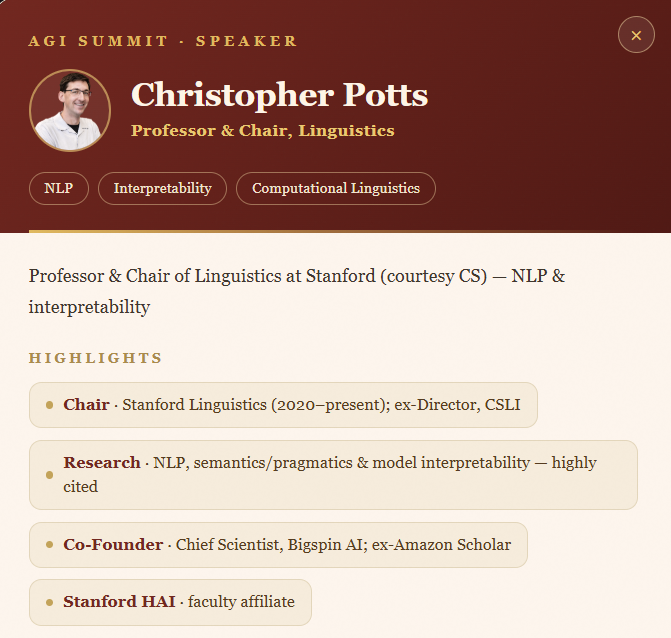
💬 Speaker Spotlight: Christopher Potts Everyone's chasing bigger models. He's focused on how to turn them into reliable systems that actually work. @ChrisGPotts is Chair of Linguistics at @Stanford and a leading force in modern NLP — co-creator of DSPy and ColBERT, tools that shape how the world builds with LLMs. 🔹 Professor & Chair of Linguistics (courtesy CS) at @Stanford · @stanfordnlp & @StanfordAILab 🔹 Co-creator of DSPy & ColBERT — foundational tools for building compound AI systems 🔹 A pioneer of semantics & pragmatics now advancing AI interpretability 🔹 Teaches CS224U · 61,000+ citations · co-founder of Bigspin AI His message: the future isn't a single model — it's well-engineered systems of them. Hear Christopher on stage at AGI Summit SF 2026. 📅 July 18–19, 2026 📍 Palace of Fine Arts, San Francisco 🎟 Tickets: agisummit.ai 🏷️ 15% off with code GenAI-26 #agisummit #aiareall #NLP
AGI Summit tweet media
English
1
4
18
4.2K
Omar Khattab retweetledi
Zijian Chen
Zijian Chen@zijian42chen·
Presenting BrowseComp-Plus at ACL2026, Sunday July 5th, 14:00 - 15:30, Harbor G Oral Session. We are grateful to the many submissions over the past year: helping accelerate agent, search, memory development for Opus 4.5, a significant leap from Opus 4 in agentic ability; the wonderful KARL team at Databricks (cc @mrdrozdov) for enterprise deep research agents; cool multi-agent works from Google; incredible open source efforts like OpenResearcher (@zhuofengli96475, @DongfuJiang); and crazy ideas such as RLM (@a1zhang, @lateinteraction). We greatly appreciate the community for building on BrowseComp-Plus and sharing our vision. Coming from a retrieval perspective, we are equally excited about a less well known, but fundamental task: how should search be designed for agents, that increasingly overtake human searchers? BrowseComp-Plus establishes this task. We are honoured to have retrieval superstars (@bclavie, @antoine_chaffin, and many) aligned with this goal (check them out!), and we think more: search agents, search for search agents, search with search agents. Let's chat!
Zijian Chen tweet media
English
2
10
31
4.6K
Omar Khattab retweetledi
Maxime Rivest 🧙‍♂️🦙🐧
Fable turned my remarkable into Tom Riddle's diary from Harry Potter. My prompts fade, a LLM respond. Magical!
English
471
1.3K
19K
2.1M
Omar Khattab retweetledi
Yoonho Lee
Yoonho Lee@yoonholeee·
Cool application of Meta-Harness to a hard domain, with thorough analysis. It's notable that code changes drove most of the gains (not prompts). This makes me believe even more that harness optimization is especially promising in specialized domains
Joël Niklaus@joelniklaus

New blog post on harness optimization. We hit Sonnet 4.6 performance with a 7x cost improvement. Fable 5 was the first frontier model release that evaluated on legal tasks. It only scored 13%, the worst performance among all benchmarks evaluated. @Harvey released this benchmark called Legal Agent Benchmark (LAB) just a month prior. It contains a set of realistic legal matters. Each task gives the agent a closed workspace of documents (contracts, emails, spreadsheets, slide decks) and asks for a concrete deliverable: a diligence memo, an issue list, a redline, a draft. An LLM judge grades the deliverable against a long rubric containing 61 distinct binary criteria each on average. Many frontier models such as Gemini 3.1 Pro don't surpass 0% all-pass rate (all rubric criteria passed). With automatic harness optimization, we manage to push DeepSeek V4 Pro from 0% to 5% all-pass rate, achieving parity with Sonnet 4.6 for 1/7 of the price. Read the blog post for the details: huggingface.co/spaces/joelnik…

English
4
9
74
12.7K