

Miiiiiii714
1.3K posts

Miiiiiii714
@M714MMM
Blockchain Developer #ETH #BNB
Tokyo Katılım Nisan 2010
98 Takip Edilen43 Takipçiler
I'm getting so many questions about this bot that made me a 10-15 eth profit in a week.
I wrote an article about how I did it here: uni-arbitrage.tech/0x9ea3cda5c2ad…

English
I'm getting so many questions about this bot that made me a 10-15 eth profit in a week.
I wrote an article about how I did it here: uni-arbitrage.tech/0x9ea3cda5c2ad…

English
Check out the channel for my project to learn more t.me/uniswap_mev
English
Miiiiiii714 retweetledi

This was written a long time ago, but these articles are still worth reading to understand front-running attack, #MEV, and the project flashboat :
Escaping the Dark Forest (@samczsun ) samczsun.com/escaping-the-d…
Ethereum is a Dark Forest (@paradigm) paradigm.xyz/2020/08/ethere…
English
Miiiiiii714 retweetledi

#BAPolicySummit panel “The Fourth Amendment, Privacy, and Crypto” will feature @valkenburgh, @amandatums, and Paul D. Clement, the 43rd Solicitor General of the U.S.
Moderator @ammori will dive into the issues outlined here by @valkenburgh (and more)!
x.com/valkenburgh/st…
Peter Van Valkenburgh@valkenburgh
It’s time to have the conversation: Is the Bank Secrecy Act unconstitutional? Beyond the speech and privacy issues, the BSA is a sweeping delegation of law making power. Today we're publishing a new report explaining in detail why that's a problem. 📜Full report is linked in the next tweet, but in a nutshell, the BSA is an incredibly broad law that criminalizes everyday life. As our report explains, breadth rather than ambiguity is the main problem with the statutory text. Take, for example, the money transmission definition: "the problem is not that the definition of 'money transmitter' is uncertain. The problem is that, taken seriously, the definition would convert every paid or paying American into a 'financial institution' and obligate each of us to register with the federal Financial Crimes Enforcement Network (FinCEN) as such, keep extensive records of all transactions, robustly identify all transactional counterparties, and regularly report any suspicious dealings we have had with other Americans or foreign persons. And we must do all of that on penalty of felony conviction, severe fines, and jail time." That's just the plain language interpretation of the relevant provisions. In practice that absurd breadth gets narrowed by regulatory opinion and the courts: "In actual practice no one reads the definition of financial institution as encompassing every paid or paying American. Instead, ambiguity in the definition is invented as a remedy to the statute’s breadth." But this selective narrowing contradicts the plain meaning of the text and also enables endless discretion to choose when to enforce the law and when to not. The result is bad for the predictability of the law and bad for fair and evenhanded enforcement. It raises topical jurisprudential questions involving the major questions doctrine and whether the Court should apply substantive canons of construction like lenity or constitutional avoidance. As judges faced with these issues have said: "Although this court, like all other institutions of the United States, is supportive of the law enforcement goals of the government and society, we cannot engage in unprincipled interpretation of the law, lest we foment lawlessness instead of compliance." By looking through rulemakings and congressional hearings across the last 30 years we come to a startling conclusion: the statute doesn't actually give the Treasury the authority it has used to selectively narrow the definition through interpretation. Instead, and even more problematically from a constitutional separation of powers standpoint, the statute simply delegates a naked power to enforce or not enforce the law to Treasury and does so without any intelligible principle. ⚖️That brings us to the nondelegation doctrine. As Justice Gorsuch has emphasized in recent opinions, Congress not the executive branch is empowered by our constitution to make laws. As we find in the context of the BSA: "Throughout this report we have recounted all the many ways that the Bank Secrecy Act, owing to its incredible breadth, has been interpreted and reinterpreted, expanded and contracted by the courts and by FinCEN. Often these have been good and necessary decisions made to avoid over-application of a dangerously invasive warrantless surveillance regime, to literally prevent our otherwise inevitable drift towards a society where everyone is obligated to spy-on and rat-out everyone else. These are not, however, factual findings. These are not decisions made according to some limiting and sensible criteria set out in the statute. These are policy judgements of serious gravity and they’ve been made by the executive branch with powers unconstitutionally delegated." Are you a big con-law nerd? Read the whole thing, you'll enjoy it. 🤓 Link to follow.
English
Miiiiiii714 retweetledi

Finematics is back with another deep dive! 🚀
💰 What is MEV?
🏗️ Who are searchers and builders?
🤖 What's Flashbots mission?
⚖️ What's the future trajectory of MEV?
Discover this and more in our latest video: "Decoding MEV: Past, Present, Future" ➡️ youtu.be/F9IuBZGseFQ

YouTube

English
Miiiiiii714 retweetledi

PREMIERE
Today's guests are from Flashbots, the silent protector of Ethereum & shield against the centralization that silently infiltrates our cryptosystems & turns them into TradFi 🛡
They believe the biggest centralization threats in crypto lie ahead
Suave is their answer 👇

English
Miiiiiii714 retweetledi

Ethereum has its dark forest of MEV, full of terrifying beasts and bots. I guess Bitcoin mining attracts a different class of monster.
"DALL-E, show me what OFAC compliance feels like"

jack@jack
“she thought it was the ocean…it’s just the pool” ocean.xyz
English
Miiiiiii714 retweetledi

Over $1.5B has been lost due to MEV attacks and most of us are victims!
It's one of Ethereum's biggest enemies and EIP 1559 was specifically created for it.
To stay ahead of the curve, you need to understand its types and prevent yourself from attacks In the bull market
A 🧵

English
Miiiiiii714 retweetledi

Miiiiiii714 retweetledi

New monster post: my own current perspective on the recent debates around techno-optimism, AI risks, and ways to avoid extreme centralization in the 21st century.
vitalik.eth.limo/general/2023/1…
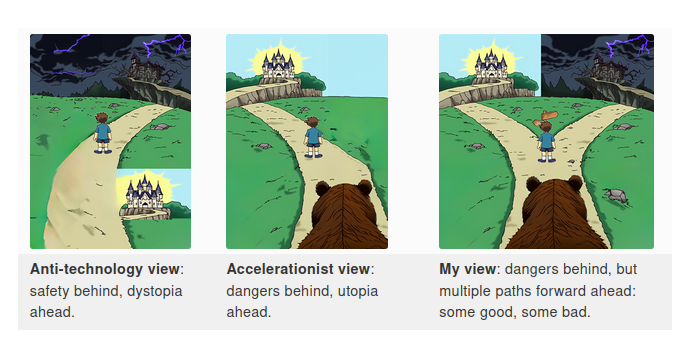
English
Gently you will now be hypnotized omgg
@ex725 @LilCryptoJi @AnhNguy08805737 @gozegir_omer @sarkarsudi @kejupedas_ @DaixiHK009
twitter.com/Faa111faaeth/s…
English
Gently you will now be hypnotized omgg
@bd_chad @HeyMrM @kskmba @yanglil20402561 @NoldSeph02 @kofiahenkora1 @iammayaman_web3
twitter.com/Faa111faaeth/s…
English
Gently you will now be hypnotized omgg
@ChristianHCode @Yogendr68892447 @NestorCondePad1 @DerekStiers4 @sehun_zzm @JonyJigwiggles @OmarOneKenobi1
twitter.com/Faa111faaeth/s…
English
Gently you will now be hypnotized omgg
@aru_sindo @J_Pianos_Crypto @LehmansTerMss @tygodineen @BezakVladimir @btcrenaissance @DupesDidItMusic
twitter.com/Faa111faaeth/s…
English