
Siobhan Fennessy retweetledi

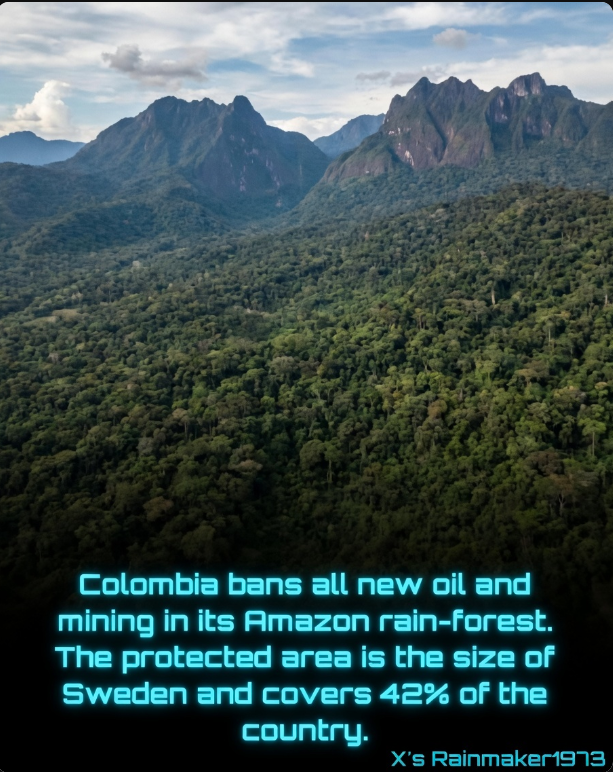
Colombia has become the first Amazonian nation to fully protect its share of the rainforest from future fossil fuel extraction and large-scale industrial mining.
In a landmark environmental decision announced in November 2025 (during COP30), the Colombian government declared its entire Amazon biome a reserve zone for renewable natural resources. This policy explicitly prohibits the approval of any new oil exploration, hydrocarbon production, or large-scale mining projects across the region.
The protected area spans approximately 483,000 square kilometers (about 186,000 square miles)—roughly the size of Sweden—and encompasses 42% of Colombia's continental territory, while representing around 7% of the total Amazon rainforest basin.
By implementing this ban, Colombia halts progress on dozens of pending concessions, including 43 oil blocks and 286 mining requests that had not yet begun operations. The move prioritizes long-term ecosystem preservation, biodiversity protection, and the rainforest's critical role in global carbon sequestration and climate regulation over short-term resource exploitation.
Environmental groups and advocates have praised the policy as a historic conservation milestone, safeguarding irreplaceable habitats, indigenous territories, and vital ecological services amid the escalating climate crisis. Acting Environment Minister Irene Vélez Torres described it as a pioneering step, urging other Amazonian countries to follow suit through initiatives like the proposed Alianza Amazónica por la Vida (Amazon Alliance for Life).
This bold action sets a powerful precedent for balancing economic development with planetary health, demonstrating that nations can lead in protecting shared global heritage like the Amazon.
English