Marcin J. Suskiewicz

1.3K posts

Marcin J. Suskiewicz banner
Marcin J. Suskiewicz

Marcin J. Suskiewicz

@MSuskiewicz

Structural biologist and biochemist. CNRS researcher at CBM Orléans. Interested in protein modifications & interactions. Also husband, dad of 3, friend, ☧.

Orléans, France Katılım Ağustos 2020
4.1K Takip Edilen1.2K Takipçiler
Sabitlenmiş Tweet
Marcin J. Suskiewicz
Marcin J. Suskiewicz@MSuskiewicz·
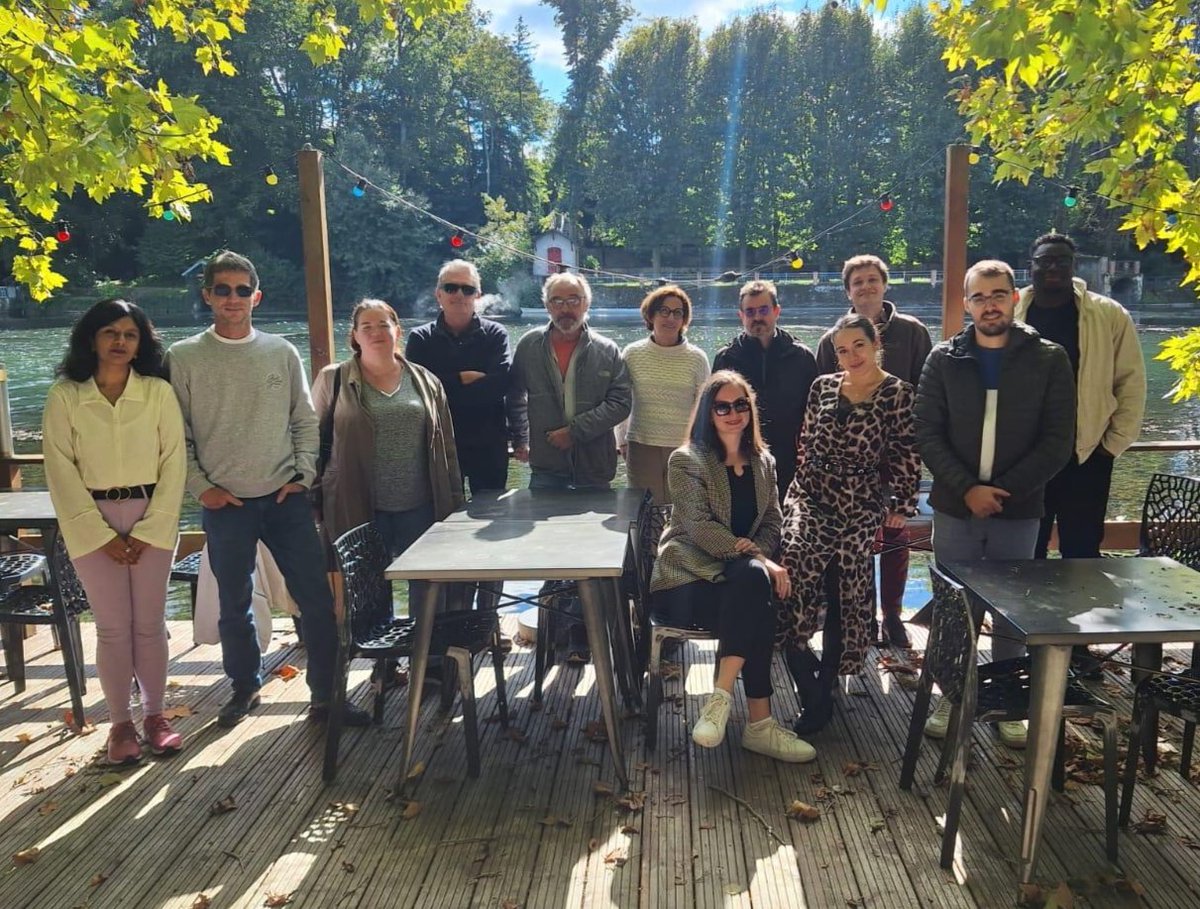
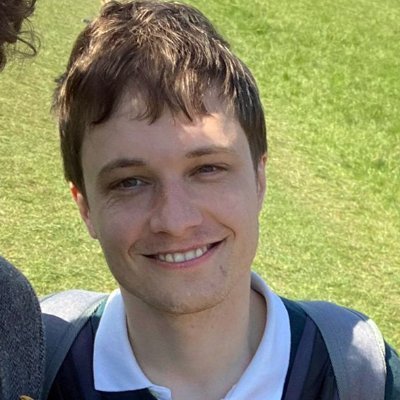
A new group photo on the banks of Loiret ☀️
Marcin J. Suskiewicz tweet media
English
1
1
21
1.9K
David Bessis
David Bessis@davidbessis·
If you want to clarify your thoughts on a complex topic, nothing beats teaching and public speaking. This conversation in February forced to me articulate my ideas on math and AI—most of the substance for my "theorem economy" piece crystallized as I was mentally preparing for it.
David Bessis@davidbessis

"Mathematics in the age of AI"—a one-hour conversation I had earlier this year, for an audience of machine-learning graduate students at Université Paris-Saclay. [In French] youtube.com/watch?v=_dTbfL…

English
3
6
94
5.8K
David Bessis
David Bessis@davidbessis·
Thank you, everyone, for the incredible feedback on "the fall of the theorem economy"! The subject is of course bigger than just AI and math—it's about the future of human cognition. A few remarks that didn't make it to the published version:⤵️
David Bessis tweet media
English
17
76
562
84.8K
Eirik
Eirik@Eirikvi·
Philosophy evening about enchantment
Eirik tweet mediaEirik tweet mediaEirik tweet media
English
3
2
37
1.5K
Marcin J. Suskiewicz
Marcin J. Suskiewicz@MSuskiewicz·
@johnmilbank3 This seems to align with some of the wiser insights of the entrepreneurial culture - perceiving risk as opportunity etc. (however limited these insights might be overall).
English
0
0
0
70
john milbank
john milbank@johnmilbank3·
We often best solve the problems in our lives by seeing that the problems are in fact advantages. In a way we need less ethical anxiety and more trusting in providence.
English
1
1
22
1.3K
Marcin J. Suskiewicz
Marcin J. Suskiewicz@MSuskiewicz·
@Ananyo @cg_geometry @spectator The tech industry's constant appropriation of credit that is at least largely due to the source human data/artwork etc. - and not, or at least not just (definitely not mostly), to the extraction method needs to be counteracted.
English
0
0
2
19
Marcin J. Suskiewicz
Marcin J. Suskiewicz@MSuskiewicz·
@Ananyo @cg_geometry @spectator That's true, and a very good point. But perhaps it's still worth always stressing that the apparent 'successes' of AI are mostly about the potential of accumulated human knowledge to yield further insights (that can be extracted with computational tools).
English
1
0
2
21
Ananyo Bhattacharya
Ananyo Bhattacharya@Ananyo·
I wrote about what the recent remarkable advances in AI for mathematics means for the subject--and for every creative human endeavour. "If mathematics can be hollowed out in this way, then every creative field is vulnerable." @spectator
Ananyo Bhattacharya tweet media
English
10
14
64
10.4K
Лъчезар Томов
Лъчезар Томов@Lptomov82·
@martinmbauer You are missing one great advantage of AI, that we see from chess and go games - it can make moves, or connect ideas we couldn't because it has no prejudices, it can explore the solution space better than us. We limit our thinking by clinging on prejudices.
English
1
0
2
1.1K
Martin Bauer
Martin Bauer@martinmbauer·
Yes, this is a significant result and a solid research paper. And it would’ve been much harder to achieve without GPT. While I understand the instinct, I think it is more interesting to evaluate what type of contribution the AI has made as opposed to focussing on how relevant the result is. ChatGPT generalised a previously derived result for an amplitude that was assumed to vanish for all physical kinematics people care about. These amplitudes are very complicated, lengthy expressions with certain structures and symmetries that are sometimes hidden and difficult to see. This kind of problem is exactly where AI shines! AI is better at detecting breast cancer than a clinician because it has seen millions of scans and detects structures where humans -which are limited by their lifetime exposure- can't. AI that systematically surveys many large amplitudes has a similar advantage Similar to the Erdős problems, it was mostly really an attention bottleneck that left this problem unsolved. This calculation was considered another elaborate way of arriving at zero. So few people were interested in the result and even fewer were working on it. Most if not all physicists would therefore consider the insight of the human physicists that there is in fact a kinematic region where these amplitudes are not zero the most meaningful piece of progress here Both these points aren't to diminish the result. It is seriously impressive and deserves the publicity. It shows where the strengths of modern models can significantly accelerate science and I'm convinced there will be even more relevant discoveries in the future.
Noam Brown@polynoamial

There have been fair questions on whether LLM contributions to STEM are overhyped, but I've spoken with physicists about this result and they've told me it is a truly significant research contribution, roughly at the level of a solid journal paper, and GPT-5.2 played a key role.

English
13
41
442
38.2K
Marcin J. Suskiewicz retweetledi
Joel Fish
Joel Fish@joelwatsonfish·
This thread highlights what I fear will be the degradation of human knowledge due to AI. If I were being charitable, I would say that here Gemini is playing a hybrid role of textbook and tutor, where your tutor has a photographic memory and world class speed reading abilities, but might not be smart enough to get that PhD. So sure, access to that type of tutor is infinitely better than reading baby Rudin in a vacuum. But there is no way AI here is replacing Rudin. Unfortunately though, to a lot of people, it gives the illusion of being better while actually being worse. And thus people will think they are learning more when they are actually learning less.
alz@alz_zyd_

Math textbooks are written in a pointlessly obtuse way. Gemini does an incomparably better job. My professional opinion is that all undergrads learning real analysis should give up reading baby Rudin, and simply learn analysis from Gemini instead

English
11
8
79
11.5K
Marcin J. Suskiewicz
Marcin J. Suskiewicz@MSuskiewicz·
@nasqret @sama I think they mainly got involved to weaponise the outcome in service of their business (which, by the way, relies on numerous questionable practices, as enthusiasts keep forgetting).
English
0
0
1
1.9K
Bartosz Naskręcki
Bartosz Naskręcki@nasqret·
I am very glad you got engaged deep into this experiment. Mathematical community needs strong signal from the AI labs that science is a serious engagement for you. Mathematics in its full proof-driven form is a pinnacle of human ingenuity and knowing how well the models can grasp this challenge is fundamental for the progress.
English
4
4
126
73.9K
Sam Altman
Sam Altman@sama·
We went from AI systems that struggled to do grade school math to AI systems that can solve research-level math problems in just a few years. I agree with Jakub this is perhaps the most important eval now. I am also pretty sure the main reaction will be "it's not that hard" :)
Jakub Pachocki@merettm

Very excited about the "First Proof" challenge. I believe novel frontier research is perhaps the most important way to evaluate capabilities of the next generation of AI models. We have run our internal model with limited human supervision on the ten proposed problems. The problems require expertise in their respective domains and are not easy to verify; based on feedback from experts, we believe at least six solutions (2, 4, 5, 6, 9, 10) have a high chance of being correct, and some further ones look promising. We will only publish the solution attempts after midnight (PT), per the authors' guidance - the sha256 hash of the PDF is d74f090af16fc8a19debf4c1fec11c0975be7d612bd5ae43c24ca939cd272b1a . This was a side-sprint executed in a week mostly by querying one of the models we're currently training; as such, the methodology we employed leaves a lot to be desired. We didn't provide proof ideas or mathematical suggestions to the model during this evaluation; for some solutions, we asked the model to expand upon some proofs, per expert feedback. We also manually facilitated a back-and-forth between this model and ChatGPT for verification, formatting and style. For some problems, we present the best of a few attempts according to human judgement. We are looking forward to more controlled evaluations in the next round! 1stproof.org #1stProof

English
1.3K
326
5.1K
1.1M
Marcin J. Suskiewicz
Marcin J. Suskiewicz@MSuskiewicz·
@SebastienBubeck How to square this enthusiasm with the ethical and legal practices of this particular company and the whole industry, e.g. in terms of (not) paying for the data used for training?
English
0
0
0
575
Sebastien Bubeck
Sebastien Bubeck@SebastienBubeck·
Well I guess we better deliver now 😅 But srly as I have said before, OAI is just the PERFECT research environment. Ambitious (in particular, non-incremental) research is in the DNA of this place. If that sounds more fun than your current frontier lab, consider joining us!
Sam Altman@sama

.@SebastienBubeck is so so good; incredible researcher and leader.

English
40
20
664
155.5K
Marcin J. Suskiewicz
Marcin J. Suskiewicz@MSuskiewicz·
@IvanAhelLab I'd also like to highlight a recent publication by Bernheim and Porier groups et al showing FAM118B, which they call "SIRal", is essential for innate immunity in cellular models; they also have great phylogenetic analysis and insights into biochemistry. science.org/doi/10.1126/sc…
English
0
0
0
101
Marcin J. Suskiewicz
Marcin J. Suskiewicz@MSuskiewicz·
@IvanAhelLab FAM118s have long interested Ivan (my postdoc PI), who, like in many other cases, had a good intuition about their importance. They have been a difficult biochemical target, though. We brought in the observation that they form filaments, an insight explored collaboratively here.
English
1
0
0
107
Marcin J. Suskiewicz
Marcin J. Suskiewicz@MSuskiewicz·
Very happy to share our collaborative project with Ahel and Huet labs et al on FAM118 proteins - noncanonical sirtuins that form filaments and process NAD in human and other vertebrate cells. nature.com/articles/s4159…
English
1
0
2
155
Eirik
Eirik@Eirikvi·
Things will only get stranger
Eirik tweet media
English
1
2
82
2.4K