MWB74

390 posts

MWB74

MWB74

@MWB741

Katılım Kasım 2018
218 Takip Edilen100 Takipçiler
MWB74
MWB74@MWB741·
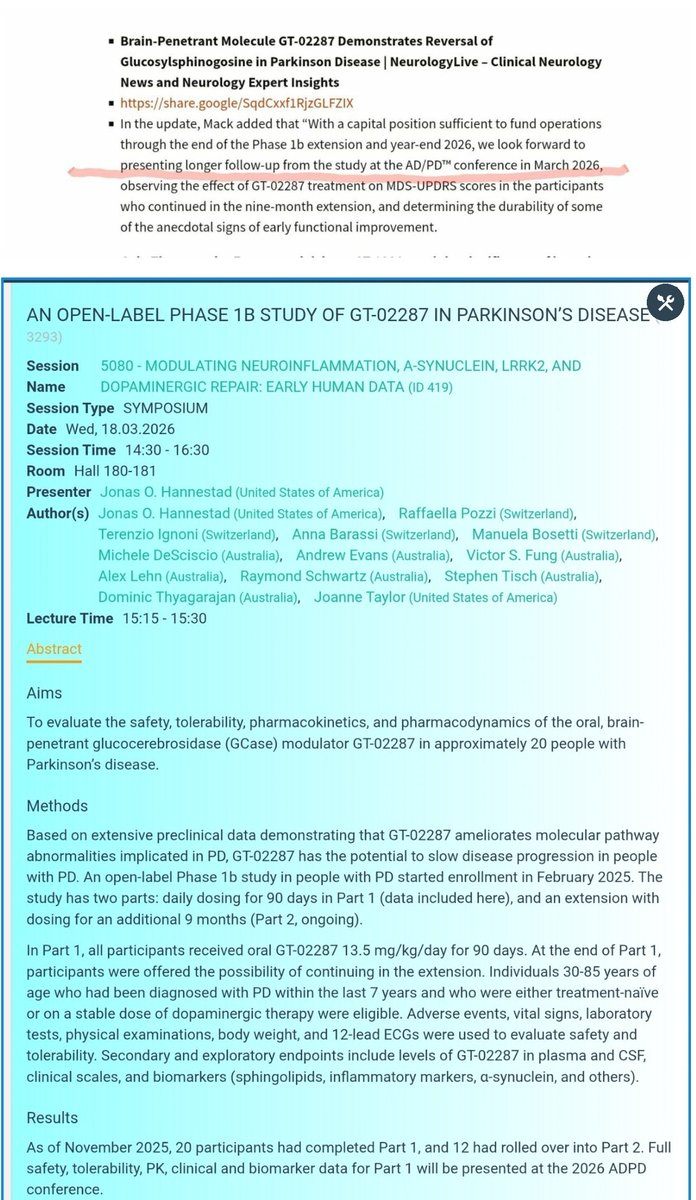
“The data from our Phase 1b study furthers our hypothesis that GT-02287 is among the first disease-modifying therapies promising to shift the treatment paradigm in PD from symptom relief to halting or slowing symptom progression, targeting the causative biology (or pathophysiology) of PD to enable a more durable and predictable treatment effect for those living with PD.” From today's press release. There are no therapies for Parkinson's that are disease-modifying, and companies are very careful about using "disease-modifying" in their press-releases, especially in the context of the above statement by the CEO. The data fully justifies this statement IMO, and if anything, they are still being conservative with their wording.
English
0
0
0
27
MWB74 retweetledi
TENET RESEARCH
TENET RESEARCH@tenet_research·
$GANX - Gain Therapeutics Announces Presentations at AD/PDTM 2026 and Provides U.S. FDA Regulatory Update
English
1
1
2
793
MWB74
MWB74@MWB741·
This was a small, short-duration study-- only 90 days-- and it was not powered for statistical endpoints. The subgroup wasn't random. GluSph was pre-specified and the main focus since it (1) reflects target engagement and (2) is known to drive a-syn aggregation, lysosomal and mitochondrial dysfunction, and ER stress. That they were able to show statistical significance in only 90 days in this (large) sub-goup is pretty amazing. In yesterday's Oppenheimer event, the CEO also mentioned that they'll be revealing another biomarker reduction that correlates with this same group, DOPA decarboxylase, which would mean some level of normalization of the dopaminergic circuitry. More strong evidence of disease-modification.
English
0
0
0
45
vms
vms@vms455·
@MWB741 So if a subgroup analysis of UPDRS found statistical significance, company must have done the same with overall sample and probably found no statistical significance. "Study not powered" logic should also transfer to the subgroup statistical significance.
English
1
0
0
63
MWB74
MWB74@MWB741·
$GANX Update on Gain Therapeutics First, a short summary on what Gain Therapeutics is trying to do in aiming for “disease-modification”… most Parkinson’s treatments help manage symptoms like tremor or stiffness, but they do not slow the disease itself. A disease-modifying therapy is different. It aims to slow, stop, or even partially reverse the underlying disease process, not just mask symptoms. Today, there are no approved disease-modifying treatments for Parkinson’s disease. Gain Therapeutics ($GANX) believes its drug candidate GT-02287 is showing early signs of disease modification — which, if confirmed in larger studies, would represent a major breakthrough not only for Parkinson’s, but potentially for related diseases such as Lewy body dementia, Gaucher disease, and possibly Alzheimer’s disease. February Corporate Update: Gain released an updated corporate deck recently (link in comments), and there are two Phase 1b findings that greatly change the risk profile going into Phase 2: GluSph reduction (upstream biological signal) About one-third (maybe more) of patients entered the Phase 1b with elevated CSF glucosylsphingosine (GluSph), a toxic lipid linked to dysfunction in Parkinson’s (and Gaucher’s disease). In this subgroup, 100% of patients saw GluSph reduced toward normal, with an average ~81% reduction after 90 days on GT-02287. Statistically significant functional improvement That same GluSph-elevated subgroup also showed a statistically significant improvement in combined MDS-UPDRS Parts II + III, with a mean improvement of 6.17 points (p < 0.05). This was actual improvement, not just “less worsening,” and it occurred over ~90 days — which is unusual for programs aiming at disease modification in PD. The “statistical significance” means that within that GluSph-elevated subgroup, the probability that the observed UPDRS clinical improvements occurred by chance alone is less than 5% (p < 0.05). In other words, If GT-02287 had no real effect in that GluSph-elevated group, the probability of observing an improvement this large (or larger) purely by chance is less than 5%. This reduction in GluSph and link to clinical improvements has never been seen before in Parkinson’s patients. If 30% is representative of the number of Parkinson’s patients who have elevated levels of GluSph, this is a giant number. Importantly, it also does not mean (1) that patients who do not have elevated levels will not develop elevated levels in the future, and (2) that GT-02287 would not be beneficial to individuals who do not have elevated GluSph levels. This (very large) sub-population simply looks like low-hanging fruit. For phase 2, this matters because: • It links mechanism to biomarkers to function in humans, not just animals • It identifies a defined responder population, which allows for clear phase 2 planning and setting it up for success • It reduces reliance on noisy, purely clinical endpoints by anchoring outcomes to GluSph • It lowers the chance of a “clean safety but messy efficacy” Phase 2 readout This is what big pharma teams look for when assessing whether early PD signals are real or just statistical noise. The company is explicitly framing this as “translation” from animal models to clinical success in humans. Upstream correction of cellular dysfunction with a strong correlation to functional benefits. CEO Gene Mack succinctly summarized what they are seeing with GT-02287 in a BioSpace interview a few weeks back: “Rather than simply trying to boost enzyme activity in the lysosome, GT-02287 stabilizes GCase folding and trafficking throughout the cell, restoring function across multiple compartments, including those critical to mitochondrial health. That matters because Parkinson’s can be seen as a disease of cellular stress, impaired waste clearance, and energy failure.” 16 out of 19 of the patients who completed the initial 90 days elected to continue into the extension study, despite the further testing and lumber puncture. If they weren’t experiencing benefits, it is unlikely they’d choose to continue. Data from the extension will show whether improvements continue over time. They should already have the 180 day blood and UPDRS data, and judging from the CEO’s statement above, the data continues to support disease-modification. Despite the recent surge, the share price is considerably lower than it was in mid-December pre-data release. Most people will look at this and assume that something must have been wrong. But the market gets misprices companies all the time, especially in small biotechs. To me, this is a great opportunity to buy what might turn out to be the first and most important disease-modifying drug in neurodegenerative disease history. @LouBasenese @PhilipEtienne @RealAvidTrader @BiotechStockRsr @odibro @yaireinhorn @thebiotechforum @BiopharmIQ @BPharmCatalyst @SupNovaTrading @StocksPursuit @Microcapreturns @dixielee1969 @fundmyfund @makedatbread88 @SheffStation @bwsm12702 @TopStockAlerts1
English
1
3
19
1.9K
pennyether
pennyether@penny_ether·
A lot of moving parts, and they consistently over promise and under deliver. Delays to ASICs are absolutely brutal, because the NPV of an ASIC is (all things equal) heavily front-loaded. So you tape out / design something... and until you mass produce or mine with it, the value of that tech exponentially decays. I don't believe the CEO's intentions are to maximize shareholder value. I want them to succeed, but it's difficult to park money there with all the execution risk.
English
1
0
1
65
pennyether
pennyether@penny_ether·
Up ~12% YTD, port blowing past ATH. Fading NFP data. AI adoption on a hockey stick, will slow hiring, will cause deflation, and it will be obvious. Inflation dead, and later this year we have tariff YoY roll-offs (baseline effect) to look forward to. "New" Fed will be fwd looking: Economy is hot, pour gas. On Mining/AI front.. hashrate has rebounded, and if BTC doesn't rally, hashprice likely to settle in lower $30's -- continuing to break all time lows. Very tough conditions. Seasonally, I expect hashrate to recover further into April, pushing hashprice even lower (all else constant). Which means: any miners still primarily relying on mining cashflow (and having been punished by such) present a very good opportunity to buy now if you feel they will pull off significant HPC. I think $CLSK may present favorable risk/reward here.. though until a deal solidifies it'll be high beta to BTC (not necessarily a bad thing, and can be hedged out). I think long $CLSK short ~1.5x $IBIT would work well into year end, though I didn't drill into what the perfect ratio would be. AI efficiency breakthroughs present a risk to the short-term AI infra stocks. I think right now enterprise adoption is limited by time, and not availability... they won't yet adopt faster just because it is cheaper. The heart of the bell curve adopts on a lag for a variety of reasons: a) larger groups take longer to make decisions. b) limitation of "how to adopt AI" knowledge workers -- this lags the actual tech by significant time. c) larger orgs have boomer mgmt that are afraid of change -- they wait for results of peers first. So, if another deepseek moment comes out that makes AI more efficient per KWH, that's not good for infrastructure narrative in the short term. As with last April, I would welcome such news as a buying opportunity. On a longer timescale, it wouldn't matter. Cheaper AI just means more of it.. and engineers will use it in "brute force" for all matter of implementations until GW capacity is filled. Cannot be bullish enough on how AI unlocks "generalized computing" that was unthinkable 5 years ago. Literally tell technology in words what you want implemented and it does a decent enough job at it. What ClawBot does for your PC, agents will increasingly do for entire enterprise workflows. Just needs non-idiots to adopt, and increasingly will become idiot-proof. If I were a software company, I'd build API's that add "agents" into the workflow explicitly. Eg, "agent user" triggered changes should be "softer", easier to audit, and only fully actualized by human interaction. End result: "hey, here is a built to be used by AI agents, but ultimately you're in charge" Enough rambling for now.. hope everyone is enjoying the ride.
pennyether@penny_ether

Macro Update - Amusing to me that market is selling the baby with the bathwater. A decline in BTC price doesn't change the core assets these tickers hold, nor does it affect execution risk. A decline in software margins doesn't matter, either.. quite the contrary: in order for AI to be as disruptive as feared, there needs to be a lot of it, running, in the real physical world. I wouldn't say this is "deepseek" level of discount yet, but I'm starting to rebuild more in names like $WULF, $CIFR, $IREN, and more speculatively $BITF and $CORZ. ------- In case you've been wondering what I've been into otherwise, I've diversified immensely. Biggest bet is ZQ futures. I think 2026 will set in stone that AI is on a hockey stick trajectory of enterprise adoption. It won't do that without either increasing productivity (deflationary) or pausing/diminishing job growth. Just have to sit and wait for the data to roll in.. like it did today. I believe it's only going to accelerate. I think we get one more cut with Powell. I think Warsh will shift Fed to be more forward looking: This year, Fed will acknowledge AI more fully, both in the sense it is a risk for jobs, as well as deflationary by virtue of increasing productivity. In other words, cut rates to throw fuel on a virtuous fire, and "protect the working class". Then there's the Trump angle. He wants lower rates, is a pain in the ass, and wouldn't have nominated Warsh unless he thought Warsh could do it. Granted, Trump admin execution seems to often be shitty, but I think this one is among the more calculated decisions. On the political side -- with AI providing so much space for innovation and growth, it's almost a national security concern to stimulate investment into its rapid adoption. Why not be more productive than the rest of the world? Or why not make a buck exporting those productivity gains? ZQ also seems to provide a decent hedge to market downturns. It's not quite a "fed put" mentality, but it's close. Assuming inflation is under control, one has to assume that any economic slowdown or market meltdown will be met with cuts. I think what has tamed ZQ is fear of "asset bubble" and "inflation" and those concerns are going to rapidly diminish. If not.. I'm still holding some gold and have responsible exposure to high beta. Assuming rates get cut.. I'm seeking companies with solid cashflow and yields. Lower rates = lower yields = higher stock price. Even better if the stocks have been eating shit because the market wants to YOLO into momentum instead of something boring the world cannot live without. So I've been participating in, among other things, the little rally in staples. ------- Anyway... I spend less time focusing on BTC and AI/HPC, because that's a 18m+ story. Buildout, app development, adoption.. all a very slow process. Despite the bumpiness of charts, fundamentals don't change much day to day. The potential of AI, and how that ties into the physical world and larger economy, doesn't move day to day or week to week. I think a "cleanse" in the YOLO/spec market is healthy. $MARA and $MSTR both eating shit as they should've long ago. Too bad I could only marginally make money from these. It's impossible to time when people come to their senses, and until they do, those tickers just capture dumb money and ratchet SP in a way you cannot hedge against. Haven't been following the $MSTR cult for awhile, but I do wonder what all the overconfident, pompous assholes saying: "durr you don't understand MSTR enough" and "we will have BTC on mars" went. $MSTR actually a sad story. Had so much time to pitch a deployment of capital to something other than bitcoin, giving shareholders something else to latch onto... but instead quadrupled down on "I'm going to buy BTC no matter what, even if it doesn't increase BTC/sh, and even if it means increasing BTC/sh in the future is nearly impossible." It was a mathematical certainty that mNAV would have to hit 1.0x -- with the only assumption that buyers become rational. Market seems to have come to their senses. $MARA is sad. Didn't get their deal approved. Fred selling every month like clockwork. Pretty much the last remaining pureplay miner, but doesn't show monthly ops, hashrate, etc. Solidly operating at a loss. I don't even know what's up with the CTO story. Slowly crawling towards several massive convertible note reckonings. Maybe I missed it.. but what are the "edge computing" AI plans that will make them money? That being said, there is a price where it makes sense to buy. I just don't care. More generally: I will not buy any ticker unless I believe in management and execution. Period. At little market panics like this, there are plenty of options, and no need to settle. ----- Long story short: I'd rather place big bets on where the puck is going, and focus my time and attention -- the most precious things in my possession -- on a variety of other things. Hope everyone is doing well.

English
7
1
55
7.7K
MWB74 retweetledi
joe iniowa
joe iniowa@Microcapreturns·
Gain Therapeutics $GANX GT-02287 showing efficacy after only 90 days in phase 1b.
drug hunter@drughunter_com

Drugging GCase: The Challenges With Targeting A Multi-Compartment Enzyme | drughunters.com/3OeJgqD GCase (encoded by GBA1) is a pivotal genetic risk factor in Parkinson’s and Gaucher’s diseases, where folding/trafficking defects disrupt lysosomal lipid metabolism and drive aggregation. In this review we will highlight: -What made drugging this target so challenging? -How active-site pharmacological chaperones showed promise in rescuing misfolded enzymes but faltered due to lysosomal inhibition -The next generation of CNS-penetrant allosteric activators, including pariceract (BIA 28-6156), GT-02287, and VQ-101 that are currently in clinical trials to test if non-inhibitory modulation can deliver on the promise of the GCase mechanism Read it on Drug Hunter: drughunters.com/3OeJgqD

English
0
2
5
608
ThriveSnap
ThriveSnap@ThriveSnap·
@moninvestor Wonder if anyone actually bought the stock when it hit $29
English
6
0
11
2.8K
mon
mon@moninvestor·
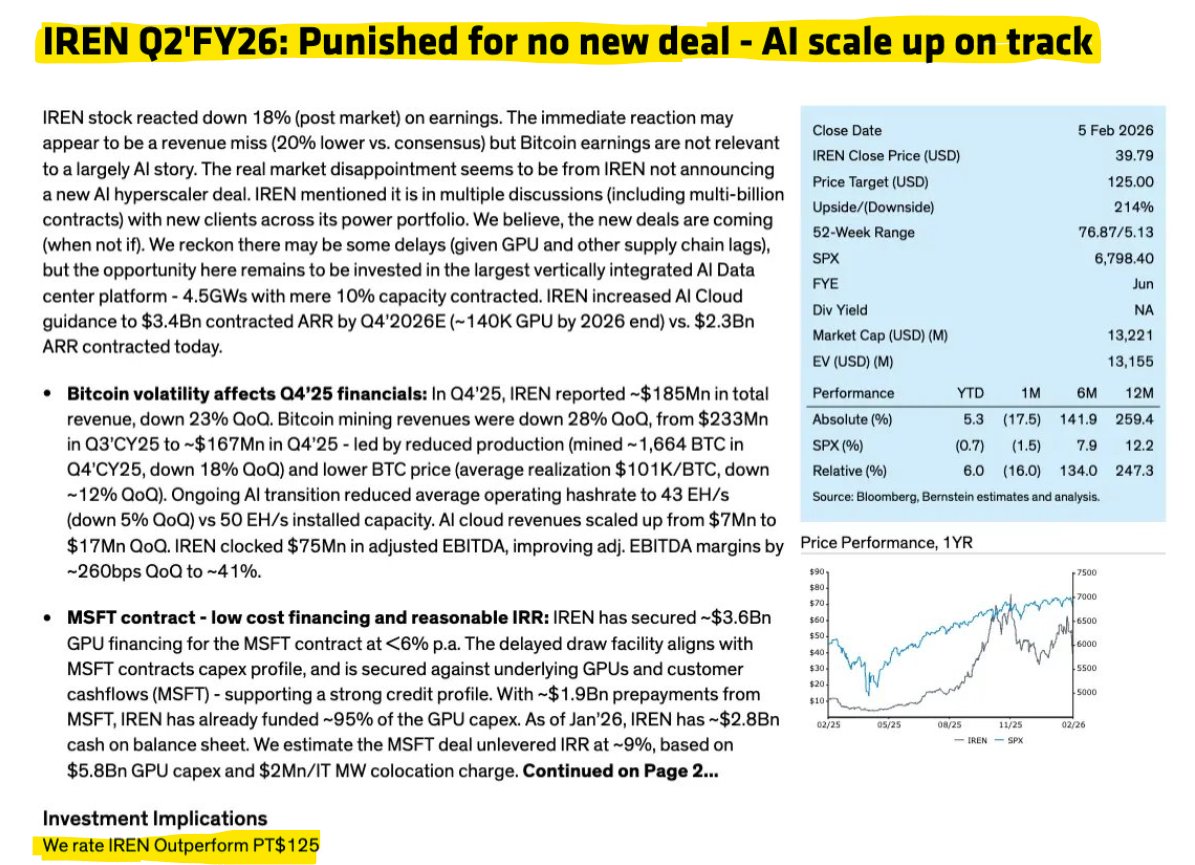
$IREN Bernstein analyst: “Punished for no new deal. AI scale-up on track.” The stock recovered from -25% after hours to -2% pre-market. Bernstein released a research report and reiterated its $125 price target.
mon tweet media
English
31
116
1.1K
101K
MWB74
MWB74@MWB741·
News spreads slowly through the scientific community. Just look at the one paper that is included in the post where they question whether Gcase and GluSph are even relevant in non-GBA cases. Gain and GT-02287 already answered that question: yes, very relevant. The world just hasn't found out yet. But when it starts spreading, it will be exponential. And I think the share price will begin to reflect reality.
English
0
0
3
119
MWB74 retweetledi
joe iniowa
joe iniowa@Microcapreturns·
$GANX Gain Therapeutics At some point people are going to figure out exactly how valuable their ability to not only stop Parkinson's but reverse it. reddit.com/r/pennystocks/…
English
2
2
6
793
MWB74 retweetledi
joe iniowa
joe iniowa@Microcapreturns·
$GANX Gain Therapeutics. Busy last week including being part of panel with M.J. Fox Foundation. Return of smell, gait and balance in patients. Data getting out. Gain Therapeutics(GANX):  KOL Reports : GT-02287 Shows Signs of Disease Modification gaintherapeutics.wordpress.com/2026/01/14/gai…
English
0
1
6
486
MWB74 retweetledi
joe iniowa
joe iniowa@Microcapreturns·
$GANX Gain Therapeutics. Gauchers connection brings in companies like Sanofi and Pfizer into the mix. The GluSph biomarker is recognized by FDA for Gaucher trials. reddit.com/r/pennystocks/…
English
0
2
5
587
MWB74
MWB74@MWB741·
What Gaucher’s disease can teach us about Parkinson’s in light of GT-02287 reducing GluSph by 75-95% $GANX Warning: skip if you don't like long posts One thing that really helps put the recent GT-02287 GluSph data in context is looking at it through the lens of Gaucher’s disease. In Gaucher’s, GluSph is the biomarker. It isn’t just associated with the disease, it is a toxic lipid that is a driver of cellular stress, and a proxy readout for lysosomal failure. It is the best predictor of both disease severity and response to therapy. Over time, we learned that if GluSph stays high, the disease stays active. And when effective therapies came along, the most reliable sign that they were truly disease-modifying was the sustained reductions in GluSph. There currently are no disease modifying therapies for Parkinson’s like there are for Gaucher’s, partly because Gaucher’s doesn’t require therapies to cross the blood-brain-barrier (BBB). Gain Therapeutic’s GT-02287 is oral allosteric enzyme modulator that crosses the BBB. GluSph doesn’t spontaneously normalize. It only comes down when lysosomal function is genuinely restored, and this only happens with the current disease-modifying (and life-saving) therapies that are now available. When therapy stops, GluSph rises again and disease activity returns. That’s why Gaucher experts view GluSph as a direct readout of whether the cell’s waste-handling mechanisms are actually working again, and why experts in neurodegenerative biomedicine are starting to take notice: reddit.com/r/StockMarketI… . Clinicians trust GluSph trends more than the actual clinical symptoms in some cases. That’s what makes the Gain Therapeutic’s GT-02287 result so remarkable. Seeing a 75–95% reduction in CSF GluSph within 90 days, in every patient who was elevated at baseline, is a huge signal. From a Gaucher perspective, that kind of magnitude and speed is what you see when a therapy is correcting the underlying biology. Gaucher’s and Parkinson’s both share impaired Gcase function, lysosomal lipid stress, and toxic sphingolipid accumulation (i.e., GlusSph). In Parkinson’s, GluSph promotes ER stress, impairs autophagy (cellular recycling), and spurs a-Syn aggregation. So experts who know Gaucher’s, when the see the GluSph reduction results, are thinking that this is an indication that the system is being functionally repaired. It’s also worth pointing out that the most successful Gaucher’s treatments work by restoring GCase function and lowering GluSph, conceptually very similar to what GT-02287 is doing. But these therapies don’t cross the blood-brain barrier. That’s why they’re life-changing for Gaucher’s, which is usually a body-disease, but don’t work for Parkinson’s, which is a brain-disease. GT-02287 is different because it does reach the CNS, and the preclinical data strongly supports that it does more than just clean up lysosomal lipid stress. By stabilizing GCase earlier in the folding in the ER, it helps deliver functional GCase not only to the lysosome, but as per pre-clinical models, also to other compartments like the mitochondria (which the Gaucher therapies do not do). That matters, because mitochondrial dysfunction and impaired mitophagy are key parts of the Parkinson’s doom loop.  GluSph reduction is likely the first visible signal of the biology being corrected, but the other signals should follow as per pre-clinical models which so far have proven to be very relevant for actual Parkinson’s cases. It can’t be overstated that, in Gaucher’s, reducing GluSph translates to a life-saving therapy. Successful Gaucher’s therapies were first developed in the 1990’s. Prior to the therapies, people with Gaucher’s became severely disabled, and often died much younger. When the therapies were being developed, they didn’t really even know the importance of GluSph, and it often wasn’t measured. In Parkinson’s, it was not really understood until relatively recently the lysosomal dysfunction is a key initiator and/or driver of the disease in idiopathic cases. Around 2000, the science community started targeting a-syn aggregation as the main upstream driver of Parkinson’s. But they were wrong— this a downstream effect of lysosomal dysfunction. So most of the efforts to combat Parkinson’s were focused on reduction of a-syn aggregation (which alone has failed to be disease-modifying), and dopamine/symptomatic approaches (not disease-modifying). Fast-forward to the resent results with GT-02287 on GluSph. I think it will become clear that this giant reduction of this upstream source of cellular stress, which also correlates to lysosomal recovery, is a landmark event for Parkinson’s even though the news is slow to spread. That’s why people who know lysosomal biology will be paying attention to this result if they haven’t started already. This GluSph reduction is a class of signal that, in another disease, turned out to be the difference between symptomatic treatment and life-saving, disease-modification. Last thing from an investment perspective… there are about 6000 people with Gaucher’s in the United States, while there are about 1 million (and growing) with Parkinson’s, and about 100 thousand of those have the same GBA1 gene mutation as those with Gaucher’s. Worldwide, the market for Gaucher therapies is ~$2 billion per year, and almost all of this is for the above-mentioned therapies that correct lysosomal dysfunction and reduce GluSph (and some of these therapies target Gcase, as does GT-02287). A first disease-modifying for Parkinson’s is estimated to bring in $100 to $200 billion per year if it effective for a good number of idiopathic cases. Applying a sales multiple, that drug could be worth ~$1 TRILLION. Obviously not implying that GT-02287 is worth $1 trillion. But there’s a lot of room between those two numbers for a treatment which appears to have the best shot of becoming the first disease-modifying drug for Parkinson’s. I wrote a recent post about why I think GT-02287 is easily at the top of the list of promising disease-modifying treatments being developed: reddit.com/r/pennystocks/…. What do you think one of the large pharmas who are currently interested in GT-02287 will pay to have a good shot at what could be the first trillion-dollar drug? Somewhere in the $1 billion to $10 billion range suddenly starts looking like a very small number when compared to $1 trillion. $1-$10 billion represents a ~6X to 60X from current market cap. As more time passes, and as more data continues to confirm what the pre-clinical models suggested, the more GT-02287 becomes de-risked, and the higher the price tag. The KOL event on Tuesday will provide more clarity: lifescievents.com/event/sw9cp0z/ @LouBasenese @PhilipEtienne @RealAvidTrader @BiotechStockRsr @odibro @yaireinhorn @thebiotechforum @BiopharmIQ @BPharmCatalyst @SupNovaTrading @StocksPursuit @Microcapreturns @dixielee1969 @fundmyfund @makedatbread88 @SheffStation @bwsm12702 @TopStockAlerts1
English
0
3
11
1.4K