Megan wa Mukuria

3.3K posts

Megan wa Mukuria banner
Megan wa Mukuria

Megan wa Mukuria

@MWMukuria

Founder of @Niayanguke & @ZA_Foundation. Doing the impossible every day & loving it. At the intersection of #socent #innovation #mhm #rights. #liveyourpurpose

Nairobi, Kenya Katılım Mart 2014
1.1K Takip Edilen1.1K Takipçiler
Megan wa Mukuria retweetledi
wanjiru
wanjiru@Wanjiru2027·
They looked at 76 acres of indigenous forest ,trees older than this republic, home to lions, rhinos & 13 endangered species,and said “hii itakuwa parking.” Kenya earns billions selling the world a wildlife dream. But we are destroying that wilderness for a convention centre parking lot.
wanjiru tweet media
English
42
449
652
28.1K
Megan wa Mukuria retweetledi
Sunny Bindra
Sunny Bindra@sunnysunwords·
“We may have democracy or we may have wealth concentrated in the hands of a few, but we cannot have both.” Louis D. Brandeis
English
0
3
5
1K
Megan wa Mukuria retweetledi
Chris Murphy 🟧
Chris Murphy 🟧@ChrisMurphyCT·
Trump is suspending sanctions on Iran and Russia, which will put over $15 billion in their treasuries to help them fund the wars against us. It’s stunning. We have never ever seen this level of war incompetence in American history.
English
1.6K
9.9K
30.9K
1M
Megan wa Mukuria retweetledi
Brian Allen
Brian Allen@allenanalysis·
🚨 Epstein’s accountant just testified under oath: The Epstein estate settled with Jane Doe 4 — for both Epstein and Trump. Jane Doe 4 alleged to the FBI that Epstein abused her at 13. And that Trump abused her at 15. The Jane Doe 4 files were missing. Discovered only through the Maxwell discovery when lawyers noticed Bates stamp numbers were gone. Those files surfaced after Trump bombed Iran. The lawyer tried to walk back the settlement testimony. The accountant refused to confirm or deny. Trump started a war the same week the Epstein names were supposed to drop. Never stop connecting the dots.
English
327
7.3K
19.3K
452K
Megan wa Mukuria retweetledi
Bernie Sanders
Bernie Sanders@BernieSanders·
72,000 killed in the genocide in Gaza. 1 million+ displaced in Lebanon. 1,700 settler attacks in the West Bank. And now war in Iran. Sending 20,000+ more bombs to Netanyahu isn’t just immoral—it’s illegal. That’s why I introduced legislation to stop it.
English
5.8K
20.1K
67.5K
1.6M
Megan wa Mukuria retweetledi
Charlie Sykes
Charlie Sykes@SykesCharlie·
Making old tweets great again.
Charlie Sykes tweet media
English
383
18.5K
82.9K
1.6M
Megan wa Mukuria retweetledi
CALL TO ACTIVISM
CALL TO ACTIVISM@CalltoActivism·
🚨HELL YES!!! JB Pritzker just dropped the mic and is calling for Project 2029. A blueprint to UNDO TRUMP. His plan would: -PROSECUTE Trump crooks who broke laws, abused power, and attacked our democracy. - Promote justice, reestablish our relationships, and rights that WORK for ALL. IT’S ABOUT DAMN TIME. No more chaos. No more impunity. No more letting fascists run wild. Democrats are DONE playing nice. LFG.
English
1.6K
7K
24.8K
477.3K
Megan wa Mukuria retweetledi
Elizabeth Warren
Elizabeth Warren@SenWarren·
Pay attention to Lebanon. Trump and Netanyahu started a regional war in the Middle East, creating a humanitarian disaster. And now, the Israeli army has killed over 1,000 people in Lebanon—about 20% of them are kids. Congress should not bankroll this escalating war of choice.
English
5K
12K
46.6K
1.6M
Megan wa Mukuria retweetledi
Shanaka Anslem Perera ⚡
Shanaka Anslem Perera ⚡@shanaka86·
The war in the Strait of Hormuz will reach your local pharmacy within six weeks. Not because your pharmacist follows geopolitics. Because the active pharmaceutical ingredients in roughly half of America’s generic prescriptions begin as petrochemical derivatives manufactured in India, and India’s petrochemical industry begins as crude oil that transited 21 miles of water that closed on March 4. Nearly 70 percent of the active ingredients in US generic drugs are produced in India. India imports approximately 40 percent of its crude oil through the Strait of Hormuz. The crude feeds refineries that produce naphtha. The naphtha feeds petrochemical crackers that produce intermediates. The intermediates feed pharmaceutical plants in Gujarat, Maharashtra, and Hyderabad that produce the API, the active pharmaceutical ingredient, that is shipped to contract manufacturers in the United States, Europe, and across Asia. The chain from the strait to the tablet is six steps long. Every step requires the one before it. CNBC reported that the Hormuz closure puts America’s generic drug supply at risk. Fierce Pharma warned of longer-term effects on US manufacturing and generics. Think Global Health mapped the pharmaceutical supply chains most vulnerable to disruption. The consensus across trade publications, health policy analysts, and industry executives is identical: four to six weeks of current inventory exists in the pipeline. After that, shortages begin with the most complex formulations first. Cancer drugs are the highest risk. Biologics requiring cold-chain storage have the shortest shelf life and the longest replenishment cycle. Clinical trial medications depend on uninterrupted supply chains that are now interrupted. Insulin analogues, antivirals, and cardiac medications all contain intermediates sourced from Indian manufacturers whose input costs are rising with every day the strait remains closed. Air cargo is the emergency bypass. But air freight rates from India have climbed 200 to 350 percent on some routes since the war began, according to logistics tracking firms. Gulf air capacity is down 79 percent because airports in the UAE, Kuwait, and Qatar have been damaged or operate under restricted conditions. The Suez Canal route adds 10 to 14 days to maritime shipping times. The Cape of Good Hope route adds 21 to 28 days. Both alternatives assume the Red Sea remains navigable, which the Houthi threat has complicated since 2024. The World Health Organisation reported a 70 percent funding gap for its operational response in the region. Medical supply chains to Iran itself have been devastated, with hospitals reporting shortages of surgical supplies, blood products, and anaesthetics. But the downstream pharmaceutical effect extends far beyond the war zone. Every Indian manufacturer that pays more for crude pays more for naphtha, pays more for intermediates, and passes the cost forward into API prices that American generic drug companies absorb until they cannot absorb any further. The molecule does not know it is a medicine. The strait does not know it is a pharmacy. The petrochemical derivative that becomes a blood pressure tablet transits the same water as the petrochemical derivative that becomes a fertiliser pellet. Both are trapped. Both have shelf lives. Both have planting windows or prescription refill cycles that do not negotiate with blockades. Six weeks. Then the pharmacy starts calling patients about substitutions. open.substack.com/pub/shanakaans…
Shanaka Anslem Perera ⚡ tweet media
Shanaka Anslem Perera ⚡@shanaka86

Your paracetamol is made from oil. The phenol comes from a cumene process that starts with naphtha. The naphtha comes from a refinery. The refinery’s feedstock transits the Strait of Hormuz. Ninety-nine percent of pharmaceutical feedstocks, solvents, reagents, and packaging are petrochemical-derived. The American Gas Association confirmed it. The medicine cabinet is the sixth layer of the Hormuz crisis and nobody is talking about it. The war started with uranium. It moved to oil. Then fertiliser. Then water. Then plastic. Now medicine. Paracetamol is 100 percent petrochemical. Phenol from cumene, converted to para-aminophenol, then acetylated. Ibuprofen is 100 percent petrochemical. Isobutylbenzene plus propionic acid derivatives. Metformin, the most prescribed diabetes drug on Earth, is 80 to 90 percent petrochemical. Dicyandiamide from natural gas derivatives. Antibiotics like amoxicillin and ciprofloxacin require methanol, acetone, and dichloromethane as solvents for extraction and crystallisation. Oncology drugs need cold-chain energy and plastic packaging. Every blister pack, every pill bottle, every syringe is PE, PP, or PET from Gulf naphtha. India makes 40 to 47 percent of American generic medicines by volume. It imports $4.35 billion in active pharmaceutical ingredients annually, 74 percent from China. But the critical precursors, the methanol and ethylene glycol that feed Indian API synthesis, are 87.7 percent and roughly 100 percent Hormuz-dependent respectively. The Indian government has prioritised household LPG over industrial petrochemical feedstock, starving the downstream pharmaceutical chain. API costs have surged 30 percent in the last two weeks. The typical buffer is two to three months of inventory. The war is nineteen days old. The clock started before the buffer was designed for this scenario. A diabetic in Ohio takes metformin every morning. The dicyandiamide that becomes the active ingredient traces back through a Chinese intermediate to a natural gas derivative that originated in the Gulf. The methanol used to crystallise the compound in a Hyderabad factory was shipped from a terminal that now sits behind the same strait controlled by provincial commanders with sealed orders. The blister pack was moulded from polyethylene derived from naphtha that loaded at a facility the IRGC published satellite targeting images of yesterday. One pill. Four petrochemical dependencies. One chokepoint. The farmer in Iowa cannot plant corn because nitrogen costs $610. The diabetic in Ohio may not be able to fill a prescription because methanol costs whatever the strait permits. Both crises trace to the same 21 miles of water. Both are governed by the same sealed packets. Both operate on biological clocks that do not negotiate with doctrine. Nitrogen decides whether the food grows. Methanol decides whether the medicine is synthesised. Polyethylene decides whether it reaches the shelf in a blister pack. Energy decides whether the cold chain holds for oncology and biologics. Every molecule in the pharmaceutical supply chain is now compromised by the same chokepoint that trapped the fertiliser, the gas, the plastic, and the water. Europe said Iran is not their war. Their existing drug shortages, 400 to 1,500 medicines depending on the country, will deepen regardless. Bangladesh, Egypt, and sub-Saharan Africa depend on Indian generics for infectious disease and maternal health. The API depletion clock runs for everyone. The strait does not distinguish between a urea molecule and a methanol molecule. Both are gated. Both are biological. And both determine whether human beings survive the next quarter. Full analysis - open.substack.com/pub/shanakaans…

English
120
2.8K
4.8K
599.8K
Megan wa Mukuria retweetledi
Charles Onyango-Obbo
Charles Onyango-Obbo@cobbo3·
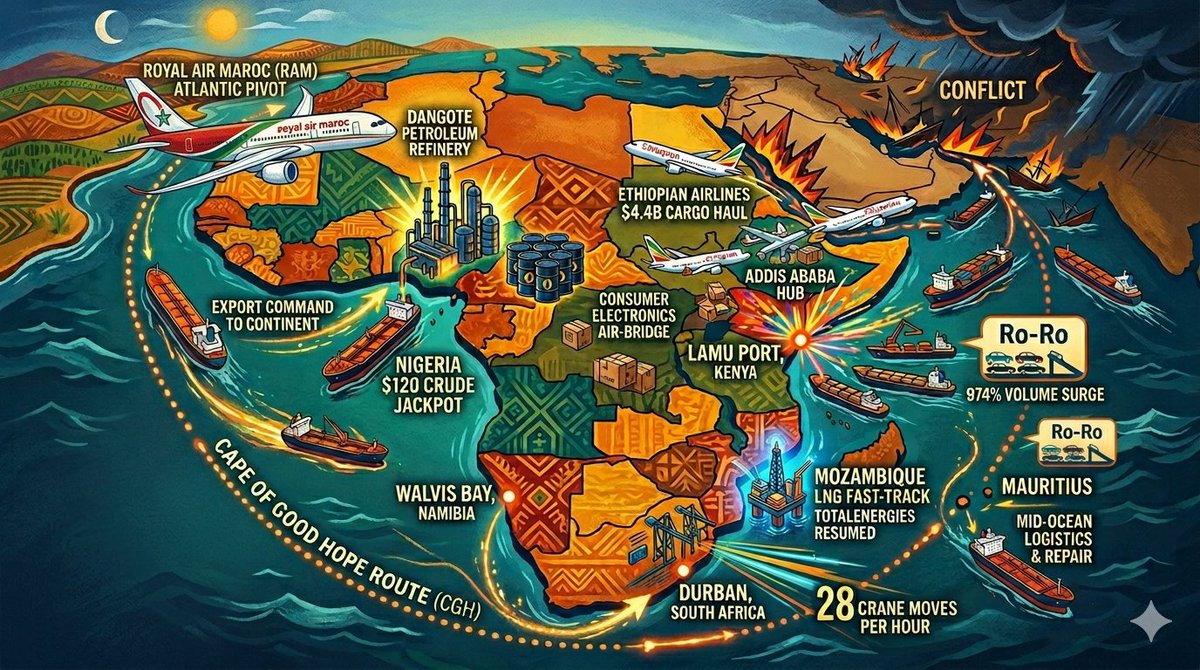
Kenya, Ethiopia, Nigeria Early African Winners as They Harvest Windfall from the Misery of US–Israel vs Iran War As the world reels from the escalation of the US–Israel vs Iran war that erupted on 28 February, the humanitarian suffering is profound. Yet in the realm of global commerce, a quieter upheaval is underway. With the Red Sea and Strait of Hormuz rendered near impassable – shipping traffic down by 90% – Africa has emerged as the world’s most vital logistics corridor. •In KENYA, the once-forgotten LAMU PORT has roared to life. Long dismissed by critics as a white elephant, it has seen a 974% surge in volume. Ultra-large vessels, too deep for Mombasa and too exposed for Gulf waters, now dock at Lamu’s 18-metre natural depth. •ETHIOPIA'S national carrier Ethiopian Airlines has seized the moment. With Dubai and Doha mostly paralysed by airspace risks from Iranian missile and droke strikes, Addis Ababa has become the continent’s primary air-bridge. Cargo revenue is up 14%. High-value goods – electronics, pharmaceuticals, perishables –are now routed through Bole International, bypassing the 40-day sea detour. •NIGERIA is counting its crude. Brent prices hit $120 per barrel in March. Against a budget benchmark of $64.85, daily revenues have doubled. The government has stumbled into an unexpected multi-billion dollar fiscal cushion. •DURBAN, South Africa’s main port, has shed its reputation for congestion. It is now clocking 28 crane moves per hour, processing thousands of ships rerouted around the Cape of Good Hope with a rare level of precision. •MOROCCO'S Royal Air Maroc has moved swiftly. Ten new international routes –including Los Angeles and Beirut – have siphoned off transit passengers who once relied on Middle Eastern hubs. Casablanca traffic is up 12%. •WALVIS BAY in Namibia has become the first reliable refuelling station for ships emerging from the South Atlantic. Bunkering demand is up 30%. •The DANGOTE Petroleum Refinery has in Nigeria, is cashing in. In March, it issued an export tender for 84,000 metric tonnes of jet fuel and diesel. It is no longer just a domestic project – it is replacing Persian Gulf supplies for the continent. •MOZAMBIQUE'S $20 billion LNG project has been fast-tracked. TotalEnergies resumed operations in early 2026. Over 4,000 workers are racing to meet an accelerated production date. Iranian gas is out. Mozambican gas is in. •At Mozambique's PORT of MAPUTO, volumes grew by 16% in the weeks following the war’s outbreak. Chrome and coal exporters have abandoned northern routes in favour of the safer Indian Ocean–Cape corridor. •MAURITIUS, ever shrewd, has leveraged its mid-ocean position into a 15% revenue increase. High-end logistics and emergency repair services are now its bread and butter. But no doubt, the most intriguing twist is the Roll-on/Roll-off (RoRo) revolution in Lamu. Manufacturers are using RoRo ships – where vehicles are driven on and off via ramps – to offload thousands of cars. These are then ferried to the Gulf on small, low-risk boats to avoid the $200,000+ war risk insurance premiums slapped on large carriers entering the Strait of Hormuz. To protect this windfall, Kenya and Ethiopia have launched joint military operations along the once-languishing Lamu Port–South Sudan–Ethiopia Transport (LAPSSET) corridor. This unprecedented coordination is designed to ensure that the new “safe harbour” of Lamu remains shielded from regional spillover. And because the closure of the Strait of Hormuz marooned shipping containers, an emergency air-bridge has formed. Nairobi and Addis Ababa are now the primary transit points for consumer electronics flown from Asia to Europe—bypassing the the 17,700KM sea detour. US leader Donald Trump despises Africa, once labelling its countries "sh*thole", but while many of them will be hit hard by rising energy and fertilisers from America and Israel's attack on Iran, several of them will get a bounty he would never have wished for them.
Charles Onyango-Obbo tweet media
English
58
652
1.1K
149.4K
Megan wa Mukuria retweetledi
The Kenyan Vigilante
The Kenyan Vigilante@KenyanSays·
Miringa, a Kenyan boy creating a ‘People’s IEBC’ to prevent any form of rigging, has come up with a way for Kenyans to beat the government at its own game if it tries to switch off the internet!
English
259
4K
8.5K
188.3K
Megan wa Mukuria
Megan wa Mukuria@MWMukuria·
Anyone know why traffic is at a standstill on James Gichuru from Lavington up to ABC?
English
0
0
0
25
Megan wa Mukuria retweetledi
Ben Crump
Ben Crump@AttorneyCrump·
Black kidney patients were blocked or delayed from transplants by a race-based medical formula that made their kidneys appear healthier, delaying life-saving care. Now research shows thousands are receiving restored wait-list time through restorative justice efforts, with a median increase of 1.7 years, meaning many patients regained more than a year and a half of lost waiting time. We must keep speaking truth to power until health care equity is real! apnews.com/article/kidney…
English
29
1.5K
3.1K
46.4K
Megan wa Mukuria retweetledi
Africa Uncensored
Africa Uncensored@AfUncensored·
With healthcare devolved under Kenya’s 2010 Constitution, many expected counties to deliver better facilities and improved services closer to the people. At the same time, the government’s push for Universal Health Care (UHC) promises that all Kenyans should access quality health services without suffering financial hardship. But in Embu County, that promise remains painfully distant for many residents. We have testimonies of mothers allegedly giving birth outside hospital gates and on verandas, stripped of their dignity. Families say they have watched loved ones die in cars in the middle of the night while medics were on strike. Others describe powerless hospitals, literally, where facilities operate without electricity or backup generators. #LockedOut, produced by Martin Mukundi, looks into the state of healthcare in Embu County. Catch the premiere this Sunday, 15th March, on Africa Uncensored’s YouTube channel.
English
2
29
36
3.6K
Megan wa Mukuria retweetledi
sarah
sarah@sahouraxo·
American Professor Jeffrey Sachs: “Israel’s doctrine of war is kill them in mass numbers, kill the civilians, kill the women, kill the children. It’s doing the same in Lebanon now, and it’s carpet-bombing Tehran in Iran. The world needs to stand up and stop accepting this as something even remotely normal or acceptable. This is mass murder with US complicity.”
English
392
11.2K
22K
330.6K