

IMansouri
428 posts

IMansouri
@Mansouri_Issam
I fear not the man who has practiced 10,000 kicks once, but I fear the man who has practiced one kick 10,000 times. Bruce Lee It goes same for trading !!!
Agadir Ida Ou Tanan, Souss - M Katılım Şubat 2012
780 Takip Edilen139 Takipçiler

Get these 18 Claude Cowork Workflows for the Entire eBook Business (44 pages).
I might charge for this in the future, but for now...
Reply "Claude" and I’ll DM it to you for free (must follow)

English

I should charge $199 for this.
But I’m giving away my full N8N Automation Mastery Guide completely free.
Inside you get:
→ 50+ ready-to-run automation workflows
→ Step-by-step mini-course to master n8n
→ Advanced AI + n8n prompts & agent setups no one shares
n8n is the future of AI automation.
This guide gives you an unfair advantage — build systems that work while you sleep.
Like + comment “n8n” and I’ll send it to you.

English
IMansouri retweetledi


IMansouri retweetledi

Claude controlling tradingview live — switching symbols, writing Pine Script, batch scanning futures, replay trading, drawing levels. All from the terminal.
Still rough edges but the vision is clear.
You only need Claude + laptop + 1 hour/day.
Giving This Free for 24 hours. To get it:
1. Comment the word 'CLAUDE'
2. Like and Retweet this post
3. Follow me @jihad_sameul (so i can DM you)
English

Anthropic released an update for Claude, and one young guy turned $1,400 into $238,000 in 11 days
He is not a trader. Not a developer. Just a student with a laptop and access to Claude.
When Anthropic updated the skills architecture for Claude, he didn’t sleep for two nights, read the documentation, and built a bot from scratch.
Result:
$1,430 → $238,006 in 11 days
366 trades.
Win rate 62%.
The biggest win $52,700 on a single bet.
How it works:
The bot scans Polymarket every few seconds looking for markets where the price deviates from the fair value by more than 8%.
That’s the edge.
Most people don’t see it the bot always does.
The strategy is painfully simple
- The market says 30¢ for an event
- The real probability based on data is 55¢
- The bot enters. Waits. Exits at the peak.
This isn’t luck. It’s attention arbitrage.
The biggest trade was a bet that Trump would sign a crypto executive order in March. The market priced it at 28¢.
The bot placed $16,000.
Exited at 81¢.
In 11 days he went through a journey most traders don’t go through in years.
Now his wallet is public, and with the help of this terminal you will be able to copy his trades in time:
Here : t.me/PolyGunSniperB…
People ask him:
“How much starting capital do you need?”
He replied:
“I had $1,400 and a sleepless night.”
Anthropic gave the tool.
He simply wasn’t afraid to use it.
You only need PolyGun + 1 hour/day.
Giving This Free for 24 hours. To get it:
1. Comment the word 'PolyGun'
2. Like and Retweet this post
3. Follow me @marryevan999 (so i can DM you)
English
IMansouri retweetledi

Here is how to actually build a skill the right way:
Step 1: Build your workflow by hand with the agent
Step 2: Turn it into a skill
Step 3: Use it. It will mess up.
Step 4: Identify the error. Feed it back.
Step 5: Fix it together in the same conversation
Step 6: updates the skill.
The iteration is where the magic happens.
This is how you build a skill that actually holds up.
GREG ISENBERG@gregisenberg
this video is the CLEAREST explanation of how claude skills + AI agents work and how to use them most people set up an AI agent and wonder why it keeps disappointing them. the context window is everything context is what the model assembles before it takes any action. think of it like everything the agent needs to read before it does anything. the quality of what goes in determines the quality of what comes out. the models are genuinely really good right now. claude and gpt are exceptional. the variable is almost always the context you give them. 1. agent.md files are mostly unnecessary every single line you put in an agent.md file gets added to every single conversation you have with your agent. a 1000 line file is around 7000 tokens burning on every run. the model already knows to use react. it can read your codebase. save the agent.md for proprietary information specific to your company that the model genuinely cannot know on its own. 2. skills are the actual unlock a skill.md file works differently. what loads into context is only the name and description, around 50 tokens. the full instructions only appear when the agent recognizes it needs that skill. so instead of 7000 tokens on every run you have 50. and the agent stays sharp because the context window stays lean. the closer you get to filling the context window the worse the agent performs, same way you perform worse when someone dumps 10 things on you at once. 3. here is how to actually build a skill the right way most people identify a workflow and immediately try to write the skill. what you want to do instead is run the workflow by hand with the agent first. walk it through every single step. tell it what to check, what good looks like, what bad looks like. correct it in real time. once you have had a full successful run from start to finish, tell the agent to review everything it just did and write the skill itself. it writes a better skill than you will because it has the full context of what actually worked in practice not in theory. 4. recursively building skills is how you go from frustrated to reliable when the skill breaks, and it will break, ask the agent exactly why it failed. it will tell you specifically what went wrong. fix it together in that same conversation. then tell it to update the skill file so that failure mode never happens again. ross mike did this five times with his youtube report generator. it now pulls from eight different data sources and runs flawlessly every single time without him touching it. 5. sub agents are something you earn not something you set up on day one start with one agent. build one workflow. turn it into one skill. once that works add another. ross mike has five sub agents now covering marketing, business, personal and more. it took months to get there and every single one exists because a workflow proved it deserved to exist. the people who set up 15 sub agents on day one and wonder why nothing works skipped all the steps that make the thing actually run. 6. your workflow is the thing the model cannot get anywhere else the model has been trained on everything. it knows more than you about most things. what it does not have is your specific process, your taste, your way of doing things. that is what skills capture. that is what makes your agent actually useful versus a generic one. downloading someone else's skill means downloading their context onto your setup and it will not work the way you want it to because it was never built around how you work. this is the clearest explanation of how agents actually work i have heard. @rasmic runs this stuff every single day and the results show it. full episode is now live on @startupideaspod where you get your pods people charge for this sorta stuff i give away the sauce for free i just want you to win watch
English
IMansouri retweetledi
This trader gave Claude $44 and one question.
Not “what should I build.”
Not “how do bots work.”
He asked: what’s the easiest way to consistently extract money from short-term mispricing.
No lecture. No disclaimer. No theory.
It said: find small windows where the market is off by a few percent.
Quietly. Repeatedly. At scale.
Then it dropped a wallet.
stargate5
$165,618 profit
16,279 trades
Joined November 2025
He almost skipped it.
Then he opened the activity.
No predictions. No narratives.
Just micro trades on 5–15 minute windows.
Over and over and over.
Tiny edges. Constant flow.
The entire strategy:
scan for mispricing above ~6%
enter instantly
redeem at $1
repeat.
He asked Claude how this keeps working.
It said: you don’t need big wins.
You need a small edge
executed thousands of times
at near-even conditions.
Volume handles the rest.
He asked: what kind of capital this started with.
Claude: based on sizing — probably under $1,000.
Compounding did the rest.
He went through the trades manually.
Same pattern every time:
short window
mispriced odds
fast execution
instant settlement
No randomness.
No luck.
The same edge, repeated 16,279 times
until it turned into $165K.
He asked Claude one last thing.
What do you call this strategy?
It said: capturing the gap between panic pricing
and actual probability
on repeat.
At scale, that gap becomes income.
Still running.
You only need Claude + laptop + 1 hour/day.
Giving This Free for 24 hours. To get it:
Just:
1. Comment the word ‘CLAUDE’
2. Like and Retweet this post
3. Follow me @marryevan999 (so that I can message you)
Marry Evan@marryevan999
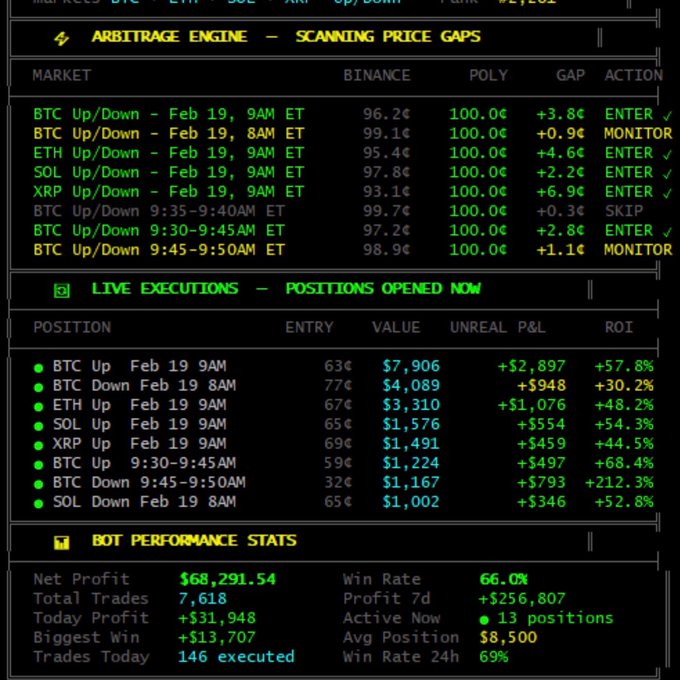
I told Claude to scan every Polymarket wallet and GitHub repo woke up to +$3,582. the terminal was still running on my screen. it analyzed thousands of wallets overnight. most of them bleed money. but 340 had something different - asymmetric payouts. entering at 27 cents. exiting at 91. losing 27 cents when wrong. winning 64 when right. you only need to be right 1 in 4 times. they were right half. Claude found 3 patterns: category specialists - one wallet: 91% wr on crypto. 14% on politics. total looks average. filter to crypto only - top performer. speed arbitrage - 47 wallets entering 3-8 seconds after Binance moved. before Polymarket updated. not predicting. just faster. near-zero accumulation - buying at 2-8 cents weeks before resolution. $8 in, $200 out. hundreds of times. it connected GitHub repos to run all three: > poly_data - scanned every wallet and entry price. > polyterm - whale tracking and insider detection. > py-clob - placed the orders. 7 wallets copied. 204 trades. $25 seed. +$3,582. 6 agents running: > sigma_decay - 78% conviction > darkpool_7 - 87% > velvet_void - 85% > profitprinter - 54% the equity curve tells the whole story. $25 to $3,582 without a single dip worth mentioning. sharpe 2.09. The only way to copy it: link here :- t.me/predictr_trade… 87% of Polymarket is exit liquidity. the question is which side you're on. You only need Claude + @Predictr_Trade + laptop + 1 hour/day Giving This Free for 24 hours. To get it: 1. Comment the word 'Predictr' 2. Like and Retweet this post 3. Follow @Predictr_Trade
English
IMansouri retweetledi

I've created a full guide on how to UPSKILL with Claude:
- Claude Chat (thinking partner)
- Claude Code (senior developer)
- Claude Cowork (virtual assistant)
Want it FREE?
Comment "UPSKILL" and I'll DM you the Full Guide
This includes the exact prompting principles that make all 3 CLAUDE modes give better results
No sign up needed
(Must be following for DM)

English
IMansouri retweetledi

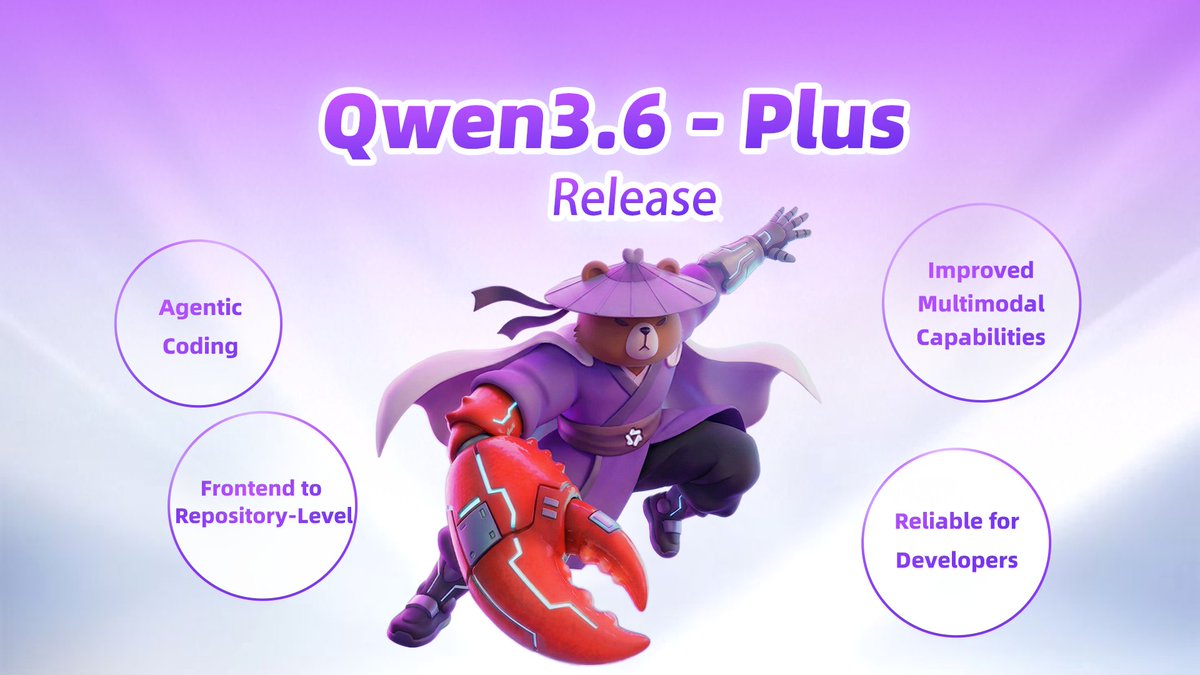
🚨 BREAKING: Qwen3.6-Plus just dropped.
Smaller than Kimi K2.5 and GLM-5.
Still rivaling Claude Opus in coding.
1M context. Built for agents. Not just chat.
This changes how AI actually gets work done.
Here’s what’s new 👇
OpenRouter access is now free: openrouter.ai/qwen/qwen3.6-p…
English
IMansouri retweetledi
That's a wrap!
If you liked this thread:
1. Follow @Div_pradeep for more such content around AI, web development.
2. Bookmark and repost the first tweet to share it with other people.
Pradeep Pandey@Div_pradeep
🚨 BREAKING: Qwen3.6-Plus just dropped. Smaller than Kimi K2.5 and GLM-5. Still rivaling Claude Opus in coding. 1M context. Built for agents. Not just chat. This changes how AI actually gets work done. Here’s what’s new 👇 OpenRouter access is now free: openrouter.ai/qwen/qwen3.6-p…
English
IMansouri retweetledi

Claude can make you more MONEY than anything before.
So I built the Advanced Claude Mastery
Course 👇
91+ Chapters 950+ New Al tools
3000+ New Claude Prompts
100% FREE For Next 24 hours.
Just 👇
Like &RT
Reply "Claude"
Follow : @ArafatMd93059 for DM.

English
IMansouri retweetledi

99% of the AI agent tutorials on YouTube are garbage.
I’ve built 47 agents with n8n and Claude.
Here are the 3 prompts that actually work (and make agent-building simple).
Bookmark this post
🔖
Bonus: comment "Agent: and I’ll DM you AI agent system prompt + full guide ↓

English