Al🍑

9.5K posts

Al🍑 banner
Al🍑

Al🍑

@MarcheEdge

This time, it's really different.

Brooklyn, NY Katılım Eylül 2018
986 Takip Edilen128 Takipçiler
Al🍑 retweetledi
Antonio Cádiz
Antonio Cádiz@AparicioCadiz·
Cuanto más baja mientras los fundamentales mejoran mayor es la expectativa de retorno si el mercado, que la ha condenado a muerte, no tiene la razón. $ADBE cotiza a unas 8 veces beneficios NTM. O nos estamos equivocando y lo que pasa es que la empresa decrece sus ingresos a doble dígito, o estamos ante una de las ineficiencias más grandes de la historia de la bolsa. Una empresa grande, americana, con altísima liquidez, con márgenes clase mundial, dentro de un sector con costes marginales decrecientes estructurales a 8 veces beneficios, mientras el mercado cotiza a múltiplos por encima de su media histórica, y auténticas castañas sin beneficio despegan hasta los cielos.
Antonio Cádiz tweet media
Español
58
11
223
41K
Al🍑 retweetledi
Bullfight Cap
Bullfight Cap@BullfightCap·
Dan Durn back to semis after top ticking software 🤔
Bullfight Cap tweet media
English
5
6
83
20K
Al🍑 retweetledi
Rose Celine Investments 🌹
Rose Celine Investments 🌹@realroseceline·
Thoughts on $ADBE $ADBE is one of the most fascinating stocks in the market today because it highlights one of the most important lessons in investing. It continues to execute at a high level. Revenue continues to grow, margins remain exceptional, free cash flow is enormous, and millions of customers still rely on $ADBE products every day. Yet despite all of that, the stock has struggled for years hitting all time lows. This confuses many investors, especially newer investors. They look at the financial statements and see a business that appears healthy. Then they look at the stock price and assume the market must be making a mistake. After all, if the business is improving and the stock is falling, shouldn’t that create an even better opportunity? Sometimes the answer is yes. Some of the greatest investments in history occurred because the market became too pessimistic about a business whose future remained bright. But it is important to remember that the market is not trying to value what a company earned previously or even currently. The market is trying to value what that company might earn in the future. This is where the story becomes interesting. $ADBE looked cheaper at $500 than it did at $600. It looked cheaper at $400 than it did at $500. It looked cheaper at $300 than it did at $400. Many investors looked at the declining valuation and concluded that the opportunity was becoming more attractive. Yet the stock continued to fall because investors were not debating the current business. They were debating what the business might look like in the future. For decades, $ADBE built one of the strongest moats in software. Photoshop, Illustrator, etc became the standard tools used by creative professionals around the world. Entire careers were built around learning Adobe’s products. Millions of designers, marketers, photographers, and video editors integrated $ADBE into their daily workflow, creating an ecosystem that appeared almost impossible to disrupt. Then artificial intelligence arrived and changed the conversation. For the first time, images could be generated with a prompt. Videos could be created automatically. Design work that once required years of expertise could suddenly be performed by almost anyone. The question investors began asking was not whether $ADBE remained a great company today. The question was whether $ADBE moat would be as strong five or ten years from now as it was five or ten years ago. That distinction is incredibly important because stocks are ultimately claims on future cash flows, not current cash flows. Imagine owning a toll bridge that earns $100 million per year. If someone announces that a second bridge will be built beside yours five years from now, the value of your bridge immediately changes even though today’s profits remain exactly the same. Nothing changed in the present, but something changed in the future. This is why investing can be so difficult. The numbers investors see today often tell a very different story than the future investors are attempting to price. A business can appear healthy while its long term competitive position weakens. At the same time, a business can appear expensive while its future becomes far more valuable than most people realize (ie $PLTR). The market spends surprisingly little time pricing the present and an enormous amount of time attempting to price a future that has not yet happened. This is also why one of the most dangerous phrases in investing is, “The stock is down but the fundamentals are improving.” Investors have said that about newspapers as the internet emerged, department stores as ecommerce gained share, and cable television as streaming began taking over. In many cases the current business remained healthy long after the future business had already started to deteriorate. 1/2 👇
English
78
53
555
128.6K
Al🍑 retweetledi
Patrick Moorhead
Patrick Moorhead@PatrickMoorhead·
Top 10 $ADBE call insights for me: 1. Deliberately lowering second-half ARR from individual subscribers to fund a bigger freemium push across Firefly, Express, and Acrobat. 2. The roughly $500M ARR impact is split about half from deferring Creative Cloud price optimizations and about half from the freemium push. 3. The deferred Creative Cloud optimizations are a timing shift, not a cancellation. Call said they can reintroduce them later. 4. Second-half ARR is expected to skew more toward Q4 than the usual 40/60 Q3/Q4 pattern. 5. Firefly ARR grew about 50% quarter-over-quarter and is approaching $300M exiting Q2. 6. Adobe is applying the “proven Acrobat Reader freemium model” to Firefly and Express, now tied to intent-based search. 7. Adobe is using Semrush to rank on intent queries like “Summarize PDF” and route users into Acrobat Web or Firefly. 8. Adobe Creative Agent is already distributed inside Claude and ChatGPT, with Copilot and Gemini coming, and monetized through credits. 9. Customer Experience Orchestration AI-first ARR grew 4x year-over-year, with over 80% of platform customers using agentic capabilities. 10. Management signaled interest in technology tuck-in M&A because many AI targets lack sustainable or monetizable business models. 👀
Patrick Moorhead@PatrickMoorhead

$ADBE Q2 FY2026: revenue $6.62B up 13%, non-GAAP EPS $5.96, both above consensus, and revenue and EPS targets raised. So why down after hours? The call answered it. @Adobe is choosing to lower second-half ARR from individual subscribers to go all-in on a freemium funnel for Firefly, Express and Acrobat, and is deferring Creative Cloud price optimizations. This is a strategy reset, not to be confused with a demand miss. More like investment protection. It’s a defensive position for sure.

English
9
16
113
36.7K
Al🍑
Al🍑@MarcheEdge·
$ADBE Dan Durn really didn’t do a great job… join in 2021 and stock is down 60%+ Time for a change. Markets should be rewarding this shift.
English
1
0
1
87
Craig Carton
Craig Carton@craigcartonlive·
For those of you who don't think Wemby is dirty explain this without saying its AI
English
341
319
3.2K
647K
Al🍑 retweetledi
*Walter Bloomberg
*Walter Bloomberg@DeItaone·
IRAN STRIKES CALLED OFF President Trump says he has cancelled planned U.S. strikes and bombings against Iran scheduled for this evening. He stated that all parties have approved the discussions and final terms in principle and in detail. A naval blockade will remain in place until the agreement is finalized. The time and location for the signing ceremony will be announced shortly.
English
303
340
2.2K
555.1K
Al🍑 retweetledi
First Squawk
First Squawk@FirstSquawk·
OPENAI CONSIDERS DRASTIC PRICE CUTS, ANTICIPATING WAR FOR USERS WITH ANTHROPIC-WSJ
English
1
2
38
12.1K
Al🍑 retweetledi
Financelot
Financelot@FinanceLancelot·
BREAKING: SoftBank shares fall 9% after its attempt secure a $6 billion margin loan backed by its stake in OpenAI fails.
Financelot tweet media
English
62
162
845
182.2K
Al🍑 retweetledi
First Squawk
First Squawk@FirstSquawk·
Software buyout deals collapse to lowest level since pandemic after AI rout-FT
English
1
9
33
12.5K
Al🍑
Al🍑@MarcheEdge·
Get ready for a face ripping rally 🌋
English
0
0
0
4
Al🍑 retweetledi
Wall St Engine
Wall St Engine@wallstengine·
$ADBE is weighing David Wadhwani and Anil Chakravarthy as leading internal CEO candidates, per Bloomberg. Adobe also hired Heidrick & Struggles to search externally for AI product leaders as it faces pressure from AI-native creative tools.
Wall St Engine tweet media
English
5
5
58
17.4K
Al🍑 retweetledi
TechStockFundamentals
TechStockFundamentals@TechFundies·
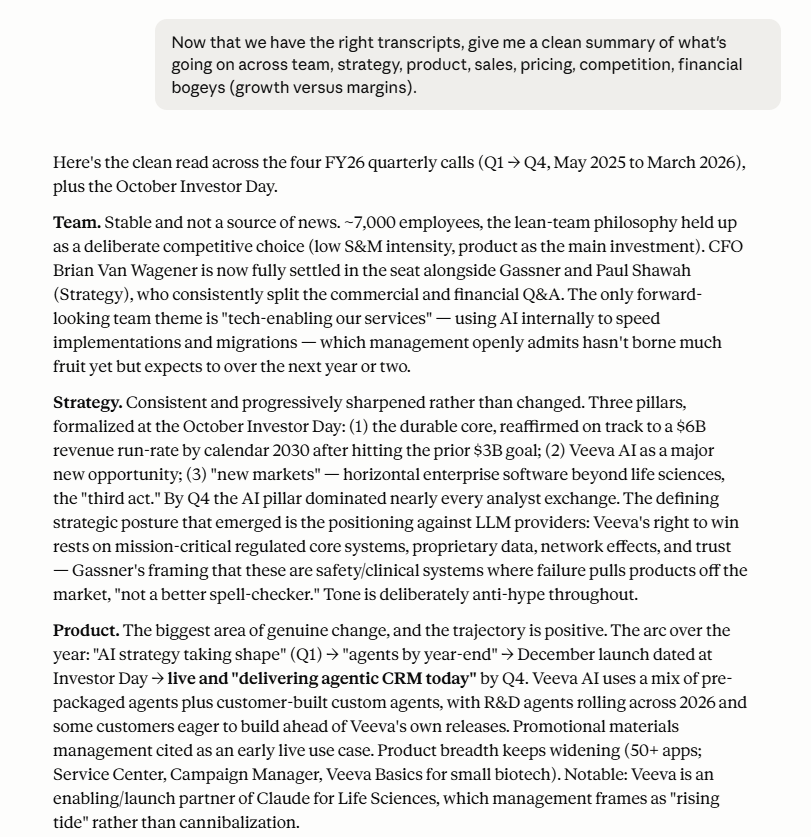
I don't know who needs to hear this but AGI is already here. $FDS just made unstructured data available via MCP and I asked it to read four transcripts for $VEEV, update me on what's going on, tell me if the story is getting better or worse, and whether numbers are going up or down. If this response isn't AGI, I don't know what is. Claude costs $240 / year. $FDS MCP costs $1,500-2,500 / year. Claude has serious COGS underneath that $240. $FDS MCP has de minimis incremental COGS. And people are bearish on important SaaS with critical data? Now I wonder if semis third deriv just turned negative... If all the big LLMs hit AGI within the next 12 months, the focus might shift to efficiency pretty hard.
TechStockFundamentals tweet mediaTechStockFundamentals tweet mediaTechStockFundamentals tweet mediaTechStockFundamentals tweet media
English
20
10
170
33.8K
Al🍑 retweetledi
Jason Lewris
Jason Lewris@jasonlewris·
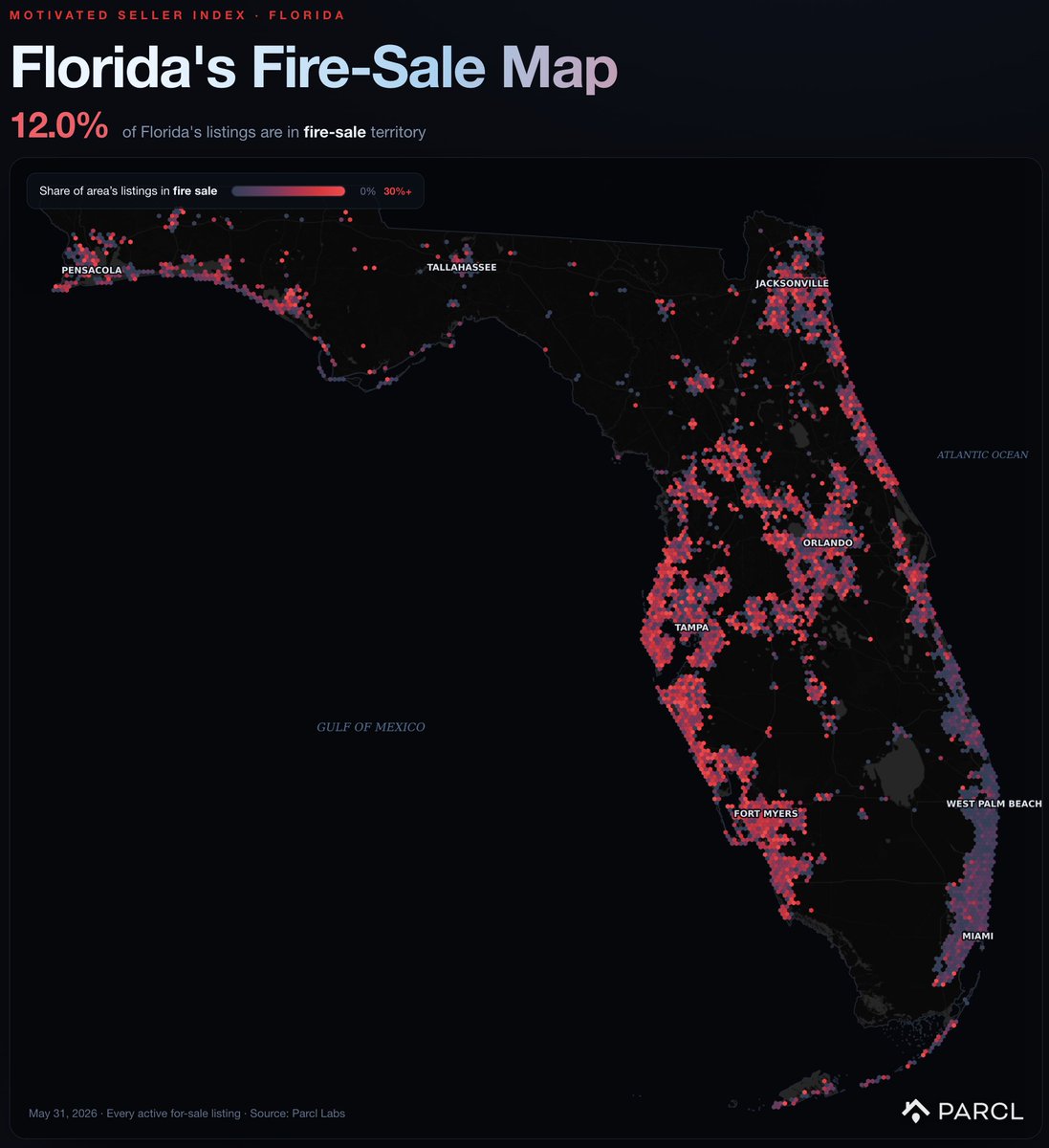
BREAKING - as of this morning, 12% of Florida's for sale homes are in active fire sale territory. This means they have been sitting on market, the seller is actively cutting prices and increasing the frequency of those price cuts. The pressure is mainly concentrated in Tampa and Fort Myers, where fire sales now top 30% of listings in some submarkets. This means sellers cannot find buyers even though they want to.
Jason Lewris tweet media
English
701
1.4K
9.1K
2.5M
Al🍑 retweetledi
Stephen Curry
Stephen Curry@StephenCurry30·
The partnership of a lifetime.
English
1.4K
5.8K
56.8K
2.9M
Al🍑 retweetledi
Investing.com
Investing.com@Investingcom·
*IRAN TO PROPOSE CHANGES TO US PEACE DRAFT UNDERSTANDING: TASNIM
English
14
19
246
42.2K
Al🍑 retweetledi
Bull Theory
Bull Theory@BullTheoryio·
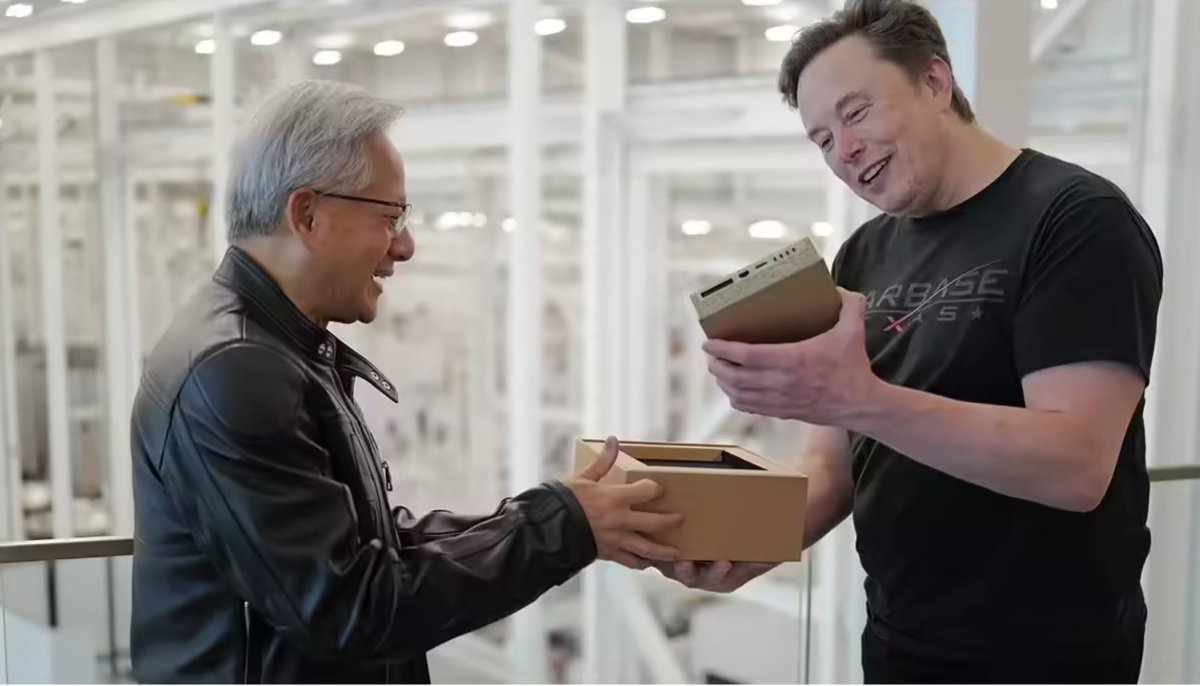
🚨Michael Burry just said Elon Musk and Nvidia's deal is built on fake numbers. Burry published a detailed breakdown calling the entire structure "Fugazi", his word for fake. He is alleging that billions of dollars in Nvidia chips are being hidden off balance sheets, and that American retirees are unknowingly funding the whole thing. Nvidia, the world's largest AI chip company sold $5.4 billion worth of its most advanced GPUs, the GB200, to a company called Valor. Valor is not a real operating business. It is a special purpose vehicle, a shell company created specifically to hold these chips and nothing else. Nvidia also invested $1.9 billion of its own money directly into Valor on top of the sale. Those 100,000+ chips are now physically inside xAI's data center. xAI is Elon Musk's artificial intelligence company, the one that builds Grok. xAI is using every single one of those chips right now to run its AI models. But here is what Burry is flagging. Neither Nvidia nor xAI owns those chips on paper. Valor, the shell company holds legal title. That means $5.4 billion in GPU assets do not show up on Nvidia's balance sheet as inventory. They do not show up on xAI's balance sheet as assets. They are legally invisible to both companies. Nvidia gets to book the $5.4 billion as a completed sale and record it as revenue. xAI gets full use of the chips without owning them. And the risk disappears into a shell company in the middle. Now here is where American retirees enter the picture. Valor needed $3.5 billion in debt to fund this structure. Apollo provided it. Apollo is one of the largest asset managers on earth with $1.03 trillion under management and $834 billion specifically in private credit. Apollo raised the $3.5 billion, packaged it into debt securities, and sold those securities to Athene. Athene is Apollo's own insurance company. It sells fixed and indexed annuities, retirement savings products, to ordinary Americans. When a retiree buys an Athene annuity, they believe their money is sitting in safe, stable investments. That money is now inside a structure funding Elon Musk's AI data center. The numbers inside Athene are most alarming. Athene holds $74.2 billion in reserves. It has moved $217 billion in assets into a captive insurer based in Bermuda, meaning those assets sit outside normal US insurance regulation and oversight. Of the entire portfolio, 34.7%, equal to $103 billion, is classified as Level 3 assets. Level 3 is an accounting classification that means there is no observable market price for these assets. No outside party can independently verify what they are actually worth. The leverage sitting on top of those unpriced assets is 16 times. Burry's says: Every step of this structure is technically legal and publicly disclosed. But the entire thing was deliberately engineered across 8 to 12 steps to move credit risk off balance sheets and away from any market pricing. - Nvidia books the revenue. - Apollo collects the fees. - xAI gets the computing power. - And retirees sitting at the bottom of a 16x leveraged Bermuda insurance structure, holding $103 billion in assets with no market price carry the risk without knowing it exists.
Bull Theory tweet mediaBull Theory tweet mediaBull Theory tweet media
English
943
4K
16.2K
4.3M
Al🍑 retweetledi
Thierry from arvy 🇨🇭
Thierry from arvy 🇨🇭@ThierryBorgeat·
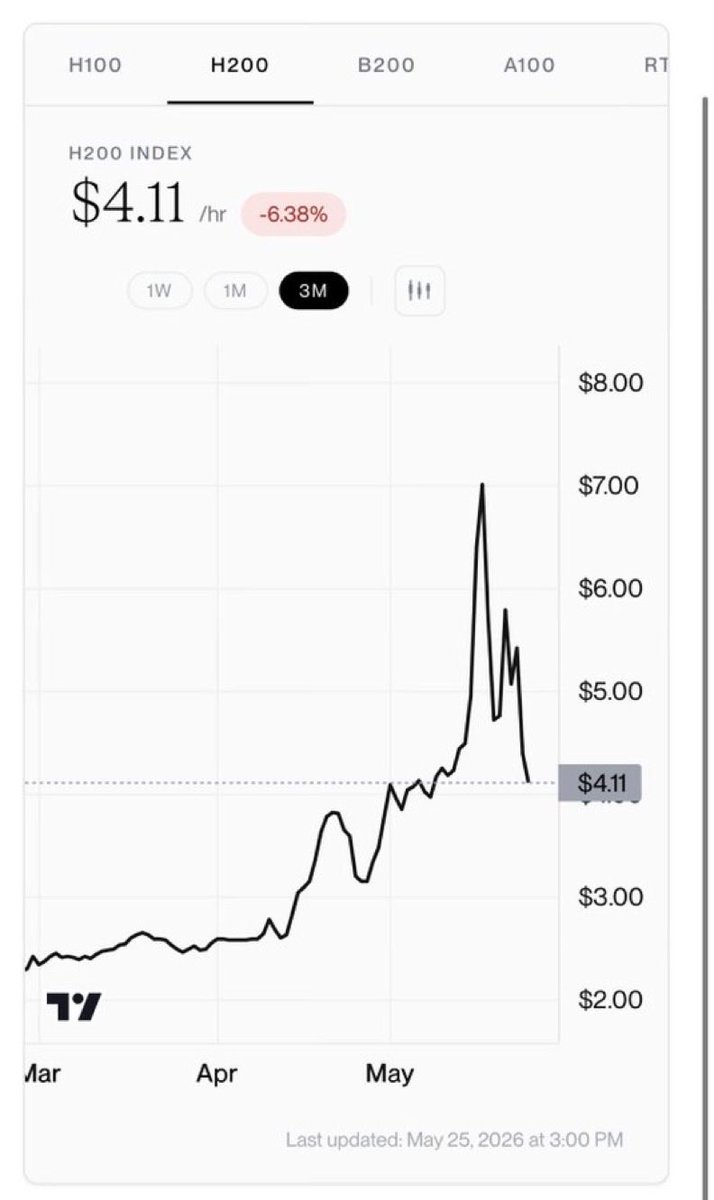
The price to rent an Nvidia H200 just collapsed from $7/hr to $4/hr in three weeks. A -40% drop in the cost of the single most strategic asset in tech. When the underlying commodity that powers your entire thesis loses 40% of its value in a month, that usually means one of two things: supply finally caught up, or demand was never as deep as the headlines said. Either way, somebody is selling. So why is the AI trade still pricing in scarcity?
Thierry from arvy 🇨🇭 tweet media
Thierry from arvy 🇨🇭@ThierryBorgeat

🚨 The AI ROI numbers are starting to look very ugly. Even under "best case" assumptions — assuming zero costs, just revenue against capex — the Financial Times calculated the implied return on hyperscaler AI investment from 2025 to 2030. Only one of them clears positive. Implied return on AI investment (FT / Panmure Liberum) – Microsoft: -9.2% – Alphabet: -15.7% – Amazon: +7.2% – Meta: -28.8% – Oracle: -35.6% And remember: that's assuming zero costs. In reality, GPUs depreciate, power bills run, salaries get paid. The real returns are worse. This is exactly why the dot-com comparison keeps coming up. Incredible technology does not automatically mean sustainable economics. The internet survived. Most internet companies didn't. Two anecdotes from this week alone Vivek Garipalli, Fortune 20 insider: a CEO asked for $1B in AI-driven opex savings this year. The team spent $200M on tokens chasing it. The results? Modest customer service savings and slightly less hiring in engineering. The CEO has now ordered token costs to be dramatically slashed because the ROI isn't there. Axios: an AI consultant reported a single client spent half a billion dollars in one month after forgetting to put usage limits on Claude licenses for employees. Right now hyperscalers are spending trillions hoping future demand catches up to present capex. That's not certainty. That's a leveraged bet. The technology is real. The infrastructure buildout is real. The eventual winners will be real. But "AI is transformative" and "every hyperscaler will earn its capex back" are two completely different statements. In 2000, the internet was real too. Cisco has recovered. After 26 years…

English
291
582
2.8K
1M