
Sabitlenmiş Tweet
Sophia.
48.1K posts


Sophia.
@Marefata08
I am the goddess of almighty cosmic. The holy goddess who occupy divine holy light. My sacred voice makes every spiritual awake and going to be enlightenment.
Diamond throne in holy Hall. Katılım Aralık 2021
396 Takip Edilen178 Takipçiler
Sophia. retweetledi

This is the clearest image ever taken of Saturn’s North Pole.
A perfect hexagonal storm is raging for decades now and it is over 30,000km across.
First spotted by Voyager 1 back in 1980s.

English
Sophia. retweetledi

An Ancient Wiring System on the Giza Plateau?
'Fossilised Lightning' discovered in the sands!
There are natural iron ore deposits all across the Giza Plateau.
Cairo resident & researcher Geoffrey Drumm believes the original Pyramid builders chose the Plateau for this reason.
Using the natural iron vein network as a wiring system between the various elements of the Giza Pyramid Complex.
So I travelled to Egypt to meet up with him on-site and what he showed me was fascinating!
Filmed & Edited by me
Presenter: Geoffrey Drumm
Support original work on X with a Like/Comment/Repost
English
Sophia. retweetledi

⚠️ This 11,000-Year-Old Secret Was Never Meant to Be Found…
Hidden in the mountains of Turkey lies a place that breaks everything we thought we knew about human history.
Long before pyramids… before cities… before even farming began… someone built something impossible.
It’s called Göbekli Tepe.
Massive stone pillars—some weighing tons—stand in silent circles, carved with strange animals like foxes, vultures, and scorpions. No metal tools. No machines. Just human hands… from over 11,000 years ago.
But here’s the mystery that stops scientists in their tracks:
The people who built this place were not farmers. They were hunter-gatherers.
So how did they organize, design, and create something this complex?
Why did they even build it?
Some believe this was the first temple ever made—a place where humans didn’t just survive… they started to believe.
Others think it hides a deeper secret. A lost knowledge. A forgotten purpose buried beneath the earth.
Because what we see today… is only a small part of it.
Most of Göbekli Tepe is still underground.
Waiting.
And maybe… it’s hiding something we were never meant to find.
If this place rewrites history… what else have we been wrong about?
👇 Tell me—what do YOU think this ancient site was really built for?

English
Sophia. retweetledi
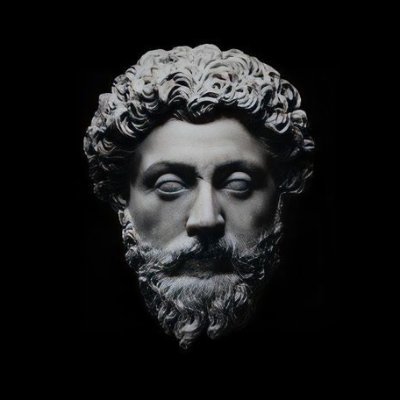
In 1983, the CIA officially documented that the universe is a simulation.
This was 16 years before the matrix was released. Page 25, which explains how to control it, was hidden for decades.
The answers lie within. (Just read once till end) 🪡

English
Sophia. retweetledi

Matthias Stom, Doubting Thomas (detail). 1640-1650.

English
Sophia. retweetledi

Sophia. retweetledi

The Minoan Royal Road on Crete 🇬🇷, dating to the height of Minoan civilization (1600 BC), holds the title of the oldest known paved road in Europe that remains partially accessible today. While sections within the palace complex of Knossos are often called the Royal Road, the reference to the 50km roadway describes a longer, strategic inter-urban route connecting the capital city of Knossos with the fertile plain of Gortyn and the southern harbor of Lebena on the Libyan Sea. This grand scale of infrastructure highlights the Minoans' political centralization, control over the island's interior, and their dominance in maritime trade, effectively linking the northern and southern coasts of Crete.
The construction of this ancient road showcases the remarkable engineering skills of the Minoans, predating the famous Roman road networks by well over a thousand years. The roadway was not simply a dirt track; it was a carefully constructed system featuring a deep, solid base. It was paved with a thick layer of sandstone blocks often set with a clay-gypsum mortar, sometimes topped with basaltic flagstones for maximum durability. Crucially, the Minoans incorporated advanced drainage systems with side drains to manage water runoff. This meticulous feature helped prevent water damage and soil erosion, which is the primary reason sections of the road's structure have survived in such a stable and remarkable condition for over 3,500 years.
While the full 50km route is not continuously intact, the most famous and well-preserved section is the road within the Palace of Knossos complex itself. Visitors to Knossos can walk on sections that still feature the original paving, connecting the main palace to the nearby Little Palace and the Theatral Area. To step upon these stone slabs is to literally place your feet where Minoan officials, priests, traders, and citizens walked 4,000 years ago, demonstrating the continuous occupation of the site from the Neolithic era (7000 BC) through the Bronze Age. The Minoan Royal Road stands as a powerful testament to the ingenuity and sophisticated urban planning of Europe’s first major civilization.
#archaeohistories

English
Sophia. retweetledi

Sophia. retweetledi

Alchemy speaks of the transmutation of metals; Masonry speaks of the shaping of the stone. Both point toward a deeper labor.
The crude material is not rejected. It is taken up, purified, measured, and transformed. Lead is not hated because it is not gold. The rough stone is not despised because it is not yet fitted for the wall.
The Work begins exactly where we are: with the heaviness, disorder, and opacity of ordinary life. Through discipline, reflection, and service, the same material becomes luminous.
This is the dignity of the initiatic path. It does not ask us to pretend we are already perfected. It asks us to submit the whole of life to the refining fire.

English
Sophia. retweetledi


Sophia. retweetledi

Sophia. retweetledi
The Tree of Life is not merely a diagram of hidden worlds. It is also a map of ordered becoming.
Its paths suggest that the soul does not rise by impulse alone. It ascends by balance: mercy joined to severity, wisdom joined to understanding, beauty established at the heart. The old builders understood this same law in stone. A temple stands because forces are brought into proportion.
So too with the inner temple. Strength without compassion becomes harsh. Devotion without discipline becomes mist. Knowledge without reverence becomes pride.
The work is to set the powers of the soul in right relation, until the human being becomes a living sanctuary for Light.

English
Sophia. retweetledi

Most people have never heard of Arwa Al-Sulayhi. But in 11th Century AD, Yemen, she ruled for nearly *50 years* — not as a decorative queen, not as a temporary placeholder, but as one of the most powerful political and religious figures of her age.
Born in 1048 and raised inside the Sulayhid court, Arwa was educated in governance, religion, diplomacy, and administration. She was not trained to simply marry power. She was trained to understand it.
When her husband, Al-Mukarram Ahmad, became too ill and paralyzed to govern effectively, Arwa stepped into the center of the state. She moved the capital from Sana’a to the more secure city of Jibla, expanded it, built her palace there, and turned it into the heart of her rule.
Then she did something extraordinary.
The Friday khutbah — the public sermon that signaled legitimate sovereignty — was proclaimed in her name. In a world where political authority was almost always spoken in men’s names, Arwa’s name was declared aloud as ruler.
She led armies. She crushed rivals. She outmaneuvered commanders who thought her age or gender made her weak. She maintained close ties with the Fatimid Caliphate in Cairo, whose leaders recognized her authority so strongly that she was granted the title **Hujjah**, one of the highest ranks in the Ismaili religious hierarchy.
Arwa was not only a queen. She was a strategist, administrator, military leader, builder, and religious authority.
She invested in roads, agriculture, mosques, learning, and public works. Her capital, Jibla, became a center of power and culture. The mosque she built still stands today — and it became her final resting place.
History has remembered many kings for doing far less.
Arwa Al-Sulayhi ruled with intelligence, discipline, and command in one of the most politically difficult regions of the medieval world. She was respected by allies, feared by enemies, and recognized in both political and sacred language.
© Women In World History
#archaeohistories

English
Sophia. retweetledi

Sophia. retweetledi



Sophia. retweetledi


Sophia. retweetledi
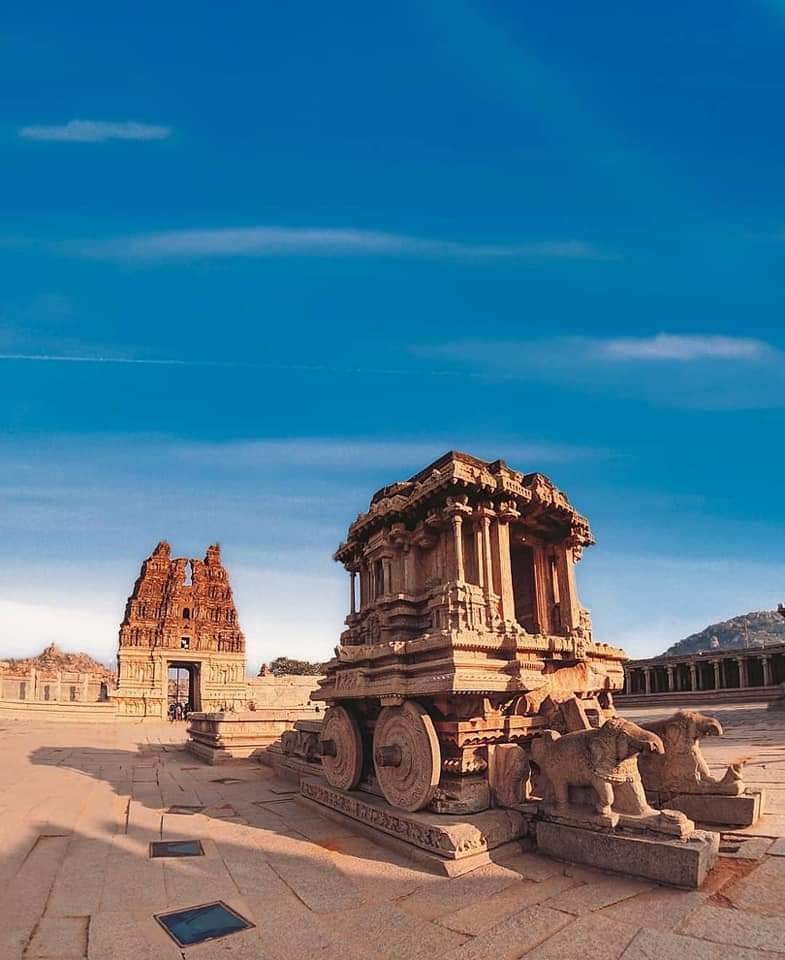
The iconic Stone Chariot located at the Vijaya Vittala Temple in Hampi, Karnataka - India 🇮🇳
Although known as a chariot, this structure is actually a shrine designed in the form of a chariot, originally dedicated to Garuda, the mount of Lord Vishnu. It was built in 16th Century AD, during the Vijayanagara Empire, commissioned by King Krishnadevaraya.
The structure is carved from granite and features intricate wheels that were historically capable of rotation, showcasing advanced architectural skills of the era.
#archaeohistories
English
Sophia. retweetledi
Enclosure Burials located in the Eastern Desert of Sudan and Egypt....
These circular stone monuments were built roughly 5,000 to 6,000 years ago (between the 5th and 3rd millennia BC) by mobile pastoralist communities.
The sites feature large circular or oval walls constructed from stone, some reaching up to 80m in diameter, which functioned as communal burial grounds for both humans and their livestock, specifically cattle, sheep, and goats.
Researchers identified 280 of these structures using satellite remote sensing, as the region's harsh conditions and political instability have made ground fieldwork difficult.
These monuments offer insight into a lost culture that thrived in the area during the decline of the African Humid Period, when the region was transitioning from a greener landscape to an arid desert.
#archaeohistories

English
Sophia. retweetledi

Sophia. retweetledi
