

Tianxing Chen
30 posts

Tianxing Chen
@MarioChan2002
PhD student @ HKU-MMLab · Founder of Lumina EAI Community · Generalist Robot Manipulation
Hong Kong Katılım Ocak 2023
172 Takip Edilen828 Takipçiler

We evaluated 30+ frontier embodied AI models.
The result is clear: current generalist robot policies are still far from robust real-world manipulation.
This is why we built RoboDojo.
English
There seems to be an issue with the video and audio. You can visit the homepage to watch the high-definition version🥲.
English

Exactly! this feels like a classic case of training data distribution bias. Policies default to the most frequent behaviors in the dataset instead of truly grounding the instruction. Makes me wonder how much of the grounding gap could be closed with more deliberate tool use and instruction-following data during collection
English
@_ok_cc_ Yes, we also evaluated several WAMs such AHA-WAM, Fast-WAM etc.
English

@MarioChan2002 Is it just for VLAs? Did you guys also try world modes in this benchmark?
English
Thank you! Yes, we do observe several consistent failure patterns. One particularly clear issue is grounding in open-ended manipulation tasks. For example, in the align_blocks task, the intended behavior is to use a ruler as a tool to push and align the square blocks. However, many policies tend to directly grasp the blocks instead, which reflects the skills they have most commonly learned from the training data, rather than grounding the instruction to the correct tool-use strategy.
This is exactly why RoboDojo is designed around multiple comprehensive evaluation dimensions rather than a single overall score. We hope it can encourage the community to build more balanced and capable policy architectures, especially for aspects that have often been underexplored in previous benchmarks, such as memory and open-ended grounding.
English
@MarioChan2002 Great work!
Btw have you observed any consistent failure patterns (e.g., in long-horizon tasks or open-vocabulary following) that seem fundamentally harder to fix with current policy architectures?
English
Fairness is our first principle.
RoboDojo is operated by AI MMLab Club, a non-profit organization, together with academic partners worldwide. The benchmark, reproduced code, and checkpoints are open-sourced, with no commercial involvement.
We welcome academic teams to join us.
English
Together with RoboDojo, we introduce XPolicyLab: a unified framework for embodied model development, deployment, and evaluation.
Using XPolicyLab, we reproduced 30+ models and built a comprehensive leaderboard for the community.
XPolicyLab code: github.com/XPolicyLab/XPo…
English
Several things deserve celebration:
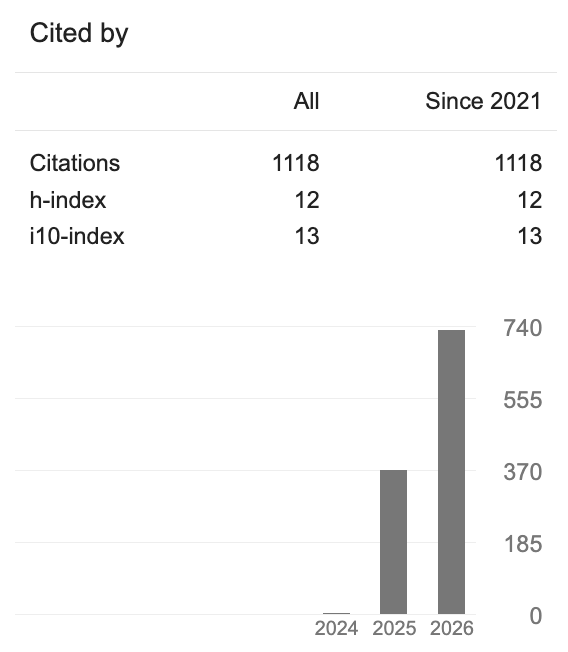
1. Reached over 1,000 Google Scholar citations.
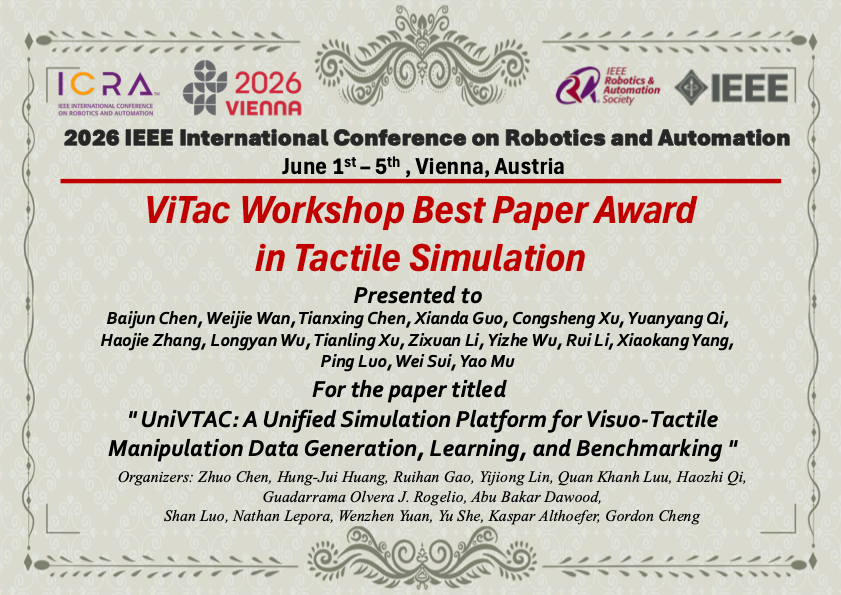
2. Received the Best Paper Award at the ICRA 2026 ViTAC Workshop.
3. The RoboTwin series has received over 500 citations, 2.5k GitHub stars, and over 600k Hugging Face downloads.
English
Tianxing Chen retweetledi

Evolvent AI @Evolvent_AI is looking for model training data partners.
We are an AI startup focused on synthetic data and self-evolving agents, with team members from top universities in China and overseas, as well as prior research and engineering experience at leading foundation model teams.
Over the past 2 months, Evolvent AI has signed RL/SFT training data contracts with 7 leading model companies, with total contract value exceeding $10M.
We provide high-quality post-training data and environment construction for coding, SWE, terminal, AutoResearch, general agents, and other long-horizon agent tasks. We also cover finance, STEM, K12, text-only and multimodal training data, including task design, sandboxes, databases, reward/verifier design, and model evaluation.
We are now exploring new collaboration models with more model companies and leading Agent teams. If you are working on RL/SFT post-training or want to improve Agent performance on complex long-horizon tasks, feel free to reach out !
English
Tianxing Chen retweetledi

Everyone says the latest AI agents will be "job-ready" soon, especially after the release of Fable 5 this week. But is that really the case?
Over the past many months, my group and collaborators have been building Agents' Last Exam (ALE), a benchmark designed to test exactly that claim on real digital labor-market work.
My group and collaborators previously have created many of the benchmarks the field runs on, including MMLU, MATH, CyberGym, and ExploitGym. Today, I'm excited to share Agents' Last Exam (ALE): a rolling benchmark that measures whether AI agents can actually perform economically valuable work across a broad range of real-world domains.
With ALE, we evaluated Fable 5, GPT-5.5, Composer 2.5, and other frontier agent systems across more than 1,500 expert-sourced tasks spanning 55 occupations.
The result is both impressive and sobering.
Today's agents can solve a meaningful fraction of professional tasks. But when we look at the hardest tasks, the ones requiring sustained reasoning, deep domain expertise, and reliable execution over long horizons, they are still far from human-level performance.
On ALE's hardest tier, every frontier agent we tested, including Fable 5, achieved a 0% success rate.
The age of useful agents is here.
The age of truly job-ready agents is not.
We hope Agents' Last Exam (ALE) will serve as a new guidepost and north star for developing agents capable of reliably performing economically valuable work across a broad range of domains.
🧵

English
Tianxing Chen retweetledi
I’m so tired of writing rebuttals to this kind of “lack of novelty” review: “This paper trivially combines A, B, and C, so the algorithmic novelty is limited.”
Technically, most (if not all) robotics papers are convex combinations of existing ideas.
I still deeply appreciate A+B+C papers—especially when they deliver:
- New capabilities: the “trivial combination” unlocks behaviors we simply couldn’t achieve before
- Sensible & organic design: A+B+C is clearly the right composition—not some arbitrary A′+B+C′
- Nontrivial interactions: careful analysis of the dynamics, coupling, or failure modes between A, B, C
- Rehabilitating old ideas: A was dismissed for years, but paired with modern B/C, it suddenly works—and teaches us why
- System-level & "interface" insight: the contribution is not any single piece, but how the pieces talk to each other
- Scaling laws or regimes: identifying when/why A+B+C works (and when it doesn’t)
- Engineering clarity: making something actually work robustly in the real world is not “trivial”
- New problem formulations: sometimes the real novelty is in the reformulation—only under this view does A+B+C make sense.
Maybe worth keeping these in mind when reviewing the next A+B+C paper : )
English
Tianxing Chen retweetledi

A robot wrapping red envelopes🧧? The future is here!
Xspark AI empowers robots with massive high-quality data, bringing embodied intelligence to life this New Year 🤖.
#XsparkAI #Embodiedai #GeneralRobots #ChineseNewYear
English
Tianxing Chen retweetledi

Introducing #MM-Hand 1.0, multisensory and modular design. Tendon-based solution. Fully open-sourced for academic research. Kudos to the team for the hard work in the past few months:) @ilnehc @HKUniversity @HKU_CDS
OpenDriveLab@OpenDriveLab
🦾 【MM-Hand 1.0】Open-Source, Lightweight, High-DoF, Multimodal, Modular Design for Easy Disassembly and Modification 🔗 Details: mmlab.hk/research/MM-Ha… 🎁 Beta Program: forms.gle/QhaHGCigY6buuS… 📮 Inquiries: research@mmlab.hk #MMHand #DexterousHand #Robotics #OpenSource #EmbodiedAI #TactileSensing
English
We won the Champion at NeurIPS SpaVLE Workshop MARS Challenge Manipulation Track ! @NeurIPSConf

English
Reached 300+ Citations these days, with over 150 from RoboTwin.

English

Introducing GEN-0, our latest 10B+ foundation model for robots
⏱️ built on Harmonic Reasoning, new architecture that can think & act seamlessly
📈 strong scaling laws: more pretraining & model size = better
🌍 unprecedented corpus of 270,000+ hrs of dexterous data
Read more 👇
English