Mario Suva

906 posts

Mario Suva banner
Mario Suva

Mario Suva

@MarioSuva

Brain cancer biology. Single-cell genomics. Mass General Hospital. Broad Institute.

Boston, MA Katılım Temmuz 2019
373 Takip Edilen2.6K Takipçiler
Mario Suva retweetledi
Avishay Spitzer, MD, PhD 🎗️🧡
14/ This of course wouldn't have been possible without the generous contribution of the patients and their families, for which we are ever thankful.
English
1
1
8
1.3K
Mario Suva retweetledi
Avishay Spitzer, MD, PhD 🎗️🧡
13/ Big thanks also to the institutions that provided tumor samples @DukeU, @MDAndersonNews, Tokyo University Hospital, Pitié-Salpêtrière Hospital, St. Michael's Hospital, Seoul National University and NORLUX and funders @NIH, @theNCI, Mark Foundation and Sontag Foundation.
English
1
2
8
1.6K
Mario Suva retweetledi
Avishay Spitzer, MD, PhD 🎗️🧡
11/ To sum-up, our multi-center study offers a high-resolution atlas of GBM recurrence dynamics, shaped by treatment response and TME context and underscores the tremendous heterogeneity of this devastating disease.
English
1
2
6
763
Mario Suva retweetledi
Avishay Spitzer, MD, PhD 🎗️🧡
10/ Overall genetic divergence (SNVs + CNAs) correlated with transcriptional evolution, suggesting that GBM cell state shifts during recurrence are at least partially genomically driven.
English
1
1
4
549
Mario Suva retweetledi
Avishay Spitzer, MD, PhD 🎗️🧡
9/ Second, small deletion phenotype (linked to radiotherapy) was associated with hypoxia-related states at recurrence, likely reflecting selection of radioresistant subpopulations. SBS21 (MMR-deficiency signature) also increased post-treatment in both CARE and GLASS cohorts.
English
1
1
5
500
Mario Suva retweetledi
Avishay Spitzer, MD, PhD 🎗️🧡
8/ Interestingly, quantifying MGMT activity from the single-cell expression data outperformed promoter methylation as a prognostic marker in this cohort.
English
1
1
3
494
Mario Suva retweetledi
Avishay Spitzer, MD, PhD 🎗️🧡
7/ However, in certain sub-groups, specific trajectories do tend to recur more often. First, MGMT-Low tumors (likely TMZ responders) tend to lose MES-like states whereas MGMT-High tumors (likely non-responders) tend to gain MES-like at recurrence.
English
1
1
4
506
Mario Suva retweetledi
Avishay Spitzer, MD, PhD 🎗️🧡
6/ Despite global conservation, individual matched tumor pairs showed frequent divergence, with the majority switching at least one transcriptional layer. Overall, 72% of all possible transitions were observed across the cohort.
English
1
1
4
483
Mario Suva retweetledi
Avishay Spitzer, MD, PhD 🎗️🧡
5/ Contrary to previous studies, we did not observe a significant enrichment of mesenchymal-like (MES-like) states at recurrence. Instead, recurrence trajectories were diverse and patient-specific, with no single state dominating across the cohort.
English
1
1
4
474
Mario Suva retweetledi
Avishay Spitzer, MD, PhD 🎗️🧡
4/ And now for the results! Across the cohort the most consistent change at recurrence was reduced malignant cell fraction, with a reciprocal increase in glial and neuronal TME cells. This was observed in ~66% of patients, suggesting increased tumor integration into brain tissue.
English
1
2
9
626
Mario Suva retweetledi
Avishay Spitzer, MD, PhD 🎗️🧡
3/ We first leveraged this large cohort to revisit the intra- and inter-tumor heterogeneity in GBM and characterized three multi-layered transcriptional ecosystems. Read more about this study in this great thread by @Masashix.com/M_Nomura/statu…
Masashi Nomura@M_Nomura

1/ Thrilled to share our TWO back-to-back papers published in Nature Genetics today! nature.com/articles/s4158… , nature.com/articles/s4158…
English
1
2
8
1K
Mario Suva retweetledi
Avishay Spitzer, MD, PhD 🎗️🧡
2/ In this study we profiled the longitudinal evolution of glioblastoma at single-cell resolution - altogether 121 treatment-naïve and exposed tumors from 59 patients, 430K nuclei, full clinical annotation and whole exome/genome sequencing.
English
1
1
7
599
Mario Suva retweetledi
Keith Ligon
Keith Ligon@KeithLigon5·
Heterogeneity only now coming in view through large scale efforts - this clearly demonstrates how in #gbm and other heterogeneous cancers if we don’t study 100+ patients then we are not going to solve the problem. Thx to all for opp to contribute to this effort.
Masashi Nomura@M_Nomura

1/ Thrilled to share our TWO back-to-back papers published in Nature Genetics today! nature.com/articles/s4158… , nature.com/articles/s4158…
English
0
2
20
964
Mario Suva retweetledi
Masashi Nomura
Masashi Nomura@M_Nomura·
13/ Also appreciate all collaborators, patients and their families who generously provided the samples.
English
0
1
1
994
Mario Suva retweetledi
Masashi Nomura
Masashi Nomura@M_Nomura·
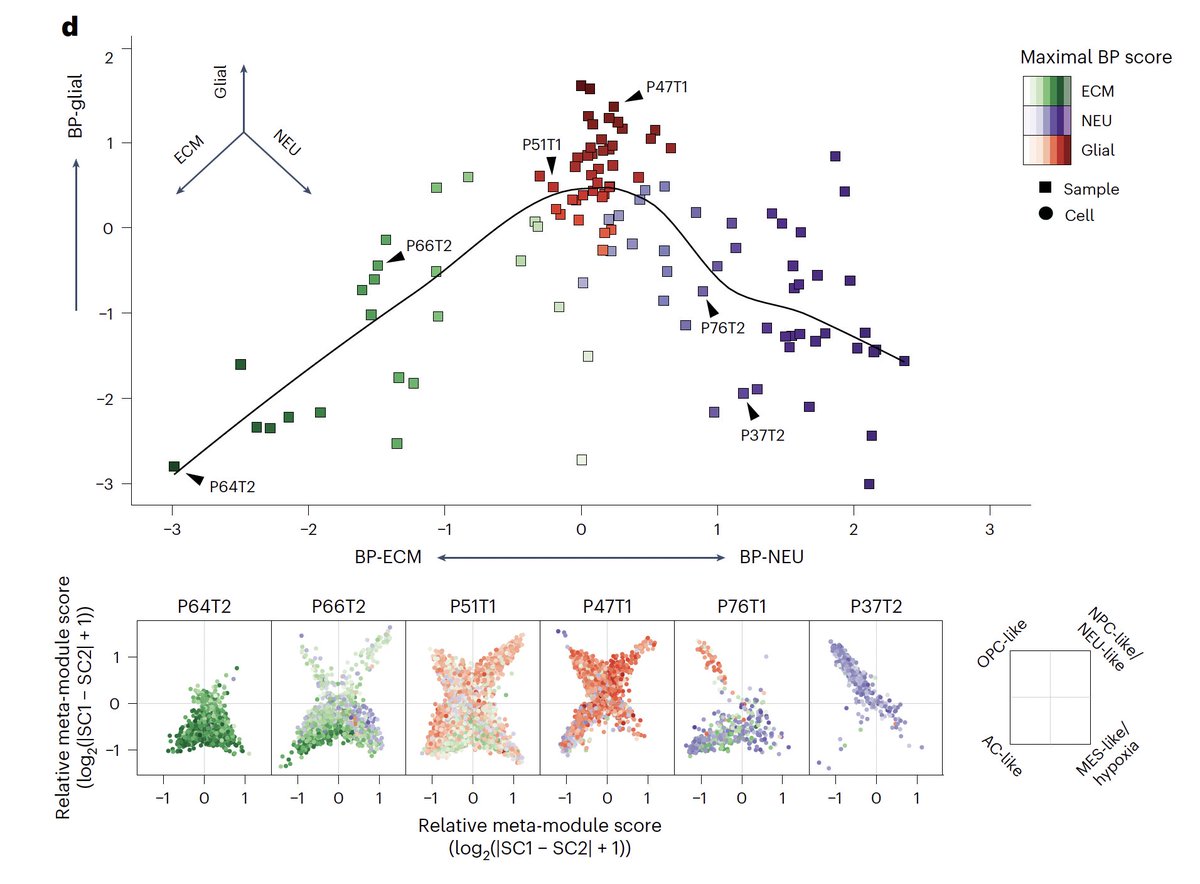
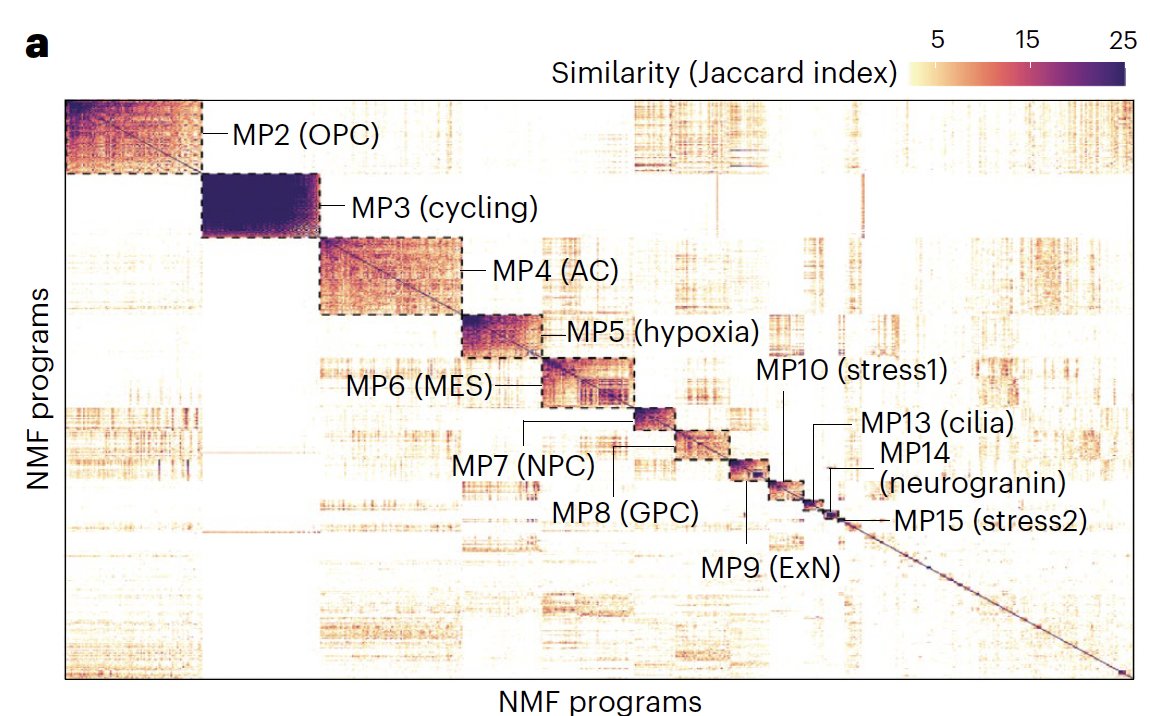
8/ Second, we describe the diversity of cellular states and their pathway-based functional activities, with an expanded set of malignant cell states, including glial progenitor cell-like, neuronal-like, and cilia-like states that were previously depleted by tumor dissociation
Masashi Nomura tweet media
English
0
1
3
870
Mario Suva retweetledi
Masashi Nomura
Masashi Nomura@M_Nomura·
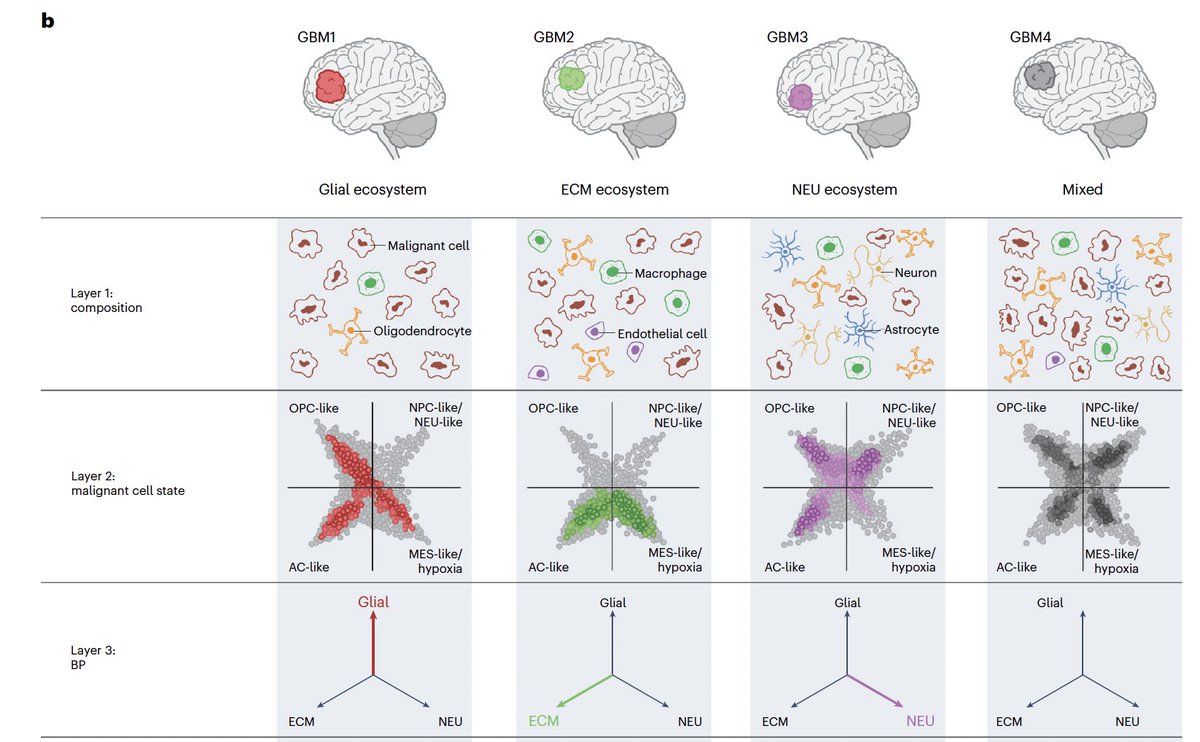
10/ These three layers of heterogeneity are inter-related and partially associated with specific genetic aberrations, thereby defining three stereotypic ecosystems in GBM. This work provides an unparalleled view of the multi-layered transcriptional architecture of GBM.
Masashi Nomura tweet media
English
0
1
3
985
Mario Suva retweetledi
Masashi Nomura
Masashi Nomura@M_Nomura·
9/ Third, after controlling for the frequencies of cellular states, we find that the remaining variation between GBM samples highlights three baseline gene expression programs which we labeled Neuronal, Glial, and Extracellular Matrix.
Masashi Nomura tweet media
English
0
1
1
690