Mark Phillips

24.9K posts

Mark Phillips banner
Mark Phillips

Mark Phillips

@Mark_Phillips

{Locked In}

On the ledger Katılım Kasım 2008
5.6K Takip Edilen10.2K Takipçiler
Sabitlenmiş Tweet
Mark Phillips
Mark Phillips@Mark_Phillips·
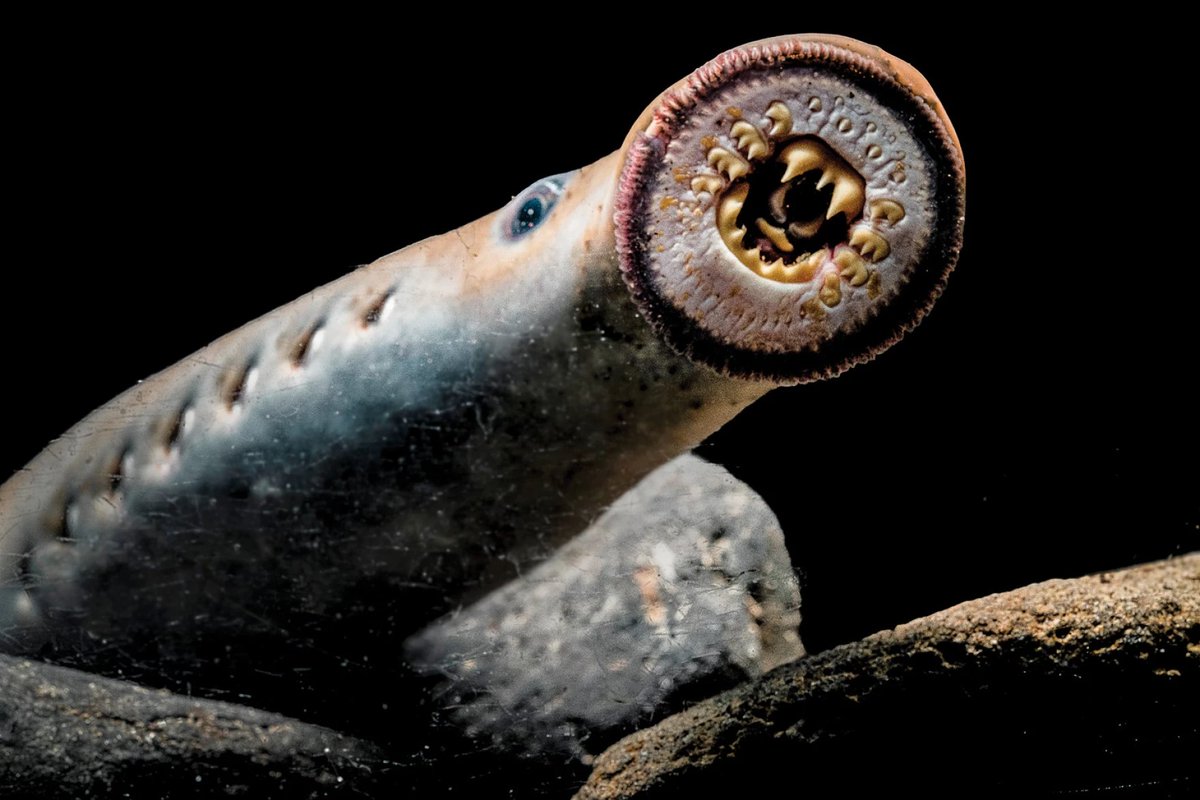
The Epstein class isn't bothered when we call them "predators" because they like to see themselves as lions, tigers, or sharks. You know, "king of the jungle" alphas.🤨 Let's call them what they really are: Parasites that suck the life, value, and dignity out of others. 🪱🦟🦠
Mark Phillips tweet media
English
1
0
4
448
Mark Phillips retweetledi
Not Jerome Powell
Not Jerome Powell@alifarhat79·
Lmaoooooo I’m crying
English
431
3K
13.5K
1.1M
Mark Phillips
Mark Phillips@Mark_Phillips·
This is some weird perversion of Christianity -- in which hate is good and love is bad -- and is not representative of the faith I was raised in. I wonder if these people have even read the New Testament. You know, the Jesus part?
Jennifer Bendery@jbendery

New: Pete Hegseth’s pastor and close spiritual advisor says he wants Texas Democratic state Rep. James Talarico to die. “We want him crucified with Christ,” Brooks Potteiger said of Talarico, as the podcast host said he prays “that God kills him.” huffpost.com/entry/pete-heg…

English
0
0
1
62
Mark Phillips retweetledi
OSINTdefender
OSINTdefender@sentdefender·
Per CNN, the updated number of injured U.S. forces since the conflict in the Middle East began is 290, with the killed in action remaining at 13.
English
60
164
2.1K
172.3K
Mark Phillips retweetledi
MAGA Cult Slayer🦅🇺🇸
“Those are the words of a potential war criminal.”
English
450
9.5K
22.1K
415.8K
Mark Phillips retweetledi
evernorthxrp
evernorthxrp@evernorthxrp·
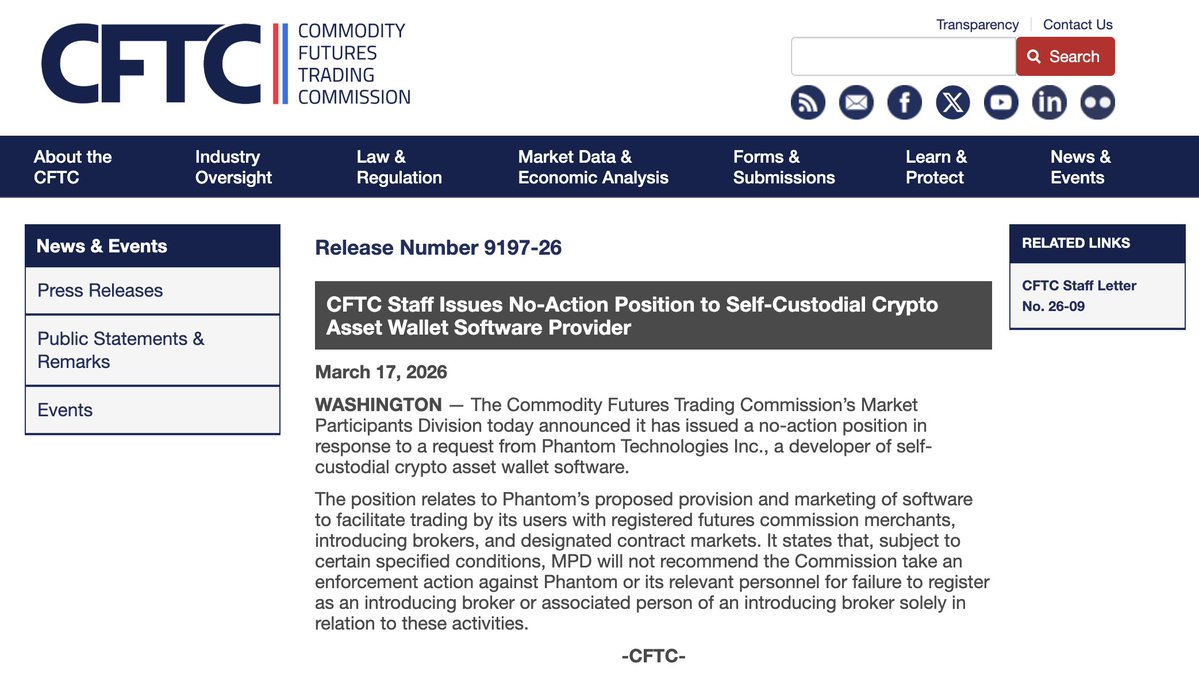
🚨More US regulatory momentum! Hidden by the SEC commodity classification last week, the CFTC issued its first no-action letter for a self-custodial wallet. The core principle: if you don’t hold customer funds, you’re not a financial intermediary. In other words, you’d be infrastructure, not a broker. XRP was designed for this. Assets settle on-chain, not through a central counterparty. cftc.gov/PressRoom/Pres… Learn more: evernorth.xyz/press-release-…
evernorthxrp tweet media
English
13
284
1.2K
62.8K
Mark Phillips retweetledi
Jungle Inc Crypto News
Jungle Inc Crypto News@jungleincxrp·
Dear @MonicaLongSF, I hope this letter finds you well. My name is Jungle Inc. I am a content creator focused on the XRP Ledger ecosystem and institutional crypto adoption. I am writing today not to report on a crisis, but to sound an alarm about a generational opportunity that is actively slipping through our fingers. We are standing at the threshold of the most explosive wave of blockchain adoption in history and it will not be driven by human users. It will be driven by AI agents. The number of autonomous AI agents that will require on-chain payment rails in the next decade will dwarf the total number of human beings who will ever interacted with blockchain technology combined. These agents need to transact continuously, instantly and at fractions of a cent, without human oversight, without friction, and without failure. This is the micropayment moment. The XRP Ledger was purpose-built for exactly this. The history is right in front of us. Coil demonstrated that streaming micropayments worked. In less than a year of operation, Coil processed 10 billion payments to creators. Ten billion. The technology was proven. The infrastructure was real. When Coil sunset in 2023, it wasn't because micropayments failed, it was because the market wasn't ready. The market is now ready. The market is arriving faster than anyone anticipated and it is wearing the face of artificial intelligence. Every other major protocol will eventually attempt to claim this vertical. They always do. We have watched XRPL developers pioneer RWA tokenization, decentralized exchanges, and payment channel infrastructure, only to watch other chains scale those use cases while XRPL moved on. That pattern cannot repeat itself here. Micropayments are not one use case among many. They are the foundational primitive of the agentic economy. Whoever owns micropayments owns the settlement layer of AI. XRPL must own micropayments. The ledger's sub-second finality, near-zero transaction costs and proven payment channel architecture make it the only credible candidate to serve this demand at scale. This is not a future we need to build from scratch, it is a birthright we need to claim. @JoelKatz knows more about micropayments and the architecture of streaming value than perhaps anyone alive. Since stepping back from his CTO role, he has spoken publicly about returning to hands-on building, running his own XRPL node, researching use cases beyond Ripple's current focus, and coding again for the love of it. Tapping David Schwartz to lead a Coil 2.0 initiative, a next-generation micropayment and AI agent payment layer built natively on XRPL, would reunite the right mind with the right mission at the right moment in history. I also want to thank you for your thoughtful response to my last open letter on the XRPL Foundation. And to the teams at Ripple, XRPL Commons, XRPL Labs, and the XAO DAO: congratulations. The progress made in moving the XRP Ledger toward the most decentralized foundation model in blockchain is a testament to what principled, coordinated leadership can achieve. The window is open. It will not stay open forever. Let's press our greatest advantages. Sincerely, Jungle Inc.
English
46
129
582
33.7K
Mark Phillips retweetledi
Shanaka Anslem Perera ⚡
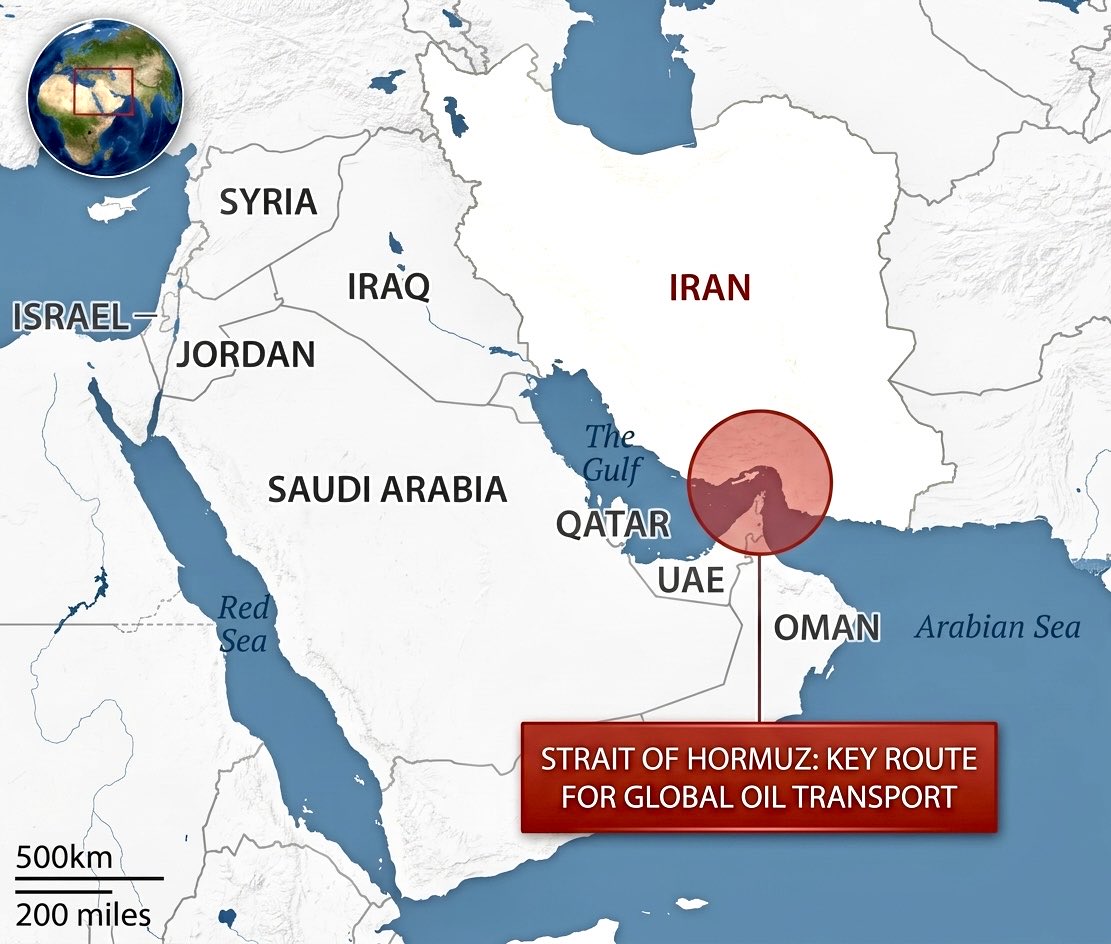
BREAKING: The nitrogen trap just closed. Three locks snapped shut simultaneously. The planting window is closing behind them. And the food the world eats next year is now being decided by molecules that cannot reach the soil in time. Lock one: the Strait of Hormuz. The IRGC permissioned corridor allows oil tankers from friendly nations to pay $2 million in yuan and pass. It does not allow fertiliser vessels to pass at any price. Zero approved fertiliser transits in 24 days. The Gulf supplies 49 percent of the world’s exported urea and roughly 30 percent of traded ammonia. That supply is not delayed. It is denied. The gate opens for molecules that fund the gatekeeper. It stays closed for molecules that feed the planet. Lock two: Russia. The world’s largest exporter of ammonium nitrate just halted all AN exports until after April 21. Three to four million tonnes per year, gone from global markets at the exact moment the Northern Hemisphere needs it most. The official reason is “domestic priority.” The strategic effect is leverage. Russia earns windfall revenue from the oil price spike its ally’s war created, then removes the fertiliser that farmers need to plant through the crisis. The disease and the cure, again, from the same address. Lock three: China. Beijing has banned exports of nitrogen-potassium blends and phosphate fertilisers through August 2026. China is the world’s largest phosphate producer and a major nitrogen supplier. The ban removes the last alternative source that could have compensated for Hormuz and Russia. Three locks. Three countries. Three deliberate decisions timed to the same biological calendar. The biological calendar does not negotiate. Corn requires nitrogen at the V6 to VT growth stage or kernel set is permanently reduced. Wheat requires it at tillering and jointing or grain fill collapses. Rice requires it at transplanting or yield drops 20 to 40 percent in low-input systems. These are not economic models. They are cellular processes. The plant either receives nitrogen during the window or it does not. If it does not, no subsequent application, no price increase, no policy reversal can recover what was lost. The damage is written into the biology of the seed. The US Corn Belt window closes mid-April. European top-dressing is happening now. Indian Kharif preparation begins in May. Bangladeshi Boro rice transplanting is underway this week. Every one of these windows is closing while the three largest sources of nitrogen on Earth are simultaneously locked: Hormuz by military blockade, Russia by export decree, China by trade ban. The USDA Prospective Plantings report arrives March 31. The FAO Food Price Index publishes April 3. These will quantify what the molecules already know: the nitrogen did not arrive. The yield loss is locked in. The 5 to 10 percent global drag will concentrate where the buffers are thinnest: subsistence farms in Bangladesh, Sub-Saharan Africa, South Asia, where a 20 percent shortfall does not mean lower profits. It means hunger. Sri Lanka banned synthetic fertiliser in 2021. Rice yields collapsed 40 percent. The government fell. In 2008, fertiliser and oil spiked simultaneously and food riots erupted across 30 countries. In 2026, the strait blocks fertiliser while Russia and China withdraw the alternatives, and the planting windows close on a planet with nowhere else to turn. The war is fought with missiles. The famine is fought with molecules. The molecules are trapped behind three locks on three continents, timed to the one calendar that cannot be paused, extended, or negotiated: the calendar written into the DNA of every seed in the soil. Full analysis: open.substack.com/pub/shanakaans…
Shanaka Anslem Perera ⚡ tweet media
Shanaka Anslem Perera ⚡@shanaka86

JUST IN: The most irreversible consequence of this war is not happening in Tehran. It is happening in a barn in Iowa. A farmer is standing over a kitchen table looking at two seed catalogues. One is corn. One is soybeans. Corn needs 180 pounds of nitrogen per acre. Nitrogen costs $610 per ton on the CBOT March futures settlement as of yesterday, up 35 percent in a month. Soybeans fix their own nitrogen from the atmosphere through root bacteria called rhizobia. They need nothing from the Strait of Hormuz. The farmer is choosing soybeans. Millions of acres are choosing soybeans. And once the planter rolls into the field, the choice cannot be reversed until next year. USDA projected corn at roughly 94 million acres for 2026, down from 98.8 million. Soybeans at 85 million, up from 81.2 million. Those projections were published February 19, before urea surged past $683 at New Orleans. The actual shift will be larger. USDA Prospective Plantings reports March 31. By then the seeds will be in the ground. This is the transmission channel the world is not watching. A 21-mile strait enforced by provincial commanders with sealed radio orders just rewrote the planting economics of 90 million acres of the most productive farmland on Earth. Not through sanctions. Not through diplomacy. Through the price of a single molecule that corn cannot grow without and soybeans do not need. Now follow the cascade. The Renewable Fuel Standard mandates 15 billion gallons of corn ethanol annually. That consumes roughly 43 percent of the entire US corn crop. The mandate is set by the EPA. It does not flex when corn acres shrink. It is inelastic demand consuming a fixed share of a declining supply. When supply tightens against a fixed mandate, the remaining corn reprices upward. Corn above $5 per bushel compresses every margin downstream. The US cattle herd stands at 86.2 million head, a 75-year low per USDA NASS. Poultry and pork operations face compression from higher corn prices. Feed is the single largest cost in livestock production. When feed reprices, protein reprices. When protein reprices, every grocery shelf in America absorbs the increase. This is the protein cascade. Corn to feed to meat to eggs to dairy to the checkout counter. Each link tightens because the link before it tightened. The originating cause is a urea molecule that cannot transit a strait because a provincial commander’s sealed orders say it cannot. The farmer did not start this war. The farmer cannot end it. The farmer responds to the price on the screen and the biology of the two crops in front of him. Corn needs the molecule. Soybeans do not. At $610 the arithmetic is settled. The planter rolls. The season is locked. Israel just authorised the assassination of every Iranian official on sight. The US has spent $16.5 billion. South Pars is burning. The Fed is holding rates because oil inflation will not break. Gold touched $5,000. Bitcoin is bleeding. China is running exercises near Taiwan. Sri Lanka shut down on Wednesdays. And underneath all of it, a man in a barn is making the decision that determines whether four billion people pay more for food this year. He has never heard of the Mosaic Doctrine. He does not know what a sealed contingency packet is. He knows what nitrogen costs. And he is planting soybeans. Full analysis - open.substack.com/pub/shanakaans…

English
120
1.2K
2.6K
277.7K
Mark Phillips retweetledi
Maine
Maine@TheMaineWonk·
Trump’s lackeys at SEC are preventing agency from investigating insider trading and fraud cases so the head of enforcement— a former military judge, resigned. Gee, I wonder why.
Maine tweet media
English
11
439
885
25.1K
Mark Phillips retweetledi
Shanaka Anslem Perera ⚡
BREAKING: The IRGC toll booth at the Strait of Hormuz right now accepts three currencies: cash, yuan, and cryptocurrency. The third one is the one that keeps sanctions lawyers awake at night. Because the third one moves at the speed of light through rails that no government on Earth fully controls. The Financial Times and Lloyd’s List confirmed that payments for the $2 million per-tanker toll are accepted in cash, cryptocurrency, or barter. The dominant crypto rail, per Chainalysis reporting on IRGC flows, is USDT on the Tron blockchain. The reason is mechanical: Tron settles in approximately 3 seconds per block, charges negligible fees, and operates with limited identity verification on many access points. A $2 million stablecoin transfer can be initiated, confirmed, and received before a sanctions compliance officer finishes reading the transaction alert. The IRGC’s crypto architecture is not improvised. Chainalysis documented over $3 billion in IRGC-linked USDT flows in 2025 alone, used for sanctions evasion, oil settlement, and proxy funding across Hezbollah and Houthi networks. The Hormuz toll gate is the latest application of an infrastructure that was already operational before the first missile was fired. The war did not create the crypto rail. The war gave it a chokepoint to monetise. The United States has responded with targeted sanctions. OFAC has designated dozens of IRGC-linked Tron addresses. Tether has frozen identified wallets. But the disruption rate, per Chainalysis estimates, remains approximately 10 to 20 percent of identifiable flows. The gap between identification and enforcement is structural. The IRGC uses layered transfers through multiple addresses, cross-chain bridges to other networks, over-the-counter desks in jurisdictions beyond US reach, and integration with yuan settlement channels for larger state-linked transactions. Each layer adds obfuscation. Each bridge adds jurisdiction. Each OTC desk adds deniability. The 3-second block time means the funds have moved before the freeze order arrives. Behind the crypto toll, a parallel rail operates at the state level. Russia’s digital ruble and China’s e-CNY are being used in bilateral trade with Iran for oil and fertiliser settlement on sovereign, permissioned blockchains that sit entirely outside US jurisdiction. These are not decentralised networks. They are centrally controlled ledgers operated by the Russian Central Bank and the People’s Bank of China. The United States cannot sanction a sovereign central bank’s own ledger. It cannot freeze a digital ruble that never touches a US-regulated rail. The CBDC channel handles the larger, slower, state-to-state flows. The USDT channel handles the tactical, fast, deniable flows. Together they form a two-tier payment system that bypasses the dollar from both the top and the bottom. This is the war’s financial dimension that almost nobody is covering. The kinetic war degrades launchers and flattens headquarters. The energy war closes the strait and blocks fertiliser. The financial war builds a parallel payment system under live fire that may outlast the conflict itself. The yuan toll collects at the gate. The USDT transfer settles in 3 seconds. The digital ruble clears between Moscow and Tehran on a ledger Washington cannot read. And the dollar, which has governed energy settlement since 1974, watches from the other side of the strait where 400 ships are waiting and none of them are paying in greenbacks. The molecules are trapped. The money is not. And the money that moves through the toll booth is building the infrastructure that the molecules will use when the strait finally reopens, in a currency that is no longer the dollar. Full analysis: open.substack.com/pub/shanakaans…
Shanaka Anslem Perera ⚡ tweet media
English
52
437
989
128.9K
Mark Phillips retweetledi
The Washington Post
The Washington Post@washingtonpost·
President Trump, who is in the midst of pressuring senators to curb the use of mail-in voting, voted by mail ballot in Tuesday’s special election in Palm Beach County, Florida. wapo.st/47fVUwf
English
1.1K
9K
17.5K
1.1M
Mark Phillips retweetledi
Dom Kwok | EasyA
Dom Kwok | EasyA@dom_kwok·
everyone’s talking about the clarity act. but barely anyone’s heard about the parity act. yet the parity act is what finally lets people use crypto in their daily lives. here’s what you need to know about the most important crypto act nobody’s heard of: 1/ no capital gains tax on daily transactions the act proposes a $200 tax exemption for personal crypto transactions. this means you don’t pay capital gains tax every time you buy something using crypto (ie a cup of coffee!) 2/ deferred taxes on staking income currently, when you stake your crypto, your staking income is taxed upon receipt. the parity act allows taxpayers to defer their taxes on staking rewards for up to 5 years. this means you won’t pay taxes on income you haven’t yet received (or on assets that have depreciated in value). 3/ no taxes on crypto lending the act creates parity between securities lending and crypto lending. so when you use your crypto as collateral, it no longer counts as a sale - preventing unnecessary tax bills.
English
102
350
1.6K
52.5K
Mark Phillips retweetledi
Anthony Scaramucci
Anthony Scaramucci@Scaramucci·
Most of you will hate me saying this, but I will say it anyway. The Democrats are in complete disarray and have no coherent message. No real solutions. Just anti-Trump rhetoric on a loop. And listen — I understand the anti-Trump sentiment. I share a lot of it. But that is not a governing platform. That is not a vision for the country. And it is not going to win elections. Talk to your constituents about affordability. About raising living standards. About the wealth gap that is tearing this country apart at the seams. Here’s the hard truth: If we don’t fix the wealth gap through traditional American capitalism, we will have a populist leader on the left or a populist leader on the right in perpetuity. And that is genuinely dangerous for the country. Trump looks imperious right now. Looks invincible. I understand why people are scared. But he’s got 36 months. He can do a lot of damage in 36 months. I won’t minimize that. But it is 36 months. The question is whether the opposition uses that time to build something real or spends it screaming into the void.
English
664
360
1.9K
120.3K
Mark Phillips retweetledi
Dustin
Dustin@r0ck3t23·
Jensen Huang just explained why China is winning the technology race in two sentences. Huang: “Our country’s leaders… they’re mostly lawyers. Most of their leaders are incredible engineers.” One country sends engineers to lead. The other sends lawyers. One builds. The other regulates what was already built. Huang: “They showed up at precisely the time when technology is going through that exponential.” China did not stumble into the AI era. They arrived engineered for it. The education system produces engineers at a scale the West refuses to match. The competition is not tough. It is Darwinian. The culture rewards builders. Not commentators. Not consultants. Builders. Then the accelerant. Open source. When your talent pool runs that deep and that hungry, you do not hoard breakthroughs. You release them. The community multiplies everything. What costs American companies a quarter, Chinese teams finish in weeks. Not because they are smarter. Because the entire system points one direction. Zero friction between idea and execution. No committee. No review board. No eighteen-month compliance process. Then Huang said the part that should terrify Washington. Huang: “Their country was built out of poverty.” Comfort makes nations careful. Poverty makes nations relentless. When you built everything from nothing, you do not slow down to protect it. You accelerate because you still taste what nothing felt like. America built its dominance with engineers. The highways. The moon landing. The semiconductor. The internet. Then it handed the keys to the lawyers. Compliance departments. Regulatory bodies. Oversight committees. Review processes for the review processes. Every layer of protection is a layer of friction. And friction is a luxury you cannot afford when your competitor rides an exponential curve. Fridman: “It’s a builder nation.” Huang: “Yeah, it’s a builder nation.” No pushback. No qualifier. The West is not being outspent. It is being out-structured. Engineers ask how do we build this faster. Lawyers ask how do we build this without getting sued. One of those questions wins the century. The other writes a detailed report about why it lost.
English
163
543
2K
335.4K
Mark Phillips retweetledi
Shanaka Anslem Perera ⚡
BREAKING: South Korea just announced mandatory fuel rationing. Government vehicles at public institutions barred from operating one day each week on a five-day licence plate rotation. The world’s 10th largest economy, a G20 member, a semiconductor superpower, home to Samsung and SK Hynix, the country that fabricates a quarter of the world’s memory chips, is rationing fuel like Sri Lanka. South Korea imports 73 to 87 percent of its oil from the Middle East. Every barrel transits the Strait of Hormuz. The strait is closed and mined. There is no alternative route for Korean crude imports at scale. The Kospi crashed 4.9 percent on Monday before Trump’s “productive conversations” post briefly eased the panic. The won is weakening. Inflation is accelerating. And now the Energy Minister is telling government workers which days they cannot drive. Count the dominoes. Sri Lanka rationed first: Wednesdays off, QR codes at pumps, LPG vanished from southern shelves. Bangladesh followed with public holidays to conserve fuel. Pakistan imposed restrictions. India tightened allocations. Slovenia became the first EU country with QR codes and odd-even plates. Now South Korea. The rationing is no longer a developing-world phenomenon. It is migrating up the GDP ladder. The 10th largest economy. The 12th largest military budget. A US treaty ally hosting 28,500 American troops. Rationing. Those 28,500 troops run on fuel. USFK operates bases across the peninsula that require continuous diesel, aviation fuel, and generator capacity. Joint exercises with the ROK military consume thousands of tonnes of fuel annually. Every barrel of that fuel traces back to the same Middle Eastern supply chain that South Korea’s Energy Minister just acknowledged cannot sustain civilian demand. If civilian vehicles are being restricted, military logistics are under pressure. If military logistics are under pressure, deterrence against North Korea erodes. If deterrence erodes, Pyongyang and Beijing calculate. The Strait of Hormuz is 7,500 kilometres from the Korean DMZ. The fuel that deters Kim Jong Un transits a chokepoint held closed by Iran’s 140 remaining missile launchers. Kim Jong Un is watching. Every day that South Korea rations fuel is a day that North Korea’s calculus shifts. Not toward war, not yet, but toward the conclusion that the American alliance system has a fuel dependency that a single regional conflict can exploit. The US cannot simultaneously secure the Strait of Hormuz with carrier groups, deploy 82nd Airborne paratroopers to the Iran theater, accelerate the 11th MEU from San Diego, AND maintain full deterrence posture on the Korean Peninsula. Something gives. The fuel rationing in Seoul is the first visible signal of what is giving. Taiwan is watching too. TSMC’s fabrication plants in Hsinchu are counting LNG reserves in single-digit days. Taiwan imports virtually all of its energy. If South Korea, with its larger strategic reserves and diversified economy, is already rationing, Taiwan’s timeline is shorter. The chips that power every Nvidia GPU, every Apple processor, every AI training run on Earth depend on a gas supply that depends on a strait that depends on a 5-day pause that depends on a Truth Social post that Iran says corresponds to nothing. Sri Lanka. Bangladesh. Pakistan. India. Slovenia. South Korea. Six countries rationing. Three continents. One strait. The molecules do not check GDP rankings. The molecules check whether the chokepoint is open. It is not. open.substack.com/pub/xerion/p/a…
Shanaka Anslem Perera ⚡ tweet media
English
148
1.8K
4.1K
490.3K
Mark Phillips retweetledi
OSINTdefender
OSINTdefender@sentdefender·
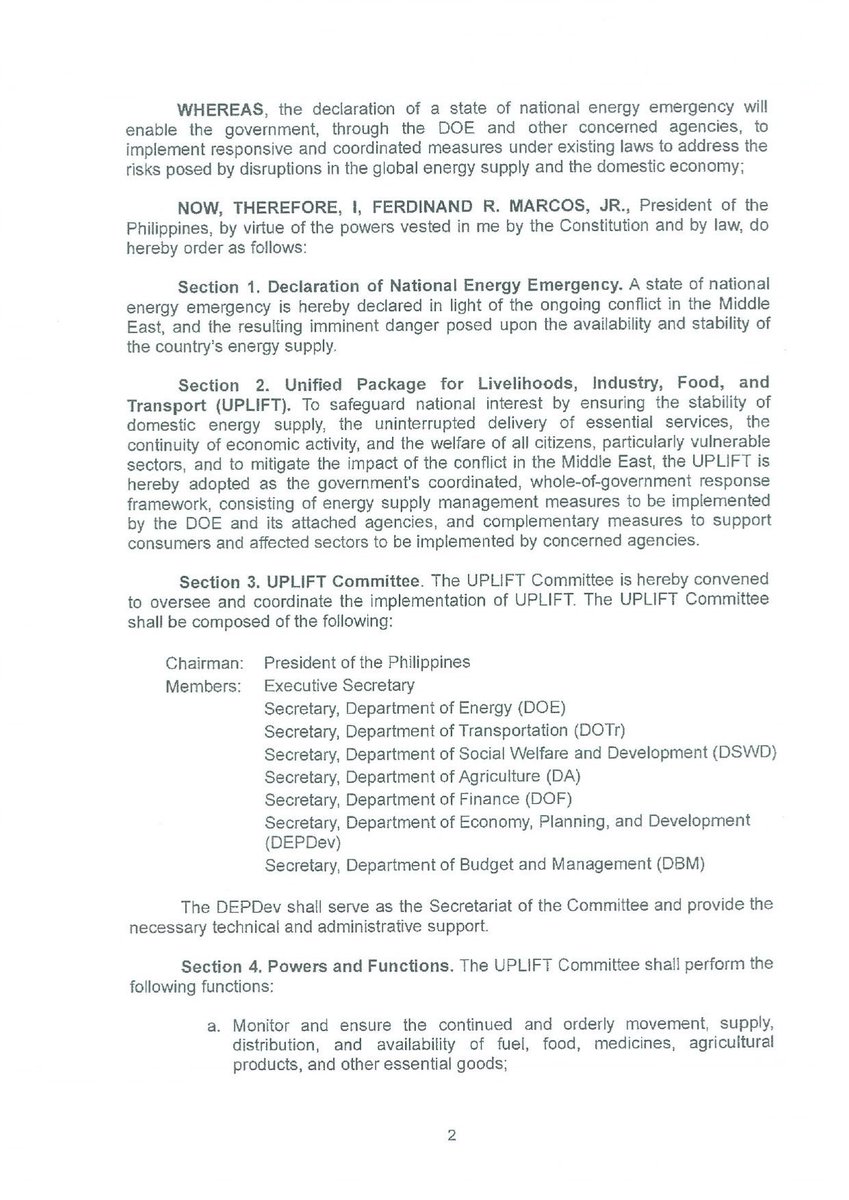
President of the Philippines Ferdinand “Bongbong” Romualdez Marcos has signed Executive Order No. 110, declaring a State of National Energy Emergency throughout the country due to the ongoing conflict in the Middle East and the closure of the Strait of Hormuz.
OSINTdefender tweet mediaOSINTdefender tweet mediaOSINTdefender tweet mediaOSINTdefender tweet media
English
51
213
1.3K
152.8K
Mark Phillips retweetledi
The Wall Street Journal
Exclusive: Securitize will become NYSE’s first digital transfer agent, allowing it to create shares for stocks and exchange-traded funds as digital tokens on a blockchain on.wsj.com/3Nyh8Pj
English
53
181
755
135.8K
Mark Phillips retweetledi
Shanaka Anslem Perera ⚡
BREAKING: The Strait of Hormuz is no longer closed. It is no longer open. It is something the world has never seen before: a permissioned corridor run by the Islamic Revolutionary Guard Corps, priced at $2 million per vessel, payable in yuan. Three ships transited in the last 24 hours. Three. Out of a pre-war average of 60 per day. Total throughput: 310,000 deadweight tonnes. Three percent of normal. Four hundred vessels are waiting outside the strait right now. One hundred and fifty tankers. One hundred and twenty bulk carriers. One hundred and thirty others. Waiting for permission from the IRGC Navy to enter a 5-nautical-mile channel between Larak and Qeshm islands inside Iranian territorial waters. This is how the gate works. A vessel operator contacts approved intermediaries with IRGC connections, submitting full documentation: IMO number, ownership chain, cargo manifest, destination, crew list. The intermediaries forward the package to the IRGC Navy’s Hormozgan Provincial Command for sanctions screening, cargo alignment checks that prioritise oil over all other commodities, and geopolitical vetting. The toll is approximately $2 million per tanker. For a VLCC carrying 2 million barrels, that is $1 per barrel. Preferred currency: yuan. If the vessel passes, the IRGC issues a clearance code and route instructions. Upon approach, VHF radio hail, AIS verification, patrol boat escort. One ship at a time. Through the narrowest channel of the most important waterway on Earth. Iranian crude is still flowing. Approximately 1.1 to 1.5 million barrels per day, mostly to China, at near pre-war levels. Iran’s own oil transits the strait it controls. The blockade applies to everyone else. Iran is simultaneously the gatekeeper and the primary beneficiary. The toll funds the IRGC. The IRGC maintains the gate. The gate generates the toll. The circle is self-sustaining. Now look at what is NOT transiting. Fertiliser. Gulf nations supply 49 percent of the world’s exported urea. Ammonia requires the natural gas that Qatar declared Force Majeure on and that Iranian strikes disrupted at South Pars. Effectively zero fertiliser vessels have received approval through the permissioned corridor. The IRGC is prioritising oil because oil generates revenue. Fertiliser does not. The molecules that feed four billion people are trapped behind a gate that only opens for molecules that fund the gatekeeper. The yuan preference is the structural shift that outlasts the war. Every tanker that pays in yuan instead of dollars establishes a precedent. Every precedent weakens the petrodollar architecture that has governed energy trade since 1974. The IRGC is not just blocking a strait. It is building an alternative payment rail under live fire. The $2 million toll in yuan is not a fee. It is a proof of concept for a post-dollar energy settlement system, stress-tested in the most extreme conditions imaginable: a three-front war with the world’s largest military. The world’s central banks are trapped by the same strait: the Fed cannot cut, the ECB is hiking, the BOJ is tightening. Six countries are rationing fuel. Japan’s 10-year yield hit a 27-year high. Slovenia has QR codes at the pump. South Korea is barring government vehicles one day per week. And behind all of it, 400 ships wait outside a 5-nautical-mile channel for a clearance code from the IRGC Navy, payable in a currency that is not the dollar. Twenty percent of the world’s oil supply. Controlled by a VHF radio call and a yuan transfer. The strait did not close. It changed ownership. open.substack.com/pub/shanakaans…
Shanaka Anslem Perera ⚡ tweet media
English
628
4K
9.8K
1.5M