
Marta May
183 posts


Marta May
@martiimay
2x PhD, 3x lingual dropout, co-founder MD practice in the Arctic Circle, working on cognitive and behavioral AI
New York, USA Katılım Ocak 2020
410 Takip Edilen606 Takipçiler

Founder closed a $15m Series A (top tier VC) and 6 months later, plans to return the cash to investors. Feels like long term, Claude will displace the product / erode the value. This is really happening, most people are not talking about it, it’s kinda wild.
English
@i_Forget_ yea, you get it. what kind of interaction model do you think emerges from that?
English

@martiimay I called it Test-Time Cognition last year. It’s a different kind of interaction from what we know today. Keep it up.
English


i don't have anxiety anymore. i have mania and when a scientist has mania they get Nobel prizes. when a founder has mania they raise rounds that get people with compute to cure everything and makes us a unicorn
Alesya@AlesyaMacWaters
Founder anxiety is really just founder ambition
English
Marta May retweetledi
Marta May retweetledi

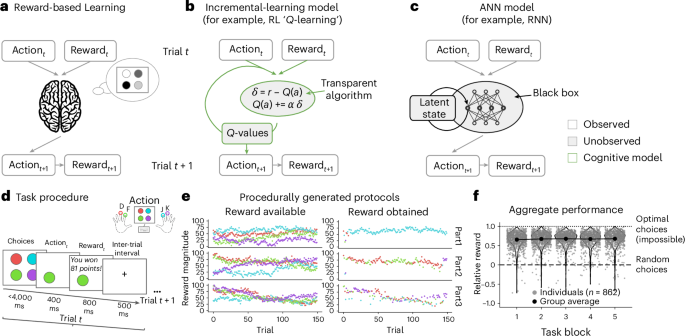
Hybrid neural–cognitive models reveal how memory shapes human reward learning dlvr.it/TQmnHG
English

Marta May retweetledi

First Principles of Human Cognition
1. Bounded Rationality — Herbert Simon's idea that we don't optimize, we "satisfice." Our brains have limited time, information, and processing power, so we use shortcuts. Our full rationality isn't available to us, and the shortcuts we use instead have predictable failure modes.
2. Asymmetry Between Construction and Critique — It's far easier for the mind to poke holes in a story than to generate a balanced one from scratch. Premortem exploits this: instead of asking you to imagine all possibilities (construction), it hands you a conclusion and asks you to explain it (critique). The brain is a better lawyer than scientist.
3. The Narrative Fallacy / Coherence Over Completeness — System 1 builds the most coherent story it can from available evidence and suppresses awareness of what's missing. Framing effects exist because different presentations activate different stories. Reference class forecasting works because it forces you to consult data that your narrative conveniently ignored.
4. Affective Contamination — Feelings about one dimension bleed into judgments about others. You like a candidate's charisma, so you rate their analytical skills higher too. Noise reduction's core principle — score dimensions independently before forming a holistic judgment — exists specifically to block this contamination channel.
5. Miscalibrated Confidence — We systematically overestimate our knowledge and our ability to predict. The gap between what we think we know and what we actually know is wide, persistent, and resistant to experience. Nearly every advanced thinking method, at root, is a humility device.
6. What You See Is All There Is (WYSIATI) — The mind works only with activated information and doesn't spontaneously ask "what am I not seeing?" Every structured thinking method is essentially a forced prompt to consider what's outside your current frame.
The deepest first principle, the one beneath all the others, might simply be this: the quality of a decision is determined by what you considered, not by how it turned out. Every structured thinking method expands what you consider.

English
@aakashgupta men who can remove the right variable are definitely attractive
English

Mark Zuckerberg engineered a custom hardware device for his wife in 2019. No clock face. One faint light. A one-hour window.
Priscilla had a specific problem. She'd wake up in the middle of the night, check her phone for the time, and the number itself spiked her anxiety. 4am meant worry about the kids waking soon. 5:30 meant calculating whether to just get up. The information was the trigger.
Most engineers approach "can't sleep" by adding things to the bedroom. A meditation app. A Hatch alarm. A weighted blanket. A sleep coach.
Mark removed the variable that was running the wake-up loop.
The Sleep Box sits on Priscilla's nightstand and shows nothing for 23 hours a day. Between 6am and 7am it emits a single faint light. Faint enough not to wake her if she's still asleep. Visible enough that if she's already up, she knows it's okay to start the day. The rest of the night, dark. No clock. No time display. If she wakes at 3am she has no data to push her cortisol up with, so she goes back to sleep.
He wrote the firmware and built the enclosure himself. No team, no procurement, no Meta resources. He posted the result on Instagram and said it worked better than he expected.
The design move most CEOs would never run is the personal one. The instinct is to outsource a family problem to a specialist. A sleep coach. A doctor. A consumer electronics startup with a Series B and a marketing budget.
Mark intervened at a specific link in the chain. Time data hitting Priscilla's brain at 3am was what broke sleep. The phone got moved off the nightstand and replaced with a box that physically cannot deliver that data.
The box has no clock. That's the entire product.


English
@Trace_Cohen Hahah, hilarious. I’d show up at the customer’s office every two weeks, testing each small part before putting it all together. Co-development is hard, but def worth the effort
English

Founders building a product without talking to any customers.
English
Marta May retweetledi

Never quit as a founder. I’m begging you.
It’s 0 for longer than you’ll ever expect. No momentum. Soul-crushing doubts. Nobody seems to care. Even when it looks like it’s working, it’s not. You keep trying new things. You don’t lose hope.
Then it snaps to 100. You finally find the one thing that resonates. You wake up with more customers than you can handle. Everything is breaking. Momentum keeps building even when you’re not pushing. Something changed.
You didn’t get lucky, you just didn’t leave.
English
@theandreboso Norwegian forest is pretty great. You can just lock in and obsess in peace
English
I was wondering what are the best tech cities in Europe right now.
Based on what I see online I’d probably say Stockholm, Paris and…? Where is the cool stuff happening right now?
I really hope to see a future when people don’t feel the need to move to the US.
English

@paulscherer we need both: frontier tech creates the tool, cultural intuition creates the category
English

last gen’s successful consumer founders (pinterest, snap, insta, etc.) weren’t on the bleeding edge of tech, they were on the bleeding edge of culture and human experience.
most of consumer ai today is still more interested in the tech than the culture. in the fullness of time, i don't think they'll survive.
English
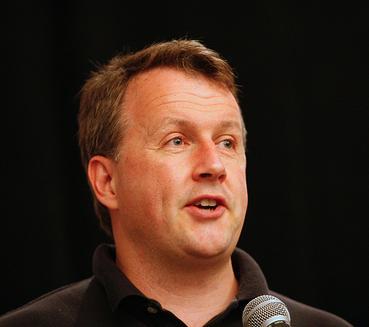
We're in Stockholm. You know how there are some places where you think "Nice place to visit, but I wouldn't want to live there"? Stockholm is the kind of place that makes you want to live there.
English
Only suffering makes you a better founder.
The rejections. The flat metrics. The 3 AM ceiling stares wondering if you’re delusional.
Embrace it. High pain tolerance is the only moat that can't be disrupted.
Don't seek ease. Seek strength. Aim for the impossible.
English
