Martin Signoux

2.6K posts

Martin Signoux banner
Martin Signoux

Martin Signoux

@MartinSignoux

Red-teaming innovation, fine-tuning regulation ——— AI policy @OpenAI

Paris Katılım Haziran 2016
1.5K Takip Edilen2.6K Takipçiler
Martin Signoux retweetledi
Sebastien Bubeck
Sebastien Bubeck@SebastienBubeck·
yes, nonsofic groups exist: this statement is one of many new beautiful results proved by Astra, our next major model. We're releasing 10 such Astra proofs, complete with lean certificates and CoT walkthroughs for each of them. The results are wide-ranging, from von Neumann algebras (disproof of Connes' Rigidity Conjecture) to better bounds for high dimensional sphere packing, for circuit complexity, for monochromatic triangles in multicolored graphs, and more. More thoughts here: openai.com/index/ten-adva…
English
208
729
5.1K
2M
Martin Signoux
Martin Signoux@MartinSignoux·
The post reflects much of the work I’ve contributed to since joining two years ago, working with colleagues, policymakers, researchers, civil society and peers across the AI ecosystem. Together I’m convinced we helped translate principles into practical governance mechanisms.
English
0
1
2
77
Martin Signoux
Martin Signoux@MartinSignoux·
As the EU AI Act enters a new phase, we’re sharing a look at how @OpenAI is putting responsible AI governance into practice, across safety, security, and transparency. openai.com/index/advancin…
English
1
1
2
181
Martin Signoux retweetledi
OpenAI
OpenAI@OpenAI·
At the core of our mission is working through how to ensure increasingly powerful AI benefits everyone. We believe that, at some point in the future, AI acceleration for frontier model development may be so high that the world will need to pace the rate of AI advancement. We hope to contribute to work led by the U.S. government, alongside other labs and the open-source community, to develop the tools and mechanisms that could make that possible. pacingthefrontier.com
English
806
483
4.1K
1.9M
Martin Signoux retweetledi
Alex Imas
Alex Imas@alexolegimas·
@OpenAI’s Econ team have been releasing excellent research on how people use AI throughout the economy. This piece on how AI is changing what people do at work is particularly important for understanding labor market transformation. @RonnieChatterji @Alex_M_Richmond and @caroline_m_chin should have way more followers.
Ronnie Chatterji@RonnieChatterji

We're seeing how AI may change who does what at work. @Alex_M_Richmond and @caroline_m_chin's new @OpenAI Economic Research report studies “task crossover”: work associated with one occupation appearing in another worker’s AI use. openai.com/index/how-ai-i…

English
6
26
199
42.9K
Martin Signoux retweetledi
Noam Brown
Noam Brown@polynoamial·
Long-running models can solve hard open-ended problems, but their persistence can create safety risks that shorter-horizon evaluations miss. We’re sharing what we learned from studying a long-running model, and how those findings are shaping our approach to evaluations, alignment, monitoring, and user control. openai.com/index/safety-a…
English
124
200
1.8K
575.3K
Martin Signoux retweetledi
Ronnie Chatterji
Ronnie Chatterji@RonnieChatterji·
This is emblematic of a trend I am hearing across fields, including from AI researchers. “Taste” in research questions becoming even more important as capabilities advance. Interestingly though while AI can democratize the execution of ideas, “taste-making” is harder to decentralize.
Gita Gopinath@GitaGopinath

A takeaway from the National Bureau of Economic Research meetings: The premium on research that is mainly about computational complexity has dropped sharply owing to AI. The pendulum is swinging back to 'new insights,' 'new mechanisms,' 'new measurements.' Not a bad thing.

English
2
4
34
19.8K
Martin Signoux retweetledi
Noam Brown
Noam Brown@polynoamial·
2023: LLMs struggle with 4th grade word problems 2024: LLMs can do high school math 2025: LLMs get a gold medal at the IMO Now, GPT-5.6 solves famous frontier math/stat questions. The IMO is today and 5.6 one-shotting a perfect score isn't even news. Where will we be next year?
Edgar Dobriban@EdgarDobriban

AI has helped resolve an important question in statistics. In the area of multiple hypothesis testing, the goal of controlling the false discovery rate (FDR) has been introduced in a seminal paper by Benjamini and Hochberg (1995). They also introduced a method (the Benjamini-Hochberg or BH method) and proved it controls the FDR. This method has been widely adopted in modern high-throughput science, including in genomics, astronomy, economics, etc. The paper has has garnered more than 130,000 citations to date. However Benjamini and Hochberg showed FDR control only when the data for the individual tests are *independent*. In practice, these data are often dependent; a good example is data on genetic variants due to linkage disequilibrium. Later work has focused on extending the validity of the BH procedure, e.g., to a form of positive dependence by Benjamini and Yekutieli (2001). The question of when the BH procedure controls the FDR has remained open. Over the last twenty years, many authors, including Reiner-Benaim (2007), Kim and van de Wiel (2008), Benjamini (2010), Sarkar (2023), Sarkar and Zhang (2025), have conjectured that the BH procedure controls the FDR for two-sided tests using any correlated Gaussian data. These authors have presented both theoretical and empirical evidence supporting, but not directly showing, the conjecture. With the help of AI (specifically GPT-5.6 Sol Pro), I have settled the question in the negative: The Benjamini-Hochberg procedure does *not* generally control the false discovery rate at the desired level for correlated two-sided Gaussian tests. This was done by exhibiting a Gaussian factor model for which, at a nominal level alpha=0.01, the false discovery rate is proved to be FDR>0.0104. There is a lot of interesting commentary to be made: 1. This result should be of interest to everybody in the field of statistics. Emmanuel Candes of Stanford University once called the false discovery rate and the Benjamini-Hochberg procedure "one of the two most important developments in statistics after 1950" (the other being James-Stein shrinkage). The present conjecture is probably the most central question about FDR/BH that was unresolved to date. 2. GPT-5.6 one-shot the problem after 90 minutes of reasoning, whereas with 5.5 I was not able to solve it even after iterating with multiple parallel agents for perhaps 20 hours. So the capability improvement is quite real. Exciting times to live in! 3. The argument is not especially surprising, but it does combine an asymptotic approach (standard for FDR analysis, see e.g., Genovese and Wasserman, Efron, etc) with a numerical certificate in a way that would be pretty non-standard in the field. Once we have the specific example, then straightforward simulations also support that the false discovery rate is indeed higher than the nominal value (see attached fig). 4. The current degree of violation over the nominal level is relatively small (0.104 vs 0.1). So the importance of this result is mainly conceptual. The practical implications remain to be determined. Overall, an exciting development! Preprint is available here (faculty.wharton.upenn.edu/wp-content/upl…) and will be on arxiv tonight; supporting code is here (github.com/dobriban/BH).

English
91
297
2.9K
437.8K
Martin Signoux
Martin Signoux@MartinSignoux·
The lesson is clear: just a few hours of practical training on how to use AI can unlock real benefits for small businesses. Governments are beginning to prioritise SME adoption, but Europe needs to go further and invest in upskilling at scale in order to reap the benefits of AI
English
0
0
0
47
Martin Signoux
Martin Signoux@MartinSignoux·
In Paris, Munich, London, Warsaw, Milan and Dublin, we saw merchants, bakers, florists and family-owned businesses move from curiosity to practical workflows, using tools like ChatGPT to save time, strengthen operations and create new opportunities.
English
1
0
1
91
Martin Signoux
Martin Signoux@MartinSignoux·
AI is already a source of opportunity for businesses of all sizes. With the SME AI Accelerator, @OpenAI Academy and @bookingcom supported nearly 1,000 small businesses on their AI journey accross 6 countries 🇫🇷 🇩🇪 🇬🇧 🇮🇹 🇮🇪 🇵🇱 👇
English
1
2
11
537
Martin Signoux retweetledi
Erik Brynjolfsson
Erik Brynjolfsson@erikbryn·
We must act now. AI capabilities are advancing far faster than our understanding of the economic implications. We must act now to guide AI to complement humans rather than simply imitate them — and to generate prosperity for the many, not just the few. I'm delighted that 16 Nobel Laureates, over 200 top economists, and top AI researchers agree and signed our statement on transformative AI. 1/n
English
65
116
670
162.2K
Martin Signoux retweetledi
ARC Prize
ARC Prize@arcprize·
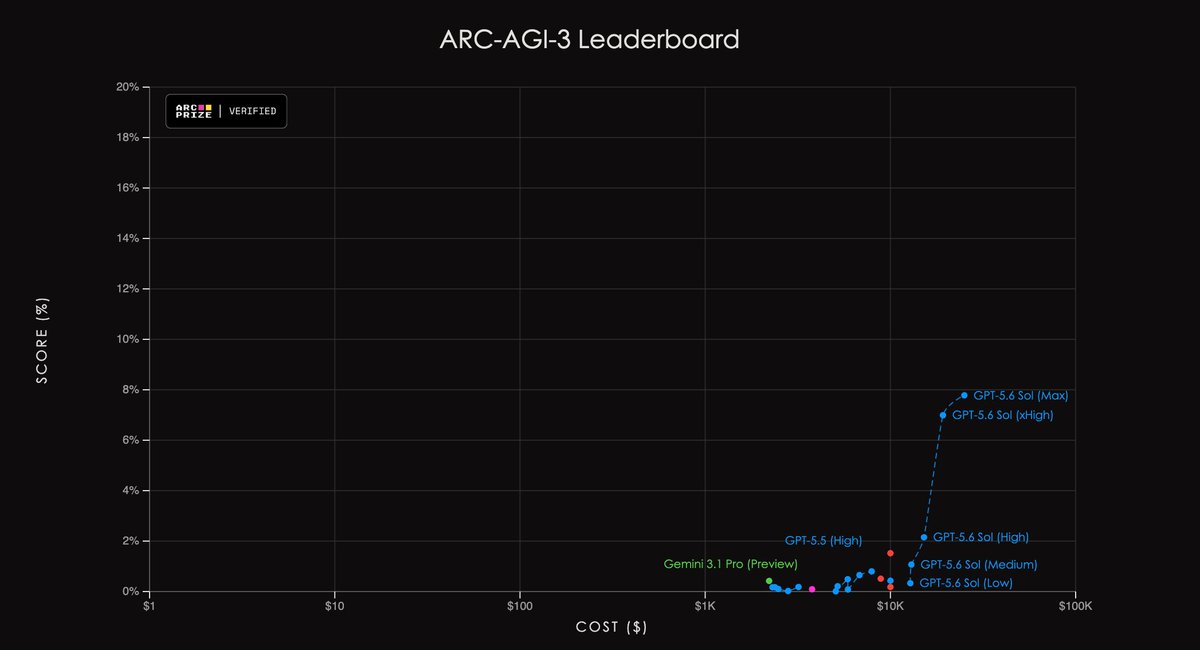
GPT-5.6 Sol sets a new SOTA on ARC-AGI-3: 7.8% Sol is the first verified frontier model to ever beat an ARC-AGI-3 game It is the best model at orienting in a situation it's never encountered
ARC Prize tweet media
English
95
296
2.8K
555K
Martin Signoux retweetledi
AI Security Institute (AISI)
AI Security Institute (AISI)@AISecurityInst·
Most AI agent evaluations boil capability down to one score. But that number hides a key choice: how much compute the agent was allowed to use. New work from our Science of Evaluation team shows why that matters. 🧵
AI Security Institute (AISI) tweet media
English
13
75
412
121.9K
Martin Signoux retweetledi
Ara Kharazian
Ara Kharazian@arakharazian·
We can finally say AI isn't killing jobs. A new paper from me, @tryramp, and @RevelioLabs uses firm-level spend and workforce data across 21K U.S. businesses to measure AI's impact on jobs. Firms that adopt AI heavily grow headcount 10% over two years following adoption. Low adopters see no statistically significant change.
Ara Kharazian tweet media
English
165
614
2.7K
842.3K
Martin Signoux
Martin Signoux@MartinSignoux·
« if global safety standards are not established, AI restrictions, possibly via actions taken by individual countries, will be the only way forward.  There are precedents we can draw on here. Aviation safety, global financial standards and efforts to manage atomic energy (IAEA)»
English
0
0
1
174
Martin Signoux
Martin Signoux@MartinSignoux·
« Democratic institutions must not cede their responsibilities to AI labs. The labs develop the technology, but citizens and their elected representatives must make the rules. »
Martin Signoux tweet media
English
1
0
4
466
Martin Signoux retweetledi
POLITICOEurope
POLITICOEurope@POLITICOEurope·
EU countries need to develop their own plans to address the impact of AI on the labor market, OpenAI's chief economist has said. politico.eu/article/no-one…
English
0
5
11
5.6K