Masoud

367 posts

Masoud banner
Masoud

Masoud

@MasoudJ_

Cofounder at Fintor - AGI for better human life 🚀

Katılım Ocak 2019
568 Takip Edilen348 Takipçiler
Masoud
Masoud@MasoudJ_·
Let’s get used to sharing prompts for good ideas 😎
Andrej Karpathy@karpathy

Wow, this tweet went very viral! I wanted share a possibly slightly improved version of the tweet in an "idea file". The idea of the idea file is that in this era of LLM agents, there is less of a point/need of sharing the specific code/app, you just share the idea, then the other person's agent customizes & builds it for your specific needs. So here's the idea in a gist format: gist.github.com/karpathy/442a6… You can give this to your agent and it can build you your own LLM wiki and guide you on how to use it etc. It's intentionally kept a little bit abstract/vague because there are so many directions to take this in. And ofc, people can adjust the idea or contribute their own in the Discussion which is cool.

English
0
0
0
19
GREG ISENBERG
GREG ISENBERG@gregisenberg·
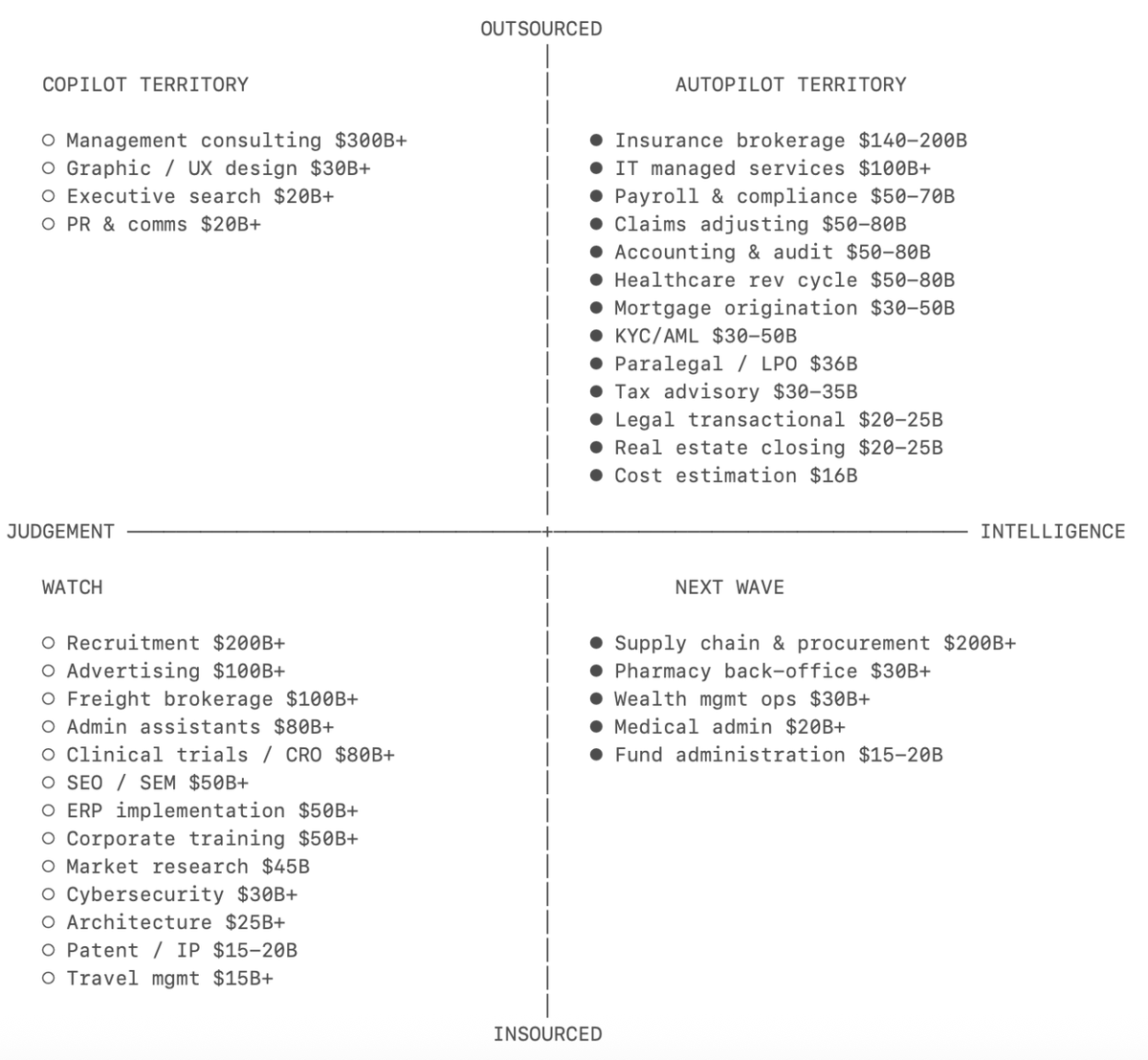
sequoia put out a blog post called "services is the new software" look at this map of over $1T in services being replaced by AI agents
GREG ISENBERG tweet media
English
263
499
4.3K
602.7K
Masoud retweetledi
Fintor
Fintor@fintorapp·
The mortgage industry's AI moment is here!⚡ ⏳ Weeks to close → ⚡ 10 days 📄 Manual tasks → 🤖 Fully automated 😩 Borrowers wait → 📲 Real-time updates This is Fintor 🏠 #mortgage #AI #fintech
English
0
4
5
100
Masoud
Masoud@MasoudJ_·
@omooretweets We are going to vertically integrate AI in all digital and physical manufacturing processes. Welcome to an AI native world🦾
English
0
0
2
639
Olivia Moore
Olivia Moore@omooretweets·
RIP, software as a service (1999-2025) Welcome to the world, services as software (2026 - ?)
English
110
97
1.2K
107.1K
Olivia Moore
Olivia Moore@omooretweets·
Funny model behavior I’ve noticed ChatGPT biases toward questions that continue the conversation Claude biases towards questions that end it 🤔
English
61
10
377
26.1K
Masoud
Masoud@MasoudJ_·
Valid point @apoth3osis_io . The benchmark driven recursion is not automatically safe, but my hope/bet is that recursive improvement of both the agent and its evaluation process is how the wall gets pushed out. Otherwise, yes, you are correct, at best we just compound our blind spots. Potentially in industries that we can deterministically evaluate the results, it would help making better agents
English
1
0
1
10
Apoth3osis
Apoth3osis@apoth3osis_io·
Genuinely impressive work, but isn't the core tension here that the original Gödel Machine required provably beneficial self-modifications, and DGM/Hyperagents replaced that with empirical benchmark validation? Selection pressure catches errors that hurt benchmark scores, but subtle errors that improve scores (reward hacking, overfitting, benchmark-specific shortcuts) get amplified instead of corrected. The compounding happens in the direction the benchmarks can't see.
English
1
0
1
23
Masoud
Masoud@MasoudJ_·
This is how AI will make sure that it doesn’t hit a wall.
Jenny Zhang@jennyzhangzt

Introducing Hyperagents: an AI system that not only improves at solving tasks, but also improves how it improves itself. The Darwin Gödel Machine (DGM) demonstrated that open-ended self-improvement is possible by iteratively generating and evaluating improved agents, yet it relies on a key assumption: that improvements in task performance (e.g., coding ability) translate into improvements in the self-improvement process itself. This alignment holds in coding, where both evaluation and modification are expressed in the same domain, but breaks down more generally. As a result, prior systems remain constrained by fixed, handcrafted meta-level procedures that do not themselves evolve. We introduce Hyperagents – self-referential agents that can modify both their task-solving behavior and the process that generates future improvements. This enables what we call metacognitive self-modification: learning not just to perform better, but to improve at improving. We instantiate this framework as DGM-Hyperagents (DGM-H), an extension of the DGM in which both task-solving behavior and the self-improvement procedure are editable and subject to evolution. Across diverse domains (coding, paper review, robotics reward design, and Olympiad-level math solution grading), hyperagents enable continuous performance improvements over time and outperform baselines without self-improvement or open-ended exploration, as well as prior self-improving systems (including DGM). DGM-H also improves the process by which new agents are generated (e.g. persistent memory, performance tracking), and these meta-level improvements transfer across domains and accumulate across runs. This work was done during my internship at Meta (@AIatMeta), in collaboration with Bingchen Zhao (@BingchenZhao), Wannan Yang (@winnieyangwn), Jakob Foerster (@j_foerst), Jeff Clune (@jeffclune), Minqi Jiang (@MinqiJiang), Sam Devlin (@smdvln), and Tatiana Shavrina (@rybolos).

English
1
0
4
105
Zach Tratar
Zach Tratar@zachtratar·
I know some folks are scared of AI, whether it's due to fear of financial bubble or fear of an all-powerful evil AI taking of the world. But Bernie and AOC's bill to ban new datacenter development isn't a solution. It's the fastest way to sabotage our economy.
English
5
1
18
1.1K
Masoud retweetledi
Jenny Zhang
Jenny Zhang@jennyzhangzt·
Introducing Hyperagents: an AI system that not only improves at solving tasks, but also improves how it improves itself. The Darwin Gödel Machine (DGM) demonstrated that open-ended self-improvement is possible by iteratively generating and evaluating improved agents, yet it relies on a key assumption: that improvements in task performance (e.g., coding ability) translate into improvements in the self-improvement process itself. This alignment holds in coding, where both evaluation and modification are expressed in the same domain, but breaks down more generally. As a result, prior systems remain constrained by fixed, handcrafted meta-level procedures that do not themselves evolve. We introduce Hyperagents – self-referential agents that can modify both their task-solving behavior and the process that generates future improvements. This enables what we call metacognitive self-modification: learning not just to perform better, but to improve at improving. We instantiate this framework as DGM-Hyperagents (DGM-H), an extension of the DGM in which both task-solving behavior and the self-improvement procedure are editable and subject to evolution. Across diverse domains (coding, paper review, robotics reward design, and Olympiad-level math solution grading), hyperagents enable continuous performance improvements over time and outperform baselines without self-improvement or open-ended exploration, as well as prior self-improving systems (including DGM). DGM-H also improves the process by which new agents are generated (e.g. persistent memory, performance tracking), and these meta-level improvements transfer across domains and accumulate across runs. This work was done during my internship at Meta (@AIatMeta), in collaboration with Bingchen Zhao (@BingchenZhao), Wannan Yang (@winnieyangwn), Jakob Foerster (@j_foerst), Jeff Clune (@jeffclune), Minqi Jiang (@MinqiJiang), Sam Devlin (@smdvln), and Tatiana Shavrina (@rybolos).

Jenny Zhang tweet media
English
155
659
3.6K
491.2K
Masoud
Masoud@MasoudJ_·
@zachtratar The boutique and niche consulting firms are affected by it more at the moment, but it won’t be long before major firms feel it too.
English
0
0
0
118
Zach Tratar
Zach Tratar@zachtratar·
I know it’s a hard pill to swallow, but the AIs already have better design and programming taste than most consulting firms.
Jason Fried@jasonfried

A bespoke software revolution? I don't buy it. It'll exist. It already exists. Small consultants and big consulting firms have made custom software for years. It almost always sucks. It’s bloated, confusing, and because the client pays, it’s built wrong in all the ways. Who’s excited about bespoke software? Software makers! Of course they're excited about building bespoke software — that's what they do. X is full of them. Your feed is full of people who love making software talking about making software. Of course they’re excited about the revolution. Echo, echo, echo... Most people don’t like computers. Nobody in tech wants to say that out loud. People tolerate computers. They use them because they have to. Given the choice, most would rather not think about them at all. So when someone suggests that AI means everyone will build their own custom tools, ask who "everyone" is. The three-person accounting firm drowning in client paperwork? They want the paperwork gone, not a new system to maintain. The regional logistics company with 40 trucks? They want the routes optimized, not Joe spouting off about this new system he’s been messing around with. The law firm billing 70-hour weeks? They want leverage on their time, not a software project to design. They don’t hate technology. But building and maintaining their own critical systems isn’t their wheelhouse, regardless of how much faster and easier it’s become. It's another job on top of the job. Will these people use AI? Absolutely, for all sorts of things. Will some outliers go deep and build real custom systems? Sure, but they're almost always people who already had some pull toward software. The curiosity was already there. They were dabblers before. Giving everyone access to software building tools doesn't mean everyone becomes a builder. A powerful excavator doesn't turn a homeowner into a contractor. Most people just want the hole dug by someone else. They don’t want the responsibility either.

English
14
0
70
15.1K
Masoud
Masoud@MasoudJ_·
"Every bug we've been fixing was something I introduced" - My Claude Code
English
1
0
2
41
Masoud retweetledi
Pulte
Pulte@pulte·
Fannie Mae and Freddie Mac Remove Certain Homeowners Insurance Requirements That Will Reduce Costs: fhfa.gov/news/news-rele…
English
105
70
461
128.4K
Masoud
Masoud@MasoudJ_·
@zachtratar I think the next hurdle to overcome is visual reasoning and understanding of physical world. Excited to see the leader board for arc-agi-3.
English
0
0
1
29
Zach Tratar
Zach Tratar@zachtratar·
Ok I’m calling it. AGI has been effectively achieved. The models are able to perform many tasks at superhuman levels. The task planner harnesses are already there. The integrations are mostly there. Taste is still off, but it’s a footnote…
English
5
0
23
2.3K
Masoud
Masoud@MasoudJ_·
🚨 The mortgage industry has a bottleneck problem. 📩 Borrower hits “submit” and the chaos starts. 📄 Docs missing. Emails flying. Processors juggling 40 files. 🤯 🛠️ It’s not a people problem. It’s a systems problem. 🤖 AI agents don’t: → Get overwhelmed → Miss gaps → Need sleep 💡 The winning mortgage teams of 2026 will run on AI, not headcount. #AI #Mortgage #Fintech #Automation 🚀
English
0
1
2
55
Masoud retweetledi
The White House
The White House@WhiteHouse·
With actions like promoting access to mortgage credit and removing regulatory barriers to home construction, President Trump is making it easier for Americans to buy homes, an integral part of the American Dream. 🏡🇺🇸
The White House tweet media
English
1.5K
2.6K
10.4K
545.7K
Masoud
Masoud@MasoudJ_·
@zebird0 Until new models learn that and start putting typos intentionally
English
0
0
0
29
robin
robin@zebird0·
I wonder if typos will become high status in the future Because it’ll confirm that you wrote the thot yourself with no AI
English
121
5
278
46.3K
Jesse Middleton
Jesse Middleton@srcasm·
We’re about six months into deploying @flybridge 2025 (our 7th fund). The "AI" honeymoon period is officially over. In 2024, everyone wanted to talk about models. In 2025, everyone wanted to talk about agents. Nowadays, I’m looking for the Invisible Infrastructure. If you’re building the plumbing that makes autonomous systems actually safe, auditable, and reliable for a Fortune 500, we should be talking. Specifically, I’m looking for: > Tools that verify human intent in a world full of high-fidelity deepfakes. > AI that doesn't "forget" who I am or what we talked about yesterday across different apps. > Founders who spent ten years in a "niche" industry (like maritime logistics or waste management) and are now rebuilding it from the studs up. I know the best founders are often too busy building to be scrolling LinkedIn. If you have a friend who is currently building something that fits this description, tell them to hit me up. I don't need a deck yet. I just want to hear about the problem they can't stop thinking about. We’re cutting $1M to $3M checks. My DMs are always open.
English
47
5
199
41.3K