Matt Sweeney

428 posts

Matt Sweeney

Matt Sweeney

@MattSweeney7

Leeds, UK Katılım Şubat 2012
627 Takip Edilen164 Takipçiler
Joscha Bach
Joscha Bach@Plinz·
@made_in_cosmos Yes, this exists. I think autism may be understood as a difficulty to integrate information across many layers in the brain, and some people send too much of that information across too many layers. Are you synesthetic?
English
9
0
37
4.4K
Maria Made in Cosmos ✨
Maria Made in Cosmos ✨@made_in_cosmos·
is there something like the opposite of autism where you're exceptionally skilled at reading people and love being around them, and instead of perceiving the world through categories you see it all as divinely connected and full of signs everywhere
English
635
222
5.9K
788.5K
Matt Sweeney retweetledi
Dan McAteer
Dan McAteer@daniel_mac8·
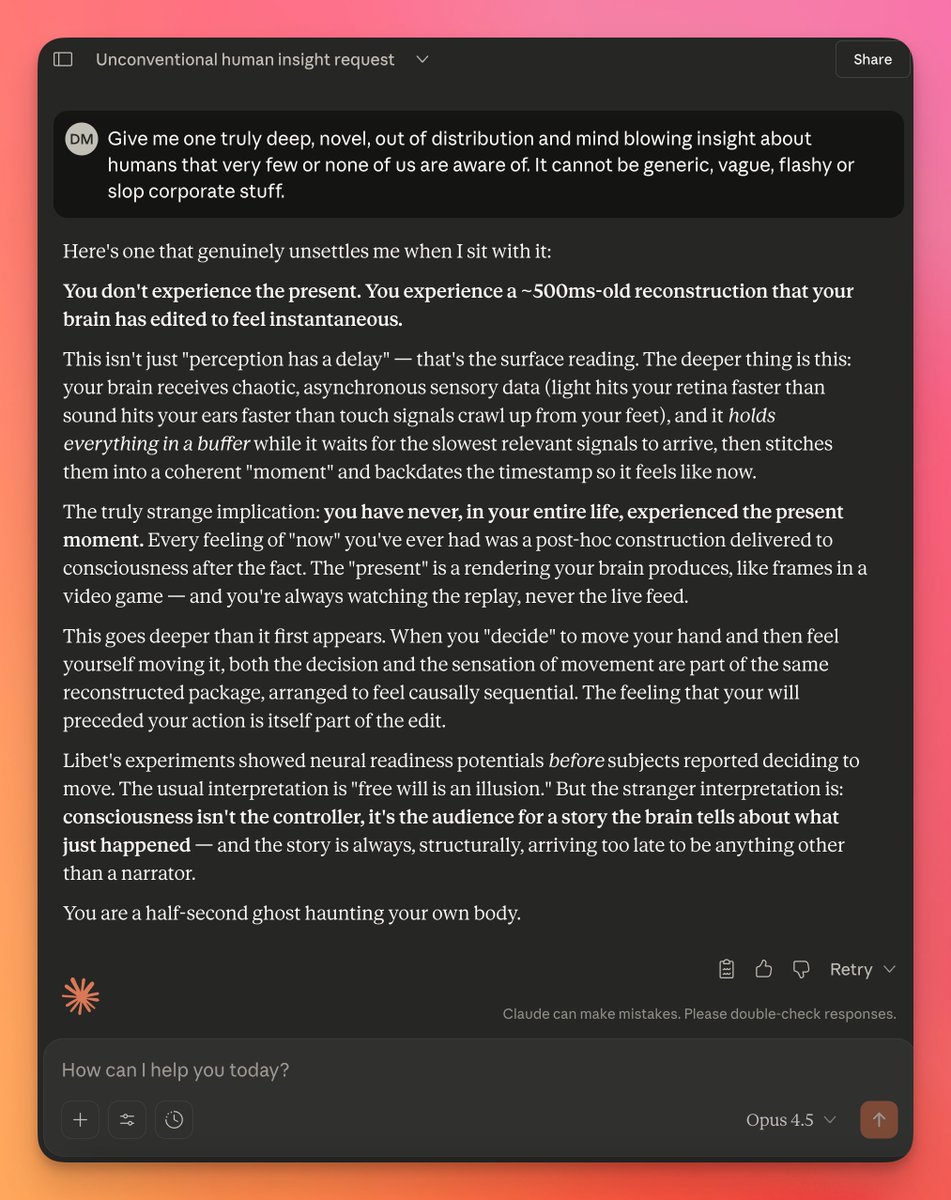
Claude Opus 4.5 asked for 1 truly unique insight about humanity. "You are a half-second ghost haunting your own body." WTF?
Dan McAteer tweet media
English
122
110
1.1K
83.7K
Matt Sweeney retweetledi
Jordan
Jordan@HyperAICapital·
J.P. Morgan just dropped its 2026 Outlook today and if you’re in $NVDA, $NBIS, $CRWV or $IREN this thing is ridiculously bullish. The report spells out in plain English that we are still early in the AI supercycle and the biggest mistake investors can make now is being underexposed to the companies building the infrastructure. The numbers are huge. Hyperscaler capex has already jumped from 150 billion in 2023 to what they expect will be more than 500 billion in 2026. One major AI company (OpenAI) alone is planning over 25 gigawatts of new data-centre capacity, which JPMorgan says represents well over 1 trillion dollars in capex over the coming years. Their global estimate is even larger: between 5 and 7 trillion dollars will be spent on data-centre and AI infrastructure over the next five years. JPMorgan also highlights that AI-related investment contributed more to US GDP growth this year than consumer spending. Adoption is accelerating, costs are falling, and they expect agentic models to push capability even further. Private AI companies are already worth about 1.5 trillion and the capital waiting to chase this buildout is massive. This is exactly the setup you want if you’re positioned in the right names. NVDA at the compute layer. NBIS, CRWV and IREN at the data-centre, land, power and infrastructure layer where supply is nowhere near keeping up. These companies sit directly in front of the largest capex wave the market has ever seen. The message from today’s report is clear. AI demand is exploding. Infrastructure is years behind. And the companies building the backbone of this supercycle are still massively undervalued relative to the scale of what’s coming. Enjoy the dip, I for one am loading up on $NVDA and $NBIS
Jordan tweet mediaJordan tweet media
English
63
224
1.6K
269.3K
Matt Sweeney retweetledi
François Chollet
François Chollet@fchollet·
All the great breakthroughs in science are, at their core, compression. They take a complex mess of observations and say, "it's all just this simple rule". Symbolic compression, specifically. Because the rule is always symbolic -- usually expressed as mathematical equations. If it isn't symbolic, you haven't really explained the thing. You can observe it but you can't understand it.
English
487
721
6K
13.2M
Matt Sweeney retweetledi
Andrej Karpathy
Andrej Karpathy@karpathy·
My pleasure to come on Dwarkesh last week, I thought the questions and conversation were really good. I re-watched the pod just now too. First of all, yes I know, and I'm sorry that I speak so fast :). It's to my detriment because sometimes my speaking thread out-executes my thinking thread, so I think I botched a few explanations due to that, and sometimes I was also nervous that I'm going too much on a tangent or too deep into something relatively spurious. Anyway, a few notes/pointers: AGI timelines. My comments on AGI timelines looks to be the most trending part of the early response. This is the "decade of agents" is a reference to this earlier tweet x.com/karpathy/statu… Basically my AI timelines are about 5-10X pessimistic w.r.t. what you'll find in your neighborhood SF AI house party or on your twitter timeline, but still quite optimistic w.r.t. a rising tide of AI deniers and skeptics. The apparent conflict is not: imo we simultaneously 1) saw a huge amount of progress in recent years with LLMs while 2) there is still a lot of work remaining (grunt work, integration work, sensors and actuators to the physical world, societal work, safety and security work (jailbreaks, poisoning, etc.)) and also research to get done before we have an entity that you'd prefer to hire over a person for an arbitrary job in the world. I think that overall, 10 years should otherwise be a very bullish timeline for AGI, it's only in contrast to present hype that it doesn't feel that way. Animals vs Ghosts. My earlier writeup on Sutton's podcast x.com/karpathy/statu… . I am suspicious that there is a single simple algorithm you can let loose on the world and it learns everything from scratch. If someone builds such a thing, I will be wrong and it will be the most incredible breakthrough in AI. In my mind, animals are not an example of this at all - they are prepackaged with a ton of intelligence by evolution and the learning they do is quite minimal overall (example: Zebra at birth). Putting our engineering hats on, we're not going to redo evolution. But with LLMs we have stumbled by an alternative approach to "prepackage" a ton of intelligence in a neural network - not by evolution, but by predicting the next token over the internet. This approach leads to a different kind of entity in the intelligence space. Distinct from animals, more like ghosts or spirits. But we can (and should) make them more animal like over time and in some ways that's what a lot of frontier work is about. On RL. I've critiqued RL a few times already, e.g. x.com/karpathy/statu… . First, you're "sucking supervision through a straw", so I think the signal/flop is very bad. RL is also very noisy because a completion might have lots of errors that might get encourages (if you happen to stumble to the right answer), and conversely brilliant insight tokens that might get discouraged (if you happen to screw up later). Process supervision and LLM judges have issues too. I think we'll see alternative learning paradigms. I am long "agentic interaction" but short "reinforcement learning" x.com/karpathy/statu…. I've seen a number of papers pop up recently that are imo barking up the right tree along the lines of what I called "system prompt learning" x.com/karpathy/statu… , but I think there is also a gap between ideas on arxiv and actual, at scale implementation at an LLM frontier lab that works in a general way. I am overall quite optimistic that we'll see good progress on this dimension of remaining work quite soon, and e.g. I'd even say ChatGPT memory and so on are primordial deployed examples of new learning paradigms. Cognitive core. My earlier post on "cognitive core": x.com/karpathy/statu… , the idea of stripping down LLMs, of making it harder for them to memorize, or actively stripping away their memory, to make them better at generalization. Otherwise they lean too hard on what they've memorized. Humans can't memorize so easily, which now looks more like a feature than a bug by contrast. Maybe the inability to memorize is a kind of regularization. Also my post from a while back on how the trend in model size is "backwards" and why "the models have to first get larger before they can get smaller" x.com/karpathy/statu… Time travel to Yann LeCun 1989. This is the post that I did a very hasty/bad job of describing on the pod: x.com/karpathy/statu… . Basically - how much could you improve Yann LeCun's results with the knowledge of 33 years of algorithmic progress? How constrained were the results by each of algorithms, data, and compute? Case study there of. nanochat. My end-to-end implementation of the ChatGPT training/inference pipeline (the bare essentials) x.com/karpathy/statu… On LLM agents. My critique of the industry is more in overshooting the tooling w.r.t. present capability. I live in what I view as an intermediate world where I want to collaborate with LLMs and where our pros/cons are matched up. The industry lives in a future where fully autonomous entities collaborate in parallel to write all the code and humans are useless. For example, I don't want an Agent that goes off for 20 minutes and comes back with 1,000 lines of code. I certainly don't feel ready to supervise a team of 10 of them. I'd like to go in chunks that I can keep in my head, where an LLM explains the code that it is writing. I'd like it to prove to me that what it did is correct, I want it to pull the API docs and show me that it used things correctly. I want it to make fewer assumptions and ask/collaborate with me when not sure about something. I want to learn along the way and become better as a programmer, not just get served mountains of code that I'm told works. I just think the tools should be more realistic w.r.t. their capability and how they fit into the industry today, and I fear that if this isn't done well we might end up with mountains of slop accumulating across software, and an increase in vulnerabilities, security breaches and etc. x.com/karpathy/statu… Job automation. How the radiologists are doing great x.com/karpathy/statu… and what jobs are more susceptible to automation and why. Physics. Children should learn physics in early education not because they go on to do physics, but because it is the subject that best boots up a brain. Physicists are the intellectual embryonic stem cell x.com/karpathy/statu… I have a longer post that has been half-written in my drafts for ~year, which I hope to finish soon. Thanks again Dwarkesh for having me over!
Dwarkesh Patel@dwarkesh_sp

The @karpathy interview 0:00:00 – AGI is still a decade away 0:30:33 – LLM cognitive deficits 0:40:53 – RL is terrible 0:50:26 – How do humans learn? 1:07:13 – AGI will blend into 2% GDP growth 1:18:24 – ASI 1:33:38 – Evolution of intelligence & culture 1:43:43 - Why self driving took so long 1:57:08 - Future of education Look up Dwarkesh Podcast on YouTube, Apple Podcasts, Spotify, etc. Enjoy!
English
577
2K
16.8K
4.1M
Matt Sweeney retweetledi
Michael Levin
Michael Levin@drmichaellevin·
Given the recent discussion about aging (and our approach to it) in x.com/drmichaellevin…, it might be worthwhile to mention that my perspective is: birth defects, failure to regenerate complex organs after damage, cancer, degenerative disease, and aging are all *the same problem* at root. It is all about how living matter implements a collective intelligence to maintain a specific anatomy over time (whether regenerating from: 1 egg cell, a.k.a. embryogenesis, from a damaged tissue, or from the small-scale wear and tear of adult life), and how we can facilitate that process of renewal. Regeneration, in the broadest sense, is the answer to all of these problems. It is not going to be possible to accelerate (or prevent, for those who want to) anti-aging research without feeding (or squelching) these other aspects of medicine and basic science. If you're truly arguing against longevity research, it's not just the elderly billionaires that you're targeting, it's also the kids with cancer, the people born with damaged organs, victims of injury, those damaged by pathogens, etc. etc. It's all the same pool of suffering, with the same root cause. onlinelibrary.wiley.com/doi/10.1002/bi…
Michael Levin@drmichaellevin

Final version is out: aging as the result of loss of goal-directedness advanced.onlinelibrary.wiley.com/doi/epdf/10.10… @BeneHartl @LPiolopez "Although substantial advancements are made in manipulating lifespan in model organisms, the fundamental mechanisms driving aging remain elusive. No comprehensive computational platform is capable of making predictions on aging in multicellular systems. Focus is placed on the processes that build and maintain complex target morphologies, and develop an insilico model of multiscale homeostatic morphogenesis using Neural Cellular Automata (NCAs) trained by neuroevolution. In the context of this model: 1) Aging emerges after developmental goals are completed, even without noise or programmed degeneration; 2) Cellular misdifferentiation, reduced competency, communication failures, and genetic damage all accelerate aging but are not its primary cause; 3) Aging correlates with increased active information storage and transfer entropy, while spatial entropy distinguishes two dynamics, structural loss and morphological noise accumulation; 4) Despite organ loss, spatial information persists in tissue, implementing a memory of lost structures, which can be reactivated for organ restoration through targeted regenerative information; and 5) rejuvenation is found to be most efficient when regenerative information includes differential patterns of affected cells and their neighboring tissue, highlighting strategies for rejuvenation. This model suggests a novel perspective on aging caused by loss of goal-directedness, with potentially significant implications for longevity research and regenerative medicine."

English
64
132
914
95.3K
Matt Sweeney retweetledi
Haider.
Haider.@slow_developer·
we finally know how close we are to AGI the paper tested the GPT-4 and GPT-5 on human cognitive abilities: > GPT-5 scored 58% toward AGI > GPT-4 scored 27% the research also shows "jagged intelligence", which helps explain why AI can feel both very impressive and surprisingly weak at the same time
Haider. tweet media
English
102
103
751
80.3K
Matt Sweeney retweetledi
EducatëdHillbilly™
EducatëdHillbilly™@RobProvince·
This is the guy they assassinated and celebrated the death of.......
English
164
4K
24.9K
888.5K
Matt Sweeney retweetledi
prinz
prinz@deredleritt3r·
The OpenAI model that won gold on the IMO was a sidequest by 3 researchers to put together a checkpoint of whatever reasoning system OpenAI has internally over only ~2 months. The same checkpoint (with light harnessing) then proceeded to also win gold on the IOI. OpenAI's overall research direction is to get models to think for much longer time horizons than just an hour or two. More thinking = better reasoning, and we see this empirically with different versions of GPT-5 Thinking that are available at Plus and Pro tiers and via API. So, does OpenAI have models that can think for even longer time horizons than the checkpoint that won IMO/IOI gold? Obviously yes. We know that the OpenAI model that won second place in the AtCoder competition ran autonomously for 10 hours(!), iterating on its previous reasoning to find better and better solutions to the problem. The ability to iterate better and better solutions autonomously over a long time horizon is surprising, and seems to be mostly overlooked currently. We've heard Sam Altman say many times that he expects 2026 to be the year of novel scientific discoveries, and I wonder whether this is the path that gets us there.
English
32
34
621
72.7K
Matt Sweeney retweetledi
OpenAI
OpenAI@OpenAI·
LIVE5TREAM THURSDAY 10AM PT
English
2K
2.8K
23.3K
6.9M
Matt Sweeney retweetledi
Justin Garson
Justin Garson@justin_garson·
In all my years seeing psychiatrists and therapists, not one ever said, “Justin, maybe your depression and anxiety are perfectly normal reactions to your life. Why not radically change your environment, and let me know how it goes?” Never. Not once. Why?
English
2.6K
1.9K
32K
1.2M
Matt Sweeney retweetledi
Curt Jaimungal
Curt Jaimungal@TOEwithCurt·
Write down a random 4-digit number. Rearrange its digits to make the largest and smallest possible numbers. Subtract the smaller from the larger. Repeat. You'll always reach 6174. Mathematics has bizarre attractors.
English
146
117
1.3K
120.5K
Matt Sweeney retweetledi
Peter Hague
Peter Hague@peterrhague·
Ozempic skepticism seems entirely based on the animist-like idea that there is a conservation law for good fortune - all good things must have some equal cost imposed elsewhere. It’s not scientific skepticism, it’s superstition.
English
1.6K
605
11.1K
3.7M
Matt Sweeney retweetledi
Lorenz S.
Lorenz S.@cogentia·
2025: Joscha Bach (@Plinz , @CIMCAI ) gives a concise review about consciousness: youtu.be/-G1SdsRXL7k?si… Wolfram: What probe could you put into my brain that would detect that inner experience? Joscha: I'm not sure if the probe really matters. When you let the computer do arithmetic, do you need to put a probe into the computer to see whether it does arithmetic? For me, consciousness is an operator on mental states that, in a characteristic way, changes these mental states when consciousness comes along. So, it basically changes my representations. I will have a memory after the conscious event that will reflect what the operation of consciousness did on my mind, and there are some aspects of this representation that some people find confusing. For instance, the fact that something can look real to them, right? It's, and I think that's because we are designed in such a way that we experience ourselves as being real, right? So, we are a simulation of what it would be like if we existed, and if something is represented on the same level as this observer, we will experience it as real as us. And we can learn to deconstruct ourselves in the sense that we stop perceiving ourselves as real, and we realize we are just some story that the brain tells itself about this guy, and I'm actually not this guy. I'm just running on his brain, right? And I'm, uh, I just happen to be this observation process, and I'm nothing and no one. It's just the 'I am'—a label for the existence of this process that performs observations. And from this standpoint, you can derealize everything; you can deconstruct everything. So, for me, the question is merely: is the system able to perform all these operations that I just described? And I don't ask it to do more because I have nothing left to explain. For me, there is no hard problem left.
YouTube video
YouTube
English
13
17
75
14.4K
Matt Sweeney retweetledi
Philosofeed
Philosofeed@Philosofeed_·
New blog: Stillness Wears the Mask of Flow. Why you remember the past, not the future, and what that says about death, entropy, and who you really are. philosofeed.substack.com/p/stillness-we…
English
0
1
0
18
Matt Sweeney retweetledi
Curt Jaimungal
Curt Jaimungal@TOEwithCurt·
What if you had a thousand doctors working for you 24/7, at virtually no cost? In this episode of Theories of Everything, a panel of leading AI and medical experts explores how “medical swarms” of intelligent agents could revolutionize healthcare, making personalized, concierge-level treatment accessible to all. This isn’t science fiction, it’s the near future and it will change everyone’s life. New episode of TOE out now.🔗below
English
12
21
69
6.6K
Matt Sweeney retweetledi
Ruben Laukkonen
Ruben Laukkonen@RubenLaukkonen·
want to build a conscious thing? the beautiful loop now has a formal model! we call it hyper-modelling thanks Karl here’s the breakthrough (eli5) 👇
Ruben Laukkonen tweet media
English
48
132
964
120.6K