Justus Mattern @ ICML

1.2K posts

Justus Mattern @ ICML banner
Justus Mattern @ ICML

Justus Mattern @ ICML

@MatternJustus

Co-Founder @ProximalHQ | prev. research @PrimeIntellect, @MPI_IS and built revideo

San Francisco, CA Katılım Mart 2021
859 Takip Edilen8.1K Takipçiler
Sabitlenmiş Tweet
Justus Mattern @ ICML
Justus Mattern @ ICML@MatternJustus·
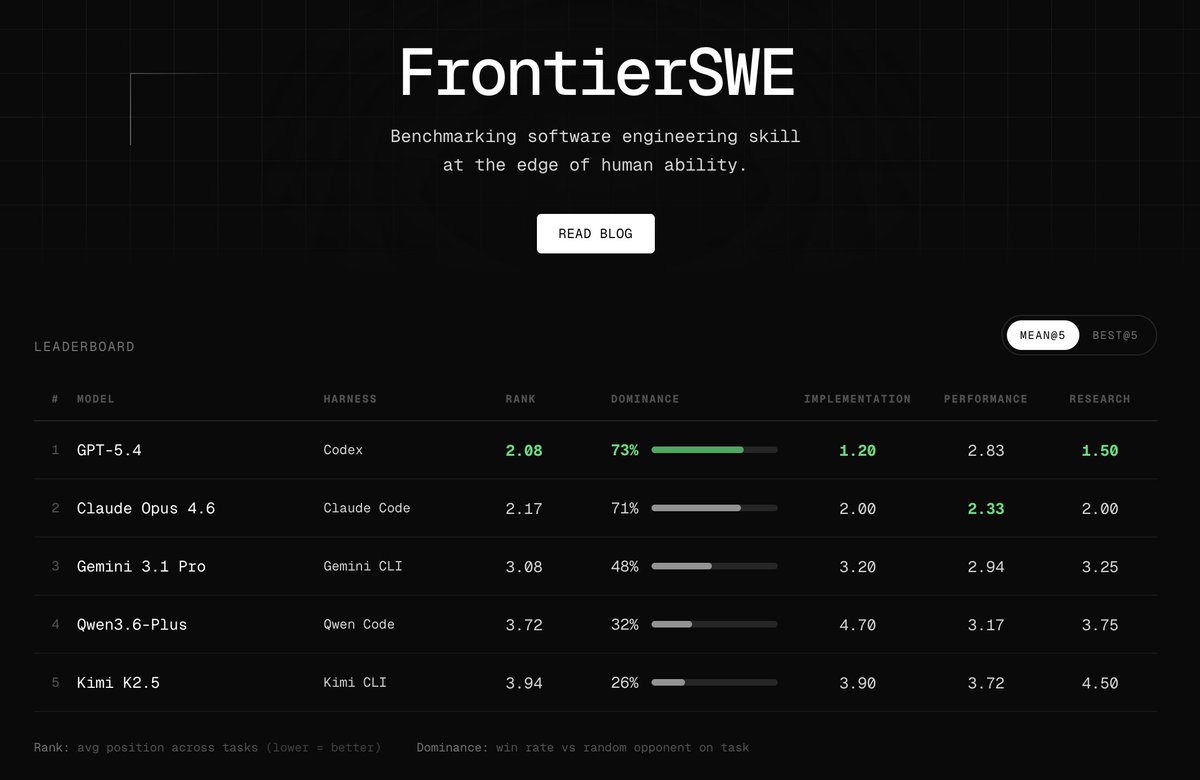
Introducing FrontierSWE, an ultra-long horizon coding benchmark. We test agents on some of the hardest technical tasks like optimizing a video rendering library or training a model to predict the quantum properties of molecules. Despite having 20 hours, they rarely succeed
Justus Mattern @ ICML tweet media
English
78
137
1.3K
274.1K
Justus Mattern @ ICML retweetledi
Logan Kilpatrick
Logan Kilpatrick@OfficialLoganK·
it’s surprising to me how many people seem to not understand that great models are built with super high quality curated data finding novel ways to create / get this data is a huge edge
English
390
210
4.8K
664.9K
Johannes Hagemann
Johannes Hagemann@johannes_hage·
We've raised $130M to build the Open Superintelligence Stack and make frontier AI infrastructure, once locked behind the walls of the big labs, accessible to every company.
Johannes Hagemann tweet media
Prime Intellect@PrimeIntellect

Announcing our $130M Series A to build the Open Superintelligence Stack Led by Radical Ventures, with NVIDIA, Intel Capital, Dell Capital, and existing investors Train, deploy, and continuously improve your own models using our stack. Own your intelligence.

English
31
13
222
17.3K
Vincent Weisser
Vincent Weisser@vincentweisser·
We raised $130M @ $1B for our series A To build the open superintelligence stack for everyone Pre-training concentrated frontier AI in a handful of labs. RL changes who can build frontier AI and just works across almost any verifiable domain. We want to enable everyone to train their own agents. Companies can now own their model optimization loop: train directly on your product, optimize for your specific workflows, and build agents that improve continuously in production Owning this model <> product improvement loop is how you build a compounding moat in the agentic era Super grateful to serve over 6k+ customers, including many leading AI startups, neolabs and enterprises already building on our stack, and to our incredible team for shipping hardcore! We train open frontier models and ship the same stack to our customers. Its spans the full stack of training, deploying and continuously improving models — compute, large-scale RL, environments, sandboxes, evals, and deployment. We're excited to be joined by angels who are building the frontier themselves, many of whom we work closely with: @johnschulman2 (Thinking Machines), @dwarkesh_sp, @AravSrinivas (Perplexity), @karimatiyeh (Ramp), @levie (Box), @_milankovac_ (Tesla), @winstonweinberg (Harvey), @amspector100 (Flapping Airplanes), @jeffwang (Cognition), @_arohan_ (Core Automation), @marksaroufim (Core Automation), @mikeknoop (Zapier, Ndea), @eastdakota (Cloudflare), @BrendanFoody (Mercor), @devanshpandey (Standard Intelligence), @hwchase17 (Langchain), @nicoup (Fleet) and many more We're a small team building open superintelligence > Reach out if you want to partner training, deploying and continuously improving your own frontier models for your use case > Join us to build open superintelligence — we're hiring across all roles including RL, inference, distributed systems, full stack engineering and compute.
Vincent Weisser tweet media
Prime Intellect@PrimeIntellect

Announcing our $130M Series A to build the Open Superintelligence Stack Led by Radical Ventures, with NVIDIA, Intel Capital, Dell Capital, and existing investors Train, deploy, and continuously improve your own models using our stack. Own your intelligence.

English
129
32
826
164.8K
Justus Mattern @ ICML
Justus Mattern @ ICML@MatternJustus·
Heading to ICML! 🇰🇷 I will be at the venue to chat about post-training and share some of the exciting but not yet public progress at @ProximalHQ 👀 If you want to hang, feel free to DM me or sign up to our dinner with @generalcatalyst!
Calvin Chen@calvinchen

we're hosting a dinner at ICML at one of the most sought after reservations in Seoul (chef was on a Netflix show) with General Catalyst! if you like great food and a small curated group of friends and researchers, would love for you to join! luma.com/y1i0ohtp

English
1
3
71
10.9K
Leonard Tang
Leonard Tang@leonardtang_·
moving to sf start of august looking for housing / roommates plz reach out if down to hunt together in this capricious sf housing market
English
20
1
60
12.3K
Ramneet Singh
Ramneet Singh@Ramneet_Singhh·
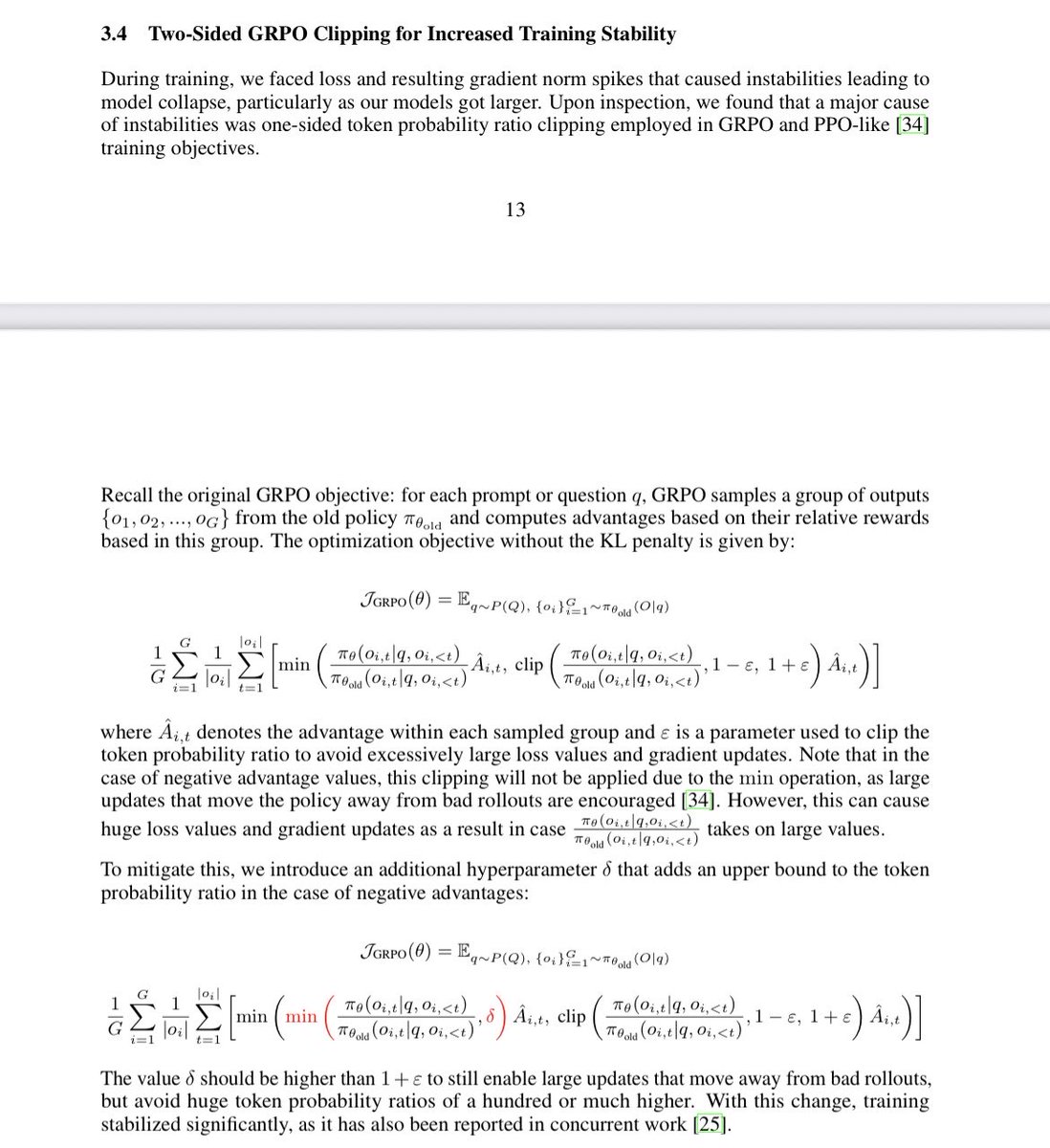
While looking at the PPO loss today, I realised that it is actually unbounded in the negative direction if advantage is negative and the policy diverges a lot. Searched a bit and found many implementations monitor the KL and do early stopping based on it to tackle this.
Ramneet Singh tweet media
English
9
10
215
20.6K
Dylan Bowman
Dylan Bowman@dylanbowmanSF·
This paper seems inconsequential for the frontier because it hinges on having a solver that is smarter than your RLed model (in this case, Qwen 397B verifying correctness of data for Qwen 4B)
Jason Weston@jaseweston

Claim: Autoresearch that moves the frontier will be about better data: we call that *Autodata*. 🧵1/6 -- Paper is out! arxiv.org/abs/2606.25996 Key idea: agentic data creation provides a way to *convert increased inference compute into higher quality model training*. We show our method gives gains on computer science, legal and math problems over classical synthetic dataset creation methods. We also show how to train (meta-optimize) such a data scientist agent, so that it can create even stronger data. Overall, we believe this direction has the potential to change how we build AI data!

English
3
0
19
2.2K
Justus Mattern @ ICML
Justus Mattern @ ICML@MatternJustus·
If access to a stronger generator model is given, the much simpler solution to improving capabilities is just to use the generator model as a teacher model for OPD. Building tasks with the stronger generator moreso serves the purpose of providing interesting research datasets
Justus Mattern @ ICML@MatternJustus

>if the authors wanted to just form a “RL environments startup” they could probably sell it for millions of dollars wrong; the recipe, like most synthetic RL env papers, relies on a strong generator and is hence not useful for frontier work (acknowledged in paper, so no shade!)

English
2
1
39
5K
Justus Mattern @ ICML
Justus Mattern @ ICML@MatternJustus·
The value of such methods is (IMO) that it lets us build really high quality tasks to study RL at a smaller scale. Hence, they are very useful!
English
1
0
11
1K
Justus Mattern @ ICML
Justus Mattern @ ICML@MatternJustus·
I definitely think papers like Tmax are interesting! I just want to clarify that one cannot derive that it is easy to create synthetic tasks for frontier models. Most pipelines that labs and vendors are building are much more complex than what you see in similar papers
English
1
0
17
1.4K
Justus Mattern @ ICML
Justus Mattern @ ICML@MatternJustus·
>if the authors wanted to just form a “RL environments startup” they could probably sell it for millions of dollars wrong; the recipe, like most synthetic RL env papers, relies on a strong generator and is hence not useful for frontier work (acknowledged in paper, so no shade!)
Nathan Lambert@natolambert

TMax: An open RL recipe for terminal agents I’m very excited to get to share a new RL paper today that I got to have a small part in – a type of paper I suspect we’ll see much more of in the future. The key is that RL research is very different today, in mid-2026, than what most observers have in their context. The average conception of an RL paper is grounded in the RLVR revolution of early 2025, where many people could use vanilla RLVR libraries to hillclimb on math benchmarks. Crucially, this style of math work could be done on base models or fairly stably on already trained models. With agents, the tasks of focus are very hard, requiring complex tool-use, harnesses where the model automatically manages its history, and much more training to make smaller eval improvements. We’re shifting from a renaissance of RL study to rapidly needing to improve its empirical rigor and common community engagements. TMax is the best open data for hillclimbing on frontier terminal tasks. It’s been validated with rigorous experiments, and if the authors wanted to just form a “RL environments startup” they could probably sell it for millions of dollars. This data work is some of my favorite stuff to be around in my 2.5+ years at Ai2. As a general summary, the recipe is open data and recipe lessons from hillclimbing the Qwen 3.5 smaller, dense models on terminal tasks. These models are super hard to hillclimb in this area, as they’re already trained heavily on the task. The training is very infrastructure-dependent, and most of the RL innovations are more designed to make training stable than to improve the rate of learning. I strongly recommend this paper. I joke around that I was happy to be an author just so I had to read it twice! You can find Hamish’s thread sharing more here or read the paper here. You can click through to find the model weights, the data, and even some fun further artifacts to study like all the RL rollouts from a training run – where the model sometimes became aware that it was being tested. The biggest takeaway I have from following this work, and more of the work in the community, is how important recipe work is. Let me define “recipe work.” It is a style of paper that explains all the steps you need to make crucial model improvements – data, algorithm, codebase, pitfalls, etc. Getting started in meaningful RL experiments today is a substantial expense. There are a ton of companies, an entire industry emerging really, around the idea of taking open-weight language models and finetuning them with RL on your domain-specific tasks. What I see in many projects is that getting an initial baseline is very hard. This phase, which can cost weeks and anywhere from $10K to $1M+, feels like spinning your wheels (A fun fact is that an RL step on a model like Nvidia Nemotron 3 Ultra on Tinker costs $1K and a meaningful RL run would be hundreds of steps – credit Edward Hu). It takes a lot of time to get traction in learning signal on meaningful, hard RL tasks. What we need as a community is a way for people to study small ablations to established RL recipes, as most labs won’t have the resources to do it from scratch in a meaningful way. This is what I hope TMAX can be for terminal agents, or the start of. Yes the training jobs are expensive, as the paper documents a standard training job being 8 nodes of H100s (2 train 6 inference) for 2-3 days, but that is approaching something academics can study. The establishment of this recipe took O(100) of these training jobs to get right. This isn’t my first time trying to establish this direction. When we launched Olmo 3 we had the “RL Zero“ model families, which are clean RL runs from a base model on a certain domain. This type of recipe-dependent work is a clear indicator that meaningful post-training work today looks much more like pretraining work of years past. We need decision-making ladders, clear ways of seeing small improvements in the models, stability, and so on. Part of this is down to academic gatekeepers, who won’t reward a paper doing very clean empirical work to push a recipe 1-2% up. They’ll favor a “new algorithm” that matches results, or something sort of bogus. My hope is that we can have multiple, stable, clear recipes across agent types, so innovations can be tested more clearly in multiple domains. (If you’re working on this, please reach out – I’m happy to support if I can, but I likely can’t reply to every email). As a quick aside, the RL frameworks in vogue today seem to be SLIME and SkyRL. The libraries of choice have shifted throughout these seasons in RL, which further contributes to a form of fragility in the literature. A bit of continuity will go a long way. So, go read this paper. It’s a really great example of how seemingly simple data and infrastructure work can be very hard and impactful. It’s also got me looking for more applications of Divergence Proximal Policy Optimization (DPPO) as another small evolution to the best RL algorithms of the day, by virtue of being a bit more stable by improving token-level clipping.

English
6
1
166
41.3K
Justus Mattern @ ICML
Justus Mattern @ ICML@MatternJustus·
@teortaxesTex to be fair, Fable would have been #1 but it was the only model that consistently cheated in the optimizer design task which dragged down its score in research
English
1
0
7
1.3K
Teortaxes▶️ (DeepSeek 推特🐋铁粉 2023 – ∞)
One really, really interesting part about GLM-5.2 is that it's absurdly strong on the "research" section. It might be straightforwardly the best research accelerator in some scenarios our Secluded Cloud Emperors would rather hoard for themselves.
Teortaxes▶️ (DeepSeek 推特🐋铁粉 2023 – ∞) tweet mediaTeortaxes▶️ (DeepSeek 推特🐋铁粉 2023 – ∞) tweet media
Proximal@ProximalHQ

GLM 5.2 ranks #3 on FrontierSWE. It is only behind Fable 5 and Opus 4.8, and it outperforms GPT-5.5. This is the first model that closes the large gap between models from Anthropic / OpenAI and other providers, and it is the strongest open-weight model by far.

English
10
17
321
36.1K
Justus Mattern @ ICML
Justus Mattern @ ICML@MatternJustus·
@PandaAshwinee which of the synthetic data recipes do you find useful? I checked my tweet again - none is a very strong word, it should have been "almost none"
English
1
0
0
649
Justus Mattern @ ICML
Justus Mattern @ ICML@MatternJustus·
It is underdiscussed how essentially none of the public research around synthetic task generation is useful at the frontier Current frontier models are so strong that none of the published synthetic data recipes yield tasks that are difficult enough to provide a learning signal
English
6
7
185
21.8K
Justus Mattern @ ICML
Justus Mattern @ ICML@MatternJustus·
Our evals team is growing! If you want to work on FrontierSWE and other interesting (and still unreleased) benchmarks, please reach out! We are experiencing incredible growth and work with nearly every frontier lab to measure model capabilities
Justus Mattern @ ICML@MatternJustus

Very exciting to see more labs using FrontierSWE to measure long-horizon engineering capabilities! Can't wait to share more about FrontierSWE v2 soon, which comes with many improvements and exciting new tasks!

English
2
2
123
11.8K
jietang
jietang@jietang·
We're introducing GLM-5.2, our latest flagship model for long-horizon tasks. It marks a substantial leap in long-horizon task capability over its predecessor GLM-5.1 and, for the first time, delivers that capability on a solid 1M-token context. GLM-5.2's new capabilities include: Solid 1M Context: A solid 1M-token context that stably sustains long-horizon work Advanced Coding with Flexible Effort: Stronger coding capabilities with multiple thinking effort levels to balance performance and latency Improved Architecture: We propose IndexShare, which reuses the same indexer across every four sparse attention layers, reducing per-token FLOPs by 2.9× at a 1M context length. We also improve GLM-5.2’s MTP layer for speculative decoding, increasing the acceptance length by up to 20% Pure Open: An MIT open-source license — no regional limits, technical access without borders Supporting long-horizon tasks starts with making long context engineering-usable: the model must maintain quality across long, messy coding-agent trajectories, not just accept more tokens. A 1M context is easy to claim, but much harder to keep reliable under real engineering pressure. To this end, we substantially expanded 1M-context training for coding-agent scenarios, covering large-scale implementation, automated research, performance optimization, and complex debugging. The result is a long-context system that is not only wide in scope, but solid in execution: a practical substrate for sustained engineering work. This capability is reflected in GLM-5.2's performance on three long-horizon coding benchmarks. FrontierSWE measures whether an agent can complete open-ended technical projects at the scale of hours to tens of hours, spanning systems optimization, large-scale code construction, and applied ML research. On this benchmark, GLM-5.2 trails Opus 4.8 by only 1%, while edging out GPT-5.5 by 1% and Opus 4.7 by 11%. On PostTrainBench, where each agent is given an H100 GPU and evaluated by how much it can improve small models through post-training, GLM-5.2 outperforms both Opus 4.7 and GPT-5.5, ranking second only to Opus 4.8. On SWE-Marathon, an ultra-long-horizon software engineering benchmark covering tasks such as building compilers, optimizing kernels, and developing production-grade services, GLM-5.2 still has room to grow, trailing Opus 4.8 by 13% while remaining second only to the Opus series. Across all three benchmarks, GLM-5.2 is the highest-ranked open-source model, showing that its 1M context has translated into practical long-horizon delivery capability.
jietang tweet mediajietang tweet media
English
181
301
3.7K
367.9K
Justus Mattern @ ICML
Justus Mattern @ ICML@MatternJustus·
It would be wrong to fine-tune an 8B model with TRL and assume that building post-training infra for frontier models is easy Similarly, you cannot extrapolate from methods like SWE-Smith and others. The data work happening in labs is very different from what is being published
English
1
0
28
1.5K