Matthew Raifman, PhD🚶‍♂️🚲🚇🛴

2.5K posts

Matthew Raifman, PhD🚶‍♂️🚲🚇🛴 banner
Matthew Raifman, PhD🚶‍♂️🚲🚇🛴

Matthew Raifman, PhD🚶‍♂️🚲🚇🛴

@MatthewRaifman

Thoughts on transport & road safety & climate / photog / Transportation Researcher at U.C. Berkeley.

Berkeley, CA Katılım Ağustos 2011
1.5K Takip Edilen940 Takipçiler
Sabitlenmiş Tweet
Matthew Raifman, PhD🚶‍♂️🚲🚇🛴
Last week, Census released 2021 data giving us our first look at the spatial distribution of the transition to working from home. A tale of two Americas emerges. Those who could adjust to work from home, and those who could not. A quick deep viz dive into the data...🧵 #wfh
Matthew Raifman, PhD🚶‍♂️🚲🚇🛴 tweet media
English
9
73
322
0
Matthew Raifman, PhD🚶‍♂️🚲🚇🛴
@alpert So bring AV back into that world and we’d be in a better place. No distracted driving or speeding, but a deconflicted intersection where ped has priority and crosswalk to themself.
English
0
0
0
40
Matthew Raifman, PhD🚶‍♂️🚲🚇🛴
@alpert Take the ped crossing: - always signal priority to ped - no car turn on red - red light camera enforcement - shorter crossings So yes, still ped crossing but ped priority & ped and car do not share same space at same time.
English
1
0
0
49
Matthew Raifman, PhD🚶‍♂️🚲🚇🛴
With AVs, we have two competing forces at play: 1) AVs can be programmed to be safer drivers than humans; 2) when cars and humans mix, we have a recipe for collisions and, worse, fatalities. If we want safe roads, with AVs or not, we need to de-conflict the road network. (1/x)
San Francisco Chronicle@sfchronicle

JUST IN: The California DMV has suspended Cruise from operating its driverless taxis in San Francisco, effective immediately. trib.al/61U6kl7

English
2
1
2
2.7K
Matthew Raifman, PhD🚶‍♂️🚲🚇🛴
@alpert Oh yes, I definitely don’t want to suggest that we should be building tunnels for cars though understand how that might come off that way. I’m for tactical urbanist low-cost separation of cars from less/cyclists.
English
1
0
0
31
David Alpert
David Alpert@alpert·
@MatthewRaifman The cars were already separated in Boston, just in an elevated highway that’s now underground. Yes it is better, but building tunneled or elevated highways is expensive and also speeds cars, encouraging more driving, more pollution, and ultimately more congestion.
English
2
0
1
23
Matthew Raifman, PhD🚶‍♂️🚲🚇🛴
@alpert Personally, I think we need to stop thinking about AVs as a monolith. Yes, we might have safety concerns about human/AV interaction on city roads, but there are applications when there is limited conflict (eg BRT, trucking). Labor policy issues but the problem isn’t tech there.
English
1
0
0
37
Matthew Raifman, PhD🚶‍♂️🚲🚇🛴
@alpert There is also temporal aspect: safer now, or safer later when tech matured? 1st: eventually AVs may be able to detect human behavior well. 2nd: much of the challenge is this transition time when AVs & human share the road. As balance shifts to AVs, they become inherently safer
English
2
0
0
38
Matthew Raifman, PhD🚶‍♂️🚲🚇🛴
@alpert I hear you. What about flipping it around and thinking about fencing off cars to prevent conflict. Say what we might about the mismanagement of the Big Dig in Boston, but moving those cars underground and topping it with a walkable park was a move in the right direction I think
English
1
0
0
27
David Alpert
David Alpert@alpert·
@MatthewRaifman I agree about protected bike lanes and so forth, but some would want to “deconflict” by fencing pedestrians off or making overpasses to keep them out of “cars’ space”, and that would be bad - sometimes they want to do that today
English
1
0
1
26
Matthew Raifman, PhD🚶‍♂️🚲🚇🛴
Ultimately, AVs are a technology that is actually safer than the human alternative but is limited (at least today) by a road network that contains operational conflicts that require human interaction. The same conflicts that drive traffic fatalities north of 40k a year in the USA
English
1
0
0
719
Matthew Raifman, PhD🚶‍♂️🚲🚇🛴 retweetledi
Carlos Gould
Carlos Gould@gould_cf·
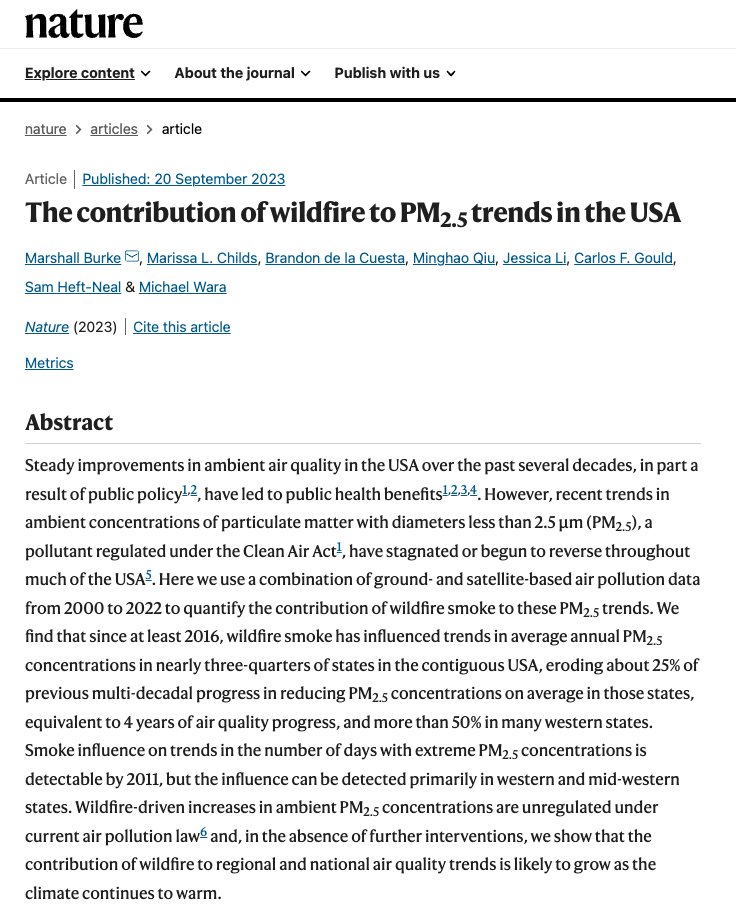
Out today in @Nature, we show that PM2.5 from wildfires has reversed, eroded, or stagnated broader improvements in total PM2.5 levels in 3/4 of contiguous US states. Led by superstar Marissa Childs and @MarshallBBurke with excellent team
Carlos Gould tweet media
Marshall Burke@MarshallBBurke

Second paper on wildfire smoke from our @stanfordecholab group out this week. This one quantifies the contribution of wildfire to US PM2.5 trends. We find much broader wildfire influence than previously estimated, on both avgs and extremes. Quick thread. nature.com/articles/s4158…

English
1
9
33
5.3K