Matthew Stachler

22 posts

Matthew Stachler

Matthew Stachler

@MatthewStachler

Molecular Pathologist and Researcher of pre-malignant gastrointestinal diseases

Katılım Mayıs 2019
38 Takip Edilen40 Takipçiler
Matthew Stachler retweetledi

Esophageal Cancer RF
Esophageal Cancer RF@SalgiFoundation·
Your donation matters! Dr. Stachler of @UCSF expressed gratitude for the research funding he was awarded. To donate in support of esophageal cancer research, visit: buff.ly/4dkI8tp To read more about Dr. Stachler's research, please visit: buff.ly/3OOu1lm

Esophageal Cancer RF tweet media
English
0
1
1
48
Matthew Stachler
Matthew Stachler@MatthewStachler·
Interesting study showing many cases of "recurrent" Barrett's esophagus after endoscopic therapy is actually residual disease. Highly collaborative effort!! Clinical and Translational Gastroenterology journals.lww.com/ctg/abstract/9…
English
0
0
0
31
Matthew Stachler
Matthew Stachler@MatthewStachler·
Frustrating but after 2 yrs, three rounds of review, and 2/3 positive reviewers our manuscript has been rejected at Nature Genetics. Not sure this is sustainable. On the plus side, it has given us a chance to update the BioRxiv version. Check it out. biorxiv.org/content/10.110…
English
0
0
1
108
Matthew Stachler
Matthew Stachler@MatthewStachler·
Great esophageal and gastric cancer conference. Some great talks and networking opportunities!
Matthew Stachler tweet media
English
0
0
0
0
Matthew Stachler
Matthew Stachler@MatthewStachler·
If you are going to submit a manuscript for publication, please review for grammar and labeling errors. Mistakes will happen (my grammar is terrible) but they shouldn’t make the paper unreadable. 😡
English
0
0
0
0
Matthew Stachler
Matthew Stachler@MatthewStachler·
@MattGosseMD @GIPathJC Our clinical information was somewhat limited (no BE length) and in the retrospective cohort controlled for age. We didn’t identify any other factors that correlated with staining. A deep dive into the histology could be interesting to see if there is something there.
English
1
1
2
0
Matthew Gosse
Matthew Gosse@MattGosseMD·
@GIPathJC Were there any clinicopathologic data that abnormal p53 staining was associated with? For example, extent of Barrett, age, symptoms, particular histologies?
English
1
0
1
0
DigestivePathJC
DigestivePathJC@GIPathJC·
#GIPathJC -Current guidelines require frequent endoscopic surveillance for Barrett's esophagus due to lack of a good predictor for progression to cancer -Risk of progression to cancer in Barrett's is low -Study sought to determine utility of p53IHC for risk stratification
DigestivePathJC tweet media
English
1
2
5
0
Matthew Stachler
Matthew Stachler@MatthewStachler·
@GIPathJC Thank you for having me. I hope our study is useful. We have several other interesting projects in the pipeline looking at genomic and epigenomic alterations as biomarkers. Always looking for potential collaborations!
English
1
1
4
0
DigestivePathJC
DigestivePathJC@GIPathJC·
#GIPathJC thank you everyone for joining the journal club discussion. Wrapping up at 9:30 pm EST, until we meet next time! A big thanks to Dr. Stachler @MatthewStachler for joining our journal club today!
English
1
1
2
0
Matthew Stachler
Matthew Stachler@MatthewStachler·
@GILiverPancreas @GIPathJC In our study no patient had a visible lesion, though as endoscopies improve more and more low-grade dysplasia is visible. We don't use that as a criteria but I can't say for certain what the gastroenterologists use to make their final decision
English
0
2
1
0
DigestivePathJC
DigestivePathJC@GIPathJC·
#GIPathJC is there a possibility of more requests for p53 IHC testing on Barrett's esophagus biopsies on current and old cases, and thoughts on use of varying p53 IHC antibody clones @MatthewStachler
DigestivePathJC@GIPathJC

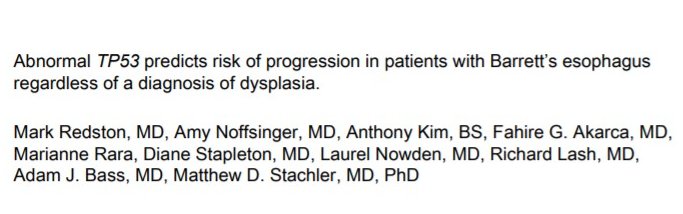
#GIPathJC Abnormal p53 immunohistochemistry status was found to predict progression regardless of histologic diagnosis (figure)

English
1
3
3
0
Matthew Stachler
Matthew Stachler@MatthewStachler·
@GIPathJC I think you will lose sensitivity if you do not stain every block with BE in it. Definitely an area for further study
English
0
2
2
0
Matthew Stachler
Matthew Stachler@MatthewStachler·
@GIPathJC That is a really good question and one that I don't think is fully answered. In our study we tried to stain every BE block we could and counted the endoscopy + if any one of them had abnormal p53. We definitely had cases were not every block was positive.
English
1
2
2
0
Matthew Stachler
Matthew Stachler@MatthewStachler·
@GIPathJC Many disagree but I have a problem with ablation for all LGD patients. I think using p53 IHC to substratify LGD is likely the lowest hurdle
English
0
2
3
0
Matthew Stachler
Matthew Stachler@MatthewStachler·
@GIPathJC I could see more requests coming in. I think if you take our study in the context of all of the previous work, there is now reasonable evidence for it. Any different clone should be tested to see if they perform similarly.
English
1
3
3
0
Matthew Stachler
Matthew Stachler@MatthewStachler·
@GIPathJC Like any more complex interpretation (HER2,...) it takes a little practice, but we did not run into too many difficulties. There were cases termed "indefinite staining" with some 2-3+ but <50%. We counted all of those as negative which seemed to work better than a lower cutoff
English
0
1
1
0
DigestivePathJC
DigestivePathJC@GIPathJC·
#GIPathJC @MatthewStachler were any challenges noted in interpretation of p53 IHC in cases with inflammation (acute or chronic), and how were those dealt with?
DigestivePathJC@GIPathJC

#GIPathJC Abnormal p53 staining was considered when 2 to 3+ nuclear positivity was present in >50% of cells in at least one crypt base or glandular profile, or in a contiguous focus of at least 20 surface epithelial cells

English
2
2
2
0
Matthew Stachler
Matthew Stachler@MatthewStachler·
@GIPathJC In areas of increased proliferation one can see slightly elevated p53 staining. In those cases it helps if you can see the staining outside of the normal proliferative zone
English
0
0
0
0
Matthew Stachler
Matthew Stachler@MatthewStachler·
@GIPathJC Its interesting, people have been using p53 as a marker for dysplasia but in reality I think it is a marker for progression risk not necessarily dysplasia. However, if one assumes the vast majority of non-dysplastic BE is low risk, using it as help in IND diagnosis is reasonable
English
0
1
2
0
DigestivePathJC
DigestivePathJC@GIPathJC·
#GIPathJC folks using p53 IHC as an adjunct in practice for indefinite for dysplasia cases or otherwise in Barrett's esophagus, what has been your experience ? If not using p53 IHC what were the concerns ?
English
1
2
1
0
Matthew Stachler
Matthew Stachler@MatthewStachler·
@GIPathJC Hi everyone. Hope you found the study interesting. It took awhile to put all of the pieces together but I think it was worth it.
English
0
4
4
0
DigestivePathJC
DigestivePathJC@GIPathJC·
#GIPathJC Welcome everyone to #gipath journal club! Please introduce yourself and tell us where you are joining from! Let's get started!
English
2
3
4
0
Matthew Stachler retweetledi
Pallavi A. Patil, MD
Pallavi A. Patil, MD@PAPatilMD·
#Tweeps #GIPathJC is today! -Tune in at #GIPathJC in Twitter search box at 8:30 pm EST #GIpath #pathology -Make sure to tag questions and comments with #GIPathJC to be visible in the discussion -Guest expert @MatthewStachler of @UCSF -@AGA_Gastro link gastrojournal.org/article/S0016-…
Pallavi A. Patil, MD tweet media
Pallavi A. Patil, MD@PAPatilMD

Happy Thanksgiving tomorrow ! - Tune in #GIPathJC next week Wednesday December 1 at 8:30 pm EST to join - @GIPathJC is also inviting questions for discussion by message at @GIPathJC -Guest expert @MatthewStachler of @UCSF @AGA_Gastro -Article link pubmed.ncbi.nlm.nih.gov/34757142/?s=09

English
0
2
4
0