Max Korbel

72 posts

Max Korbel

Max Korbel

@MaxKorbel1

Principal Engineer @ Intel, lead for ROHD https://t.co/sYLcNxebPb

San Francisco Katılım Şubat 2025
111 Takip Edilen30 Takipçiler
Max Korbel retweetledi
Flutter
Flutter@FlutterDev·
Flutter developers can now write backend logic in the same language, and with the same tooling, as their frontend 🎉 Follow along as we build a complete serverless application live, using full-stack Dart across client and cloud environments → goo.gle/48zqPnR
Flutter tweet media
English
3
28
158
10.8K
Tristan Ross 😺❄️
Tristan Ross 😺❄️@RossComputerGuy·
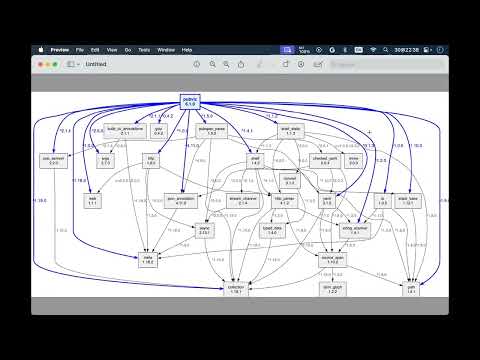
@MaxKorbel1 It's an implementation of Dart I'm working on that's written in Rust. It uses Cranelift and compiles down straight to an ELF. It skips things like the AOT runtime because it can be truly native.
English
1
0
0
32
Max Korbel retweetledi
CHOI
CHOI@arrakis_ai·
This GPT Image 2 prompt is going insanely viral right now. “Redraw the attached image in the most clumsy, scribbly, and utterly pathetic way possible. Use a white background, and make it look like it was drawn in MS Paint with a mouse. It should be vaguely similar but also not really, kind of matching but also off in a confusing, awkward way, with that low-quality pixel-by-pixel feel that really emphasizes how ridiculously bad it is. Actually, you know what, whatever, just draw it however you want.”
CHOI tweet mediaCHOI tweet media
English
1.3K
1.3K
12.6K
6.8M
Max Korbel retweetledi
Tristan Ross 😺❄️
Tristan Ross 😺❄️@RossComputerGuy·
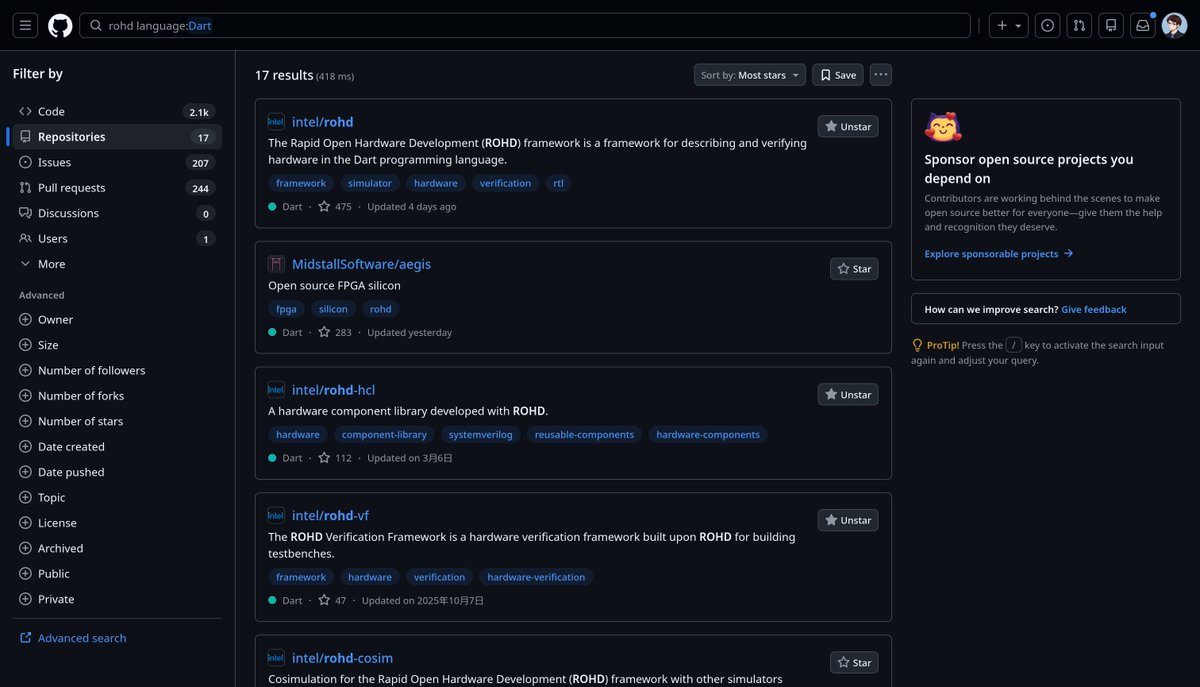
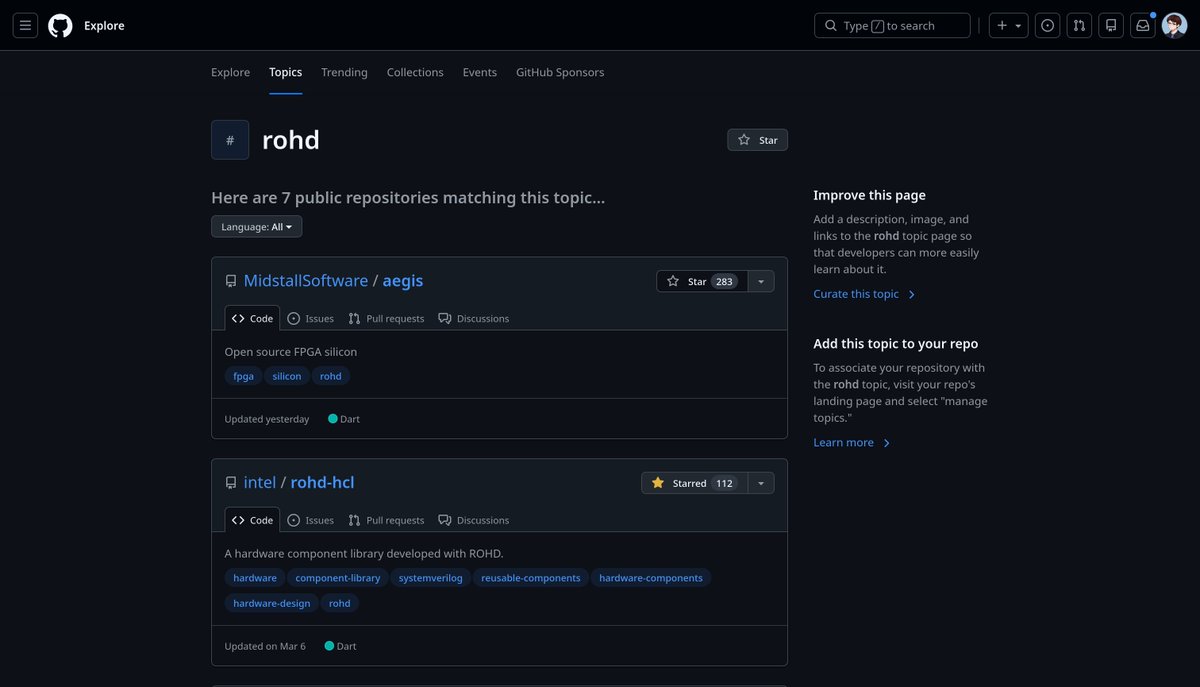
It seems Aegis is the most popular project using ROHD on GitHub.
Tristan Ross 😺❄️ tweet mediaTristan Ross 😺❄️ tweet media
English
0
1
13
1.2K
Max Korbel retweetledi
Anthropic
Anthropic@AnthropicAI·
Introducing Project Glasswing: an urgent initiative to help secure the world’s most critical software. It’s powered by our newest frontier model, Claude Mythos Preview, which can find software vulnerabilities better than all but the most skilled humans. anthropic.com/glasswing
English
2K
6.7K
44.1K
31.1M
Max Korbel retweetledi
Andrej Karpathy
Andrej Karpathy@karpathy·
Three days ago I left autoresearch tuning nanochat for ~2 days on depth=12 model. It found ~20 changes that improved the validation loss. I tested these changes yesterday and all of them were additive and transferred to larger (depth=24) models. Stacking up all of these changes, today I measured that the leaderboard's "Time to GPT-2" drops from 2.02 hours to 1.80 hours (~11% improvement), this will be the new leaderboard entry. So yes, these are real improvements and they make an actual difference. I am mildly surprised that my very first naive attempt already worked this well on top of what I thought was already a fairly manually well-tuned project. This is a first for me because I am very used to doing the iterative optimization of neural network training manually. You come up with ideas, you implement them, you check if they work (better validation loss), you come up with new ideas based on that, you read some papers for inspiration, etc etc. This is the bread and butter of what I do daily for 2 decades. Seeing the agent do this entire workflow end-to-end and all by itself as it worked through approx. 700 changes autonomously is wild. It really looked at the sequence of results of experiments and used that to plan the next ones. It's not novel, ground-breaking "research" (yet), but all the adjustments are "real", I didn't find them manually previously, and they stack up and actually improved nanochat. Among the bigger things e.g.: - It noticed an oversight that my parameterless QKnorm didn't have a scaler multiplier attached, so my attention was too diffuse. The agent found multipliers to sharpen it, pointing to future work. - It found that the Value Embeddings really like regularization and I wasn't applying any (oops). - It found that my banded attention was too conservative (i forgot to tune it). - It found that AdamW betas were all messed up. - It tuned the weight decay schedule. - It tuned the network initialization. This is on top of all the tuning I've already done over a good amount of time. The exact commit is here, from this "round 1" of autoresearch. I am going to kick off "round 2", and in parallel I am looking at how multiple agents can collaborate to unlock parallelism. github.com/karpathy/nanoc… All LLM frontier labs will do this. It's the final boss battle. It's a lot more complex at scale of course - you don't just have a single train. py file to tune. But doing it is "just engineering" and it's going to work. You spin up a swarm of agents, you have them collaborate to tune smaller models, you promote the most promising ideas to increasingly larger scales, and humans (optionally) contribute on the edges. And more generally, *any* metric you care about that is reasonably efficient to evaluate (or that has more efficient proxy metrics such as training a smaller network) can be autoresearched by an agent swarm. It's worth thinking about whether your problem falls into this bucket too.
Andrej Karpathy tweet media
English
962
2.1K
19.5K
3.6M
Max Korbel retweetledi
Andrej Karpathy
Andrej Karpathy@karpathy·
It is hard to communicate how much programming has changed due to AI in the last 2 months: not gradually and over time in the "progress as usual" way, but specifically this last December. There are a number of asterisks but imo coding agents basically didn’t work before December and basically work since - the models have significantly higher quality, long-term coherence and tenacity and they can power through large and long tasks, well past enough that it is extremely disruptive to the default programming workflow. Just to give an example, over the weekend I was building a local video analysis dashboard for the cameras of my home so I wrote: “Here is the local IP and username/password of my DGX Spark. Log in, set up ssh keys, set up vLLM, download and bench Qwen3-VL, set up a server endpoint to inference videos, a basic web ui dashboard, test everything, set it up with systemd, record memory notes for yourself and write up a markdown report for me”. The agent went off for ~30 minutes, ran into multiple issues, researched solutions online, resolved them one by one, wrote the code, tested it, debugged it, set up the services, and came back with the report and it was just done. I didn’t touch anything. All of this could easily have been a weekend project just 3 months ago but today it’s something you kick off and forget about for 30 minutes. As a result, programming is becoming unrecognizable. You’re not typing computer code into an editor like the way things were since computers were invented, that era is over. You're spinning up AI agents, giving them tasks *in English* and managing and reviewing their work in parallel. The biggest prize is in figuring out how you can keep ascending the layers of abstraction to set up long-running orchestrator Claws with all of the right tools, memory and instructions that productively manage multiple parallel Code instances for you. The leverage achievable via top tier "agentic engineering" feels very high right now. It’s not perfect, it needs high-level direction, judgement, taste, oversight, iteration and hints and ideas. It works a lot better in some scenarios than others (e.g. especially for tasks that are well-specified and where you can verify/test functionality). The key is to build intuition to decompose the task just right to hand off the parts that work and help out around the edges. But imo, this is nowhere near "business as usual" time in software.
English
1.6K
4.8K
37.3K
5.1M
Max Korbel retweetledi
Kilian Schulte 💙
Kilian Schulte 💙@schultek_dev·
The Flutter 2026 Roadmap is out. 💙 Happy to confirm that I will be collaborating more closely with the Flutter and Dart teams this year on Jaspr, Dart Web and more... 🔥
Kilian Schulte 💙 tweet media
English
6
19
226
8.9K
Max Korbel retweetledi
Chris Lattner
Chris Lattner@clattner_llvm·
I wrote about what I uncovered while unpacking the tech, and what I think it all means: modular.com/blog/the-claud… ps, thanks to many humans for their feedback, judgement and improvements!
English
18
97
727
77.4K
Max Korbel retweetledi
James E. Stine, Jr.
James E. Stine, Jr.@JamesStineJr·
We made a webpage for our content for our new Elsevier textbook coming out hopefully counting down in hours now. We hope to publicize more in the coming days: pages.hmc.edu/harris/ddca/rv…
James E. Stine, Jr. tweet media
English
14
149
951
47.9K
Max Korbel
Max Korbel@MaxKorbel1·
So proud to introduce Rayan Oliver Korbel
Max Korbel tweet media
English
0
0
0
27
Max Korbel
Max Korbel@MaxKorbel1·
🌉 ROHD Bridge v0.2.1 is out! 🔌 Smarter connectivity analysis (incl. constant tie-offs) 🧠 Better APIs for sliced & multi-dim ports 🛠 Robustness & logging fixes If wiring big designs hurts, try ROHD Bridge. buff.ly/IuFHW8z #ROHDBridge #EDA #RTL #HardwareDesign
English
0
0
0
11
Max Korbel
Max Korbel@MaxKorbel1·
After a hectic week, just finished up Day 7 (both parts), maybe can start to catch up on some of the prior ones this weekend
English
0
0
0
29
Max Korbel
Max Korbel@MaxKorbel1·
Got day 1 working, see my solution in ROHD on GitHub here: github.com/mkorbel1/aoc20… There's some brief write-ups in README files, might write some more later.
English
1
0
1
73