
Sabitlenmiş Tweet
Meinolf Heptner
7.7K posts

Meinolf Heptner
@MeinolfHeptner
Concerned Citizen - Awed by the simulation // following the terrible twins (update: T1 is -temporarily?- gone)
Germany Katılım Temmuz 2009
572 Takip Edilen295 Takipçiler
Meinolf Heptner retweetledi

*BRITISH WRITER PENS THE BEST DESCRIPTION OF TRUMP*
Someone asked "Why do some British people not like Donald Trump?" Nate White, an articulate and witty writer from England wrote the following response:
A few things spring to mind. Trump lacks certain qualities which the British traditionally esteem. For instance, he has no class, no charm, no coolness, no credibility, no compassion, no wit, no warmth, no wisdom, no subtlety, no sensitivity, no self-awareness, no humility, no honour and no grace – all qualities, funnily enough, with which his predecessor Mr. Obama was generously blessed.
So for us, the stark contrast does rather throw Trump's limitations into embarrassingly sharp relief.
Plus, we like a laugh. And while Trump may be laughable, he has never once said anything wry, witty or even faintly amusing – not once, ever.
I don't say that rhetorically, I mean it quite literally: not once, not ever. And that fact is particularly disturbing to the British sensibility – for us, to lack humour is almost inhuman.
But with Trump, it's a fact. He doesn't even seem to understand what a joke is – his idea of a joke is a crass comment, an illiterate insult, a casual act of cruelty. Trump is a troll. And like all trolls, he is never funny and he never laughs; he only crows or jeers.
And scarily, he doesn't just talk in crude, witless insults – he actually thinks in them. His mind is a simple bot-like algorithm of petty prejudices and knee-jerk nastiness. There is never any under-layer of irony, complexity, nuance or depth. It's all surface.
Some Americans might see this as refreshingly upfront. Well, we don't. We see it as having no inner world, no soul. And in Britain we traditionally side with David, not Goliath. All our heroes are plucky underdogs: Robin Hood, Dick Whittington, Oliver Twist. Trump is neither plucky, nor an underdog. He is the exact opposite of that. He's not even a spoiled rich-boy, or a greedy fat-cat. He's more a fat white slug. A Jabba the Hutt of privilege.
And worse, he is that most unforgivable of all things to the British: a bully. That is, except when he is among bullies; then he suddenly transforms into a snivelling sidekick instead.
There are unspoken rules to this stuff – the Queensberry rules of basic decency – and he breaks them all. He punches downwards – which a gentleman should, would, could never do – and every blow he aims is below the belt. He particularly likes to kick the vulnerable or voiceless or female – and he kicks them when they are down. So the fact that a significant minority – perhaps a third – of Americans look at what he does, listen to what he says, and then think 'Yeah, he seems like my kind of guy' is a matter of some confusion and no little distress to British people, given that:
• Americans are supposed to be nicer than us, and most are.
• You don't need a particularly keen eye for detail to spot a few flaws in the man.
This last point is what especially confuses and dismays British people, and many other people too; his faults seem pretty bloody hard to miss.
After all, it's impossible to read a single tweet, or hear him speak a sentence or two, without staring deep into the abyss. He turns being artless into an art form; he is a Picasso of pettiness; a Shakespeare of shit. His faults are fractal: even his flaws have flaws, and so on ad infinitum. God knows there have always been stupid people in the world, and plenty of nasty people too. But rarely has stupidity been so nasty, or nastiness so stupid. He makes Nixon look trustworthy and George W look smart. In fact, if Frankenstein decided to make a monster assembled entirely from human flaws – he would make a Trump.
English
@littlelindsay08 @Theholisticpsyc That Sounds like a very fair Deal!
I would love it. But haven’t been Lucky yet
English

@MeinolfHeptner @Theholisticpsyc All of it. She gives all of it. She’s asking for the same in return.
English

This is the partner the "angry daughter" wants:
English
@Theholisticpsyc All very nice and understandable. Will she give anything in return?
English
What would you add to this list?
Drop it in the comments...
English
Meinolf Heptner retweetledi

Thomas Sowell: "We're raising whole generations who regard facts as optional. They are being taught that it's important to have views, they are not being taught that it's important to know what you are talking about."
English
Meinolf Heptner retweetledi

Alain de Botton On Love As Education
Alain de Botton on one of the most unhelpful expectations we bring to relationships:
"A really unhelpful expectation is the idea that in a good relationship everything about us should be approved of by our partner."
He points out how common it's become to hear people say things like: *"Oh I had to break up with my partner because they didn't really accept me for who I am."*
But Alain pushes back on this framing:
"Do you accept who you are fully? No. None of us accept who we are fully, and none of us should expect to be fully accepted by other people. What we need to do is to not accept parts of ourselves with kindness and grace. It's judgmentalness that's the enemy, not the desire to nudge people towards being better versions of themselves."
He continues:
"When love is functioning properly we are able to tell our partners that there are things wrong with them, but they're able to listen without feeling under intolerable attack. Part of the work of love is helping people to evolve into better versions of themselves."
According to Alain, a real brittleness creeps in when people interpret any desire for change as a betrayal:
"There can be a real brittleness that comes in when people think 'if my partner in any way wants something to be different in me, that means they're not on my side.' Of course they could be on your side. They're totally on your side. They want you to improve. That's part of what love is."
He draws on the ancient Greeks to reframe what love is actually for:
"The ancient Greeks helpfully thought that love is a kind of classroom where, under the aegis of the tenderness of love, people are able to take the big steps towards acknowledging some of their flaws, rather than clinging rigidly on to who they happen to be and saying 'that's me and you've got to accept me, come hell or high water.'"
His conclusion:
"We should accept that love is a kind of process of education. We should be educating one another to be better than we currently are."
English
Meinolf Heptner retweetledi
Mr President,
It took everyone in the global investment community about 20 minutes after your Tuesday evening ceasefire announcement to notice that Iran's published version of the terms sheet included BOTH tolls for transiting the strait AND US and Iran respecting Iran's 'right' to continue enriching uranium.
Your latest statement seems to indicate that you have only just now noticed the bit about the tolls, and that you STILL haven't noticed that their version of the terms includes continued enrichment.
Now would be a good time to catch up with the rest of us, Mr. President. There's a lot at stake here.
@POTUS
x.com/Rory_Johnston/…
English

@MeinolfHeptner @Theholisticpsyc She stayed 3 years and was an amazing partner, and we're reconnecting
English
How to deal with someone with an avoidant attachment style:
English
@Theholisticpsyc very patiently and making plenty of space.
trauma that they didn't ask for has wrecked their ability to perceive closeness and love the same as everyone else, even though they really want it.
source: dated an avoidant that really fuckin tried
English
Meinolf Heptner retweetledi

Meinolf Heptner retweetledi
I am not a military analyst. I'm a financial analyst focused on macroeconomic risk.
That different lens might explain why I see something most military strategists and investors are missing.
---
The New Rules of Warfare—And Why We Can't Opt Out
For nearly a century, warfare belonged to whoever controlled the biggest defense budget. Aircraft carriers. Stealth bombers. Multibillion-dollar weapons systems.
That model is changing in ways many aren't appreciating.
Ukraine and Iran are showing the West what 21st-century conflict actually looks like: decentralized, highly iterative, fast-changing, unmanned, and cheap. Neither the US nor Russia—beginning in 2022—appears prepared.
We might now have no choice but to show we can fight and win such a war.
The Ukraine Approach
Faced with a small defense budget, a much smaller population, and a vastly outnumbered army, Ukraine had to get creative. They couldn't match Russia's industrial capacity or spending. So they abandoned that playbook entirely.
They developed an entirely new way to fight, highly decentralized, iterative, and most importantly, cheap.
They also created Brave1—a completely new way to conduct war.
Frontline commanders log into an iPad and bypass central command entirely. They spend digital points to purchase equipment directly from hundreds of (Ukrainian) manufacturers. When they encounter a new threat, they message the manufacturer directly and work with the engineers to find a solution, even if that means they visit to the front. The result is hardware or software upgrades that once took months now take days.
Here's the crucial part: hundreds of manufacturers compete fiercely for these dollars by offering the best possible product as fast as possible. This isn't centralized procurement. It's a market. Competition drives innovation at scale. Weapons evolve as the enemy evolves in real time.
Units are also awarded points for confirmed kills, uploaded from drone video—a powerfully eloquent way to grade effectiveness.
But the real innovation might be how they decentralized manufacturing itself. Instead of building weapons in massive, centralized factories that make perfect targets for Russian bombing, Ukraine distributed production across hundreds of small manufacturers—workshops, machine shops, garages, and yes, kitchens. Each produces components or complete systems. This approach serves two purposes: speed and survival.
You can bomb a tank factory. You destroy production for months. You cannot bomb ten thousand kitchens. If one workshop gets hit, ninety-nine others keep producing. The network regenerates faster than Russia can destroy it. This is why the manufacturing process includes actual kitchens—it's not a metaphor. It's a strategy.
The Metric That Defines a New Era
The result is staggering: at least 70% of battlefield casualties now come from drones. This is the first time in over a century that the primary cause of combat death is neither a bullet nor an artillery shell. Since World War I, industrial warfare meant industrial killing. Ukraine has broken that equation entirely.
As a result, Russia is now controlling less territory than at any point since 2022 and going backward. In March, Ukraine made gains while Russia recorded no gains for the first time in two and a half years, and Drone-led offensives recaptured 470 square kilometers while paralyzing 40% of Russian oil exports.
Ukraine has lowered the "cost per kill" to less than $1,000 per casualty—a 99.98% reduction from the millions of dollars that were common in the post-9/11 wars. This isn't an incremental improvement. This is a complete inversion of modern military economics.
Yet the Western defense establishment is not learning from this.
Rheinmetall CEO Armin Papperger mocked Ukraine's entire approach. In The Atlantic, he called Ukrainian manufacturers "housewives with 3D printers," dismissing their work as "playing with Legos." They are not studying this revolution. They are mocking it.
And the "housewives with 3D printers" are beating the Russian army!
Ukraine Is Now in the Middle East
The US Military and Gulf states face an eerily similar problem. Iran's Shahed drones threaten shipping in the Strait of Hormuz—a chokepoint that funnels 21% of global oil. They cannot fend off Iran by firing a $4 million Patriot missiles at $20,000 drones.
They need what Ukraine has discovered: a decentralized, rapidly adaptive defense network that doesn't require centralized industrial capacity.
That's why Ukraine just signed historic 10-year defense deals with Saudi Arabia, Qatar, and the UAE.
Over 220 Ukrainian specialists are now on the front lines of the Persian Gulf—exporting not just weapons, but a completely new doctrine of how to fight.
The precedent is set. The model works. Everyone is watching.
Mosaic
On April 1st, Trump threatened to bomb Iran "back to the stone ages" if they don't reopen the Strait within weeks.
It's the classic 20th-century playbook: overwhelming offense force, massive bombardment, industrial-scale destruction.
The problem? That playbook doesn't work against distributed, cheap, rapid-iteration systems—especially when your enemy is organized under a mosaic structure.
Iran's "Mosaic Defense" doctrine is a decentralized command system where authority and capability are distributed across multiple geographic and organizational nodes.
Each region operates semi-autonomously with overlapping chains of command and pre-planned contingencies. It's designed so that when you destroy the center, the edges keep fighting. You cannot decapitate a system with no head. You cannot out-bomb your way to victory when your enemy is not centralized; this was the solution for 20th-century industrial warfare.
Defense Wins Championships
21st-century asymmetrical threats require defensive shields, not aggressive offenses. Ukraine has built exactly that: rapid-iteration defenses, decentralized manufacturing, commanders empowered to buy solutions in real time and rewarded for success.
That same defensive model may hold the key to opening the Strait of Hormuz. Not through massive offense, but through the ability to adapt and defend quickly.
Why We're Stuck
Whether you viewed this as a war of choice or not, it has now become a war to keep global trade open. And that makes it inescapable.
This is precisely why the US cannot declare victory and walk away from the Strait of Hormuz— or TACO.
Every adversary on the planet will interpret American withdrawal as confirmation that cheap asymmetric systems work against powerful centralized platforms.
And these adversaries might have sent us a message last month. In mid-March 2026, an unauthorized drone swarm penetrated Barksdale Air Force Base in Louisiana, home to the U.S. Air Force's Global Strike Command.
The fact that this happened not overseas but in the United States, and that these tests occurred just weeks ago, underscores how close this threat is now.
They didn't attack. They announced their presence. Every adversary watching learned that cheap drone networks can reach into the US.
The Global Supply Chain Risk
If the US abandons the Gulf while Iran holds the Strait contested, markets will price this as validation that cheap systems can hold global trade hostage. The current market disruptions will become permanent.
Supply chains will have to pivot from "just-in-time" efficiency back to "just-in-case" redundancy. Inflation returns as safety costs money. Trade routes diversify away from vulnerable chokepoints. The global friction tax becomes permanent.
The Unavoidable Truth
Once you prove that cheap, asymmetric systems can hold global trade hostage, that knowledge spreads globally and irreversibly. Every adversary learns the same lesson: you don't need a $2 trillion Navy—you need $20 million in drones and the will to use them.
Withdrawing while the Strait remains contested would permanently validate this model. Supply chains shift to "just-in-case" redundancy. Insurance costs rise. The friction tax becomes structural—baked into every global transaction for decades.
The cost of staying is measured in months. The cost of leaving is measured in decades of economic drag.
We cannot leave unfinished business.
English
Meinolf Heptner retweetledi

Throughout the history of warfare, predicting outcomes at this early stage remains speculative nonsense. Pundits will say anything; their declarations lack probability.
The Iranians are human. Ascribing an infinite "rope-a-dope" capability to their military strategy requires magical thinking. They have suffered enormous losses to their enabling infrastructure, requiring at least a decade to rebuild.
Add @johnkonrad thesis: the Strait of Hormuz is functionally closed by insurance mechanisms. The U.S. Navy deliberately delays escorts to force European compliance with U.S. maritime policies—including the SHIPS Act and IMO carbon tax exemptions—mirroring the reflagging requirements of the 1987–1988 Operation Earnest Will.
Trump is executing a larger strategy. Observing this reality is independent of political support; a broader mechanism is unfolding in contrast to the doomsday consensus among pundits.
The Chinese restrictions I described on critical metals share a fundamental architecture with the U.S. maritime insurance controls described by Konrad.
Their shared structural design links these mechanisms. Both insurance and critical materials occupy mandatory conversion points within their respective systems, stages that require transformation before progression.
Both mechanisms are bureaucratic
A ship exists, a route opens, and cargo waits; without insurance, the process fails to become an authorized voyage.
Ore exists, demand peaks, and factories operate; without refining, the material remains unusable as an input.
One requires Chinese licensing, the other US insurance
In both scenarios, power stems directly from commanding the step where possibility transforms into permission or usability.
These stages concentrate risk, standardization, and coordination into a single layer. Disruption at this node propagates instantly across the entire system.
Both act as gateways aggregating dependency. Everything upstream feeds directly into them; everything downstream relies entirely upon them. When these gateways tighten, the system stalls exactly at the point of conversion.
John Spencer@SpencerGuard
It is insane how every so called "expert," academic getting 5 minutes of fame, podcaster, or media personality starts their critique or prediction of the war in Iran with regime change. Too bad it is a house of cards built on a lie 🧵 Such as "in all of military history, bombing campaigns have never caused a regime change." "The U.S. will lose the war, be embarrassed, didn't plan for this or that...Iran will win and be stronger...because the operation won't cause regime change."
English
Meinolf Heptner retweetledi
Thoughts on making life easier
Everyone keeps trying to control the wrong layer.
Some things are up to you.
Some things are not.
Not up to you: outcomes, other people, timing, markets, events.
Up to you: judgments, choices, attention, the use you make of what happens.
Most frustration comes from crossing that line. It’s that simple .
You treat what isn’t yours as if it were, then blame the world when it doesn’t obey.
There are only two levers:
•tighten your inputs
•raise the level of consciousness those inputs come from
Define what is actually yours to do.
Turn it into fixed daily actions. There is no other way. The better you do that, the better you do.
Keep a steady rhythm. Same time, same process.
Begin each block with a clear decision to act.
Do the task without bargaining. Stop bargaining with yourself, full stop.
If there is no bargain, it actually gets easier.
Finish the work you set.
Track execution, not results.
If you did the work, it stands complete.
Cut what pulls you off course.
Reduce noise. Reduce parallel aims.
Act fully, then release the outcome.
Once done, it no longer belongs to you.
Raise the level of consciousness
Examine your judgments.
Disturbance comes from how you interpret events, not the events themselves.
Pause before reacting.
Insert choice between impression and action.
Hold attention on what is in your control.
Return to it each time the mind drifts.
When something external goes against you, reframe it:
“This is not mine to command.”
Shift motive from result to conduct.
The aim is to act well, not to win.
Build consistency.
Carry the same discipline across situations.
Act where you have authority.
Withdraw from what you don’t.
Prepare, then choose, then act, then release, then continue.
It’s mechanical.
Focus on the use of your will.
If you become adept everything gets easier .
Everything else follows its own course.
Most of all, if you miss, if you fail, just smile and say “fuck it” and try again.
Let it go.
English
Meinolf Heptner retweetledi

Meinolf Heptner retweetledi

Der Silent-Hill-Effekt
(aus den Fragmenten einer vergangenen Wirklichkeit)
Ich habe neulich alte VHS-Aufnahmen gesehen – aus amerikanischen Schulen der 80er Jahre. Ein Schüler läuft mit der Kamera durch die Flure, filmt lachende Gesichter, Sonnenlicht, das durch staubige Fenster fällt.
Und während ich das sah, überkam mich dieses seltsame Gefühl, als würde ich in eine andere Dimension blicken. Nicht in die Vergangenheit – sondern in eine Welt, die es nicht mehr gibt. Oder vielleicht in eine, die für mich nie existiert hat.
Die Gesichter waren anders.
Locker, frei, von einer Natürlichkeit, die ich nicht kenne. Ohne die angespannte Selbstbeobachtung, die heute jede Bewegung begleitet.
Die Menschen wirkten ganzer.
Mädchen und Jungs lachten, machten Witze, zogen sich gegenseitig auf und es war einfach echt. Da war Leben, das sich noch nicht selbst zensierte.
Ich verglich die Aufnahmen mit Fotos aus meiner eigenen Schulzeit, mit Freundinnen und Freunden aus meiner Klasse. Und ich erschrak.
Es war, als würde man aus der eigenen Realität gerissen werden –
ein Moment, den man in der Psychologie als existenzielle Dissonanz oder kognitive Inkongruenz bezeichnet:
Wenn das vertraute Weltbild plötzlich nicht mehr stimmt,
und man begreift, dass etwas Grundlegendes verloren gegangen ist.
Im Vergleich wirkten wir wie eine Kolonne aus einem Straflager.
Unsere Gesichter puppenhaft, gestellt. Das Lächeln technisch korrekt, aber innerlich leer.
Die Augen hatten keine Wärme – sie waren einfach nur da,
blickten irgendwo ins Leere.
Es hatte einen gewissen Zynismus.
In der Wahrnehmungspsychologie nennt man das kontrastive Wahrnehmung – den Moment, in dem man den Verfall erst erkennt,
wenn man das Verlorene danebenstellt.
Ich nenne dieses Gefühl den Silent-Hill-Effekt.
Wer das Spiel oder den Film kennt, weiß: Es ist die gleiche Welt – dieselben Straßen, dieselben Häuser – aber plötzlich wird alles düster, tot, erdrückend. Der Nebel liegt über der Stadt, und etwas Unsichtbares hat das Lebendige verschluckt.
Früher war der Mensch ein Wesen, das die Welt erlebte, fühlte – in Musik, in Kultur, in Begegnungen.
Heute ist er ein Beobachter seiner eigenen Projektion.
Er lebt nicht mehr, er dokumentiert.
Er lacht nicht, er postet.
Er liebt nicht, er performed.
Und während wir uns selbst in Echtzeit aufzeichnen, verblasst die Realität wie ein müdes Magnetband,
auf dem sich Erinnerung und Echo überlagern, bis nur noch ein Rauschen bleibt.
Was uns fehlt, ist nicht Technik, nicht Fortschritt – es ist die Echtheit der Gegenwart. Das Ungefilterte, das Spontane, das Menschliche.
Wir haben alles vervielfacht,
außer das Gefühl, da zu sein. Vielleicht sind wir gar nicht so weit von Silent Hill entfernt.
Vielleicht leben wir längst darin –
in einer Welt, die aussieht wie unsere,
nur ohne Seele.
Ich selbst habe diese Zeit nie erlebt,
habe keine Erinnerungen, keinen Geruch, keinen Ton – nur die flimmernde Aufnahme auf dem VHS-Band. Und doch wirkt sie auf mich wie ein Relikt aus einer anderen Welt – einer Welt, in der der Mensch noch echt war.
#80s #Gesellschaft

Deutsch
Meinolf Heptner retweetledi
How to deal with someone who is committed to misunderstanding you:
English
Meinolf Heptner retweetledi

In 2009, Stanford professor Robert Sapolsky explained why depression is not a mental problem but a biological breakdown.
He revealed:
- Why “just be strong” is nonsense
- Why stress rewires your future
- How biology + psychology collide
15 lessons on the science of depression:
English
Meinolf Heptner retweetledi

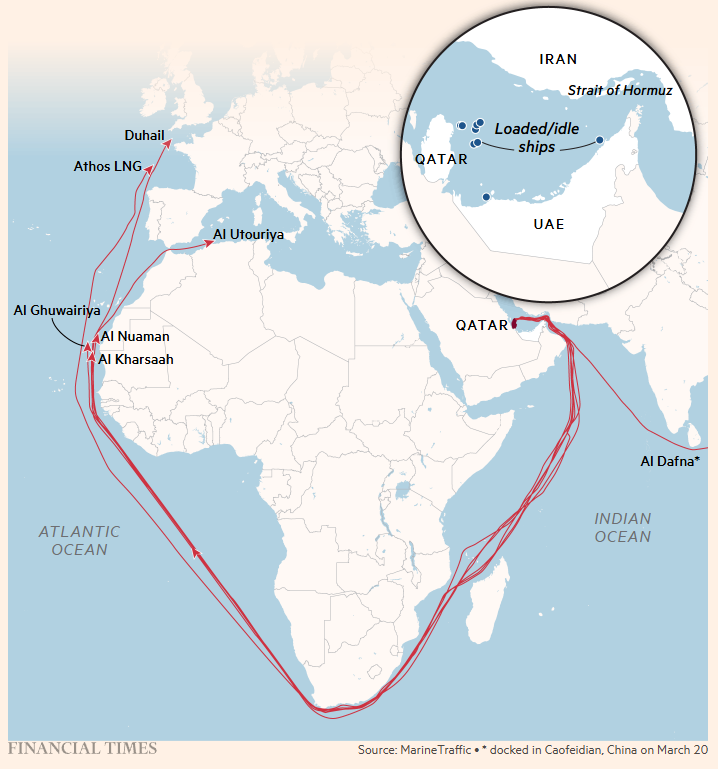
In 10 Tagen erreichen die letzten Gastanker aus dem Persischen Golf ihre Häfen. Schiffe, die vor Kriegsbeginn beladen wurden. Eine einzige Ladung davon geht nach Asien. Einen Kontinent, der 90 Prozent des katarischen Gases abnimmt. Sechs Ladungen gehen nach Europa. Wenn diese Schiffe entladen sind, ist Schluss. Kein nächster Konvoi. Kein Nachschub. Die Uhr tickt.
Katar produziert ein Fünftel des weltweit gehandelten Flüssiggases. Seit der Blockade der Straße von Hormuz steht der Export still. Seit den iranischen Raketenangriffen auf Ras Laffan, die größte Gasanlage der Welt, ist ein Teil der Infrastruktur physisch zerstört. Was jetzt noch auf dem Wasser schwimmt, sind Schiffe, die vor Kriegsbeginn beladen wurden. Letzte Reste eines Systems, das nicht mehr existiert.
Was danach kommt, zeigt Pakistan.
Im Januar hatte Pakistan einen Gas-Überschuss. Die Terminals waren unterausgelastet. Die Regierung bat Katar, 24 geplante Ladungen umzuleiten. Eni aus Italien sollte weitere 11 Ladungen verschieben. Pakistan brauchte das Gas nicht.
Acht Wochen später brach der Krieg aus. Pakistan versuchte sofort, die Eni-Ladungen zurückzubekommen. Eni lehnte ab. Pakistan kontaktierte Händler in Europa, den USA, Oman, Aserbaidschan und Afrika. Alle boten Preise an, die Pakistan nicht bezahlen konnte. Der Spotmarkt für asiatisches Flüssiggas hat sich seit Kriegsbeginn verdoppelt, auf rund 23 Dollar pro Million BTU.
Im März kamen 2 von 8 geplanten LNG-Ladungen an. Die anderen sechs wurden nie geliefert. Für April erwartet die Regierung, dass 3 von 6 Ladungen ausfallen. Beide LNG-Terminals des Landes laufen auf einem Sechstel ihrer normalen Kapazität. Die letzten Reste der beiden Schiffe, die vor dem Krieg ankamen, werden gestreckt bis Ende März.
Der Chef eines der beiden Terminals, Iqbal Ahmed, sagt: "Danach sind wir trocken. Wir wissen nicht, wann die nächste Ladung kommt."
Pakistan zahlt trotzdem weiter. 538.000 Dollar pro Tag an die privaten Terminalbetreiber. Rund 16 Millionen Dollar im Monat. Für Anlagen, die kein Gas verarbeiten. Die Verträge laufen auf Take-or-Pay-Basis. Kein Gas, aber volle Rechnung.
Gas aus Aserbaidschan wäre eine Alternative. Der Preis: dreimal so hoch wie der bisherige Import. Für ein Land mit einer Armutsrate von 29 Prozent und einem Pro-Kopf-Einkommen von 1.800 Dollar ist das keine Option. Pakistan wird stattdessen auf Schweröl umsteigen. Dreckiger. Teurer. Die einzige Wahl, die bleibt.
Der CEO des Terminals fasst es zusammen: "Ich sehe ein sehr schwieriges Jahr vor uns, gefolgt von zwei bis drei weiteren schwierigen Jahren."
Pakistan ist der extremste Fall. Aber nicht der einzige.
Bangladesch importiert 95 Prozent seines Energiebedarfs. Das Land hat Universitäten geschlossen, Treibstoff rationiert, Klimaanlagen in Regierungsgebäuden abgeschaltet. Vier von fünf staatlichen Düngemittelfabriken stehen still. Das Gas, das noch da ist, wird in Kraftwerke umgeleitet, um Blackouts zu verhindern. Ein Land mit 170 Millionen Menschen, im Dunkeln.
Und die reichen Länder? Kaufen sich Zeit. Aber nicht viel.
Taiwan bezieht ein Drittel seines Gases aus Katar. Die Regierung hat 22 Ersatzladungen gesichert, genug bis Ende April. Klingt beruhigend. Bis man eine Zahl kennt: Taiwan hat Gasreserven für elf Tage. Im Juli liegt der Stromverbrauch 40 Prozent über dem Februarniveau. Der Atlantic Council warnt vor "schweren Energieengpässen", wenn die Straße von Hormuz geschlossen bleibt. Und Taiwan produziert über 90 Prozent der weltweit fortschrittlichsten Halbleiter. Wenn dort der Strom knapp wird, betrifft das jedes Smartphone und jeden Server auf dem Planeten.
Japan hält sich bei Spot-Käufen zurück. Nur wenige Versorger erwägen überhaupt, auf dem freien Markt zu kaufen. Stattdessen plant Japan die Rückkehr zu Kohle und Atom. Im Januar hat das Land das größte Kernkraftwerk der Welt in Niigata teilweise wieder hochgefahren. Die Energiewende läuft rückwärts.
Aber selbst wenn die Straße von Hormuz morgen wieder öffnet, bleibt ein Schaden, der nicht reparierbar ist.
Diese Woche hat Katars Energieminister Saad al-Kaabi bestätigt: Zwei der 14 Produktionslinien von Ras Laffan sind zerstört. 12,8 Millionen Tonnen pro Jahr. 17 Prozent der gesamten katarischen Exportkapazität. Reparatur: drei bis fünf Jahre.
Die Anlagen haben 26 Milliarden Dollar gekostet. Der jährliche Umsatzverlust liegt bei 20 Milliarden Dollar.
Katar wird Force Majeure erklären auf Langzeitverträge mit Italien, Belgien, Südkorea und China. Für bis zu fünf Jahre. Das sind keine kurzfristigen Ausfälle. Das ist ein struktureller Verlust für den Rest dieses Jahrzehnts.
Al-Kaabi sagte gegenüber Reuters: Er hätte sich "nie in seinen kühnsten Träumen" vorstellen können, dass Katar so angegriffen würde. Von einem muslimischen Bruderland. Im Ramadan.
Die Schiffe, die jetzt noch unterwegs sind, werden in zehn Tagen ihre Häfen erreichen. Die Tanks werden entladen. Das Gas wird verbraucht.
Und dann beginnt die eigentliche Krise.
In diesen Recherchen steckt eine Menge Arbeit. Wenn dich solche Makro Insights interessieren und dir helfen, interagiere gerne mit dem Post. 🧡
Deutsch
Meinolf Heptner retweetledi
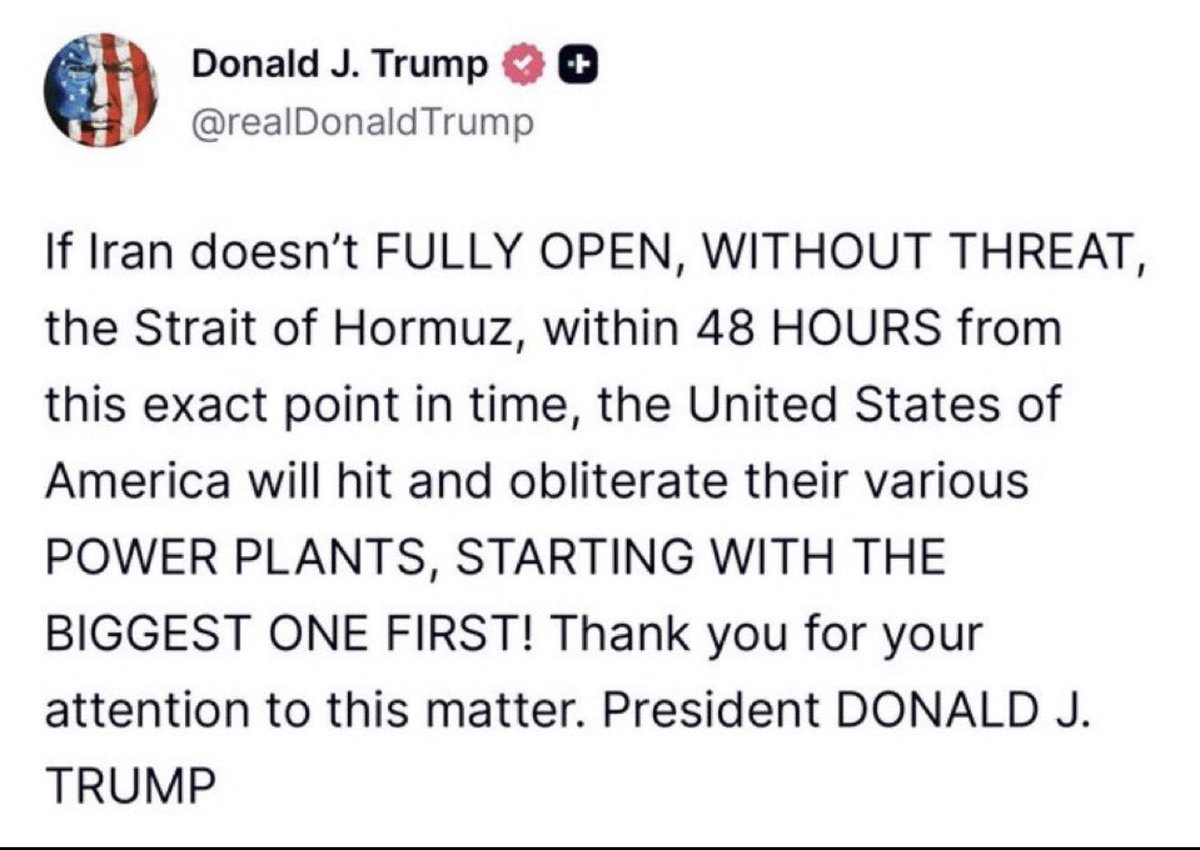
Decoding Trump on Iran electrical infrastructure threats
The strategical & tactical consequences and the motivation/s ———-expressed in neutral moral terms explicitly so the facts can land .
The neutralization of Iran’s electrical infrastructure focuses on twelve nodes that support the nation's political, military, and industrial operations.
The Damavand Combined Cycle Power Plant near Tehran stands as the primary target for the central region. It provides the base load for the capital’s ten million residents and the administrative heart of the government. Its removal triggers a total failure of high-altitude water pumping stations and urban transit systems.
The Shahid Rajaee Power Plant in Qazvin acts as the secondary anchor for the northwest industrial corridor. It supplies the heavy manufacturing zones that produce automotive parts and defense components.
In the northern Caspian region, the Neka (Shahid Salimi) Power Plant maintains grid frequency for the agricultural and logistical hubs bordering Russia. Its destruction isolates the northern provinces and halts the operation of strategic port facilities.
To the southwest, the Ramin Power Plant in Ahvaz and the Abadan Power Plant provide the high-voltage energy required for oil extraction and refinery operations in Khuzestan. Disabling these plants shuts down domestic fuel production. Electric pumps and cooling systems are necessary for crude processing.
The southern coastal theater relies on the Bushehr Nuclear and Conventional complex and the Bandar Abbas Thermal Plant. These facilities are the sole energy providers for the desalination plants that supply potable water to the IRGC naval bases and the millions of civilians in the arid southern provinces.
The neutralization of these coastal nodes creates an immediate humanitarian crisis.
Water storage in these regions is limited to a 48-hour window. The Asaluyeh Power Plants, integrated into the South Pars gas complex, are already degraded.
Their destruction halts the production of petrochemicals and fertilizers. These are essential for domestic food security and foreign exchange.
Civilian defense capabilities collapse as the national grid fails. Modern Passive Defense (Sazman-e Padafand-e Gheyr-e Amel) protocols require active power for the subterranean bunkers and civil defense centers that coordinate emergency responses.
Hospital systems face immediate failure as backup diesel generators exhaust localized fuel supplies within 72 hours. This is particularly certain given the disruption of the domestic refinery network. Telecommunications and internet connectivity vanish entirely. This prevents the state from managing the movement of the 3.2 million internally displaced persons fleeing urban centers for the rural north.
Manufacturing for the defense sector experiences total paralysis. The assembly of solid-fuel missiles and drone components requires precise temperature control and high-energy industrial mixers.
A grid collapse halts these production lines and prevents the testing of guidance systems. Heavy industries, including aluminum smelters and steel mills in the Persian Gulf Special Zone, suffer permanent equipment damage from sudden power loss. Molten materials solidify within the furnaces.
It’s that thing I keep referring to if you’re a regular reader the idea that our infrastructure can be immediately bought back online in any country is one of our naive beliefs.
This creates a multi-decade timeline for industrial reconstruction. The result is a transition from a centralized industrial state to a fragmented, localized survival economy.
There is a humanitarian catastrophe lurking here that is hard to contemplate .
English
Meinolf Heptner retweetledi

Imagine being a hedge fund manager trying to price risk while the President sounds like he’s freelancing World War III from the toilet.
Nobody knows what the plan is. There is no plan.
The plan is vibes, caffeine, and one man screaming into his phone like the manager of a failing Atlantic City steakhouse.
You open your brokerage app and everything is red, except oil and defense contractors, because of course.
Of course.
Every time civilization starts wheezing, Exxon walks out in a tuxedo with a martini and Lockheed buys another island.
The Nasdaq looks like it got hit in the face with a folding chair because suddenly the market remembered that semiconductors do, in fact, require an operating global economy and not just TED Talk confidence and a black turtleneck.
And Trump, God bless him, is tweeting like a guy who was handed six different war briefings, understood none of them, and decided to freestyle foreign policy from the toilet.
“We may be winding down.” Great!
“We may obliterate their power plants in 48 hours.”
Fantastic!
“Oil sanctions are off, but also maybe on, but also maybe we’re taking the island.”
Beautiful. Just beautiful.
This is why the market can’t price anything. You can’t build a discounted cash flow model around a national mood swing. There’s no Bloomberg terminal function for “presidential posting episode.”
There’s no options chain for “what if the leader of the free world says three contradictory things before lunch and Brent crude goes vertical while JPMorgan analysts begin quietly chewing through their own ties.”
The average investor is just sitting there like, “I bought an index fund because they told me it was safe.”
Safe? SAFE? Your “safe” portfolio is now directly connected to whether some 28-year-old NSC staffer can stop a rage-post from becoming a missile exchange before the European open.
That’s your diversification. Congratulations.
You own a basket of companies whose earnings now depend on whether Hormuz is open and whether Trump has confused deterrence with posting.
And Wall Street still does the same little dance every time. “Well, maybe this is already priced in.”
Oh really? Already priced in?
Was the possibility of a full-blown oil shock, shipping disruption, inflation resurgence, and presidential caprice “priced in,” Chad?
Was it in the spreadsheet next to “soft landing” and “AI productivity miracle”?
No, it wasn’t.
What was priced in was endless delusion, infinite buybacks, and the belief that history had ended because the S&P had a nice quarter.
Now everybody’s doing that thing they do where they act shocked that war affects markets.
“Wow, yields are up. Wow, energy’s squeezing margins. Wow, rate cuts are less certain.”
Yes, genius.
That tends to happen when the world’s most important oil chokepoint turns into a live-action Call of Duty map and the White House communications strategy is basically drunk casino owner at 2 a.m.
This is the real genius of the modern empire. It can’t build a train station, can’t balance a budget, can’t explain what victory looks like, but it can absolutely vaporize your 401(k) with a single weekend news cycle.
That part works flawlessly. That part is incredible. The only truly efficient American institution left is panic transmission.
We get chaos from the battlefield to your Robinhood account faster than Amazon gets paper towels to your porch.
And the best part is that by Monday morning every idiot on television will sit there with perfect hair and say, “Markets dislike uncertainty.”
Wow. Thank you, Socrates. What a contribution.
They dislike uncertainty. Incredible analysis.
We’ve spent billions on financial infrastructure just to reinvent the village idiot pointing at the sky going, “Storm bad.”
That’s where we are. The market is a hostage, oil is a weapon, diplomacy is a hallucination, and the President is posting like a divorced nightclub owner who just found the nuclear football in a Denny’s booth.
Everybody wants calm, nobody has control, and your portfolio is being managed by events that sound fake even when they’re real.
Absolute clown planet. Premium clown planet.
Goldman Sachs clown planet with institutional custody.
English