Michael Mendoza retweetledi
Michael Mendoza
712 posts

Michael Mendoza
@MendozaCodes
Software Developer | MRI Researcher @imperialcollege | Artist. Formerly@Consensys. Interested in Science, Tech, Economics, Machine Learning, GameDev, Art
London, England Katılım Mayıs 2018
389 Takip Edilen55 Takipçiler
Michael Mendoza retweetledi

Imagine every pixel on your screen, streamed live directly from a model. No HTML, no layout engine, no code. Just exactly what you want to see.
@eddiejiao_obj, @drewocarr and I built a prototype to see how this could actually work, and set out to make it real. We're calling it Flipbook. (1/5)
English
Michael Mendoza retweetledi

What if your whole computer were just pixels streamed to you from a model? I’ve been working with @zan2434 and @drewocarr to imagine a version of generative computing that’s much more flexible and visually rich than the GUIs we have today.
(Video is sped up and edited)
English
Michael Mendoza retweetledi

Introducing Simile.
Simulating human behavior is one of the most consequential and technically difficult problems of our time.
We raised $100M from Index, Hanabi, A* BCV, @karpathy @drfeifei @adamdangelo @rauchg @scottbelsky among others.
English
Michael Mendoza retweetledi

New Engineering blog: We tasked Opus 4.6 using agent teams to build a C compiler. Then we (mostly) walked away. Two weeks later, it worked on the Linux kernel.
Here's what it taught us about the future of autonomous software development.
Read more: anthropic.com/engineering/bu…
English
Michael Mendoza retweetledi

Introducing Prism, a free workspace for scientists to write and collaborate on research, powered by GPT-5.2.
Available today to anyone with a ChatGPT personal account: prism.openai.com
English
Michael Mendoza retweetledi

Chinese scientists have developed,
The best shortest-path algorithm in 41 years!
A team from Tsinghua University has broken Dijkstra's "sorting barrier" - the first improvement since 1984.
Just use for a world-map 🤯
Paper - arxiv.org/pdf/2504.17033
x.com/0x0SojalSec/st…
English
Michael Mendoza retweetledi

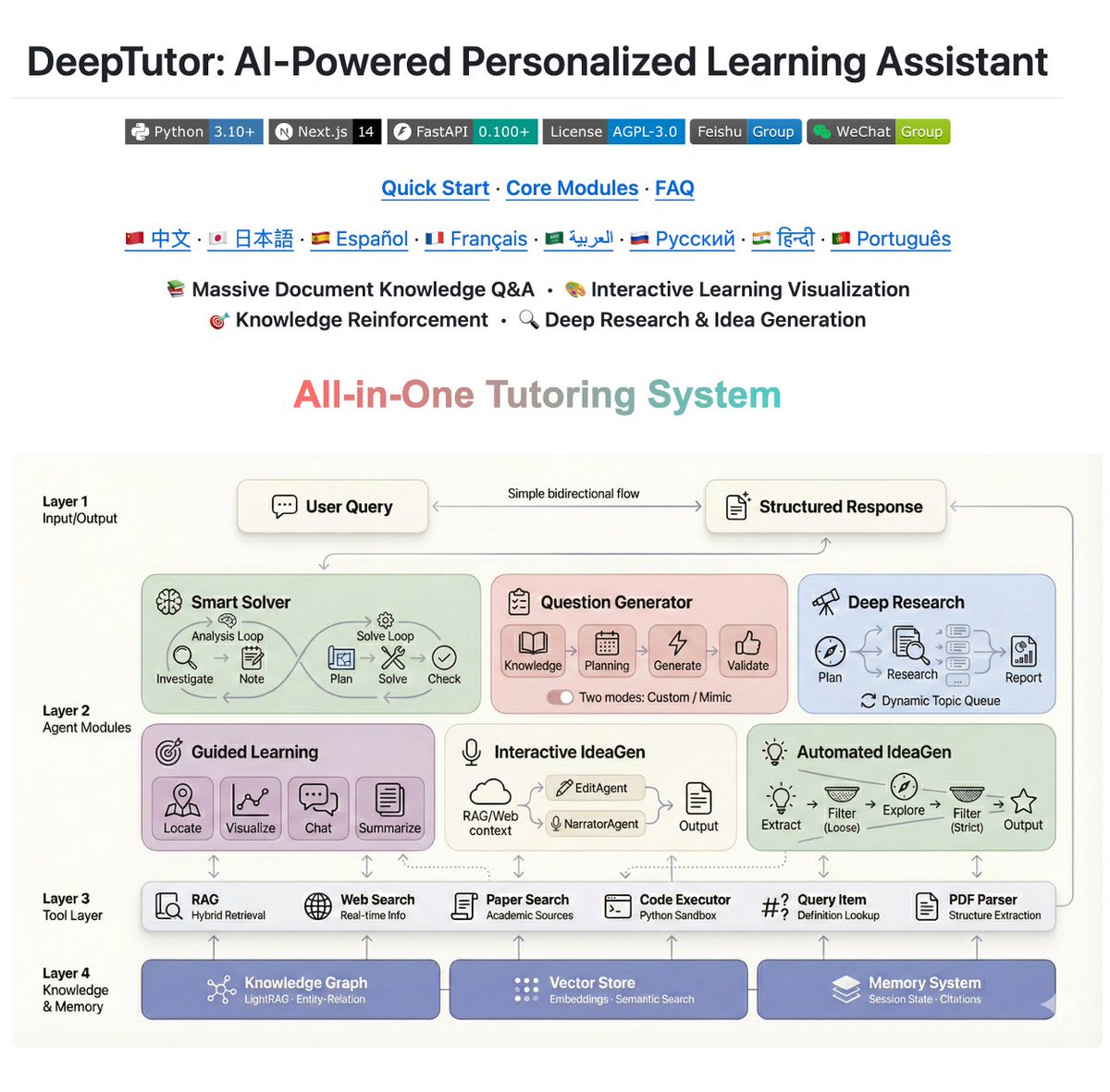
Released just five days ago, DeepTutor has already surged past 1.4K stars on Github! It seems people are hungry for a smart learning assistant that truly understands them.
🔗 Fully Open-Source: github.com/HKUDS/DeepTutor
We talked to countless students and kept hearing the same pain points: existing AI tools are either too fragmented or fail to capture personal learning context effectively. That's exactly why we built DeepTutor—to create an AI learning companion that actually remembers your progress and adapts to your unique learning style.
DeepTutor's Core Architecture
- 💬 User Interface Layer
Intuitive bidirectional interaction with structured, actionable outputs that organize complex context seamlessly.
- 🤖 Intelligent Agent Modules
Specialized multi-agent collaboration: problem solving, deep research, guided learning, and idea generation.
- 🔧 Tool Integration Layer
Unified access to RAG retrieval, real-time web search, academic databases, and code execution capabilities.
- 🧠 Personalized Knowledge & Memory Foundation
Persistent memory system built on knowledge graphs with contextual session tracking. Creates truly personalized learning experiences tailored to your individual progress and preferences.

English
Michael Mendoza retweetledi

Today, we’re announcing a major breakthrough that marks a significant step forward in the world of quantum computing. For the first time in history, our teams at @GoogleQuantumAI demonstrated that a quantum computer can successfully run a verifiable algorithm, 13,000x faster than leading classical supercomputers.
This continues to build momentum on past quantum computing discoveries. Back in 2019, we proved a quantum computer could solve a problem that would take a classical computer thousands of years. Then in 2024, our new Willow chip solved a major issue in quantum error correction that challenged the field for nearly 30 years. Today’s breakthrough moves us closer to quantum computers that can drive discoveries in areas like medicine and materials science.
English
Michael Mendoza retweetledi

LoRA makes fine-tuning more accessible, but it's unclear how it compares to full fine-tuning. We find that the performance often matches closely---more often than you might expect. In our latest Connectionism post, we share our experimental results and recommendations for LoRA.
thinkingmachines.ai/blog/lora/

English
Michael Mendoza retweetledi

I finally solved player recognition
- player and number detection with RF-DETR
- player tracking with SAM2
- team clustering with SigLIP, UMAP and KMeans
- number recognition with SmolVLM2
stay tuned for YT tutorial: youtube.com/c/Roboflow
↓ full breakdown + code
English