Mek Metapon

1.9K posts

Mek Metapon banner
Mek Metapon

Mek Metapon

@MetaponA

ทวีตเกี่ยวกับการลงทุน เน้นหุ้นอเมริกาจ้า Facebook / Youtube: หุ้นเปลี่ยนโลก

Bangkok Katılım Ağustos 2012
733 Takip Edilen4.3K Takipçiler
Mek Metapon
Mek Metapon@MetaponA·
Thanks for the post! Do you think they will face more pressure in the future? There is checkout.com and airwallex and others adjacent which could encroach into Adyey’s territory. They are growing much faster and taking incremental share of payment volume. Also does approval uplift has a ceiling? once the tech got good enough/commoditized enough, their uplift is not significantly higher than competitors? Thanks!
English
0
0
0
61
Rose Celine Investments 🌹
Rose Celine Investments 🌹@realroseceline·
It is a very different business from Stripe or $ADYEY, but the underlying idea is remarkably similar. Sit in the middle of the transaction flow and become essential infrastructure for commerce across the so called “Global South”. For anyone interested in this category of businesses, $DLO is definitely another company worth studying closely. There is another interesting way to think about companies like Stripe and $ADYEY. They quietly have one of the most extraordinary vantage points in the global economy. Because so much commerce flows through their systems, they can see economic activity across industries, countries, and currencies in real time. They see which payment methods are gaining share, which banks decline transactions more frequently, and how fraud patterns evolve across the world. In many ways they operate something that looks less like a payments network and more like a global economic sensor network. The future could make these companies even more important. As artificial intelligence systems begin to transact online on behalf of humans, the number of transactions in the digital economy could increase dramatically. Software agents may purchase cloud services, advertising, data, APIs, and digital goods automatically. If that happens, the number of payments flowing through infrastructure like Stripe and $ADYEY could grow far faster than the underlying economy itself. Another interesting aspect of these businesses is that they benefit from the success of the entire internet economy without taking the same risks. When $SHOP merchants sell more products, when $UBER grows rides, when SaaS companies expand globally, or when digital services add millions of new users, payments infrastructure companies quietly benefit from all of it. Payments infrastructure also tends to be surprisingly durable. Many industries experience disruption every decade, but financial plumbing tends to persist once it becomes deeply embedded. Companies like $V, $MA, and $FIS have operated for decades because replacing payments infrastructure is extremely difficult. Stability becomes more valuable than novelty when moving billions of dollars every day. Another often overlooked moat in payments is trust. These companies move enormous amounts of money and handle fraud prevention, compliance, and regulatory oversight for their merchants. Businesses do not simply choose the cheapest provider. They choose the company they trust to reliably move money across borders and banking systems. This creates an interesting paradox. Some of the most valuable companies in the world are not the ones consumers talk about every day. People discuss companies like $META, $NFLX, or $TSLA. But underneath those companies sits a layer of infrastructure that quietly powers the entire system. Stripe, $ADYEY, and increasingly $DLO sit inside that invisible layer. And over time, that invisible layer may prove to be one of the most valuable places in the global economy. 🌹 End/
English
4
0
10
2.3K
Rose Celine Investments 🌹
Rose Celine Investments 🌹@realroseceline·
Will Stripe beat $ADYEY? The short answer is that Stripe is already bigger, but that does not automatically mean it will beat $ADYEY. The two companies are winning in different ways. Stripe today operates at a much larger scale. In 2023 businesses on Stripe processed roughly $1.4t in payment volume, and Stripe is estimated to generate about $14b in revenue, significantly larger than $ADYEY’s roughly ~$1.7b. Stripe grew by onboarding millions of startups, SaaS companies, and developers. Think about companies like $SHOP, OpenAI, and thousands of SaaS platforms that built their financial infrastructure on Stripe from day one. Over time Stripe became the default payments provider for the internet economy. $ADYEY plays a different game. Instead of focusing on startups, $ADYEY concentrates on the largest merchants in the world. Companies like $UBER, $SPOT, $MCD, $MSFT, rely on $ADYEY for global payment processing. The model is more vertically integrated and more profitable. $ADYEY maintains EBITDA margins close to 50%, which is quite extraordinary. Stripe only recently reached profitability. So while Stripe is larger, $ADYEY has demonstrated stronger margins and a much longer track record of operational discipline. But the more I think about the industry, the more I believe the original question is framed incorrectly. Stripe and $ADYEY are not really playing the same game. Stripe is trying to become the financial operating system of the internet, like AWS. A company might initially integrate Stripe simply to accept payments, but very quickly Stripe becomes much more than that. Billing, subscriptions, fraud tools, issuing, treasury, tax, lending, identity services, and even company formation. Stripe is not just processing payments. It is building financial infrastructure for internet businesses. In many ways Stripe is attempting to become something similar to the $AMZN of finance. A foundational infrastructure developers can build on top of. $ADYEY’s strategy is different, it wants to be the best global payments engine for enterprise merchants. Its strengths come from direct acquiring licenses, omnichannel commerce for online and in store payments, and deep integration with some of the largest merchants in the world. Instead of winning thousands of small customers, $ADYEY focuses on “quality over quantity”. Once a global enterprise integrates a payments provider deeply into its systems, switching becomes difficult. Payments are connected to billing infrastructure, fraud management, reporting systems, treasury flows, refunds, and dispute management. Replacing that infrastructure for a large company can take years. What many investors miss is that the metric merchants actually care about most is not take rate or even revenue growth. It is authorization rates. If a payments provider can successfully approve even 1% more legitimate transactions, that difference can translate into millions of dollars of additional revenue for a large merchant. The provider that can approve the most good transactions while minimizing fraud becomes valuable. This is where data becomes extremely powerful. Payments companies like Stripe and $ADYEY see enormous volumes of global commerce flowing through their systems. They see which banks decline transactions, which payment methods perform best in different countries, and how fraud patterns evolve. Over time this data improves routing algorithms, which increases authorization rates, which attracts more merchants. It becomes a powerful data flywheel. In that sense payments is really a data business disguised as finance. Stripe has another fascinating advantage that people rarely talk about. Every year thousands of startups launch using Stripe. Most of those startups fail. But a small number eventually become massive companies. When that happens those companies rarely leave Stripe because their entire financial infrastructure is already built around it. 1/ 👇
English
4
1
26
4.3K
Mek Metapon
Mek Metapon@MetaponA·
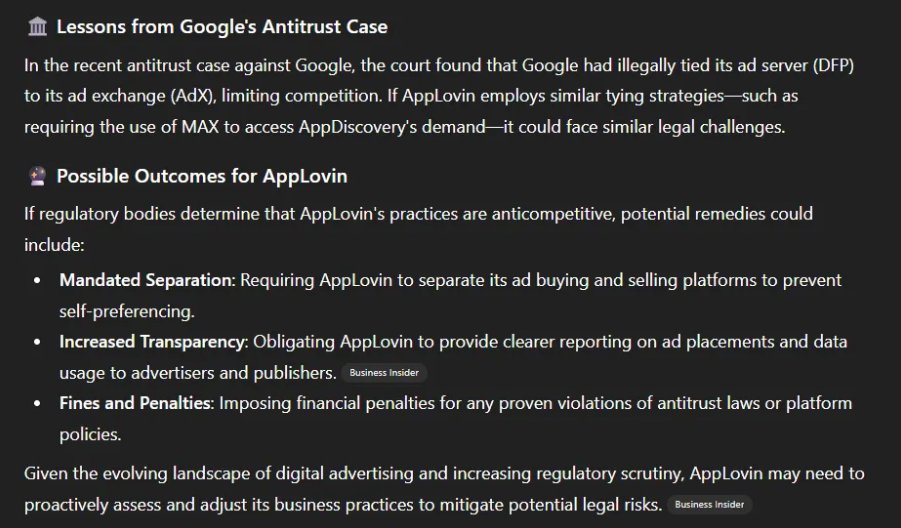
I don't see this get discussed much.. Can $APP be sued for favoring it’s own product that cause unfair advantage in the competition by waiving Publishers who uses both Max and Appdiscover 5% in mediation fee (small, but decisive as every % compound the monetization flywheel)? Although game publishers still have the choice to user other mediation though. ChatGPT though told me that this practice could be illegal if the company is deemed as a monopoly in a “defined” market. Now this depends on how you define this. If you are talking about the whole digital ad space, then APP is just <5% of total ad spend. But if you talk about gaming only, then the number flipped to >50%. Anyway, if deemed illegal, any kind of mandate from the court will destroy the company’s moat. I don’t see this risk get mentioned in the public much though. Anyone have any ideas? thanks!
Mek Metapon tweet media
English
0
0
1
506
Mek Metapon
Mek Metapon@MetaponA·
Its not about Blue Origin. Its not about turtle vs hare. He’s implying that Jassy’s $AMZN is slow like a turtle hehe
Jeff Bezos@JeffBezos

English
0
0
0
529
Mek Metapon
Mek Metapon@MetaponA·
@peter_mantas @rebound_capital Can CSU deploy this agent? If not, is it becaue thier team is not good enough at AI or cluade dominate evey aspect? Or they can but at price so low because of more competition?
English
1
0
0
77
Peter Mantas
Peter Mantas@peter_mantas·
Think about a power grid: an agent predicts a transformer failure, reroutes load, dispatches crews, and updates regulators automatically. The CSU ‘system of record’ logs but execution intelligence captures all of the economic value. That’s the long-term bear case: the willingness to pay premium prices for the ‘system of record’ layer collapses even if it remains mandatory. That lowers the terminal durability of newly acquired assets, pulling down incremental ROIC permanently. Btw this is one tiny example of what an agent can do let alone moving over that record. Once agents sit on top of systems of record, data gravity weakens. It no longer takes a full migration or ERP replacement to neutralize a vendor’s leverage. And it’s not like these agents aren’t getting smarter every 6 months either.
English
3
0
2
366
Rebound Capital
Rebound Capital@rebound_capital·
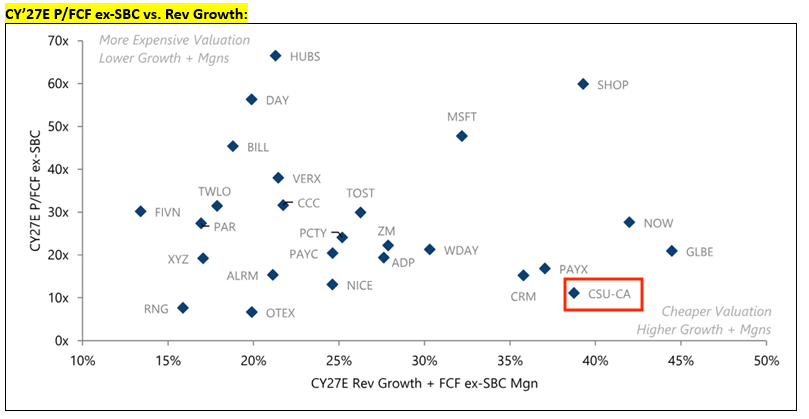
Constellation Software $CSU is now down 52%, the largest drawdown in its 20-year history. The company is now trading as if AI will disrupt its entire business. At its current valuation, the company outperforms almost all other companies on the “Rule of 40.” It will take a few quarters for the market to realize that AI is not taking away business from Constellation Think about it: There is next to no chance that a telecom or mining business that has worked with a vendor for 10+ years and fine-tuned the software to cater to their business perfectly is suddenly going to vibe-code an alternative just to save 0.1% of their revenue in software costs.
Rebound Capital tweet media
English
18
14
282
52.9K
Mek Metapon retweetledi
Ramp Labs
Ramp Labs@RampLabs·
A finance team just sent us this. They ran a full budget vs. actuals analysis in under 5 minutes. Uploaded their budget P&L and 10 months of GL actuals. Ramp Sheets matched every line item, calculated variances, and flagged problem areas. This used to take half a day.
English
20
49
1.1K
141.1K
Mek Metapon
Mek Metapon@MetaponA·
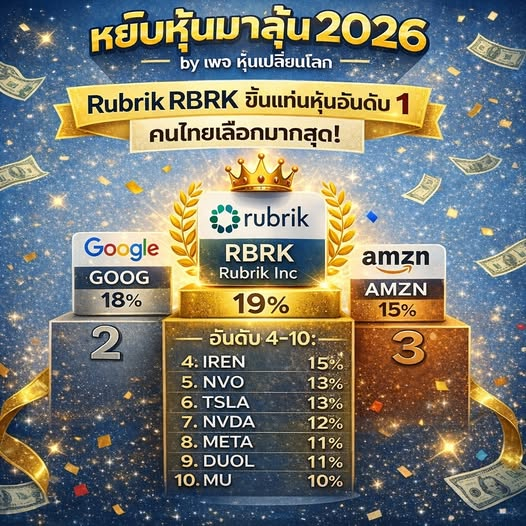
มาไงเนี่ย!? Rubrik คือหุ้นที่ถูกเลือกมากที่สุดจากเกมหยิบหุ้นมาลุ้นปี 2026 ตามมาด้วย GOOG และ AMZN ยักษ์ใหญ่ ส่วนตัวที่โผล่มาแบบซิ่งๆ อันดับ 4-10 ก็จะมี IREN, Novo Nordisk, Duolingo (ยังซิ่งอยู่ไหม) และ Micron! ว่าแต่ Rubrik ทำอะไร? Rubrik (RBRK) เป็นหุ้น Cybersecurity อีกโต โดยเน้นทำพวก backup ป้องกัน ransomware และทำ recovery อะไรแบบนี้ เก็บเงินเป็น subscription หุ้นนี้เกาะเทรนด์ใหญ่ 3 อย่าง: ข้อมูลโตเร็ว, ภัยไซเบอร์/แรนซัมแวร์, และ องค์กรย้ายขึ้นคลาวด์ + ใช้ AI (เอา AI มาช่วยดูแล/กู้ข้อมูล) มึคนสรุปหุ้น Rubrik เยอะมากทั้งจากพี่แดมที่มาออกเพจสามหนุ่มหุ้นนอก พี่มาร์ชเพจ เทรนด์ลงทุน และลงทุน Diary ลองหาในยุทูปได้เลยครับ ถ้าเพื่อนๆ อยาก "ลอกการบ้าน" หุ้นที่แต่ละคนเลือกมา สามารถเข้ามาหาได้ที่ Google Sheet นี้เลยครับ docs.google.com/spreadsheets/d… ผมมีให้ Gemini ช่วยบอกด้วยว่าแต่ละหุ้นทำอะไร จะได้ไม่ต้องไปกดหาเอง
Mek Metapon tweet media
ไทย
0
64
102
9.6K
Mek Metapon retweetledi
BuccoCapital Bloke
BuccoCapital Bloke@buccocapital·
Anthropic uses Workday. OpenAI uses Slack. It’s incredibly clear to anyone with half a brain that nobody is vibe-coding critical infrastructure. It is genuinely the lowest EV activity you can do. That bear case is dead (to I think most sensible investors). BUT, there are others. Here’s my remaining set of bear cases for SaaS, stack ranked. If you’re going to invest in SaaS you should be aware of all these and have a very strong POV on how impactful they are and the timeline on which you think they will (or won’t) play out 1. Platform differentiation trends toward zero, hurting CAC as each customer/upsell becomes a knife fight with multiple competitors. We were already trending toward every platform offering every app, AI just made it easier 2. Value will accrue to the agentic layer sitting on top of the system of record (SOR). Even with all their context, a SOR still lives in a silo 3. Investor sentiment becomes a structural headwind as revenue quality/business model is de-rated 4 . AI-native startups will deliver tremendous value at better prices, eating the incremental LTV of incumbent customers 5. As Agents do more work, seat-based revenue will decline. 6. Legacy SaaS will struggle to transition from seats to outcomes 7. Diminished pricing power due to decreased differentiation and lock-in takes away yet another growth lever 8. Gross margins will deteriorate because AI revenue is structurally more expensive which hurts the value prop of the business model 9. Decreased organic traffic due to LLM adoption increases CAC 10. Competition for scarce AI talent increases SBC/opex faster than revenue as incumbents fight to keep A talent from AI-native companies
English
100
102
2.2K
401.3K
Mek Metapon
Mek Metapon@MetaponA·
@nikoliasgoninus Problem is more like monetizable TAM growth and digesting last year’s growth.
English
0
0
0
45
Mek Metapon retweetledi
John
John@market_sleuth·
When you hold puts too long after a Trump tariff threat 😆
English
368
3K
34K
5.4M
Dr. Tomislav Marinovic
Dr. Tomislav Marinovic@DrTomsLens·
I’m not married to $DUOL. I’ll be the first person to jump ship if the thesis breaks. That happens if either of these becomes true: 1. Humans keep teaching better than AI, even as AI keeps improving. 2. Another company builds a richer learning/teaching dataset than $DUOL. The first one is virtually impossible in the long run. And on the second, right now, nobody is even in the same league. (Not investment advice.)
Dr. Tomislav Marinovic@DrTomsLens

I’m convinced most $DUOL bears who keep repeating “AI translation will disrupt Duolingo” will eventually accept the opposite conclusion, but only after the stock price makes it socially safe to believe it. Because this business is becoming less about languages and more about learning. And learning isn’t a dictionary problem. It’s a habit formation problem. Habit formation is an optimization loop: streak mechanics, pacing, difficulty curves, motivation triggers, timing, retention, and the thousands of small choices that determine whether a learner stays five minutes longer, or shows up tomorrow. You don’t solve that with a better translator. You solve it with years of proprietary data and relentless iteration on what actually changes behavior. Most investors don’t update their understanding based on what the business is. They update based on what the price is doing. When $DUOL is down, the narrative is “no moat, AI replaces it.” When $DUOL is up, the narrative becomes “behavioral psychology, data moat and new verticals.” Same facts. Different price. Different understanding of the business. And that’s the real game: the psychology of staying loyal to your research, your thinking, and your conviction while the entire market is against you. It’s the hardest skill in investing. It’s what separates multibagger holders from megabagger holders. (Not investment advice. Green owls move in mysterious ways.)

English
3
1
77
12.1K
Mek Metapon
Mek Metapon@MetaponA·
@MikeLongTerm @Meta Except from lacking capacity and pricing elsewhere, why would one go with meta cloud instead of more established clouds with all the tools?
English
0
0
1
109
Mike
Mike@MikeLongTerm·
$META Intrinsic value| DCF Focus 🧵 @Meta is trading around $620, with Analysts PT from $820-$1,117. Implying a massive upside from Analysts alone. I will build a base, and bull case to see where the share price should be on this thread. Revenue Trailing ~$189–190B.Full-year ~$200B+. Base case CAGR: 15-18% next 5 years Operating Margin 40-44% Bull Case: 18-22% CAGR next 5 years Operating Margin 45-48% FCF conservion is in 80-90% of Operating income to FCF. WACC/ Discount rate in the 9-10% is reasonable. Terminal Growth 3-4% is reasonable but could be above 4% as Meta to become Hyperscaler working with $AMD DCF Base case: 16% CAGR 7–8%, margins 42%, 10% WACC) => $800-$950, this is exactly consensus PT from analysts Bull case: 18–20% CAGR 5 yrs,9%, margins 44–46%, 9.5% WACC => $950-$1,100 closer to Rosenblatt Analyst Barton Crockett $1,117 PT. I think this is the most accurate Ultra Bull Case: 22% CAGR, 48% Margin, 9% WACC, 4%+ terminal) => $1,050- $1,250+. This ultra bull case odd is also likely due to clever partnership with Blue Owl to speed up Data center and lower upfront CapEx. Basically, If still 42% allocation to $AMD EPYC and MI Series, it would be $25B For every 1GW with $3B OpEx On @AMD Helios or $35-$40B for 1GW with $4B OpEx On $NVDDA Rubin The rent is higher per year, but it saves $META $27B to scale up construction, building, land, power, cooling for 5GW. The speed is amazing, where certain units are already live right now. This is equivalent of @elonmusk and @awscloud type of data center up and running. Certainly, @finkd is determined with this kind of structure. Market is pricing in way too much CapEx pain, where $META can generate $20-$25B revenue per 1GW excess capacity compute from $AMD hardware. META AI is now over 1B users, so internal need is already expensive when renting compute. Inference and training bill could go up as high as $30-$40B OpEx when renting. Mark Zuckerberg saw the fastest rise in Users interest on Meta-AI, hence "Not Aggressive enough" on AI CapEx rather than too aggressive! This is why $META is aggressively scaling data center with AMD due to superior TCO,TDP, and $ on training/inference per million tokens. If fully scaled out like @finkd stated, "tens to hundreds of gigawatts", we are talking about $200B-$1 Trillion revenue opportunity over the next 10 years+ when factoring in Renting out AI Compute. Essentially we are talking about @Azure, @googlecloud, @awscloud , @OracleCloud, @Meta-Cloud, and @OpenAI-Cloud in the coming years and decades as Hyperscalers. In the comment section, do you think $META is trading at a massive discount right now? Not Financial Advice!
Mike@MikeLongTerm

BREAKING $AMD & $META Secret Hyperscaler🧵 @Meta Roadmap to 10s-100s+ GW Hyperscaler This thread will focus more on how META is going to scale this kind of AI Infrastructure by skipping upfront construction cost and cool. And how Dr. @LisaSu going to take AMD's shareholders to 20%+ Market share. Meta and funds managed by Blue Owl Capital formed a JV to develop and own the Hyperion data center (a massive ~2GW up to 5GW where @AMD is already a major supplier) AI-focused campus in Richland Parish, Louisiana, with total development costs around $27 billion). ~Blue Owl funds hold ~80% ownership; Meta retains 20%. ~Meta will lease the entire completed campus from the JV under operating lease agreements (4yr term with options to extend/renew) ~Meta received a one-time distribution of approximately $3 billion from the JV as part of the transaction setup. ~Meta effectively received ~$3 billion net upfront rather than putting money down. This creative financing helps Meta scale its AI infrastructure rapidly without fully burdening its balance sheet, especially given its massive ongoing CapEx (~$60–70B+ annually in recent guidance). The JV owns the campus, Meta leases it back (initial 4-year term + extensions), and future rent payments support the JV's returns/debt service. This is where most analysts misunderstood the clever structure @finkd came up with Blue Owl. Or how this will significantly help $AMD boosting Revenue growth. $AMD should be able to generate $70B-$100B by FY 2026(read more below)! While $META did not disclose the rental detail, but we can expect 6-9% yield for META investment-grade or 7% in this case, which would imply around $2B annual rent obligation plus $1-$1.2B OpEx(for 1GW, or $4B for 5GW). Which is still going to be massively cheaper than renting compute from $MSFT, $AMZN, $GOOGL or roughly $20-$25B renting bill on 1B+ users on MetaAI owning $AMD EPYC Venice and MI455X or Helios rack which collaborated with $AMD. In case of Hyperion campus at 5GW, Blue Owl join venture will handle all the constructure, building, power, cooling and others, while $META will have to cover the cost of GPUs purchase or in this case hybrid of $AMD Helios and $NVDA Rubin Rack. Blue Owl gets higher rental rate and ownership of building, land. If $META owns everything, it will only be $1B-$4B of OpEx from 1GW to 5GW capacity. In this case, $META will pay $3B-$6B OpEx instead. The bonus is much much faster construction where Meta can gets it online very quickly, or as some of the space is already "going live" right now, where more units to go "live" in 2027-2028-2029-2030. We need an example, where you can understand the number a bit more clear. 5GW, at 42% allocation of prior chips to $AMD in 2025 and 58% to $NVDA. If we use the same allocation for 5GW, that would be around 2GW. $META is already a very large customer for $AMD, so I assume the highest discount at large multi-GW scale deployment as Dr. @LisaSu indicated throughout various events. 1GW Helios= $25B. This number could go up to $30-$33B per GW for slower/smaller deployment. 2GW will mean $50B revenue for $AMD. MI500 Racks will probably at 10-15% higher price tag. I will talk about that when we get there. Conclusion: This clever structure allows $META to scale AI Infrastructure much much faster than owning everything as it would be far more capital intensive. Think of $2B Rent/year for every 2-5GW capacity, Meta saves $27B CapEx upfront, or Meta shareholders would punish the stock aggressively. I expect this kind of clever structure to be used in the next 100-200GWs deployment, where $META will generate significant revenue renting out AI compute at lower price to compete with @awscloud , @Azure, @googlecloud, @Oracle and @OpenAI. Current Industry rental price is $3-$10 per hour. $META needs for internal use as well, but will rent excess capacity, similar to the early day of AWS. Meaning, for each GW excess capacity, $META could generate $20-$25B Revenue. However, with $AMD superior TCO, TDP, and lowest Inference/Training cost per million tokens, META would be able to generate $25-$30B per GW excess capacity offering rental rate at 10-15% lower than AWS, Azure, Google Cloud. With $NVDA, $META would be able to generate $5-$10B revenue per GW due to @nvidia Premium position of 70$ gross margin. The most likely outcome will be Split of ~58% $NVDA Rubin Racks to handle 60% training ~42% $AMD Helios Racks to handle 40% training and all Inference with 500-700k additional EPYC Venice to lower Inference cost whether it is renting or internal use! Alright, that is it. Not Financial Advice!

English
7
20
148
44.7K
Mek Metapon
Mek Metapon@MetaponA·
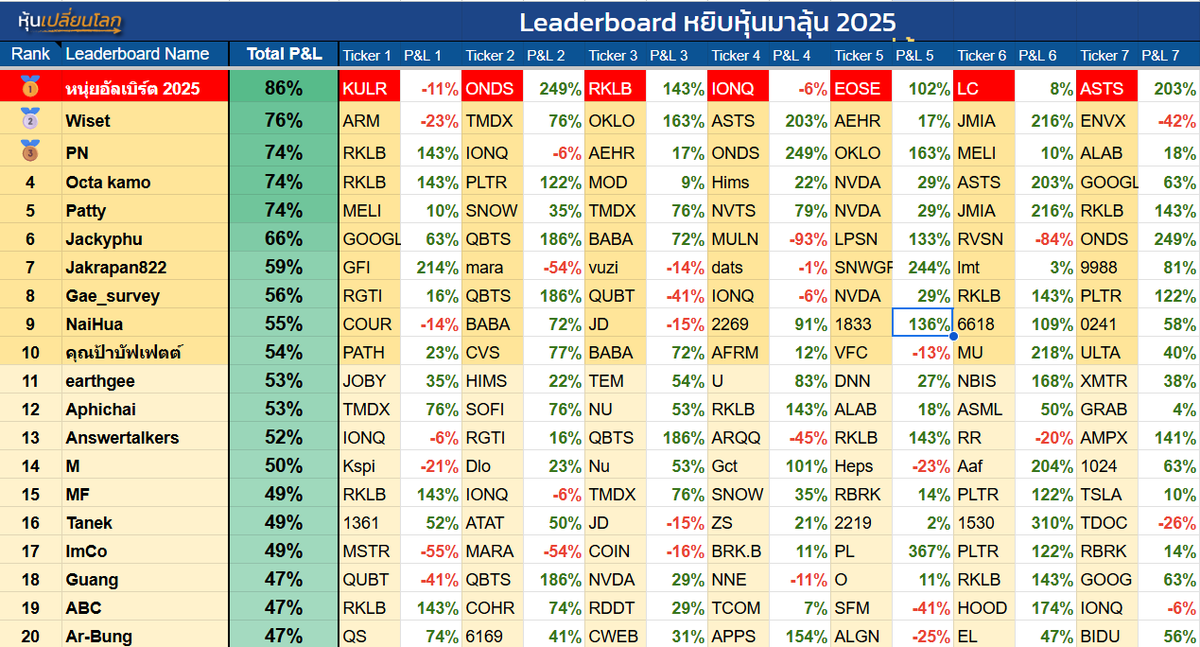
พอร์ตใครโตระเบิดในปี 2025 มาดูกันครับ เข้าปีที่ 5 แล้วกับกิจกรรมหยิบหุ้นมาลุ้น! ทุกๆ ปีผมจะให้เพื่อนๆ เลือกหุ้นต่างประเทศมา 7 ตัวแล้วดูว่าปลายปี 7 ตัวของใครทำผลงานได้ดีที่สุด สำหรับปี 2025 มาสรุปจุดที่น่าสนใจกันตามนี้ครับ 1. ปีนี้บอกได้คำเดียวว่า “ซิ่ง” ความซิ่งเท่านั้นที่จะทำให้พอร์ตหุ้นคุณติด Top 20 ได้ เพราะหุ้นหลายตัวที่ทำได้ดีนั่นยังไม่มีกำไร (บางตัวแทบจะยังไม่มีรายได้ด้วยซ้ำ!) OKLO, Rocket Labs, ASTS, IONQ หลายตัวผมเคยบอกให้ระวัง ถ้าใครฟังผมก็พลาดไปเต็มๆ 2. พวกเราชนะตลาดอีกแล้ว! โดยเฉลี่ยแล้วผู้เล่นทั้งหมดได้กำไรเฉลี่ย 24% ชนะ S&P (แถมได้เปรียบค่าเงินด้วย) และถ้าดูจาก Distribution ก็ถือว่ากำไรกันเกือบทุกคน ผมว่าช่วงที่ตลาดกำลังร้อนแรง รายย่อยที่มีหุ้นซิ่งเยอะจะชนะตลาดได้ไม่ยาก แต่ถ้าย้อนกลับไปอย่างปี 2022 พวกเราก็แพ้ตลาดกันยับๆ เหมือนกัน ตอนนี้หุ้นซิ่งชนะมาปีสองปีแล้ว อาจจะบิดน้อยลงบ้างนะครับผมว่า 3. Admin ของเราเป้นยังไงบ้าง? พอร์ตของผมในเกมนี้ทำได้ดีกว่าพอร์ตตัวเองในชีวิตจริง (อีกแล้ว! อะไรวะเนี่ย 555) พอร์ตจำลองผมได้ตามนี้ ปี 2022 -65% ปี 2023 +93% ปี 2024 +118% ปี 2025 +30% รวมสี่ปีแล้ว +91% ในขณะที่ Nasdaq +57% ในขณะที่พอร์ตชีวิตจริงนั้นแพ้ Nasdaq ผมก็พยายามเลือกให้ชนะอยู่นะ บางทีเราแค่ถือลืมๆ ไปยังจะดีกว่า นี่มันแพ้ภัยตัวเองระดับนึงเลย ส่วนพี่โต Billionaire VI เลือกหุ้นซิ่งๆ ไม่เหมือนชีวิตจริง กดไป +15% พี่มิกกดไป 43% สวยๆ (ดีกว่าในชีวิตจริงเช่นกัน 5555) 4. บทเรียนอื่นเกี่ยวกับการเลือกหุ้นน่าจะซ้ำกับปีก่อน เช่นขอแค่มีหุ้นเด้งตัวเดียวพอร์ตคุณก็สวยแล้ว หรือผู้ชนะแต่ละจะไม่ค่อยหน้าซ้ำ และมักจะทำได้แย่กว่าเฉลี่ยในปีต่อไปด้วย ยินดีกับผู้ชนะ คุณหนุ่ยอัลเบิร์ต 2025 และเพื่อนๆ ที่เหลือด้วยครับ รับเงินรางวัลไป 1500 บาท นอกจากนี้เราจะสุ่มรางวัลอีก 4 รางวัลตอนที่พวกผม Live กันในรายการสามหนุ่มหุ้นนอกครั้งถัดไปนะครับ คุณสามารถเข้าไปดูอันดับของตัวเองได้ที่ลิงค์นี้ (หน้าดูสกอร์) และช่วยกันเข้ามาเลือกหุ้นของปีหน้าได้ที่ลิงค์นี้ (หมดเขต 24 มค) » form.jotform.com/260144094582456 « รางวัลยังเหมือนเดิม 🥇 ผู้ชนะอันดับ 1 รับไป 1,500 บาท! 🥈 อันดับ 2-20 สุ่มรับรางวัล 1,000 บาท! จำนวน 4 รางวัล 🏵️ รางวัลชมเชย แค่พอร์ตไม่ติดลบ ก็มีลุ้นรับ 500 บาท 1 รางวัล 🏵️ อันดับ 1-10 ได้รับเชิญไปทานข้าวกับสามหนุ่มหุ้นนอก Happy New Year!
Mek Metapon tweet media
ไทย
0
1
10
632
Mek Metapon retweetledi
Sheel Mohnot
Sheel Mohnot@pitdesi·
This is so good. I am so bad at it! RIP
Sheel Mohnot tweet media
English
72
474
5.1K
182.6K
Mek Metapon retweetledi
Eugene Ng
Eugene Ng@EugeneNg·
Sharing an additional list of 14 qualitative traits of companies that we have grown to really appreciate from my Q3 2025 Investor Letter for Vision Capital Fund: 1. Highly customer-centric and focused. 2. Focuses on selling value, not the product. 3. Pricing power from growing customer value first. 4. Enables and participates in their customers' success. 5. Provides highly mission-critical products/services that result in highly recurring and predictable revenues, and has a long and high lifetime value. 6. Start with a niche, expand into more niches, and become a platform. 7. Continuously innovates to stay ahead of competitors. 8. Becoming increasingly vertically and/or horizontally integrated. 9. Management expands into new products, markets, and countries. 10. Took time to build an advantageous, lowest-cost structure that is difficult and takes time for competitors to replicate. 11. Scale economies shared, reducing customer pricing over time. 12. Typically sell premium-priced products/services and are usually the most expensive. 13. Management is visionary and strategic, able to see ahead, and willing to pivot at crucial turning points. 14. Management is willing to sacrifice short-term gains for long-term benefits and reinvest during difficult times. I continue look to refine and expand this list over time.
English
1
6
23
2.6K
Mek Metapon
Mek Metapon@MetaponA·
📊📈 Portfolio Tracker ที่ดีที่สุดที่ผมเคยใช้มา • ใช้ติดตามหุ้นและสินทรัพย์ทั่วโลกแบบ REAL TIME หุ้นไทย DR ออพชั่น มีหมด • คำนวณ Split และ Dividend ให้อัตโนมัติ • แปลงสกุลเงินให้เองถ้ามีหลายพอร์ต • คำนวณ performance และเทียบ Benchmark ให้เสร็จสรรพ • สร้างโดยคนไทย แต่ดีระดับโลก Portseido ใช้ลิงค์ผมเพื่อลองใช้ฟรีและรับส่วนลดครับ >> portseido.com/?fpr=metapon11 << ถ้าใครจดการซื้อขายไว้ใน Excel หรือ Goole Sheet อยู่แล้ว ย้ายไปไม่ยากเลย
ไทย
1
24
47
3.2K
Mek Metapon
Mek Metapon@MetaponA·
บับเบิ้ลกี่โมง?? ⏰ Is It Bubble? By Howard Marks ช่วงนี้นักลงทุนหลายคนเริ่มตั้งคำถามกันว่าตลาดหุ้นตอนนี้เป็นฟองสบู่หรือยัง โดยเฉพาะกลุ่มหุ้นเทค ที่กระแส AI พามาจนถึงตอนนี้ Howard Marks ได้เขียน Memo วิเคราะห์ฟองสบู่ในรอบนี้ไว้อย่างน่าสนใจ สรุปได้ดังนี้ 1️⃣ ธรรมชาติของฟองสบู่ Howard Marks เริ่มจากตั้งข้อสังเกตว่าฟองสบู่มักเริ่มจากนวัตกรรมอะไรบางอย่างที่ “เป็นสิ่งใหม่” “ผู้คนเชื่อว่าสามารถจะเปลี่ยนโลกได้” หรือ “ทำกำไรได้มหาศาล” ความ “ใหม่” ของสิ่งเหล่านี้ทำให้เราไม่มีประวัติศาสตร์ของมันให้เปรียบเทียบ เราจึงสามารถจินตนาการไปได้ไกลไร้ขอบเขต มันเลยส่งผลให้ Valuation พุ่งไปไกลเกินพื้นฐาน เมื่อรวมความตื่นเต้นในสิ่งใหม่กับความกลัวที่จะตกรถเลยส่งผลให้ตลาดเกิดการไล่ราคาของสิ่งนั้นพุ่งขึ้นอย่างบ้าคลั่งไร้เหตุผล (Irrational Exuberance) Howard Marks อ้างอิงจากบทความของ Ben Thomson: The Benefits of Bubbles ที่ว่าฟองสบู่นั้นแบ่งได้ 2 แบบ คือ 1. Mean Reversion Bubbles (ฟองสบู่แย่) คือ ฟองสบู่ที่เกิดจากนวัตกรรมทางการเงินหรือสินทรัพย์ที่ไม่สร้างประโยชน์ในระยะยาว เช่น วิกฤติ Subprime หรือวิกฤติดอกทิวลิป เมื่อฟองสบู่แตกแล้วทุกอย่างกลับสู่สภาพเดิมและทำลายความมั่งคั่งของนักลงทุน 2. Inflection Bubbles (ฟองสบู่ดี) คือ ฟองสบู่ที่เกิดจากเทคโนโลยีเปลี่ยนโลก เช่น รถไฟ หรือ อินเทอร์เน็ต แม้ฟองสบู่จะแตกและนักลงทุนขาดทุนมหาศาลเช่นกัน แต่สิ่งที่เหลืออยู่คือ "โครงสร้างพื้นฐาน" (Infrastructure) ที่ปูทางไปสู่ยุคใหม่และเร่งความก้าวหน้าทางเทคโนโลยี 2️⃣ เปรียบเทียบกับประวัติศาสตร์ สำหรับ Howard Marks แล้ว เขาไม่ได้มอง AI boom เทียบกับยุค Dotcom แต่เขาคิดว่ามันเหมือนกับตอนยุคที่มีเทคโนโลยี “วิทยุ” และ “การบิน” เกิดขึ้นมากกว่า เทคโนโลยีทั้งสองนี้เข้ามาเปลี่ยนโลกให้เกิดความก้าวหน้าได้จริง แต่ไม่ได้สร้างความร่ำรวยให้กับนักลงทุนทุกคน ในตอนนั้นก็มีหุ้นร้อนแรงอย่าง RCA ที่เทียบได้กับเป็น Nvidia แห่งยุค 1920 เลยทีเดียว นักลงทุนพากันไล่ราคาขึ้นไปสูงมากก่อนฟองสบู่แตก หุ้นตกถึง 97% สาเหตุส่วนใหญ่ในตอนนั้นคือ ยังไม่มีโมเดลธุรกิจที่ชัดเจน กำไรไม่มาตามนัด และไม่รู้ว่าใครจะเป็นผู้ชนะกันแน่ ทำให้เมื่อความจริงปรากฎ หุ้นก็กลับเข้าสู่มูลค่าที่แท้จริง 3️⃣ ความกังวลเรื่องหนี้และความไม่แน่นอน หากดูสถานการณ์ในปัจจุบันจะพบว่า 75% ของผลตอบแทน S&P 500, 80% ของกำไร และ 90% ของรายจ่ายลงทุน (Capex) มาจาก AI หุ้น Nvidia เติบโตจากมูลค่า 626 ล้านดอลลาร์ในปี 1999 กลายเป็นบริษัทมูลค่า 5 ล้านล้านดอลลาร์ (เพิ่มขึ้น 8,000 เท่า) สิ่งที่ Howard Marks ตั้งคำถามและสังเกตเห็นคือ ตอนนี้ยังไม่รู้ว่าบริษัทไหนจะเป็นผู้ชนะ เหมือนกับในปี 1999 ที่การมาของรถยนต์จะเปลี่ยนโลกแน่นอน แต่จากบริษัทรถยนต์กว่า 2,000 แห่ง เหลือรอดสุดท้ายเพียง 3 แห่ง ภาพการลงทุนตอนนี้เป็นแบบ “Lottery Ticket Thinking” คือ นักลงทุนยอมจ่ายเงินมหาศาลให้กับ Startup ที่ระดมทุน (เช่น Thinking Machines Lab, Safe Superintelligence (SSI)) โดยหวังผลตอบแทนระดับล้านล้านดอลลาร์ แม้โอกาสชนะจะมีเพียงน้อยนิด พฤติกรรมนี้คือการเสี่ยงโชค ไม่ใช่การลงทุน ส่วนเรื่องหนี้เป็นสิ่งที่ Howard Marks กังวลที่สุด เพราะในอดีตเทคโนโลยีมักสร้างด้วยส่วนทุน (Equity) แต่ตอนนี้เริ่มมีการใช้หนี้ (Debt) มหาศาลในการสร้าง Data Center แถมยังมีเรื่อง Circular Deals ที่บริษัท Tech ยักษ์ใหญ่ลงทุนใน Startup (เช่น OpenAI) แล้ว Startup นั้นก็นำเงินกลับมาซื้อ Cloud หรือชิปจากบริษัทเดิม ทำให้รายได้ดูสูงเกินจริง คล้ายกับกรณี Telecom Boom ยุค 90 ที่บริษัท Fiber ซื้อขายความจุกันเองเพื่อปั้นตัวเลขกำไร 4️⃣ บับเบิ้ลหรือยัง? Howard Marks สรุปว่า "ใช่" พฤติกรรมของตลาดในขณะนี้เข้าข่าย "Irrational Exuberance" คือไล่ราคากันเกินจริง แต่ก็ยอมรับว่าเทคโนโลยี AI นี้จะเข้ามาทำให้โลกเกิดการพัฒนาขึ้นมาก เช่น การ Coding หรือวงการโฆษณาดิจิตอล พูดง่ายๆว่ามันเป็นทั้ง สิ่งที่ดี และ สิ่งที่น่ากังวล ไปพร้อมๆกัน 5️⃣ คำแนะนำในการลงทุน อย่า All-in เพราะความเสี่ยงที่จะขาดทุนหนักมีสูง แต่อย่า All-out เพราะคุณจะพลาดโอกาสจากเทคโนโลยีที่สำคัญที่สุดในยุค ทางออกคือ Moderate Position คือลงทุนอย่างพอดีแบบทางสายกลาง เลือกหุ้นอย่างระมัดระวัง /แอดเติ้ล
ไทย
0
53
69
7.4K
Mek Metapon
Mek Metapon@MetaponA·
@pickzenn น่าจะ 30% ได้ ตอนนั้นไม่ได้จกไว้ดีๆครับ
ไทย
0
0
1
24
Mek Metapon
Mek Metapon@MetaponA·
ตอนแรกๆ ที่ผมเริ่มลงทุนหุ้นต่างประเทศผมรู้สึกว่าไปไม่ค่อยถูก ไม่รู้ว่าสิ่งที่ควรทำคืออะไรบ้าง จนทำให้ผมล้มเลิกไปรอบนึง เสียโอกาสไปก็หลายปีอยู่ ผ่านมาสิบกว่าปีจากวันนั้น ความสนใจในหุ้นต่างประเทศเพิ่มขึ้นอย่างมาก ผมเลยทำคอร์ส ลงทุนหุ้นอเมริกาตัวแรก มาให้มือใหม่ที่อาจจะเจอปัญหาเดียวกับผม คอร์สนี้ผมตั้งในทำให้มันคล้ายๆ เป็นเหมือนหนังสือ how to ที่อธิบายขั้นตอนสำคัญในการศึกษาหุ้นอเมริกา หวังว่าจะทำให้ผู้เรียนลงทุนได้อย่างมั่นใจ และอยู่กับตลาดได้นานๆ ไม่ give up ง่ายๆ นอกจากอธิบายวิธีการแล้ว สิ่งที่ผมเรียนรู้คือนักลงทุนแต่ละคนมีสไตล์การลงทุนที่ไม่เหมือนกัน ไม่มีวิธีไหนที่เหมาะที่สุด มีแต่วิธีที่เหมาะกับตัวเอง ช่วงพักหลังผมเลยได้สรุปวิธีการลงทุนของนักลงทุนที่ผมนับถือรวมกว่า 10 ท่าน ต้องขอบคุณอาจารย์ทั้ง 4 ท่านที่มาให้สัมภาษณ์ ถ่ายทอดบทเรียนดีๆ ให้กับนักลงทุนรุ่นต่อไปด้วยครับ youtu.be/8vXzzaDl2tg?si…
YouTube video
YouTube
ไทย
2
148
330
42.2K