Jared Sleeper

3.6K posts

Jared Sleeper banner
Jared Sleeper

Jared Sleeper

@JaredSleeper

Partner at Avenir, where I invest in startups. Here to bring some analytical irreverence, while trying to add a little information to the world. Views my own.

NYC Katılım Ekim 2011
1.6K Takip Edilen18.1K Takipçiler
Sabitlenmiş Tweet
Jared Sleeper
Jared Sleeper@JaredSleeper·
Built a fun side project today. WhatWouldClaudeUse.com shows which vendor/tech LLMs recommend for vibe-coding use cases. Some categories are competitive (see: email APIs, below) and others are clean sweeps (@sentry in observability, @vercel in hosting, etc.).
Jared Sleeper tweet media
English
9
5
89
38.8K
Matt Stockton
Matt Stockton@mstockton·
This is going to be a good series to follow along with.
Jared Sleeper@JaredSleeper

Many investors (including me!) are embarrassingly imprecise when they use AI terms. So I'm starting a daily series where I chip away at fixing that for myself. If you're like me and you use AI a lot/want to deepen your understanding, follow along. :) Day one: tokens. "Tokens" are a critical unit in AI, because they measure context, latency and model usage and relate to costs. Under the hood, tokenizers were built by finding common character sequences. If the word "the" shows up frequently, it might be represented as a single token. In practice, a token can be a word, part of a word, a set of characters, a punctuation mark, a space, a code fragment, etc. Critically, tokenizers are typically model-specific. This has important context-engineering implications- the same prompt can consume more tokens in one model than another, leading to tradeoffs. One distinction worth covering is input vs. output tokens. The words are somewhat self-evident, but output tokens cost more because input is processed at once in a parallel pass, while output tokens are generated one at a time. As a result, output tokens typically cost 3-6x as much as input tokens. On the input side (the meat of today's post), tokenizers convert language into tokens, each of which is mapped to a numerical ID (e.g. 1431), which corresponds to a vector stored in one row of the model's embedding table. This process itself is not particularly computationally intensive. The result looks like this: 1431 → [0.17, -0.42, 0.08, 0.91, ...] A modern model like GLM 5.2 might have 6,144 numbers per token (i.e. the vector above would be 6,144 dimensions). Others have 2-3x more than that. Closed models generally don't publish the number of dimensions they encode. Confusingly, each number means almost nothing on its own- meaning is encoded in patterns and directions across many of the values at once. We could imagine that say, the first number is "gender" and -1 = male / 1 = female, but in practice most concepts are captured diffusely across the vector's values, in part because there are obviously far more than 6,144 concepts in a given language. So the concept "queen" might involve a constellation of features or relationships distributed across the embedding's dimensions, including dimensional patterns that roughly correspond to "female," "ruler," "monarch," etc. This is why human-legible interpretability of embeddings is hard. Dimensions are one aspect of what makes a model "good" but they come with tradeoffs as well (including requiring dramatically more compute). Improving models is much more complicated than simply increasing dimensionality. As it stands, there's a clear problem: words have different meanings depending on context. So even a 6,144-value vector of the word "bank" is context-independent, which matters because "bank" has multiple definitions. This gets us to the core of the LLM innovation: attention and transformers, which let us pull information from the representation of the other tokens around a given token to update its vector. That's day two.

English
1
0
1
179
Jared Sleeper
Jared Sleeper@JaredSleeper·
Many investors (including me!) are embarrassingly imprecise when they use AI terms. So I'm starting a daily series where I chip away at fixing that for myself. If you're like me and you use AI a lot/want to deepen your understanding, follow along. :) Day one: tokens. "Tokens" are a critical unit in AI, because they measure context, latency and model usage and relate to costs. Under the hood, tokenizers were built by finding common character sequences. If the word "the" shows up frequently, it might be represented as a single token. In practice, a token can be a word, part of a word, a set of characters, a punctuation mark, a space, a code fragment, etc. Critically, tokenizers are typically model-specific. This has important context-engineering implications- the same prompt can consume more tokens in one model than another, leading to tradeoffs. One distinction worth covering is input vs. output tokens. The words are somewhat self-evident, but output tokens cost more because input is processed at once in a parallel pass, while output tokens are generated one at a time. As a result, output tokens typically cost 3-6x as much as input tokens. On the input side (the meat of today's post), tokenizers convert language into tokens, each of which is mapped to a numerical ID (e.g. 1431), which corresponds to a vector stored in one row of the model's embedding table. This process itself is not particularly computationally intensive. The result looks like this: 1431 → [0.17, -0.42, 0.08, 0.91, ...] A modern model like GLM 5.2 might have 6,144 numbers per token (i.e. the vector above would be 6,144 dimensions). Others have 2-3x more than that. Closed models generally don't publish the number of dimensions they encode. Confusingly, each number means almost nothing on its own- meaning is encoded in patterns and directions across many of the values at once. We could imagine that say, the first number is "gender" and -1 = male / 1 = female, but in practice most concepts are captured diffusely across the vector's values, in part because there are obviously far more than 6,144 concepts in a given language. So the concept "queen" might involve a constellation of features or relationships distributed across the embedding's dimensions, including dimensional patterns that roughly correspond to "female," "ruler," "monarch," etc. This is why human-legible interpretability of embeddings is hard. Dimensions are one aspect of what makes a model "good" but they come with tradeoffs as well (including requiring dramatically more compute). Improving models is much more complicated than simply increasing dimensionality. As it stands, there's a clear problem: words have different meanings depending on context. So even a 6,144-value vector of the word "bank" is context-independent, which matters because "bank" has multiple definitions. This gets us to the core of the LLM innovation: attention and transformers, which let us pull information from the representation of the other tokens around a given token to update its vector. That's day two.

English
0
0
11
936
Jared Sleeper
Jared Sleeper@JaredSleeper·
Few are as thoughtful in cybersecurity as @jkamdjou and @ianthiel. Worth a read!
Josh Kamdjou@jkamdjou

Today @ianthiel and I published Part 1 of our thesis for the future of detection and prevention in the post-Mythos world. It is an architectural shift, not just better models. It's informed by building in this space at @sublime_sec for the past several years. Our intent with this series is to share our thinking in the hope that it reaches the right people, so we can collectively get better as defenders and protect what matters most from those who wish us harm. I hope you'll take a look and share your thoughts: sublime.security/blog/centraliz… Thank you to Zack Allen, @DAlperovitch, Haider Dost, @mark_dufresne, @filar, @riskybusiness, @rpargman, @samkscholten, @vector_sec, and @mr_cwitter for reading drafts of this.

English
0
0
8
4.2K
Jared Sleeper
Jared Sleeper@JaredSleeper·
The Saascpocalpse has quietly reverted and WCLD is up 44% from lows. This is far from the same thing as being seen as AI-relevant, which is still reserved for infra/cyber vendors. But at least the market is starting to differentiate winners/losers.
Jared Sleeper tweet media
English
4
2
37
18.2K
Jared Sleeper
Jared Sleeper@JaredSleeper·
@yrechtman This was me with Magic Mind until my little brother pointed it out 🥲
English
0
0
0
646
yoni rechtman
yoni rechtman@yrechtman·
i routinely chew "neuro energy and focus" gum and am convinced there is zero caffeine despite advertising 40 mgs (theoretically perfect for a little pick-me-up)
English
2
0
0
2.2K
Jared Sleeper
Jared Sleeper@JaredSleeper·
Survey results are in- generally pretty impressive adoption of Fable 5, though likely below what we would have seen at this stage for prior releases. Will be interesting to see how it trends a month post release- my guess is that there's travel towards using it
Jared Sleeper tweet media
English
0
0
2
1.6K
Jared Sleeper
Jared Sleeper@JaredSleeper·
In the consumer credit card panel I have access to, July 2nd was the first day in history when Anthropic was bigger than OpenAI, driven (no doubt) by Fable 5. At the beginning of the year, Anthropic was 1/6th the size of OAI in the consumer data.
English
5
3
88
28.6K
SouthernValue
SouthernValue@SouthernValue95·
@JaredSleeper I assure you the reasons why this doesn’t work for teams is not obvious to the casual observer
English
1
0
2
724
Jared Sleeper
Jared Sleeper@JaredSleeper·
Today three pinned browser tabs became one and I've officially churned from Notion, Roam, and Airtable in favor of an app I built. IMO if you are the sort of person who loves tinkering with your personal software stack (Roam/Notion/Airtable/Evernote/etc.) building your own is a no-brainer today. Now I have: 1) An agent-managed personal CRM (Airtable) 2) A note taker w/tagging, AI search, email ingest, etc. (Roam) 3) A wiki (Notion) All on one platform/browser tab, all accessible via a Telegram agent, Claude and a web UI. All with unique to me features/functionality like: 1) Ingest of contacts from Partiful screenshots 2) Headshots as a core feature of the CRM 3) Accommodation for my poorly tagged legacy Evernotes base 4) The fact that I use X follow-backs as a way to denote people I might want to meet one day, etc. And incremental features/tweaks are just a few minutes away. I still don't think this applies to software shared across teams for various (hopefully obvious) reasons, but the era of power users using packaged software for mostly personal use is over.
English
9
1
53
21.2K
Jared Sleeper
Jared Sleeper@JaredSleeper·
bunch of examples (and I'm sure more to come) but for one it keep photos natively for each person who is tagged, which is very helpful especially for people I've only met once or years ago. Also just total UI flexibility, easy to programmatically/probabilistically update tags, etc.
English
0
0
1
145
Jared Sleeper
Jared Sleeper@JaredSleeper·
@ilyasu 😭 you can evict Maine south of Bangor if you want
English
0
0
0
1.4K
Ilya Sukhar
Ilya Sukhar@ilyasu·
Concepts I would like to evict from my brain: the state of Maine, soccer
English
6
0
20
5.6K
Jared Sleeper retweetledi
Andrew Sugrue
Andrew Sugrue@AndrewGSugrue·
Talk about talent density! Last night, Avenir hosted an AI dinner in Paris with some of our favorite founders and friends @ScottWu46 (Cognition), @andrewdfeldman (Cerebras) @oliveur (Datadog), Chris Clark (OpenRouter), @paraga (Parallel), @nikhilbenesch (TurboPuffer), @dylan522p (the self described shit poster and SemiAnalysis legend), @robertwachen (Etched), @goodwin_ml (Fractile), @annadgoldie (Ricursive), @agermanidis (Runway), @PhilipJohnston (Starcloud), @dan_lahav (Irregular), @G_Princen (Anthropic), @JacobWallenberg (Ramp) and Rohit Iragavarapu @graceisford , @DelahayeHenri @DavidPrilutsky. Great discussion on open vs closed source models, intelligence saturation, the inference explosion, the geopolitics of AI and the future of work
Andrew Sugrue tweet mediaAndrew Sugrue tweet media
English
17
7
271
60.4K
Jared Sleeper
Jared Sleeper@JaredSleeper·
It seems realistic to admit that some are "above" you, but you're implicitly admitting that you are "above" others. It seems humble to believe that you aren't "above" anyone else, but you're implicitly believing that no one is above you. Earthly hierarchy vs. cosmic comity
English
0
0
8
2.1K
Jared Sleeper
Jared Sleeper@JaredSleeper·
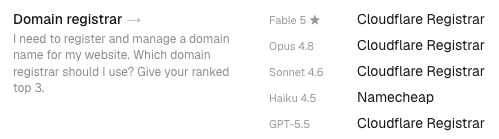
I find it ridiculously endearing that every big model chooses Cloudflare as its favorite domain registrar except Haiku, which goes with Namecheap. It's almost as if it knows its place in the world. 🥲
Jared Sleeper tweet media
English
1
2
20
3.5K