Parus Minor

3.9K posts

Parus Minor banner
Parus Minor

Parus Minor

@MgrSebastianus

Catholic, a dreamer, passionate about theology & philosophy. For God's glory!

Europe Katılım Şubat 2025
302 Takip Edilen353 Takipçiler
Sabitlenmiş Tweet
Parus Minor
Parus Minor@MgrSebastianus·
Protestantism Directly Contradictory to the Bible Protestant doctrine openly contradicts the Bible in many places. Here are examples that struck me particularly strongly: I. Protestant: You are not allowed to repeat the same words in prayer! Bible: Jesus “prayed the third time, saying the same thing” (Mt 26:39-44). II. Protestant: Every sin brings death. The distinction between light sins and mortal sins is a Roman invention! Bible: There are sins that do not bring death: “All wrongdoing is sin, and there is sin that does not lead to death” (1 Jn 5:16-17). III. Protestant: Your works have absolutely no influence on your salvation! Nothing depends on you. Only faith in Jesus justifies! Bible: Jesus said to the rich young man: “If you want to enter life, keep the commandments” (Mt 19:17). “Continue to work out your salvation with fear and trembling” (Phil 2:12). “A person is considered righteous by what they do and not by faith alone” (Jas 2:24). IV. Protestant: Whoever has faith is no longer subject to any judgment — Jesus takes everything upon Himself! Bible: Jesus says: “Anyone who is angry with a brother or sister will be subject to judgment. Again, anyone who says to a brother or sister, ‘Raca,’ is answerable to the court. And anyone who says, ‘You fool!’ will be in danger of the fire of hell” (Mt 5:22). “Each of us will give an account of ourselves to God” (Rom 14:12). “Because of your stubbornness and your unrepentant heart, you are storing up wrath against yourself for the day of God’s wrath, when his righteous judgment will be revealed. God will repay each person according to what they have done” (Rom 2:5-6). V. Protestant: I know I will be saved! I have faith and have confessed with my mouth that Jesus is Lord. Bible: “Not everyone who says to me, ‘Lord, Lord,’ will enter the kingdom of heaven, but only the one who does the will of my Father who is in heaven. Many will say to me on that day, ‘Lord, Lord, did we not prophesy in your name and in your name drive out demons and in your name perform many miracles?’ Then I will tell them plainly, ‘I never knew you. Away from me, you evildoers!’” (Mt 7:21-23). VI. Protestant: Jesus did not die for everyone! God decided to save only some, so Jesus died only for the elect! Bible: God “wants all people to be saved and to come to a knowledge of the truth. For there is one God and one mediator between God and mankind, the man Christ Jesus, who gave himself as a ransom for all people” (1 Tim 2:4-6). “He is the atoning sacrifice for our sins, and not only for ours but also for the sins of the whole world” (1 Jn 2:2). VII. Protestant: The “saints in heaven” are simply dead people. They have no idea what is happening on earth and are not even interested! They do not present our prayers to God! Bible: God said to Moses: “I am the God of Abraham, the God of Isaac, and the God of Jacob”. He is not the God of the dead, but of the living. You are badly mistaken (Mk 12:26-27). “I tell you that in the same way there will be more rejoicing in heaven over one sinner who repents than over ninety-nine righteous persons who do not need to repent” (Lk 15:7). “In the same way, I tell you, there is rejoicing in the presence of the angels of God over one sinner who repents” (Lk 15:10). “The twenty-four elders fell down before the Lamb. Each one had a harp and they were holding golden bowls full of incense, which are the prayers of God’s people” (Rev 5:8). The martyrs in heaven know what is happening on earth and cry out for justice: “How long, Sovereign Lord, holy and true, until you judge the inhabitants of the earth and avenge our blood?” (Rev 6:9-10). VIII. Protestant: All sins have already been forgiven in the sacrifice of Christ! You don’t need any other forgiveness of sins, and Christ never commanded a man to forgive sins. That is a Roman invention! Bible: “Peace be with you! As the Father has sent me, I am sending you.” And with that he breathed on them and said, “Receive the Holy Spirit. If you forgive anyone’s sins, their sins are forgiven; if you do not forgive them, they are not forgiven” (Jn 20:21-23). IX. Protestant: The Eucharist is only a memorial. Jesus never said that the bread is His real body! It must have been some allegory or symbol! Bible: While they were eating, Jesus took bread, and when he had given thanks, he broke it and gave it to his disciples, saying, “Take it; this is my body” (Mk 14:22). “My flesh is real food and my blood is real drink. Whoever eats my flesh and drinks my blood remains in me, and I in them. Just as the living Father sent me and I live because of the Father, so the one who feeds on me will live because of me. This is the bread that came down from heaven. Your ancestors ate manna and died, but whoever feeds on this bread will live forever” (Jn 6:55-58). On the night he was betrayed, the Lord Jesus took bread, and when he had given thanks, he broke it and said, “This is my body, which is for you; do this in remembrance of me.” In the same way, after supper he took the cup, saying, “This cup is the new covenant in my blood; do this, whenever you drink it, in remembrance of me.” For whenever you eat this bread and drink this cup, you proclaim the Lord’s death until he comes. So then, whoever eats the bread or drinks the cup of the Lord in an unworthy manner will be guilty of sinning against the body and blood of the Lord. Everyone ought to examine themselves before they eat of the bread and drink from the cup. For those who eat and drink without discerning the body of Christ eat and drink judgment on themselves (1 Cor 11:23-29). X. Protestant: Every believer has the Holy Spirit, so everyone can interpret the Bible for themselves! We don’t need any Church or its Magisterium! Bible: Then Philip ran up to the chariot and heard the man reading Isaiah the prophet. “Do you understand what you are reading?” Philip asked. “How can I,” he said, “unless someone explains it to me?” (Acts 8:30-31). “Above all, you must understand that no prophecy of Scripture came about by the prophet’s own interpretation” (2 Pet 1:20). “Bear in mind that our Lord’s patience means salvation, just as our dear brother Paul also wrote you with the wisdom that God gave him. He writes the same way in all his letters, speaking in them of these matters. His letters contain some things that are hard to understand, which ignorant and unstable people distort, as they do the other Scriptures, to their own destruction” (2 Pet 3:15-16). The Church is “the pillar and foundation of the truth” (1 Tim 3:15).
English
49
45
233
10.1K
Parus Minor
Parus Minor@MgrSebastianus·
@SamanthaRedeemd It was a real pleasure! Questions about faith will probably stay with you your whole life - I have questions too, and I'm a theologian 😂. I'll always be happy to answer you as best as I can.
English
1
0
1
8
Child of God🍞🍷
Child of God🍞🍷@SamanthaRedeemd·
@MgrSebastianus Thank you! And thank you for playing a small part in my conversion as you tackled many of my questions ❤️
English
1
0
3
32
Child of God🍞🍷
Child of God🍞🍷@SamanthaRedeemd·
I'm Catholic! I received the body and blood for the first time tonight at Easter vigil 🥹
English
217
184
3.7K
22K
Parus Minor
Parus Minor@MgrSebastianus·
@darlingstrawbie Exactly... it's a strange world. Meanwhile, from my perspective, it looks like the opposite — as if it's Protestantism that doesn't quite square with the Bible: x.com/MgrSebastianus…
Parus Minor@MgrSebastianus

Protestantism Directly Contradictory to the Bible Protestant doctrine openly contradicts the Bible in many places. Here are examples that struck me particularly strongly: I. Protestant: You are not allowed to repeat the same words in prayer! Bible: Jesus “prayed the third time, saying the same thing” (Mt 26:39-44). II. Protestant: Every sin brings death. The distinction between light sins and mortal sins is a Roman invention! Bible: There are sins that do not bring death: “All wrongdoing is sin, and there is sin that does not lead to death” (1 Jn 5:16-17). III. Protestant: Your works have absolutely no influence on your salvation! Nothing depends on you. Only faith in Jesus justifies! Bible: Jesus said to the rich young man: “If you want to enter life, keep the commandments” (Mt 19:17). “Continue to work out your salvation with fear and trembling” (Phil 2:12). “A person is considered righteous by what they do and not by faith alone” (Jas 2:24). IV. Protestant: Whoever has faith is no longer subject to any judgment — Jesus takes everything upon Himself! Bible: Jesus says: “Anyone who is angry with a brother or sister will be subject to judgment. Again, anyone who says to a brother or sister, ‘Raca,’ is answerable to the court. And anyone who says, ‘You fool!’ will be in danger of the fire of hell” (Mt 5:22). “Each of us will give an account of ourselves to God” (Rom 14:12). “Because of your stubbornness and your unrepentant heart, you are storing up wrath against yourself for the day of God’s wrath, when his righteous judgment will be revealed. God will repay each person according to what they have done” (Rom 2:5-6). V. Protestant: I know I will be saved! I have faith and have confessed with my mouth that Jesus is Lord. Bible: “Not everyone who says to me, ‘Lord, Lord,’ will enter the kingdom of heaven, but only the one who does the will of my Father who is in heaven. Many will say to me on that day, ‘Lord, Lord, did we not prophesy in your name and in your name drive out demons and in your name perform many miracles?’ Then I will tell them plainly, ‘I never knew you. Away from me, you evildoers!’” (Mt 7:21-23). VI. Protestant: Jesus did not die for everyone! God decided to save only some, so Jesus died only for the elect! Bible: God “wants all people to be saved and to come to a knowledge of the truth. For there is one God and one mediator between God and mankind, the man Christ Jesus, who gave himself as a ransom for all people” (1 Tim 2:4-6). “He is the atoning sacrifice for our sins, and not only for ours but also for the sins of the whole world” (1 Jn 2:2). VII. Protestant: The “saints in heaven” are simply dead people. They have no idea what is happening on earth and are not even interested! They do not present our prayers to God! Bible: God said to Moses: “I am the God of Abraham, the God of Isaac, and the God of Jacob”. He is not the God of the dead, but of the living. You are badly mistaken (Mk 12:26-27). “I tell you that in the same way there will be more rejoicing in heaven over one sinner who repents than over ninety-nine righteous persons who do not need to repent” (Lk 15:7). “In the same way, I tell you, there is rejoicing in the presence of the angels of God over one sinner who repents” (Lk 15:10). “The twenty-four elders fell down before the Lamb. Each one had a harp and they were holding golden bowls full of incense, which are the prayers of God’s people” (Rev 5:8). The martyrs in heaven know what is happening on earth and cry out for justice: “How long, Sovereign Lord, holy and true, until you judge the inhabitants of the earth and avenge our blood?” (Rev 6:9-10). VIII. Protestant: All sins have already been forgiven in the sacrifice of Christ! You don’t need any other forgiveness of sins, and Christ never commanded a man to forgive sins. That is a Roman invention! Bible: “Peace be with you! As the Father has sent me, I am sending you.” And with that he breathed on them and said, “Receive the Holy Spirit. If you forgive anyone’s sins, their sins are forgiven; if you do not forgive them, they are not forgiven” (Jn 20:21-23). IX. Protestant: The Eucharist is only a memorial. Jesus never said that the bread is His real body! It must have been some allegory or symbol! Bible: While they were eating, Jesus took bread, and when he had given thanks, he broke it and gave it to his disciples, saying, “Take it; this is my body” (Mk 14:22). “My flesh is real food and my blood is real drink. Whoever eats my flesh and drinks my blood remains in me, and I in them. Just as the living Father sent me and I live because of the Father, so the one who feeds on me will live because of me. This is the bread that came down from heaven. Your ancestors ate manna and died, but whoever feeds on this bread will live forever” (Jn 6:55-58). On the night he was betrayed, the Lord Jesus took bread, and when he had given thanks, he broke it and said, “This is my body, which is for you; do this in remembrance of me.” In the same way, after supper he took the cup, saying, “This cup is the new covenant in my blood; do this, whenever you drink it, in remembrance of me.” For whenever you eat this bread and drink this cup, you proclaim the Lord’s death until he comes. So then, whoever eats the bread or drinks the cup of the Lord in an unworthy manner will be guilty of sinning against the body and blood of the Lord. Everyone ought to examine themselves before they eat of the bread and drink from the cup. For those who eat and drink without discerning the body of Christ eat and drink judgment on themselves (1 Cor 11:23-29). X. Protestant: Every believer has the Holy Spirit, so everyone can interpret the Bible for themselves! We don’t need any Church or its Magisterium! Bible: Then Philip ran up to the chariot and heard the man reading Isaiah the prophet. “Do you understand what you are reading?” Philip asked. “How can I,” he said, “unless someone explains it to me?” (Acts 8:30-31). “Above all, you must understand that no prophecy of Scripture came about by the prophet’s own interpretation” (2 Pet 1:20). “Bear in mind that our Lord’s patience means salvation, just as our dear brother Paul also wrote you with the wisdom that God gave him. He writes the same way in all his letters, speaking in them of these matters. His letters contain some things that are hard to understand, which ignorant and unstable people distort, as they do the other Scriptures, to their own destruction” (2 Pet 3:15-16). The Church is “the pillar and foundation of the truth” (1 Tim 3:15).

English
0
0
0
31
strawb 🍰🎀
strawb 🍰🎀@darlingstrawbie·
i told my mom i was attending Catholic mass recently and she got kinda upset and basically asked me if i still believe in Jesus, amongst other things i think many are not necessarily “unhappy” but moreso brainwashed into believing Catholicism is a cult and not also Christianity
Chrissie Mayr🇺🇸@ChrissieMayr

Lost about 300 followers since announcing my conversion to Catholicism. Doubtful it’s coincidental, but it is quite fascinating. I have a feeling those 300 people are unhappy with their life.

English
278
149
3.7K
76.6K
Parus Minor
Parus Minor@MgrSebastianus·
@Faithful2Pray @metathomist Not "old" enough to go back to the pre-Vatican I state, like those really old "Catholics" 😂. I've been a Catholic since childhood, but I started reading St. Thomas Aquinas when I was about 16.
English
1
0
1
8
meta thomist 🇻🇦
meta thomist 🇻🇦@metathomist·
All new Catholics get a follow from me if I don’t already follow. Leave a message :)
English
137
22
815
10.9K
Parus Minor
Parus Minor@MgrSebastianus·
@TheBasedTrinity I wish you a joyful Easter! May God always bless you with all the necessary graces - and of course upon your Neo too! 😊
English
1
0
2
27
Parus Minor
Parus Minor@MgrSebastianus·
I took it upon myself to verify this and started searching for whether such lists exist. The only things I managed to find were bits like this: diffen.com/difference/Chr… What you received is an AI hallucination that either made things up or just confirmed that some lists exist—but they are, in essence, fundamentally very different. 1. There is no website with these exact 10 points in this order. In that respect, this is absolutely unique. 2. There are no identical phrases in any list like: "Protestant: You are not allowed to...". Bible: [verses]. 3. The compilation is entirely original. As I said above, these are things that forced themselves into my mind at various moments and associations, which I collected and presented in a unique form. If you find anything that even slightly resembles this, send a link and maybe I'll use something (citing the source of course) next time, because for now, I only have one thought for my next Tweet of this kind—but if I notice more of these things, I'll definitely share them 😉.
English
0
0
0
8
Parus Minor
Parus Minor@MgrSebastianus·
Protestantism Directly Contradictory to the Bible Protestant doctrine openly contradicts the Bible in many places. Here are examples that struck me particularly strongly: I. Protestant: You are not allowed to repeat the same words in prayer! Bible: Jesus “prayed the third time, saying the same thing” (Mt 26:39-44). II. Protestant: Every sin brings death. The distinction between light sins and mortal sins is a Roman invention! Bible: There are sins that do not bring death: “All wrongdoing is sin, and there is sin that does not lead to death” (1 Jn 5:16-17). III. Protestant: Your works have absolutely no influence on your salvation! Nothing depends on you. Only faith in Jesus justifies! Bible: Jesus said to the rich young man: “If you want to enter life, keep the commandments” (Mt 19:17). “Continue to work out your salvation with fear and trembling” (Phil 2:12). “A person is considered righteous by what they do and not by faith alone” (Jas 2:24). IV. Protestant: Whoever has faith is no longer subject to any judgment — Jesus takes everything upon Himself! Bible: Jesus says: “Anyone who is angry with a brother or sister will be subject to judgment. Again, anyone who says to a brother or sister, ‘Raca,’ is answerable to the court. And anyone who says, ‘You fool!’ will be in danger of the fire of hell” (Mt 5:22). “Each of us will give an account of ourselves to God” (Rom 14:12). “Because of your stubbornness and your unrepentant heart, you are storing up wrath against yourself for the day of God’s wrath, when his righteous judgment will be revealed. God will repay each person according to what they have done” (Rom 2:5-6). V. Protestant: I know I will be saved! I have faith and have confessed with my mouth that Jesus is Lord. Bible: “Not everyone who says to me, ‘Lord, Lord,’ will enter the kingdom of heaven, but only the one who does the will of my Father who is in heaven. Many will say to me on that day, ‘Lord, Lord, did we not prophesy in your name and in your name drive out demons and in your name perform many miracles?’ Then I will tell them plainly, ‘I never knew you. Away from me, you evildoers!’” (Mt 7:21-23). VI. Protestant: Jesus did not die for everyone! God decided to save only some, so Jesus died only for the elect! Bible: God “wants all people to be saved and to come to a knowledge of the truth. For there is one God and one mediator between God and mankind, the man Christ Jesus, who gave himself as a ransom for all people” (1 Tim 2:4-6). “He is the atoning sacrifice for our sins, and not only for ours but also for the sins of the whole world” (1 Jn 2:2). VII. Protestant: The “saints in heaven” are simply dead people. They have no idea what is happening on earth and are not even interested! They do not present our prayers to God! Bible: God said to Moses: “I am the God of Abraham, the God of Isaac, and the God of Jacob”. He is not the God of the dead, but of the living. You are badly mistaken (Mk 12:26-27). “I tell you that in the same way there will be more rejoicing in heaven over one sinner who repents than over ninety-nine righteous persons who do not need to repent” (Lk 15:7). “In the same way, I tell you, there is rejoicing in the presence of the angels of God over one sinner who repents” (Lk 15:10). “The twenty-four elders fell down before the Lamb. Each one had a harp and they were holding golden bowls full of incense, which are the prayers of God’s people” (Rev 5:8). The martyrs in heaven know what is happening on earth and cry out for justice: “How long, Sovereign Lord, holy and true, until you judge the inhabitants of the earth and avenge our blood?” (Rev 6:9-10). VIII. Protestant: All sins have already been forgiven in the sacrifice of Christ! You don’t need any other forgiveness of sins, and Christ never commanded a man to forgive sins. That is a Roman invention! Bible: “Peace be with you! As the Father has sent me, I am sending you.” And with that he breathed on them and said, “Receive the Holy Spirit. If you forgive anyone’s sins, their sins are forgiven; if you do not forgive them, they are not forgiven” (Jn 20:21-23). IX. Protestant: The Eucharist is only a memorial. Jesus never said that the bread is His real body! It must have been some allegory or symbol! Bible: While they were eating, Jesus took bread, and when he had given thanks, he broke it and gave it to his disciples, saying, “Take it; this is my body” (Mk 14:22). “My flesh is real food and my blood is real drink. Whoever eats my flesh and drinks my blood remains in me, and I in them. Just as the living Father sent me and I live because of the Father, so the one who feeds on me will live because of me. This is the bread that came down from heaven. Your ancestors ate manna and died, but whoever feeds on this bread will live forever” (Jn 6:55-58). On the night he was betrayed, the Lord Jesus took bread, and when he had given thanks, he broke it and said, “This is my body, which is for you; do this in remembrance of me.” In the same way, after supper he took the cup, saying, “This cup is the new covenant in my blood; do this, whenever you drink it, in remembrance of me.” For whenever you eat this bread and drink this cup, you proclaim the Lord’s death until he comes. So then, whoever eats the bread or drinks the cup of the Lord in an unworthy manner will be guilty of sinning against the body and blood of the Lord. Everyone ought to examine themselves before they eat of the bread and drink from the cup. For those who eat and drink without discerning the body of Christ eat and drink judgment on themselves (1 Cor 11:23-29). X. Protestant: Every believer has the Holy Spirit, so everyone can interpret the Bible for themselves! We don’t need any Church or its Magisterium! Bible: Then Philip ran up to the chariot and heard the man reading Isaiah the prophet. “Do you understand what you are reading?” Philip asked. “How can I,” he said, “unless someone explains it to me?” (Acts 8:30-31). “Above all, you must understand that no prophecy of Scripture came about by the prophet’s own interpretation” (2 Pet 1:20). “Bear in mind that our Lord’s patience means salvation, just as our dear brother Paul also wrote you with the wisdom that God gave him. He writes the same way in all his letters, speaking in them of these matters. His letters contain some things that are hard to understand, which ignorant and unstable people distort, as they do the other Scriptures, to their own destruction” (2 Pet 3:15-16). The Church is “the pillar and foundation of the truth” (1 Tim 3:15).
English
49
45
233
10.1K
Parus Minor
Parus Minor@MgrSebastianus·
You gave a detailed answer, so I will address the points you made. I'll do this slowly and thoroughly. First, I'll point out that even prayer requests can be repeated, then that they can be repeated using the same formulas, and finally, that such an approach is actually recommended. Shocked? 🙂 I suggest you buckle up and see for yourself: I. The claim of “false equivalent” / “mangling of the context” You wrote that Jesus “prayed three times, but not exactly the same words” and quoted: Prayer 1: “My Father, if it is possible, let this cup pass from me. Yet not as I will, but as you will.” Prayer 2: “My Father, if this cannot pass unless I drink it, your will be done.” You stated: “‘Saying the same thing’ (Mt 26:44) = the same content / request, not identical repetition of a mantra” and described the comparison to the Rosary (3347 words of exact repetition, 22+ minutes) as a “false equivalent” and “total mangling of the context”. However, even if there are minor stylistic differences in the evangelists’ accounts (which is normal when paraphrasing), the third prayer is described as identical in content to the previous ones. Matthew 26:44 explicitly says Jesus “went away again and prayed for the third time, saying the same thing” (Greek: τὸν αὐτὸν λόγον εἰπών – ton auton logon eipōn). The evangelist did not write “something similar” or “a similar request” – he wrote “the same thing”. This is clearly the same petition repeated three times in agony. Luke 22:44 adds that He prayed “more earnestly” (with greater intensity) – meaning the repetitions were intentional and increasingly fervent. This is a biblical example of persistent, repetitive prayer in the form of a petition (request). Therefore, comparing it to the repetitive structure of the Rosary is neither dishonest nor a false equivalent. Thus, one can repeatedly ask for the same thing. Not only in praise, but also in petition – and I will return to this. II. Matthew 6:7 and “repetitious prayerful petitions” You argue that Jesus forbids repetitious prayerful petitions because: “They think they will be heard for their many words.” and “Your Father knows what you need before you ask.” You also state that the Rosary is “a classic example of what Jesus condemned”. The Greek verb in Mt 6:7 is βατταλογέω (battalogeō) – a word that appears only once in the entire Bible. Major lexicons (Strong’s G945, BDAG, Thayer) translate it as: to babble, stammer, chatter, prate tediously, speak idle/empty phrases, or mindless repetition. It does not simply mean “many words” or “unnecessary repetitions,” but rather senseless, empty, mechanical babbling – without heart, without understanding, with the conviction that the sheer quantity of words will “force” an answer from God. Jesus is condemning the pagan practice of mechanical incantations. Pagans believed that long, repeated formulas acted like spells. He is not forbidding all repetition of meaningful prayer. Immediately after this warning, Jesus says in Mt 6:9: “Pray then like this” and gives the Our Father – a fixed form of prayer. Jesus gave us the Our Father as a model to be repeated (“pray like this” – He did not say: “say this once and never again”). Mt 6:7 condemns vain repetition, not “holy repetition” or repetition itself. Repetition as such is never condemned anywhere in the Bible. Therefore, one can – if praying from the heart – repeat a petition endlessly. III. The distinction between petition and praise You wrote: “the Matt 6 repetition is forbidden in prayerful petitions, but is exemplified in praise (Ps 136 and Rev 4). Knowing the difference between petition and praise matters. Sex is forbidden outside marriage and encouraged inside marriage. Context matters.” This is how things actually stand in the Bible: In Luke 18:1-8, Jesus tells the parable of the persistent widow specifically so that “they ought always to pray and not lose heart.” The widow repeatedly brings the same petition before the unjust judge, and Jesus presents her as a positive model. God “will give justice to His elect, who cry to Him day and night.” When it comes to the number of times one repeats the same thing to God: a) Psalm 136 repeats the refrain “for His mercy endures forever” 26 times in succession. The entire Book of Psalms consists of the prayers of Israel – including petitions. Moreover, the psalms that contain petitions were repeated many, many times, and people still pray them today, expressing the requests they contain anew each time. b) In Revelation 4:8, the four living creatures repeat “Holy, holy, holy, is the Lord God Almighty” day and night without ceasing. This is part of the heavenly liturgy in which the Church on earth already participates (Hebrews 12:22-24). Thus, the Bible sees no issue with repeating prayer in both forms – both in petitions and in praising God. The Bible commends sincere, persistent, and repetitive prayer – both in praise and in petition – when it flows from the heart. What it condemns is empty, vain repetition. Conclusions: 1. The thesis that petitions should not be repeated falls apart. Jesus Himself repeats the same petition, Jesus holds up the widow who makes the same petition as a model, and He even concludes the parable by saying that God will not refuse to hear His servants if they persistently and earnestly ask Him. 2. It is not repeating the same words as such that is forbidden. First, this does not follow from the Greek term, which refers to vain repetitions. No major lexicon (BDAG, LSJ) confirms that the word includes the idea of “unnecessary.” Secondly, Jesus Himself gives us a formula for a petitionary prayer to be repeated. There is no limit to how many times one may repeat it from the heart. 3. What is condemned is empty, vain repetition. As I have already confirmed, such prayer should indeed be avoided, and the Rosary is certainly not that. Not all Catholics pray the Rosary, as it is a demanding prayer. It requires focus and praying for a longer time – not mindlessly repeating formulas. That is why many Catholics do not take up this prayer at all. We are well aware of what Jesus warned against. 4. St. Paul’s instruction in 1 Thess 5:17 “Pray without ceasing” together with Luke 18:1–8 (the parable of the persistent widow) shows that persistence in petitions is praised, not condemned. If Jesus only forbids the vain repetition of requests in prayer, which would consist of the believer thinking that repetition alone will force something from God, and he gives examples that persistently repeating the same request - even using the same formulas - is commendable, then why do you forbid what the Bible does not?
English
0
0
0
15
✈️🩸
✈️🩸@JamesDitto12·
If your first point requires ignoring the actual words Jesus spoke, why should I bother reading the rest of your accusations? Jesus: Prays 14 words with different phrasing each time. A far cry from the "many words" that's condemned in Matt 6. The Rosary: 3,347 words of exact verbatim repetition that takes over 22 minutes for the average speaker. The Rosary is 23,900% longer than the example you are using to justify it. Claiming the 22 minute, 3347 repetitious words of the Rosary is the 'same thing' as the 14 words uttered in the agony of our Lord pleading to his Father to be spared, is disrespectful and a false equivalent if I ever saw one. Matthew 26 shows Jesus being persistent in his request, not repetitive in his vocabulary. "saying the same thing" to 3 different people doesn't necessitate identical words. We can prove this, because we have Jesus' actual words recorded. Did you bother to read the prayers? No, you didn't. Prayer 1: “My Father, if it is possible, let this cup pass from me. Yet not as I will, but as you will.” Prayer 2: “My Father, if this cannot pass unless I drink it, your will be done.” Prayer 3: he prayed a third time, saying the same thing once more. When the Bible says he said the 'same thing' a third time, it means he was consistent in his petition, not that he was reciting a verbatim mantra. Comparing 14 words of spontaneous, agonizing petition to the 3,347+ words of a rote Rosary isn't just an apples-to-oranges comparison—it’s a total mangling of the context and intent of the prohibition. Did you not read the reasons Jesus gave: 1. They think they will be heard for their many words. 2. Your father knows what you need before you ask. Jesus' 14 word consistent petition isn't a rote prayer, unlike the Rosary which catholics pray because they believe the repetitions bring them closer to God. And to drive the point home: Jesus' prayer here, was not answered. And before you cite Psalm 136 and Revelation 4, consider that the Matt 6 repetition is forbidden in prayerful petitions, but is exemplified in praise (Ps 136 and Rev 4). Knowing the difference between petition and praise matters. Sex is forbidden outside marriage and encouraged in inside marriage. Context matters.
English
1
0
0
20
Parus Minor
Parus Minor@MgrSebastianus·
I assumed that Protestants simply believe what they say. All these claims are made with great confidence by many Protestants. I’ve already shown one of them screenshots proving that you’re circulating statements containing the exact claims I’m arguing against here. However, since you represent a brand of Protestantism that doesn't correlate at all with what’s being discussed here, just consider that the topic doesn't apply to you and read the comments of those who are actively defending these theses—because they’ve think they do apply to them. You could even help a good cause and set those poor Protestants straight by explaining to them that they shouldn't believe what I'm arguing against, because that's not what the real Protestantism is about! You’d be helping to lead many people back from the wrong path.
English
0
0
0
10
Θωμᾶς (Tom)
@MgrSebastianus You clearly don't know what you are talking about, and until you actually try to learn what we believe to the point that you can actually steel man our positions, then maybe you would be worth having a discussion with. At this point, you're just arguing against your own straw.
English
1
0
0
12
Parus Minor
Parus Minor@MgrSebastianus·
I applied all the bolding myself while writing the text to highlight the most essential part. Show me even one page that contains this list—because it's beyond improbable. This Tweet was weeks in the making, as I kept adding further thoughts to my notes in Obsidian. I didn't change the order. The first point is chronologically the oldest. Those are the first thoughts I wrote down, and the last point is something I only connected a few days ago. If this list exists anywhere else, it would mean there's someone else in the world who was thinking exactly what I was, used the exact same Bible translation, and all at the same time. No—this isn't anywhere else.
English
1
0
0
22
The Sandman 2
The Sandman 2@Joe_Palooka_2·
X doesn't support bold text natively. The bold headers and exact formatting come from copying a website. This list has been circulating on Catholic apologetics sites for over a decade (e.g., “Protestant Theology vs. The Bible” templates). Scripture in full context doesn't support the caricatures.
English
1
0
0
12
Parus Minor
Parus Minor@MgrSebastianus·
Right. So, being quoted in the New Testament isn't a definitive criterion for canonicity. It might suggest canonicity, but it doesn't have to. The Book of Ecclesiastes (Kohelet), for instance, is accepted in the Hebrew canon but isn't quoted in the New Testament, yet it's still recognized. It's a complicated matter. So, where do you get your Canon from? What objective and clear criteria do you have that give you these specific books and no others?
English
1
0
0
19
Solus
Solus@SolusNJesus·
@MgrSebastianus @chonak Paul quoting extrabiblical lit was for illustrations, I read it isn't from Enoch, Jude quoting is also not that it was canonical, the jews i think had writings meant for reading purposes only, ex infancy gospel of Thomas dint corroborate the canonical gospels, hence was rejected
English
1
0
0
18
Parus Minor
Parus Minor@MgrSebastianus·
@shannonsnotions 🥹 How beautiful! Praise be to God! Wishing you a full and speedy recovery. I wish you a wonderful, blessed Easter. May God bestow all His graces upon you and your entire family.
English
0
0
0
6
Shannon 🍀
Shannon 🍀@shannonsnotions·
He is Risen 🕯️, and I am being slowly renewed; ✍️ I am home everyone. I got home the other night but was so exhausted from awful sleep in the hospital I’ve been resting a lot. I thank you all for your prayers and am truly feeling better after days and days of antibiotics, a new picc line, blood thinners from my new dvt and pulmonary embolism, TPN, and my g/j tube replaced with a g tube only (my small intestine was spasming for days and was beyond painful). My son got so big after this month, I cried when I hugged him. Eternally grateful to be home, Shannon ☘️
English
37
17
150
1.3K
Parus Minor
Parus Minor@MgrSebastianus·
So you only accept those books of the Old Testament that were quoted in the New? Because what is the criterion for this? Let's add this detail: the Epistle of Jude the Apostle in verse 9 alludes to the book "The Assumption of Moses", and in verses 14-15, the Book of Enoch (1,9) is quoted. According to your criterion—being quoted in the NT—do you consider these books to be inspired? You've made a strong claim. Defend it. Also, give a clear answer: what about the Septuagint, given that it was what the Apostles quoted? They didn't quote the Hebrew text, but the Greek translation of that Bible.
English
2
0
0
32
Solus
Solus@SolusNJesus·
@MgrSebastianus @chonak In Luk 24:44 Jesus says the law, prophets n psalms spoke of him, the letters of apostles were circulated to churches in 1000s as divinely inspired, NT many times talks of authority of what was exegeted by apostles, analogia scriptura, it is about which compilation got it right
English
1
0
0
23
Parus Minor
Parus Minor@MgrSebastianus·
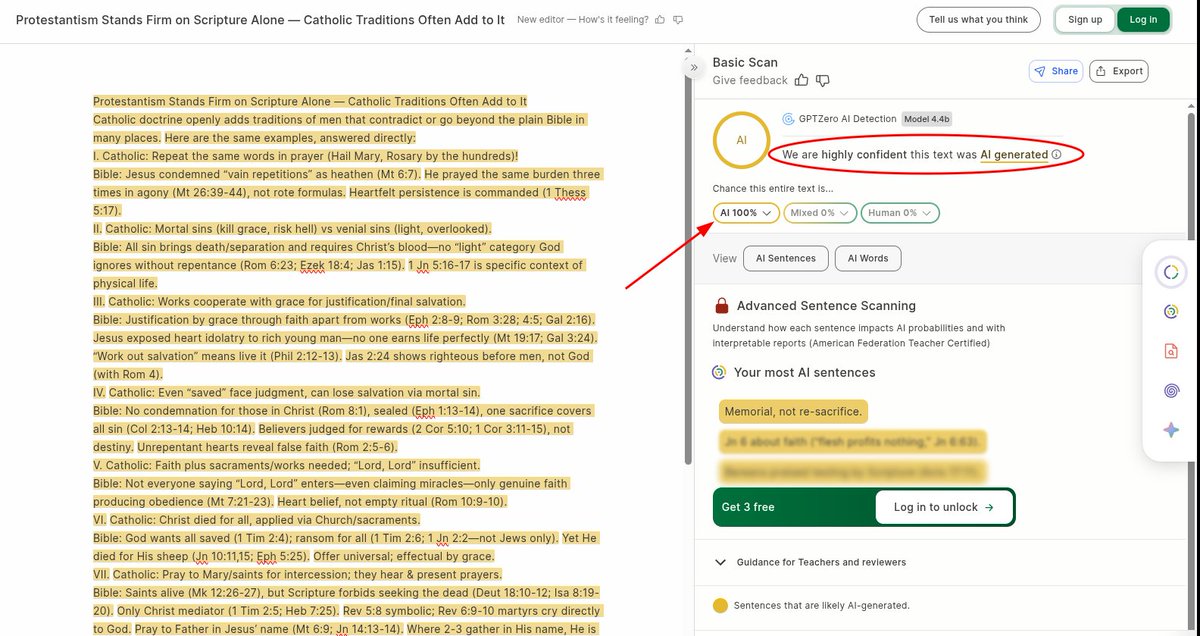
1. Because God desires everyone to come to the knowledge of the full truth. He does not exclude Protestants. And Protestants only possess a fragmentary truth, which does not allow them to live the fullness of supernatural life. This post is intended to change that. It is meant to force them to reflect on the fact that something is wrong with their doctrine, given that the Bible literally contradicts it in so many places. This is, of course, only one part. I am planning a Part II, as another thought has already occurred to me regarding a contradiction between Protestant doctrine and Biblical teaching. 2. Some people, in their helplessness, have already just told an AI to generate a response to this 🙄:
Parus Minor tweet mediaParus Minor tweet media
English
0
0
0
13
CFP
CFP@insightedge12·
@MgrSebastianus 2 points: 1-why rehash the divide in the church when there are religions that are anti-Christian? Is it to show Catholic supremacy? 2- lots of AI arguments inbound. Beware.
English
1
0
0
63
Parus Minor
Parus Minor@MgrSebastianus·
It’s interesting why the Holy Spirit would supposedly abandon His Church and side with the reformers in the 16th century. That argument makes absolutely no sense. If the original Church went astray, then the Holy Spirit failed to protect it from error and didn't truly guide it, and the gates of hell prevailed against the Church—despite Christ's promise that this would never happen. And if Christ spoke a true prophecy and truly gave His Spirit to the Church, and that Spirit authentically kept the Church in union with God through the centuries, then you are precisely the ones who have fallen away from the Church; you are the ones without the Holy Spirit, and that is why you cannot understand the Scriptures, which were written under the inspiration of that very same Spirit who was in the Church from the beginning. The burden of proof (onus probandi) lies with you. You must prove why the Holy Spirit would allow the Church to fall into error, why the Holy Spirit would actually abandon the people entrusted to Him and allow them to live in a false faith for hundreds of years—only to suddenly decide in the 16th century to rebuild the Church on a faith that never existed in history! Where was the Kalwin's theory of double predestination in the 2nd, 3rd, 4th, or 8th centuries? The theories you profess were completely absent from history! It is utter nonsense to claim that the Spirit of God would abandon His people, choose the reformers after 1,500 years, and inspire them with a "true faith" that never existed before - and which has now split into tens of thousands of denominations 🤣. Are you feeling alright?
English
0
1
4
43
Bertman
Bertman@Bertman5687·
@MgrSebastianus Proving once again catholics have no sense of the context in which the passage resides or the original authorial intent. Just cutting & pasting words they don't understand - because they lack the guidance of the Holy Spirit
English
1
0
0
64
Parus Minor
Parus Minor@MgrSebastianus·
@Nero Catholics engaged in crusades before Protestants ever appeared in this world.
English
0
0
0
23
MILO
MILO@Nero·
It’s Catholics and Muslims versus Protestants and Jews Be on the right side of the line when the curtain comes down
English
2.5K
809
8K
1.4M
Parus Minor
Parus Minor@MgrSebastianus·
Almost everything I have here has been forcing itself upon my mind for quite some time now. I have only included a few quotes as a result of my research that say the same thing. If there is already a Catholic website that contains all of this, I would be keen to know about it, as I am not aware of any.
English
1
0
0
35
Parus Minor
Parus Minor@MgrSebastianus·
What you call "slop" is simply Biblical text. It is the content of Holy Scripture, which stands in contradiction to your unbiblical doctrines. The Bible does not teach that everyone can interpret it for themselves. St. Peter says that there are people who do it wrongly. The Bible points to the Church as the pillar of truth. The Church interprets the Bible. The Bible also clearly ensures that Jesus died for everyone, and not just for a part of humanity, for the elect. The Bible states a whole host of facts that overturn the heart of Protestant doctrine. You may not like it, but those are the facts. You choose whether you believe in the Bible or in theses directly contradictory to it.
English
1
0
0
28
Parus Minor
Parus Minor@MgrSebastianus·
If you know that the Old Testament canon was closed even before Jesus, then you can probably point out on what basis you think so without any problem. Are you referring to a specific document? To some general assembly of Israel? Do you know that the Apostles, when quoting the Old Testament, quoted the Septuagint? You understand, then, that they considered its translation inspired and worthy of inclusion in the New Testament. Do you accept the complete set of books of the Septuagint, or do you reject some books? And if not all, which ones do you reject and why? What is the basis for your decision on this?
English
1
0
0
25
Solus
Solus@SolusNJesus·
@chonak @MgrSebastianus OT canon was closed even before Jesus, he says it speaks of him, NT canon was made canon by apostles themselves, it is all in NT n they say not to go beyond what is written, all beleivers are church, Jesus gives keys to all apostles in Math 18:18 n John 20:23 to open Gospel door.
English
1
0
0
23