michael offredi

460 posts

michael offredi

michael offredi

@MichaelOffredi

Katılım Ocak 2013
180 Takip Edilen191 Takipçiler
michael offredi retweetledi

Gilles Babinet
Gilles Babinet@babgi·
Cette vidéo de conduite autonome est époustouflante. Elle montre un véhicule évoluer dans un contexte très difficile (piétons et véhicules au comportement erratique), démontrant par là même que la réalité commerciale de ce type de service est probablement proche. @julialuc
Français
36
91
225
88.6K
michael offredi retweetledi
Paweł Huryn
Paweł Huryn@PawelHuryn·
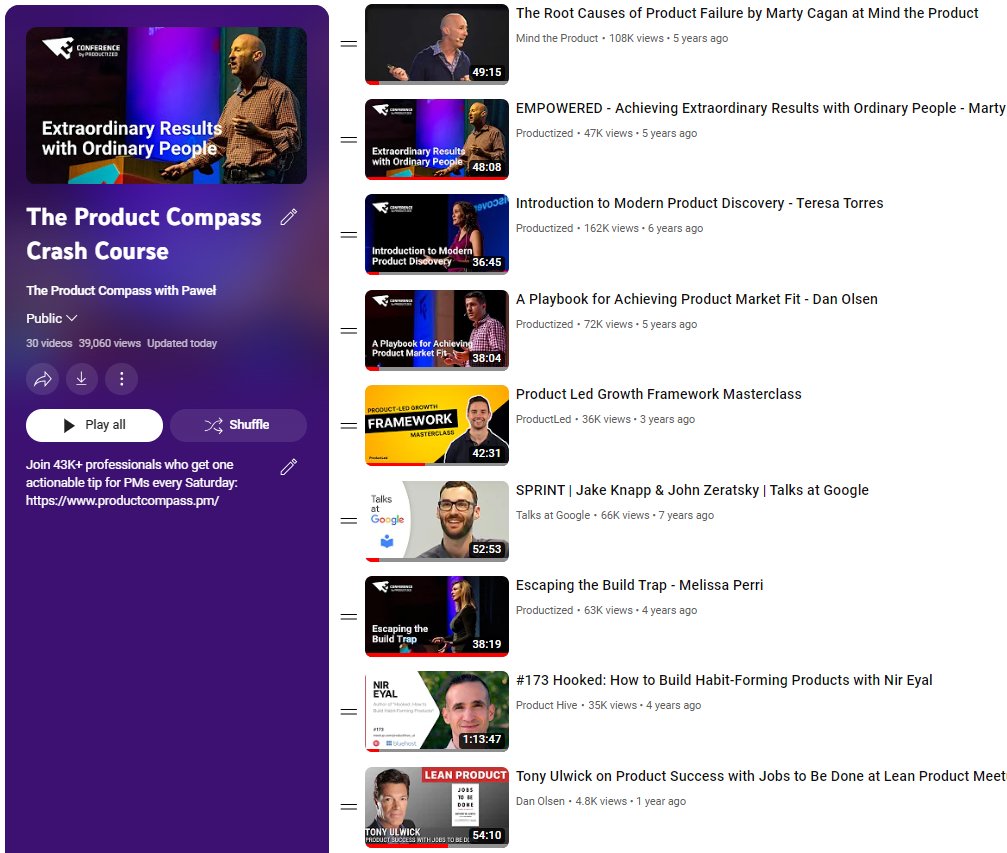
Product Manager makes $156,313 on average (US). But it's becoming increasingly difficult to break into PM. I created a list of 30 top PM videos that will quickly give you an overview of the most important topics. 80% of PMs don't know many of those things. A free YouTube playlist: youtube.com/playlist?list=… - A full list: 1. The Root Causes of Product Failure by Marty Cagan 2. EMPOWERED - Achieving Extraordinary Results with Ordinary People by Marty Cagan 3. Introduction to Modern Product Discovery - Teresa Torres 4. A Playbook for Achieving Product Market Fit - Dan Olsen 5. Product Led Growth Framework Masterclass by ProductLed 6. SPRINT by Jake Knapp & John Zeratsky at Talks at Google 7. Escaping the Build Trap - Melissa Perri 8. How to Iterate & Improve Your Product with Rapid User Testing by Dan Olsen 9. The Finite and Infinite Games of Leadership by Simon Sinek 10. A Plan Is Not a Strategy by Roger Martin (Harvard Business Review) 11. Product Strategy: The Missing Link by Marty Cagan 12. Michael Porter - Strategy at UNC 13. Objective and Key Result by Christina Wodtke 14. Geoffrey Moore Shares His Advice from Crossing the Chasm and Zone to Win 15. Rethink marketing for tech products with Martina Lauchengco 16. Product Success with Jobs to Be Done by Tony Ulwick 17. Hooked: How to Build Habit-Forming Products with Nir Eyal 18. Product Innovation by Alexander Osterwalder 19. Designing Your Value Proposition by Alexander Osterwalder 20. The Basics Of Testing Business Ideas by Strategyzer 21. How to Use Analytics to Optimize Your Product and Business by Dan Olsen 22. Growth Hacking Workshop: Alistair Croll - Lean Analytics | Part 1 23. Growth Hacking Workshop: Alistair Croll - Lean Analytics | Part 2 24. How to develop a strategy that wins in competitive markets by Roger Martin 25. Julie Zhuo Learning to manage like a leader by InVision 26. Stanford Seminar - Build The Right It by Alberto Savoia 27. The XYZ Hypothesis by Alberto Savoia 28. Introduction to Continuous Product Discovery 29. Sean Ellis On Growth Hacking 30. Steve Jobs. The lost Interview. - If the last video is not allowed in your country, use a VPN. You can also rent it on Amazon. - Hope that helps. There are still a few days left in 2023. What did I forget?
Paweł Huryn tweet media
English
5
58
238
37K
michael offredi retweetledi
Paweł Huryn
Paweł Huryn@PawelHuryn·
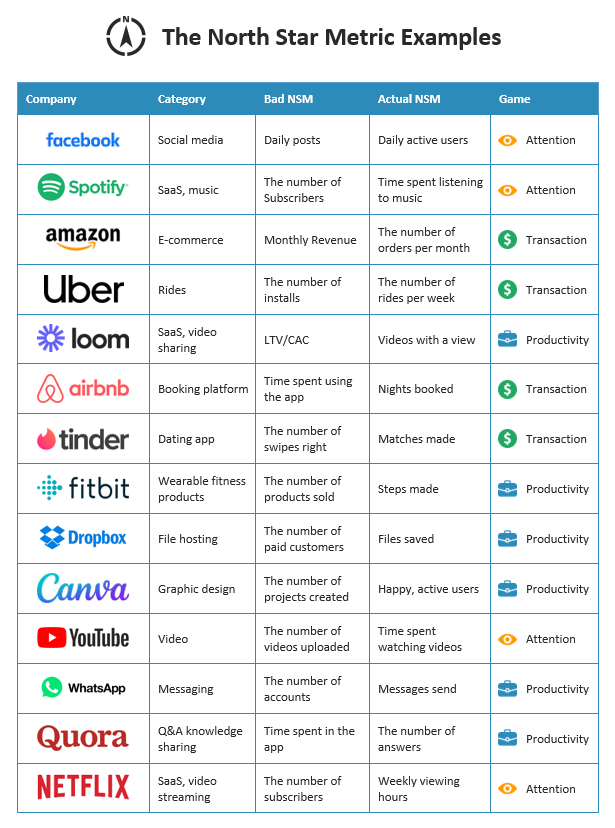
The North Star Metric is an extremely simple, powerful concept. But it's largely misunderstood. In this post: 1. What is a North Star Metric? 2. Common Misconceptions 3. Recommended Classification Let's tackle them one by one: 1. What is a North Star Metric? The term has been popularized by @SeanEllis, also known for coining "growth hacking" while being a growth marketer at Dropbox. In the Growth Hacking world, North Star Metric: - Is a single metric. The goal is to create focus. - Is easy to understand, enabling everyone to speak the same language. - Is customer-centric. Reflects how customers get value from the product. - Ideally, it ensures the value is sustainable, typically by forming habits. - Represents your progress toward vision/mission, fostering alignment and inspiring teams to move in the same direction. - Is quantitative. It relies on numbers, not opinions. - Is actionable. You take action based on how it changes. Otherwise, what's the point of tracking it? - Serves as a leading indicator of your long-term business success. 2. Common Misconceptions It's important to clarify what the North Star Metric is not: - A few metrics. While a company may select a few key metrics, referring to them as "North Star Metrics" is a misunderstanding. Have you ever seen multiple North Stars in the sky? - A metric focused on business value, like LTV/CAC. This overlooks the essential aspect of being customer-centric. Besides, can your team truly get excited about solely growing revenue? - An Objective Key Result. OKR is a goal-setting technique. You can use Key Result to express an expected change in the Nort Star Metric. But it is important not to confuse these terms. - A strategy. A strategy is a cohesive set of choices, such as a Value Proposition, that reinforce one another and enable you to succeed in your chosen playing field. Your North Star Metric must align with your strategy. 3. Recommended Classification I've come across various attempts to classify North Star Metrics. The best one I've found is proposed by Amplitude. Depending on the game you are playing, you might want to focus on: - Attention: Attention: How much time do your customers want to spend using your product? The time and recurrent use of a product can indicate the value people derive from it. - Transaction: How many transactions do your customers make in your product? Your goal is to help customers find the right product quickly and easily. - Productivity: How efficiently and effectively can someone do their work? Your goal is to help customers with specific tasks. Identifying the game you are playing is the first step toward finding your North Star Metric. Hope that helps. What are your thoughts? - P.S. You can download a free The North Star Framework 101 (12 pages, PDF) by subscribing to my newsletter: theproductcompass.tech/nsm101pdf More about Amplitude's classification: lnkd.in/dWAa3aN6
Paweł Huryn tweet media
English
10
124
591
65.4K
michael offredi retweetledi
Paweł Huryn
Paweł Huryn@PawelHuryn·
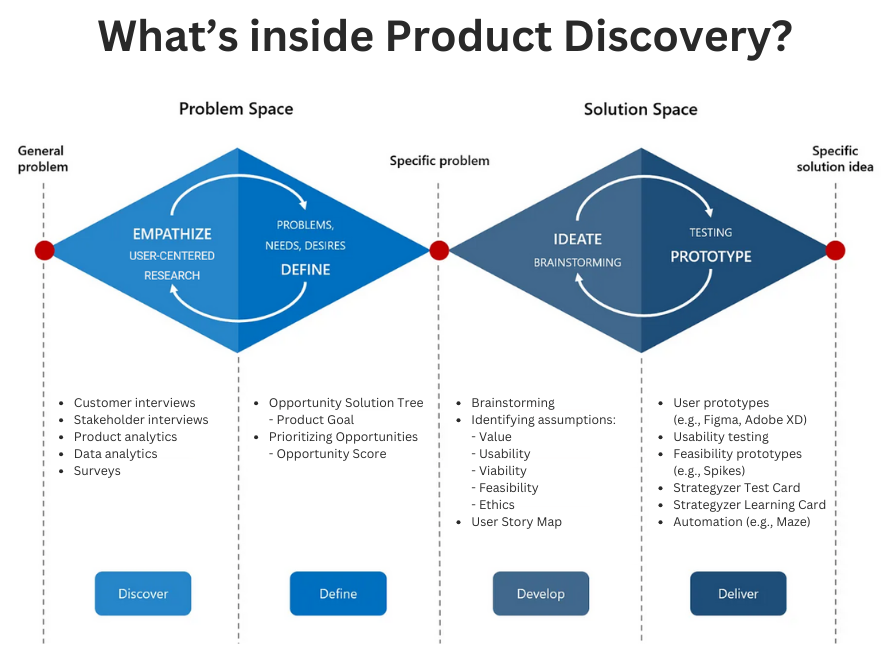
Product Discovery is the most important area for a Product Manager. But it's often misunderstood. People waste time and energy rushing to deliver features that don't work and don't drive the expected outcomes. The feature factory. It often looks like this: - Product Manager asks customers about the requirements - She creates detailed user stories and gets an estimation - The ideas that seem promising are selected for the Sprint - Developers do the magic - Designers make the thing prettier (it's like lipsticking a pig) - When everything is ready, nothing changes, or things become even worse Some say "the risk is limited to the length of the Sprint." But this will happen every Sprint. And the best ideas might not even be on the list. - Here's how to fix this: 1. Prerequisites: - Start with the product goal. My favorite approach is using OKRs. How to start (free): linkedin.com/posts/pawel-hu… - Product Discovery is not a task for a single person. The Product Trio (Product Manager, Designer, and at least one Engineer) must work together. 2. Problem Space: - Every week, interview customers to identify opportunities (problems, needs) that, when solved, will drive the desired product outcome. - Map opportunities using the Opportunity Solution Tree (by @ttorres). Free explanation: producttalk.org/opportunity-so… - Prioritize opportunities. My favorite approach is using the Opportunity Score by @danolsen. Free explanation: lnkd.in/dGZ_dsM9 + Dan's template: lnkd.in/df4sKc7H 3. Solution Space: - Brainstorm possible solutions. The more, the better. The best approach is brainstorming individually and combining the results in a group. - Identify risks related to value, usability, feasibility, viability, and ethics. A great technique is using a User Story Map. Free template: docs.google.com/presentation/d… - Test the riskiest hypotheses by experimenting. I love Strategyzer Test and Learning cards. Free templates and the experiments library: #library" target="_blank" rel="nofollow noopener">strategyzer.com/library?type=T…  - Product Discovery results in a validated Product Backlog. High-risk assumptions are tested before the implementation. - Tips: - People are biased. Ask about specific situations. Prioritize facts and behaviors over opinions. - Talk to the sales, success, customer support, and founders. They spend hundreds or thousands of hours with your customers every month. - Product analytics will tell you WHAT people are doing across their customer journey. Interviewing customers will help you understand WHY they are doing it. - Don’t verify every hypothesis. Factors that suggest you should test a hypothesis: high risk, low test cost, and a short time. - Eliminate waste by automating your UX testing. I fell in love with @mazedesignhq, which easily allows you not only to test ideas but also to recruit participants. Hope that helps! - P.S. A free introduction to Product Discovery (no email, no paywall): lnkd.in/dvZ4p7PY
Paweł Huryn tweet media
English
8
65
428
106.1K
michael offredi
michael offredi@MichaelOffredi·
I’m happy to share that I’ve obtained a new certification: Certified SAFe® 5 Product Owner/Product Manager. lnkd.in/e8hZKZn4
English
0
0
1
25
michael offredi retweetledi
Trung Phan
Trung Phan@TrungTPhan·
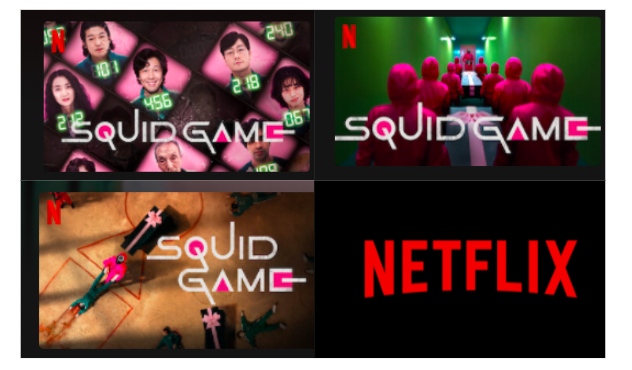
A Netflix user will browse the app for 90 seconds and leave if they find nothing. Thumbnail artwork is actually NFLX's most effective lever to influence a viewer's choice. A user will look at one for only 1.8 seconds, so NFLX spends huge to optimize them. Here's a breakdown🧵
Trung Phan tweet media
English
362
7.2K
28.8K
0
michael offredi retweetledi
Itamar Gilad
Itamar Gilad@ItamarGilad·
Hire Product Managers not Product Owners In my early days in product management there were no product owners, just product managers. The term was introduced a few years later with Scrum, the most popular Agile development methodology. /1
English
15
60
404
0
michael offredi
michael offredi@MichaelOffredi·
"Les leaders de demain devront être plus résilients (confiants et pleins de ressources dans un monde incertain), engagés (capables de motiver les autres à s’améliorer et à être au maximum de leurs possibilités), curieux (trouver de…lnkd.in/eNiaSCYB lnkd.in/e9gbnezC
Français
0
0
0
0
michael offredi retweetledi
Easlo
Easlo@heyeaslo·
I started an online business, and made over 5 figures at 20 years old. Here’s 10 no-code tools every entrepreneur should know:
English
94
981
4.4K
0
michael offredi retweetledi
Aakash Gupta
Aakash Gupta@aakashgupta·
One of the easiest mistakes you can make as a job seeker is to think all PM jobs are the same. There are totally different types of PMs: 1. Core 2. Platform 3. Growth
English
10
51
309
0