
Sabitlenmiş Tweet

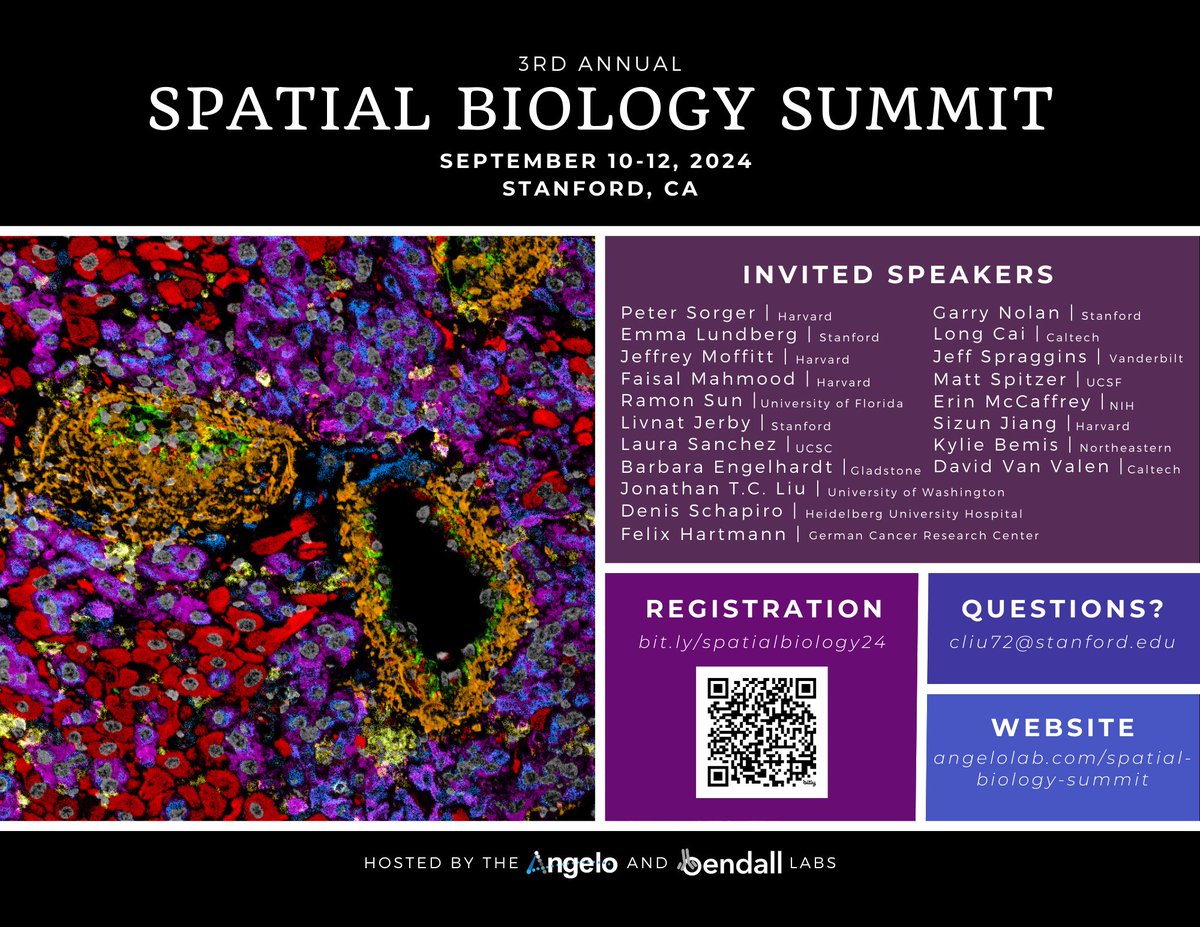
Registration for the 3rd Annual Spatial Biology Summit is now open! Don't miss out! Hope to see you in September.
English
Michael Angelo
493 posts
@MikeAngeloLab
Pathology and computational biology through engineering and applied physics
@ericweinstein @ChrisCuomo The correct processing for David Grusch is that he is nuts. Although watching intelligent people fall for this con is enough to leave the uninfected unhinged.
Thrilled to share that our paper is out in @Cancer_Cell: We apply spatial proteomics, transcriptomics, and glycomics to define tumor antigens, TME organization, and predictors of grade and survival. cell.com/cancer-cell/ab…
What limits a cell's size? One factor (and I'll explore others in an upcoming essay) is its surface area-to-volume ratio. A semi-spherical cell's internal volume grows proportionally to the cube of its radius, and its surface area grows proportionally to the square of that radius. A cell’s volume thus grows much more swiftly than its surface area. This ratio has serious consequences for cellular survival, though. The cell’s membrane funnels nutrients into the cell and secretes waste. So if the interior grows too large relative to the cell membrane, the cell’s metabolic processes slow to a crawl. A new study reveals that some mammalian cells have evolved a mechanism to keep their surface area-to-volume ratio CONSTANT even as the cell grows. They do this by folding their plasma membranes hundreds of times to increase *effective* surface area, thus helping them maintain high levels of nutrient uptake. There are other ways to get around this limit, too. Case in point: a giant bacterium called Thiomargarita magnifica can exceed one centimeter in diameter, so large that it is visible by the naked eye. It does so by filling between 65-80 percent of its internal volume with an empty vacuole. In other words, it pushes most of its “working” molecules to the cell periphery, thus shortening diffusion distances. All this, and much more, in a forthcoming essay for @AsimovPress.
🧵 (1/8) Today, @BenOberlton and I are excited to share the preprint of our work on: A comprehensive multi-omic study of human gliomas, spanning diagnosis, treatment, and recurrence. We address the longstanding challenge of developing effective therapies for gliomas, which have shown limited response to immunotherapy and targeted treatments compared to other malignancies. #GliomaResearch #NeuroOncology #CancerImmunotherapy biorxiv.org/content/10.110…
🧵 (1/8) Today, @BenOberlton and I are excited to share the preprint of our work on: A comprehensive multi-omic study of human gliomas, spanning diagnosis, treatment, and recurrence. We address the longstanding challenge of developing effective therapies for gliomas, which have shown limited response to immunotherapy and targeted treatments compared to other malignancies. #GliomaResearch #NeuroOncology #CancerImmunotherapy biorxiv.org/content/10.110…
RE: reforming NIH funding, my view is -- keep total $ the same or increase it, but: a) Do fast review (<1 month) based on 2 page applications & email exchanges for clarifying questions b) Give $ directly to investigators with broad discretion aside from "don't pocket it"

I’m super excited to share what I’ve been working on for the last (many) years: a spatial + genomic + transcriptomic characterization of how the breast cancer microenvironment evolves through immunotherapy! (1/x) biorxiv.org/content/10.110…

sam altman: “we will see diseases get cured at an unprecedented rate … what this will do to cure the diseases at a rapid rapid rate” immortality is not too far ahead. we live in the most incredible of times

Super excited to introduce QUICHE (Quantitative InterCellular Niche Enrichment) - a statistical method that can be used to discover local cellular niches differentially enriched in spatial regions, longitudinal samples, or clinical patient groups :) (1/10) biorxiv.org/content/10.110…


Please RT. I am currently hiring graduate students and postdoc fellows. Details can be found here: postdocs.stanford.edu/prospective/op… My lab is dedicated to developing and integrating imaging, AI, and spatial omics technologies to uncover mechanisms driving disease initiation, progression, and therapeutic response, with the ultimate goal of advancing next-generation theragnostics to cure diseases. We are excited to be equipped with cutting-edge spatial omics technologies, including Xenium spatial transcriptomics @10xGenomics and Phenocycler-fusion @AkoyaBio .