Hornéd Cu of Wessex retweetledi

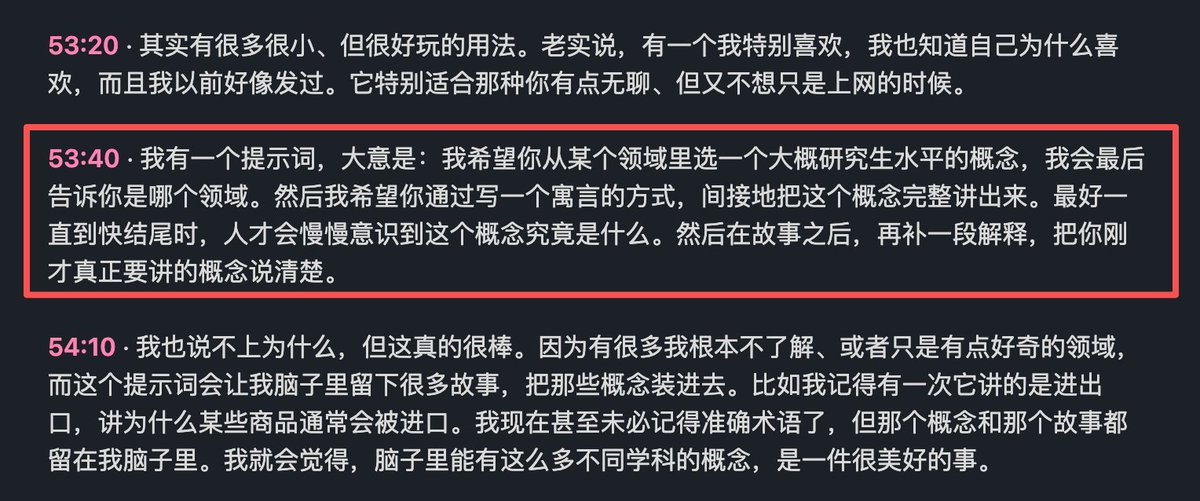
Anthropic 的哲学家@AmandaAskell 最近参加了一个访谈,在访谈中她分享了自己探索好奇领域的一个方法。
提示词大概是:
我希望你从「xx」领域里选一个大概研究生水平的概念。然后我希望你通过写一个寓言的方式,间接地把这个概念完整讲出来。最好一直到快结尾时,人才会慢慢意识到这个概念究竟是什么。然后在故事之后,再补一段解释,把你刚才真正要讲的概念说清楚。


中文
Hornéd Cu of Wessex
54.6K posts


@MikeDiez
Masked not to hide, but to reveal

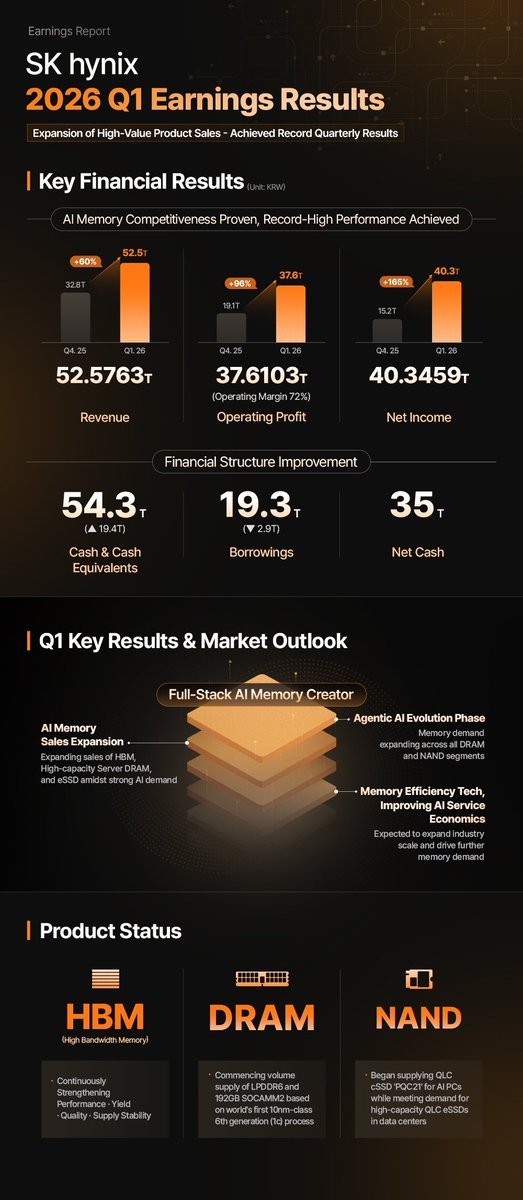
SK HYNIX Q1’26 EARNINGS HIGHLIGHTS 🔹 Revenue: $35.6B (Est. $35.1B) 🟢; +60% QoQ / +198% YoY 🔹 Operating Profit: $25.4B (Est. $24.6B) 🟢; +96% QoQ / +405% YoY 🔹 Net Profit: $27.3B (Est. $20.8B) 🟢; +165% QoQ / +398% YoY 🔹 Operating Margin: 72% 🔹 EBITDA Margin: 79% Q2 Guide: 🔹 DRAM B/G: high single% increase QoQ 🔹 NAND B/G: mid teen% increase QoQ (including Solidigm) Other Metrics: 🔹 HBM4: plan to ramp up volume in line with agreed schedule 🔹 CapEx: expected to increase significantly vs last year Financials: 🔹 Cash: $36.7B; Debt: $13.1B 🔹 Gross Profit: $28.2B; +85% QoQ / +313% YoY 🔹 EBITDA: $28.0B; +82% QoQ / +284% YoY 🔹 Non-operating Profit: $9.5B 🔹 Income Before Tax: $34.9B 🔹 Tax Expense: $7.6B 🔹 COGS: $7.4B 🔹 SG&A: $2.8B 🔹 CF from Operating Activities: $17.9B 🔹 CF from Investing Activities: ($4.9B) 🔹 Acquisition of PP&E: ($5.2B) 🔹 CF from Financing Activities: ($2.0B) FX used for USD conversion: $1 = ₩1,479 (mid-market; Apr 22, 2026)




THE OPTICAL PHOTONICS BOTTLENECK As AI clusters scale past copper’s physical limits, the bottleneck shifts to optical & these are the companies building that layer across the stack: 1. $AAOI building the transceiver layer of the AI network through vertically integrated U.S.-based InP laser manufacturing. It has already secured over $200M in its first volume 1.6T order from one hyperscale customer followed by another $124M in 800G orders from a second. 2. $AEHR building the reliability layer for the optical & AI hardware stack through burn-in & test systems. It just received a record $41M follow-on order from its lead hyperscale customer reinforcing the idea that Sonoma is becoming a key production burn-in platform for high-power AI ASICs. 3. $CRDO building the connectivity layer that helps AI clusters move data faster through active electrical cables, retimers & high-speed interconnect silicon. The DustPhotonics acquisition also extends that platform into silicon photonics before copper becomes a real constraint. 4. $LITE building the laser layer of the AI optical stack through EMLs, optical components & optical switching exposure. The setup is backed by a $2B $NVDA strategic investment & optical circuit switch backlog above $400M with orders reportedly extending through 2028. 5. $VIAV building the testing & validation layer of the optical stack through network instrumentation & photonics measurement tools. It is the picks-and-shovels layer of the transition because every high-speed optical buildout still needs to be tested regardless of which transceiver vendor wins. 6. $COHR building one of the core photonics bottlenecks through indium phosphide lasers, optical engines & communications components tied to next-gen AI networking. It also has a $2B $NVDA strategic investment behind it & is doubling InP device capacity into the 1.6T ramp. 7. $MRVL building the DSP & optical infrastructure layer through electro-optics, PAM DSPs, interconnect silicon & custom networking chips. The Celestial AI deal & NVLink Fusion exposure both strengthen its position as photonics becomes more central to AI cluster design.




$TSM 80% CAGR. That is how fast TSMC CoWoS capacity is growing and that's not a typo. Advanced 2.5D/3D packaging is Moore's Law going 3D. The most critical bottleneck nobody is talking about. Give it 15 minutes if you want to learn why. You will not regret it.