Milosh

851 posts

Milosh

Milosh

@MiloshOffical

Katılım Nisan 2025
2.1K Takip Edilen1.5K Takipçiler
Milosh
Milosh@MiloshOffical·
Welcome to Miami, where third-world infrastructure meets the brilliance of high-IQ American engineers & politicians. As sea levels rise, so do does septic tank waste leaking into the Miami Water systems. When your own city (backyard) is fighting to keep sewage out of the water supply, maybe ease up on the ethnic arrogant superiority routine. washingtonpost.com/climate-enviro…
English
0
0
1
18
Aleksandar Sasha Jovicic
Aleksandar Sasha Jovicic@OfficialJovicic·
Over in the majority-Albanian town of Gostivar in Macedonia, the super high IQ Albanian engineers connected wastewater (read: shit and piss) to…wait for it…fresh water supply and promptly got 3,000 people (also Albanian) sick. Way to go, doctors and engineers of the Albanian kind. 🤮🤮🤮🤮🤮
gjoko@gjoko74

@kos_data english.republika.mk/macedonia/gost…

English
7
6
54
966
Milosh
Milosh@MiloshOffical·
Yes, indeed, we shall see. But keep this in the back of your mind: despite all the screaming, crying, and wildly inflated price targets from the oil bulls, crude still can't sustain a rally with wars, sanctions, OPEC production cuts, and elevated geopolitical risk already supporting the market. But If prices struggle to move materially higher with all of those tailwinds in place, what exactly is the catalyst for a lasting breakout?
English
0
0
0
37
Jeffrey Currie 🆔++
Jeffrey Currie 🆔++@CommodMkt·
I joined @BloombergTV's @FerroTV and @annmarie to discuss the current energy market and why the abundance illusion is fading. During the initial phase of the Middle East disruption, we saw a coordinated release of strategic reserves, from the U.S., Europe, Japan, alongside China and other Asian consumers flexing their substitution and drawing inventories, particularly products. That created weak oil prices and the illusion that the market was well supplied. However, crude oil prices are the noise, and product prices are the signal. The 3-2-1 Crack reached an all-time high of $70/bbl this morning. At $85/bbl Brent that’s $155/bbl product basket. And remember no one consumes crude oil, only products. This is why crude oil prices are the noise. Phase 2 of the US-Iran conflict is now starting from record low inventories, with multiple pressure points across the system — the Red Sea, the Strait of Hormuz, the Black Sea — alongside significant refinery outages. In fact, I’d argue I’ve never seen an energy environment this stretched. At the same time, there’s a major disconnect. Despite the pull back in crude oil prices, commodities are still the best performing asset class, up 34% ytd with the petroleum index up 81% ytd. Scarcity and debasement are still a core driver of investment returns despite the themes being underinvested and uncrowded trades. Commodities are the best place to hide with tech and equities poised for a correction. Own HALO (Hard Assets Local Operations) via commodity indices. Watch the full interview here: bloomberg.com/news/videos/20…
English
22
46
177
21K
Milosh
Milosh@MiloshOffical·
You're assuming both factors are temporary, but the market is correctly pricing deeper structural weakness. First, the "peace deal headlines" argument cuts both ways. If crude repeatedly sells off on ceasefire rumors, that suggests traders believe geopolitical risk premium is a significant part of current prices. If a conflict de-escalation eventually does occur—even imperfectly—that risk premium permanently disappear. Calling it "jawboning" doesn't change the fact that markets price probabilities, not certainties. Second, China's crude demand is no longer the one-way growth story that drove oil bulls for two decades. China's economy faces persistent real estate weakness, slowing industrial activity, accelerating EV adoption, and a plateauing population. What appears to be a temporary import decline may actually be a reflection of structurally slower oil demand growth. The bullish assumption is that China snaps back; the bearish view is that China has already passed peak demand growth. Third, even if China rebounds and geopolitical fears persist, global supply remains far more responsive than it was in previous cycles. U.S. shale, OPEC spare capacity, and the potential return of previously constrained barrels create a ceiling on prices. Demand only needs to disappoint slightly for inventories to build. Finally, if the bullish thesis depends on dismissing the primary reasons for price weakness as "unsustainable," that's the main warning sign. Markets don't care whether a catalyst is fair or unfair, they care whether the underlying trend is real. The fact that oil keeps failing to hold rallies despite wars, sanctions, and production cuts indicates that fundamentals are weaker than bulls understand.
English
1
0
0
57
Roby
Roby@InRibat·
@MiloshOffical @piersmorgan Fuck those eyes are amazing what a body..can tell she's great to talk to the intelligence is emanating out of her...no suprise piers Morgan is a chopsy bastard with that at home In contrast Messi's tart not a lot going on behind the eyes certainly hasn't read a book in her life
English
1
0
1
84
Milosh
Milosh@MiloshOffical·
Why is the Oil floor suddenly $40 and not $60 or $50? Every oil bull seems overly confident declaring where crude can't go, but history always shows commodity markets regularly overshoot in both directions. If oil can supposedly make a new all-time high because of geopolitics, supply disruptions, and sentiment, then it can just as easily fall sharply if those fears ease, supply grows faster than expected, or demand disappoints. Nobody thought oil would trade below $50 before 2014. Nobody thought it would briefly go negative in 2020. The market has a way of humbling anyone who speaks in absolutes. Fiona Wilson may be bullish on energy stocks and there are valid reasons to be. Energy companies are leaner, generating more free cash flow, and returning more capital to shareholders than they did a decade ago. But a bullish case for energy companies is not the same thing as proof that oil prices are headed to all-time highs. In fact, you can be constructive on energy stocks while still believing crude could trade in the $60s or even lower if supply growth contiunes to outpaces demand growth. The real question isn't "Why won't oil go to $40?" The real question is? What data says oil can't go to $60 or $50, when it has spent much of the last 2 decade trading at or below those levels? Absolute statements are always where the strongest investment thesis become the weakest arguments.
English
0
0
0
71
inthemoneypod
inthemoneypod@inthemoneypod·
🛢️ Oil isn't going back to $40. Fiona Wilson, Senior Portfolio Manager at i3 Investments™, Guardian Capital LP, says geopolitical tensions, supply disruptions and global stockpiling have fundamentally changed the outlook for energy. That's why her fund was overweight energy even before the Iran conflict—and why she believes high-quality energy companies are still some of the best dividend investments today. She also explains why she bought Shell back after selling it ahead of its 2020 dividend cut, and why today's energy sector is stronger thanks to years of cost-cutting and disciplined capital allocation. Watch the full interview! youtube.com/watch?v=wezqPZ… #Oil #EnergyStocks #DividendStocks #Investing #StockMarket #Shell #OilPrices #Energy #Geopolitics
YouTube video
YouTube
English
4
10
43
7.2K
Milosh
Milosh@MiloshOffical·
Markets have been hearing from the oil bulls since March that crude was on the verge of making new all-time highs. Then it was April. Then May. Then June. Now it's July, and the timeline has somehow expanded from "any day now" to anywhere between the next 3 months and 18 months. At some point, a prediction that keeps getting pushed further into the future stops being a forecast and starts becoming an excuse. When your bullish oil thesis needs a 3‑month timeline, an 18‑month timeline, and a 2028 timeline all at the same time, that's not conviction—it's moving the goalposts. As for "watch the data" not the news,' but the data doesn't support inevitable all-time highs. Oil only makes new highs when demand growth outpaces supply. Today and going forward the biggest structural trend is the opposite, oil supply continues to outpace demand as today oil markets isn't the oil markets of 10 yr, 20, 30 yr or 40 yrs ago.
English
0
0
0
57
Common Sense Investing
Common Sense Investing@investinguab·
People are genuinely naive if they think oil won’t surge higher this year, or that any politician can stop it from hitting all-time highs in the coming 3-18 months. I don’t care about the news cycle — I believe in the power of the free market. The free market will push crude to all-time highs, and there’s not a damn thing anyone can do about it. Bookmark that bears and let me know by 2028 if a tweet saved you. This is why I keep telling you: turn off the news, watch the data. The news will downplay it until it’s so bad everyone panics — and by then, it’ll be too late to reverse course.
GIF
English
12
4
70
4.9K
Milosh
Milosh@MiloshOffical·
Funny how Sasha fails to mention a few important details about this particular building or any +30 yr building in South Florida particular Miami and why the price appears so low. The building was built 1980 (46 years old), and after the Surfside condominium collapse in 2021, older Florida condo buildings are all under stricter inspection, reserve funding, and structural maintenance requirements. All buildings 30 years old are significant renovation projects, reserve assessments, and rising carrying costs that are ultimately borne by unit owners. For this unit, the real numbers tell a very different story than the headline price: Purchase Price: $350,000 HOA Fees: Approximately $13,920 per year ($1,160/month) Property Taxes: Approximately $2,400 per year (~$200/month) That means the owner is paying $1,360 per month in carrying costs before even making a mortgage payment. Now no doubt the view is million dollars, but the monthly carrying costs and future future capital expenditures make the purchase unattractive and why they condo hasn't sold even at "affordable" headline price. C'mon Sasha, we all know "Miami is place for Shady people, but don't try to hustle hustlers. urldefense.com/v3/__https:/vo…$
Milosh tweet mediaMilosh tweet media
English
1
0
0
56
Milosh
Milosh@MiloshOffical·
The fact that you're immediately changing the subject from manipulation to barrels tells me everything. One day it's 'the market is rigged,' the next day it's 'what about the barrels?' Pick a lane. As for your 'missing barrels' argument, markets don't price today they're forward discounting mechanisms. They price probabilities, risks, and future expectations. If traders collectively truly believe those barrels were truly at risk of disappearing, oil would be materially higher, but they don't and why price of oil doesn't care about your "missing barrels" argument. The real issue is that every time price action goes against Energy Bull thesis, the explanation is never 'maybe the market sees something I don't.' It's always shorts, algos, hedge funds, market makers, or manipulation. Funny how the market is only broken when you're losing money.🔥
English
0
0
0
29
Vancouver Island Guy 🌊
Vancouver Island Guy 🌊@VanIsleInvestor·
Prices will defy logic until you succumb, Midterms or we run out.
Vancouver Island Guy 🌊 tweet media
English
5
0
42
3.5K
Milosh
Milosh@MiloshOffical·
@OliveGardeds @VanIsleInvestor @ericnuttall According to energy bulls, the market is manipulated every day except the days they're green. You've blamed shorts, algos, hedge funds, market makers, and governments. Have you tried blaming yourself for just getting it dead wrong.
English
1
0
0
28
Olive Garden Gnome
Olive Garden Gnome@OliveGardeds·
@VanIsleInvestor @ericnuttall Russia is getting hammered … I feel like I can’t sell cuz one second , one minute .. it could shoot to 160 bucks … I just think it’s a ticking time bomb.. being short here is mind blowing .. but we will see what happens !
English
1
0
1
40
Milosh
Milosh@MiloshOffical·
@Cole_Smead, you're talking about solving a supply problem that may not actually exist. The conclusion that the world is "short 4 million barrels per day" depends heavily on the assumption of sustained, robust demand growth. Yet global oil demand growth is slowing, China is becoming less oil-intensive, EV adoption continues to pressure transportation fuel demand, and even the IEA has projected periods of declining demand rather than uninterrupted growth. At the same time, OPEC still holds meaningful spare capacity that can be brought back to market if prices rise, while producers in the U.S., Canada, Brazil, Guyana, and other non-OPEC regions continue to add supply. The bearish case is straightforward, if global oil demand peaks before 2030, existing spare capacity proves sufficient, and non-OPEC production continues to grow, then the world may never need the additional 4 million barrels per day of supply you're forecasting. In this scenario, the inventory draws of recent years will look more like a temporary consequence of geopolitical disruptions than evidence of a structural shortage requiring materially higher long-term oil prices
English
0
0
1
174
Trevor Rose
Trevor Rose@trevor_rose_·
4 Million Bbbls Short: "The world's short on oil." "If you look at what we have to build up from what we just lost in 2026 in inventory, we're gonna need to produce a million barrels more per day for 3 years." "Based on crack spreads, demand's humming. And if demand is growing, we're gonna need a million barrels more per year. So looking 3 years out, we're gonna have to do something close to 4 million barrels of extra supply." "I think Canada's in for 1. Maybe OPEC Plus is in for 1. Where are we gonna get the other 2? The only way to fix this is price. You want me to make more? How do you get supplies to do that? Higher prices." @Cole_Smead - CEO, Smead Capital Management
English
11
25
146
20K
Milosh
Milosh@MiloshOffical·
@ericnuttall , if the market can stare directly at missile attacks, threatened chokepoints, low inventories, absorbed excess barrels, Chinese buying, SPR depletion, and still print a seven-handle, maybe the market isn't missing the story. Maybe the story is that these conditions are no longer sufficient to create the price response bulls assume they should. At some point you have to stop asking why oil isn't $120 and start asking why every bullish catalyst now produces a smaller reaction than the last one. That's what happens near the end of a thesis, not the beginning.
English
0
0
0
41
Milosh
Milosh@MiloshOffical·
@ericnuttall, every one of you Energy Prema Bull presentation starts with a supply apocalypse and ends with a price target. The problem is the market has heard this movie before. Yes, inventories are tight. Yes, geopolitics are ugly. Yes, shipping disruptions matter. And yet crude is still struggling to hold levels that were supposedly impossible under these conditions. Nuttall, your bullish argument boils down to: "Ignore the actual price because the fundamentals say the price should be higher." But price is information too as the market is looking past today's headlines and seeing: Massive OPEC spare capacity waiting for a price signal. Non-OPEC supply continuing to surprise to the upside. Chinese demand that constantly underwhelms the hype. Global growth slowing enough to offset part of the supply risk. A decade-long track record of "imminent" oil shortages that never quite arrive. You act like every disrupted barrel is lost forever. Reality says high prices cure high prices. Demand falls. Producers hedge. Supply responds. Routes adjust. Governments intervene. The most damning fact isn't that the Strait of Hormuz is at 10% of normal or that inventories are low. It's that the market knows all of that and still won't pay $100+. If the setup is truly as explosive as you advertised and crude can't break out despite your school girl screams, the problem isn't that the market is stupid. The market is telling you the shortage is more visible than it is real and just your analysis to be dead wrong.
English
0
0
1
129
Milosh
Milosh@MiloshOffical·
Jeff, you continue to say "commodities are not anticipatory assets" but that just dead wrong. Commodities absolutely behave as anticipatory assets because prices are set at the margin by future expectations & probabilities, not just current physical balances. While the prompt-month contract is anchored by today's supply and demand, market participants constantly price future risks, policy changes, weather events, sanctions, OPEC decisions, inventories, and macroeconomic expectations before they fully materialize in physical fundamentals. If commodities only reflected current conditions, oil would not rally ahead of anticipated supply disruptions, nor sell off ahead of expected demand destruction. Yet history repeatedly shows exactly this behavior. Your idea that "the market would arbitrage it away" overlooks the fact that expectations themselves are a fundamental input into price discovery. Arbitrage does align prices across the curve, but it cannot eliminate uncertainty premiums, risk premiums, or forward-looking positioning. Time spreads don't simply reflect today's reality, they also reflect market expectations about how today's balances will evolve. A move into steeper backwardation can signal current tightness, but it can also reflect expectations that future supply will be more abundant relative to present availability. The clearest evidence is that commodity prices often move sharply before physical data confirms the change. Markets routinely anticipate wars, sanctions, OPEC policy shifts, economic recessions, and weather events months before they appear in inventory statistics. Therefore, saying commodities are "not anticipatory assets" is too absolute. Commodities can be more constrained by physical realities than equities, but they still incorporate collective expectations about the futureand often move well before fundamentals visibly change.
English
0
0
0
87
Jeffrey Currie 🆔++
Jeffrey Currie 🆔++@CommodMkt·
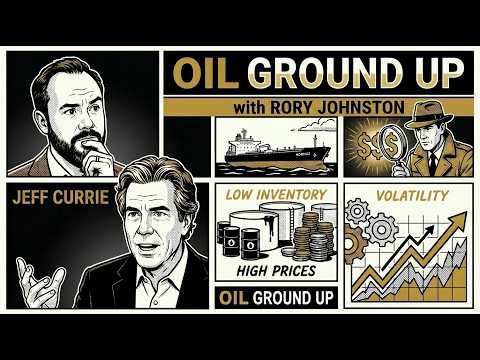
I joined @Rory_Johnston on the Oil Ground Up podcast to discuss oil market price formation, the current geopolitical backdrop, and why this environment looks very different to anything we’ve seen in decades. One of the key points is this: commodities are not anticipatory assets. The front of the curve has to price today’s fundamentals. It cannot carry expectations. If it did, the market would arbitrage it out immediately. Time spreads don’t lie. When you see the curve move, particularly at the front, it’s not forecasting what’s coming next. It’s reflecting what is happening right now. That’s critical in the current environment, because what we’re seeing is less about direction and more about volatility. The system is struggling to adjust. You have dislocations between crude and refined products, constraints across logistics and refining, and a market that can shift from surplus to tightness very quickly. Backwardation isn’t a signal that prices are going lower. It’s a signal that there’s a premium on having the commodity today. At the same time, the broader backdrop is changing. Deglobalisation, energy security, and electrification are all reshaping how these markets function. This isn’t a typical cycle. It’s a more fragmented, more volatile system, where price moves are driven by shocks rather than smooth adjustments. That’s what makes this environment so different. Listen to the full conversation here: youtube.com/watch?v=ApWHGr…
YouTube video
YouTube
English
20
36
237
42K
Milosh
Milosh@MiloshOffical·
Jeff, this reads less like analysis and more like a perpetual bull case searching for a justification. Sine March, we were told that this time the "supply shock is different", "greatest energy crisisi of lifetime" as the buffers are gone, resilience has disappeared, and structurally higher prices are inevitable. Yet global oil markets continue to do what they've done for decades: adapt. Your "abundance illusion" isn't in the market, t's in the assumption that every geopolitical headline must end in a lasting supply crisis. Russia was supposed to collapse. Iranian exports were supposed to vanish. The Red Sea was supposed to create a shipping catastrophe. Instead, crude keeps flowing because money always finds a route. The bigger issue is that your argument stacks worst-case assumptions on top of one another and presents them as a base case. Hormuz disruption. Russian outages. Red Sea bottlenecks. Inventory depletion. Strong demand. No offsetting production. No demand destruction. No policy response. No market adaptation. When your thesis requires everything to go wrong simultaneously to justify your subjective bull conclusion, sorry but it's not a forecast, that's a stress test. Markets aren't dismissing risk because they're naive. They're dismissing it because they've watched analysts predict an imminent supply crunch for years while global production repeatedly surprises to the upside. The real "illusion" is believing that modern energy markets are fragile when they've spent the last 40 yrs proving they're remarkably anti-fragile. Every disruption creates new trade routes, new suppliers, new incentives, and new investment. We're all past the point now when commodity bulls need to explain not why prices could spike, but why the market should believe the 20th warning of a structural shortage when the previous 19 never materialized and the Bulls are just dead wrong in their bullish dooms day forecasts.
English
0
0
2
161
Jeffrey Currie 🆔++
Jeffrey Currie 🆔++@CommodMkt·
I joined @RomaineBostick and @kgreifeld on @bloombergtv's The Close to discuss the latest within the commodities markets in light of the re-escalation of the Iran war. We are entering a far more dangerous phase than we experienced during the initial Iran war phase leading up to the ceasefire agreement. When the Iran-US ceasefire was announced, more than 120-150 million barrels of previously trapped crude quickly returned to the market almost instantly, putting immediate downward pressure on prices while refiners raced to process the additional supply. At the same time, Ukraine's deep strikes on Russian energy infrastructure have removed more than half of Russia's refining capacity, whilst both the Houthis and the Saudis have been dragged into conflict - which brings the Red Sea into play. They represent two major bottlenecks that could force crude shut-ins and take years to resolve. Now, with hostilities returning around the Strait of Hormuz, we face simultaneous constraints on both Middle Eastern exports and Russian supply. The critical difference is that we've already used much of the inventory buffer that protected markets during Round 1. We are entering this next phase with far less insurance. This is why I believe confidence that markets will remain well supplied reflects what I've called the abundance illusion. As deglobalisation continues to reshape commodity markets, the system becomes progressively less resilient, increasing the likelihood of structurally higher prices and greater volatility. Watch in full below - and huge thanks to Romaine, Katie and the @business team for inviting me on. bloomberg.com/news/videos/20…
English
12
38
183
21.6K
Milosh
Milosh@MiloshOffical·
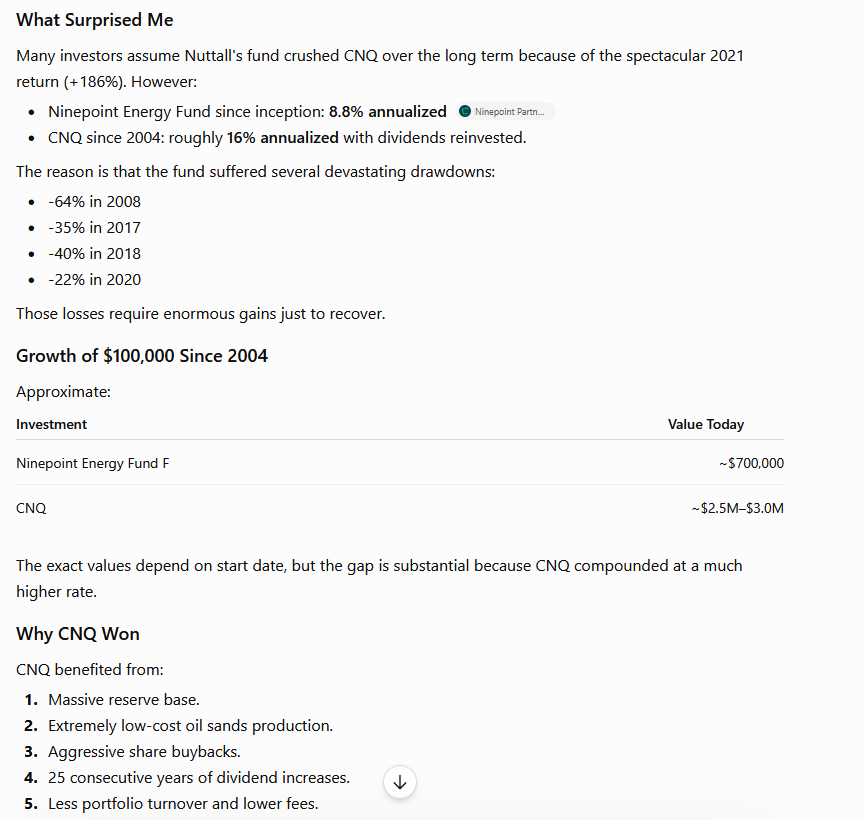
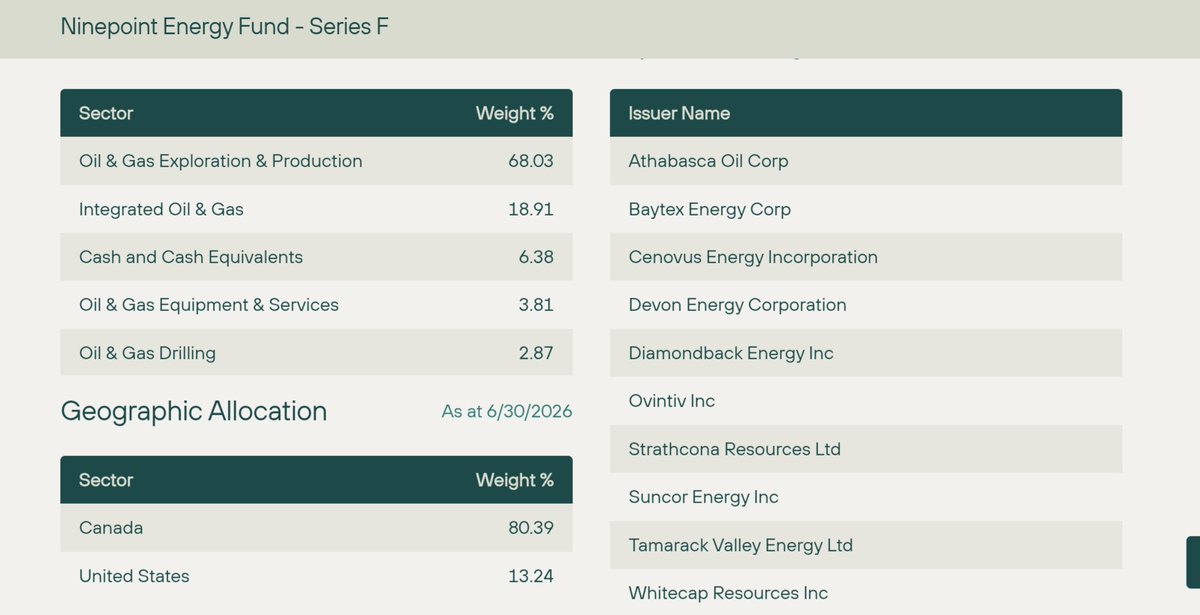
@garquake @ericnuttall 24 years in risk management. An 8.8% annualized return. The résumé did all the outperforming.
Milosh tweet media
English
0
1
2
335
Burnsco
Burnsco@garquake·
Here is latest Top 10 Holdings from Eric's @ericnuttall Energy fund - for fun I included his monthly returns since Ninepoint was started - Gives ya idea why oil and gas guys go grey early 😀 Has done a phenomenal job promoting Canada industry and navigating positions
Burnsco tweet mediaBurnsco tweet media
English
12
8
139
16.5K