
Minerva
1K posts

Minerva
@minerva_crypto
research @rwa_xyz • ex-banking, PE, real estate • whisky & writing • our time is now


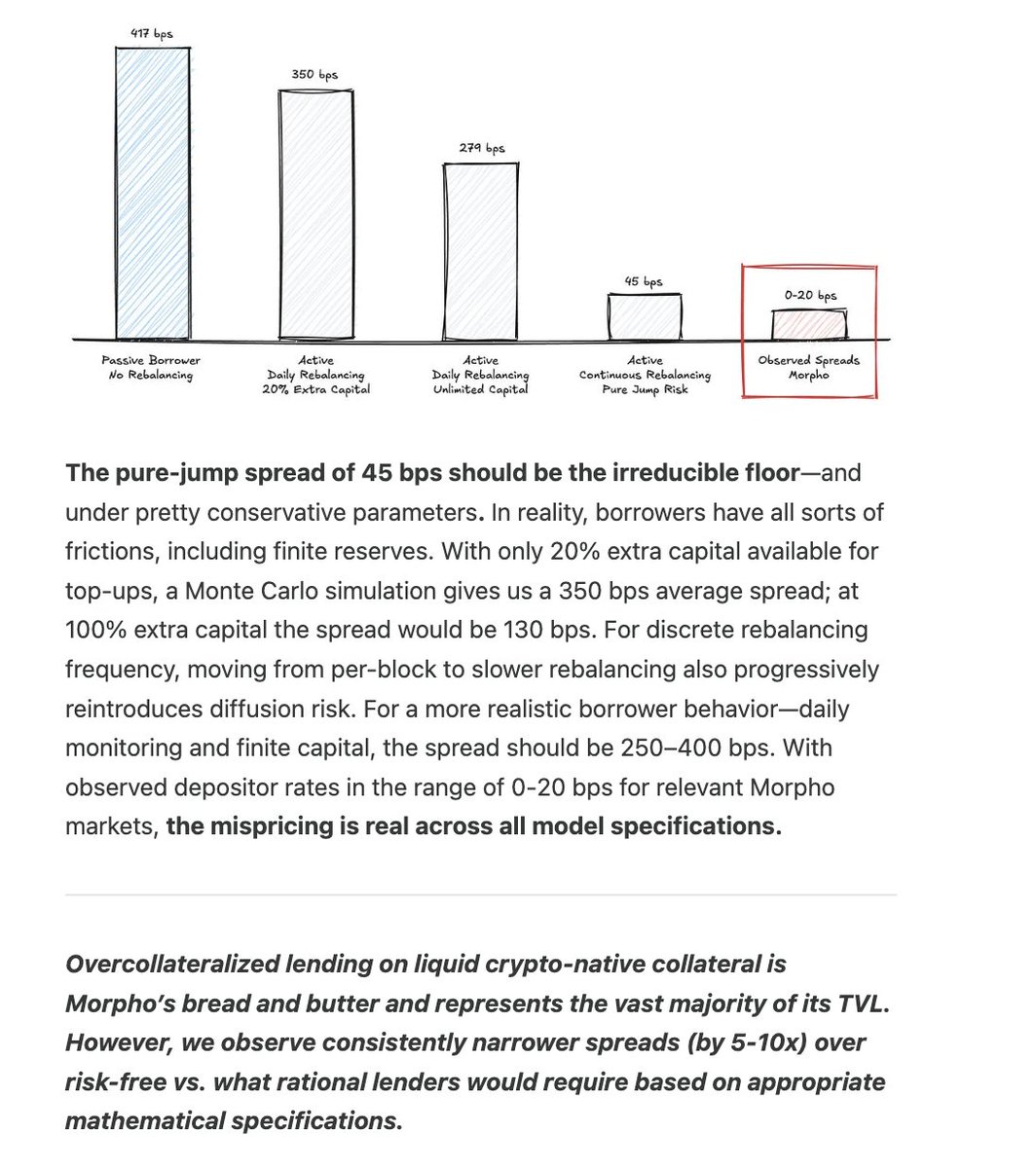
New Dirt Roads out. The Physics of On-Chain Lending. First of three parts. @Morpho's surge into notoriety, driven by flawless execution, is undeniable. The protocol has $11b in deposits, @coinbase and @krakenfx distribution, an Apollo deal for 9% of token supply. Pointing to the lending market as the dominant primitive for the future of finance is compelling but, as usual, the claim requires deeper analysis. Today, most of Morpho's TVL is simply regulatory arbitrage. Under the GENIUS Act, stablecoin issuers cannot share yield directly with holders. Ironically, the regulator, by restricting intermediaries, is enacting a full pass-through risk transfer onto retail depositors, who, in order to get risk-free proxy rates on their stablecoins, are selling cheap puts on crypto collateral through a clean savings UI without recognizing it as such. Survivorship bias from flagship vaults and bull market masking do the rest. The piece breaks Morpho's business into three distinct risk regimes: (a) Liquid crypto collateral lending (b) Leverage looping (c) RWA lending (a) is where, historically, the lending market primitive genuinely shines. Atomic liquidation and continuous oracles make it categorically superior to traditional credit infrastructure, even at mispriced rates. Unfortunately, not many assets fit the category. (b) is also crypto's bread and butter. wstETH/wETH, sUSDe, sUSDS. Leverage looping is not a credit product but a carry trade on mean-reverting basis. Extremely profitable, temporarily, but very hard to manage. (c) is the land of illiquid collateral (private credit, tokenized funds) where assumptions for most quant models fail simultaneously. Unobservable volatility, stale oracle marks, non-atomic liquidation, unenforceable claims across jurisdictions. The dream of building a private credit supermarket on permissionless rails, instantly connected to retail capital across the world, is compelling—and not necessarily for the right reasons. When crypto-native yield compresses, capital on non-custodial rails reaches for off-chain return. We have been here before. I tried to apply quantitative, and mathematically sound, structural credit frameworks to Morpho's isolated markets: Merton, first-passage defaults, jump-diffusion, hazard rate term structures. The results are not too comfortable, but tell the story of WHO is using those markets and WHY. Even under the most generous rebalancing assumptions, rational spreads over risk-free for the safest markets would require fair compensation at 250–400 bps spread. The observed depositor spread on Morpho: 0–20 bps. The mispricing is 5–10x or more. This story is about market inefficiency, regulatory idiocy, and the spotless execution by a building team. This is Part I of III. Part II covers governance, on-chain risk management, and the curator model. Part III talks about addressable markets, unit economics, and implications for MORPHO valuation. Link in comments.


CLAUDE FULL COURSE 4 HOURS This is the most detailed Claude guide I’ve seen online. Bookmark this before you forget. 4 hours. Build tools. Automate work. Learn how people build bots and systems. Claude → Tools → Automation → Products → Money

Morpho's fixed rate protocol now has a name: Morpho Midnight. Morpho Midnight is not an iteration of Morpho Blue. It is a completely new paradigm for onchain lending, and should not be considered a "V2" of Blue. Blue = pool-based open term variable markets with externalized risk management. Midnight = intent-based fixed term fixed rate markets with externalized risk AND rate management. The two will coexist, complementing one another to extend the capabilities of the Morpho network. We’ll start sharing more updates on Midnight as audits finalize.


Luca’s model for onchain lending is rigorous and the framework is genuinely novel. However, we have two disagreements with it: 1. Onchain lending is repo not a put option sale 2. If you use a more realistic LGD parameter, the model predicts observed lending rates without significant mispricing The model relies on a loss-given-default (LGD) parameter to estimate the fair value of an onchain lending position. We would set the LGD parameter to a few bps over 0% (higher than the empirical bad debt rate for lenders in Prime markets) rather than ~5% (which is modeled on the liquidation incentive, a borrower cost). If you do, the model outputs fall exactly in line with observed rates at around 3-30bps, and the alleged mispricing disappears.