B.F. Randall ⚛ ⛏ ⚡

16.8K posts

B.F. Randall ⚛ ⛏ ⚡ banner
B.F. Randall ⚛ ⛏ ⚡

B.F. Randall ⚛ ⛏ ⚡

@Mining_Atoms

Env. & Nat. Res. Lawyer. Nuclear Power = the best solution for humanity's geopolitical, economic, & environmental problems. https://t.co/oXEtb4JMgA

USA Katılım Mart 2022
1.6K Takip Edilen22.6K Takipçiler
Sabitlenmiş Tweet
B.F. Randall ⚛ ⛏ ⚡
B.F. Randall ⚛ ⛏ ⚡@Mining_Atoms·
If you want to know who I am and the great cause of Civilization that I support, start👇. Subscribe to my Substack. And join the cause. Humanity and Mother Earth, whose riches we share, need us to make better decisions. open.substack.com/pub/bfrandall/…
English
41
53
233
0
B.F. Randall ⚛ ⛏ ⚡
B.F. Randall ⚛ ⛏ ⚡@Mining_Atoms·
@Dr_Keefer Chris you’ve educated and persuaded my thinking on this and related topics—especially the fuel-related content you’ve created lately. Lots of great content. Let’s hope we can keep the shiny keys in the right space and focus on proven tech.
English
0
0
6
437
chris keefer
chris keefer@Dr_Keefer·
The SMR craze reflects a fundamental category error & combined cycle gas turbine envy. It tries to map the attributes of a CCGT plant onto nuclear, where the underlying cost structure & physical infrastructure is fundamentally different. A CCGT plant is essentially a jet engine bolted to a heat recovery steam generator and a smaller steam turbine. The critical point is where the complexity sits. The gas turbine, which is the expensive & technically demanding component, is built in a factory, hot functionally tested & shipped to site as a finished machine. Construction on site is largely installation, foundations, piping, electrical connection, using conventional materials & repeatable processes. That architecture shifts risk into manufacturing & compresses timelines. Rather than building the hardest part on site you are simply installing it in 24-36 months. Nuclear does not behave this way. It can incorporate modular components, but the NSSS is only 25-40% of cost. The dominant cost drivers sit elsewhere. Civil works, excavation, basemat, containment, seismic qualification, remain site specific & labour intensive. Nuclear grade quality assurance, documentation, & inspection add another layer of fixed overhead. Safety systems with redundancy and independence are function driven, not size driven, so they do not shrink proportionally with output. The nuclear steam supply system is not analogous to the gas turbine in a CCGT. It is not a fully integrated, factory proven machine that arrives ready to run. The plant comes together on site, under regulatory oversight, with integration, testing & certification happening during construction & commissioning. This is why economies of scale are so strong in nuclear. Many of the costs do not scale linearly with power. When you reduce reactor size, you reduce output & revenue, while a large share of the cost base remains. Studies show that smaller reactors actually increase the relative share of on site construction because the civil works do not shrink in proportion to capacity. The SMR thesis assumes nuclear can transition from a project to a product, capturing the modular, factory built economics of gas plants. The constraint is that the parts of nuclear that dominate cost remain stubbornly project based. None of this explains why the comparison is made in the first place. CCGTs are extraordinarily compelling. They are marvels of thermally efficiency, capital light, fast to deploy & supported by a global supply chain of standardized components. They are the most successful large scale power plants of the past decades. It is natural that nuclear developers would look at that model & attempt to emulate it but in so doing they are committing a grave category error, an error that sets the western nuclear industry up for decade(s) of disappointment. Some SMRs will get built but they will not replicate the CCGT promise. They will be mini versions of large reactors with mini revenues to pay off the significant inherent costs of nuclear.
chris keefer tweet media
English
35
18
115
7.8K
Jon Burke 🌍
Jon Burke 🌍@jonburkeUK·
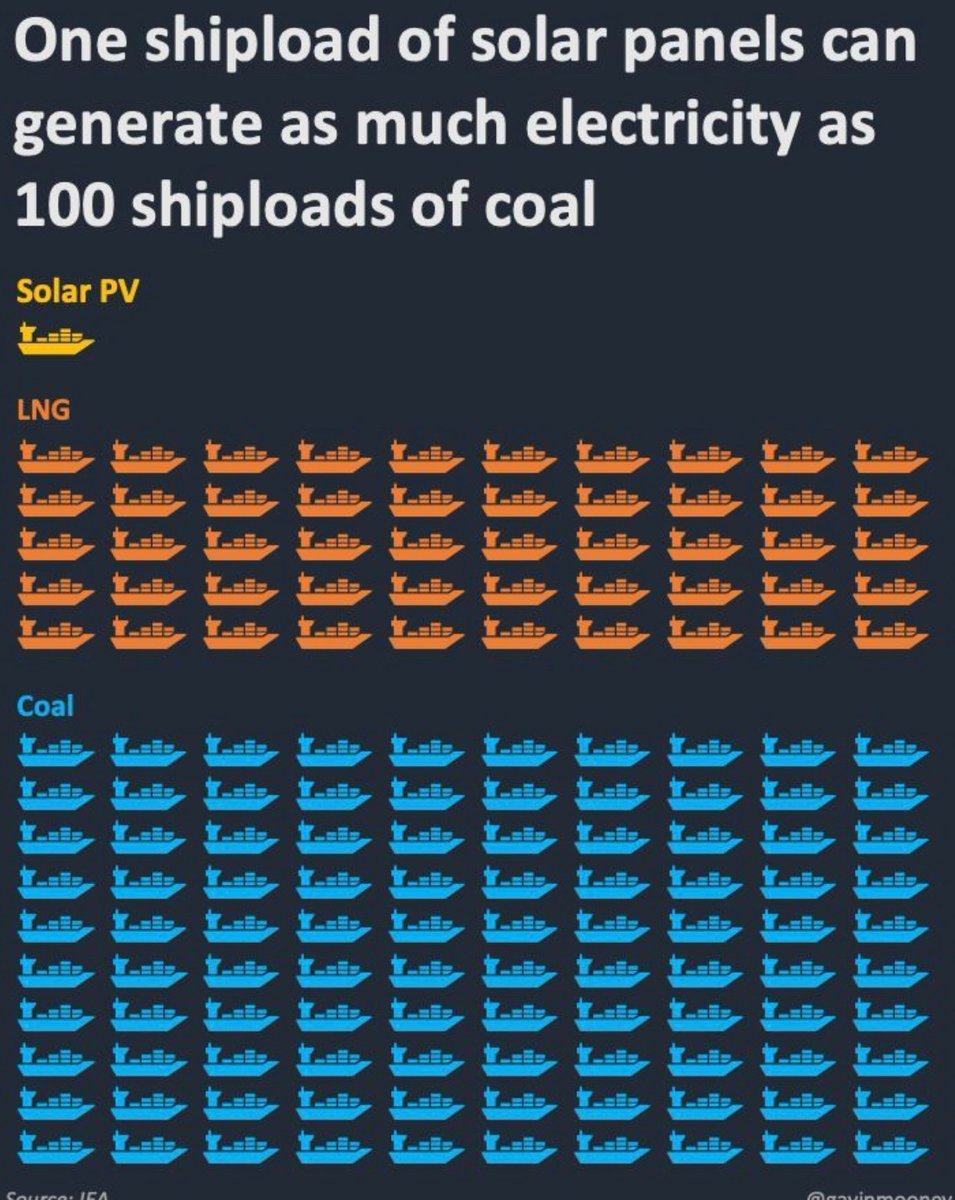
The sun doesn’t have a ‘choke point’.
Jon Burke 🌍 tweet media
English
950
616
2.3K
234.1K
Electroverse
Electroverse@Electroversenet·
Solar and wind are sold as cheaper than coal, gas or nuclear using a number called LCOE (Levelized Cost of Energy). But LCOE is a junk metric. It pretends that one-megawatt-hour of intermittent power is the same as one-megawatt-hour of reliable power. It isn't. When the sun doesn't shine or the wind doesn't blow, you still need electricity. So backup plants (coal, gas or nuclear) must run in the background, ready to fire instantly. LCOE fails to count that cost. It also ignores the miles of transmission lines for remote wind farms, the giant storage systems to cover lulls, the stabilizers to keep frequency steady, and the massive overbuild needed just to survive bad weather weeks.These hidden costs explode as wind and solar take over more of the grid. On paper, LCOE makes these renewables look cheap. In reality, they drive up costs system-wide. That's why nations with the most wind and solar have the highest electricity prices. LCOE isn't just misleading, it's a lie.
English
65
441
894
12.7K
Mackinac Center
Mackinac Center@MackinacCenter·
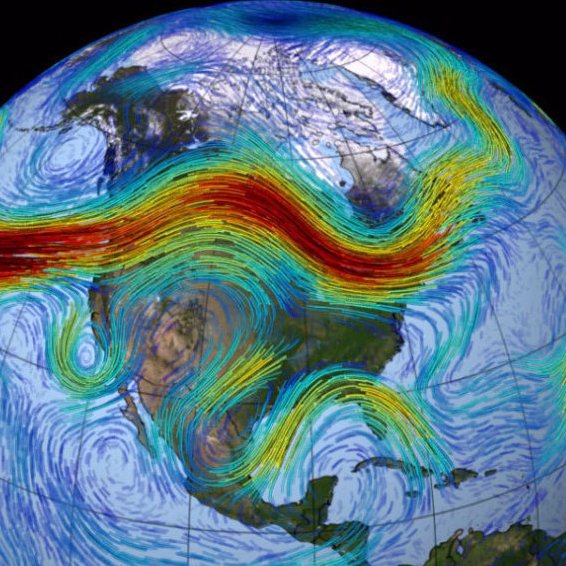
Power from solar and wind can be unavailable for days at a time. Both are often unavailable on the coldest and hottest days, when demand for power is at its peak. Solar power in Michigan generates electricity for about four hours a day, on average, and solar projects last only about 25 to 30 years. Wind power in our region operates about 27% of the time, and wind projects last about 20 to 25 years. Parts of decommissioned projects of either type end up in landfills.
Mackinac Center tweet media
English
3
10
26
821
Hermann O.
Hermann O.@Clarsonimus·
#Green Utopia zealots bravely ignore the two fundamental problems with renewables: They are unreliable, thus requiring 100% backup, and energy dilute (that is, large amounts of #energy are needed to produce small amounts of useful energy). This means they require extensive land, transmission lines, large-scale mining, etc. that other forms of energy do not require.
Hermann O. tweet media
English
73
81
214
4.6K
BladeoftheSun
BladeoftheSun@BladeoftheS·
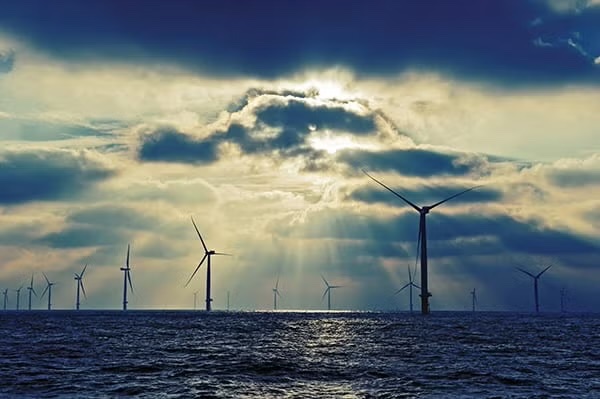
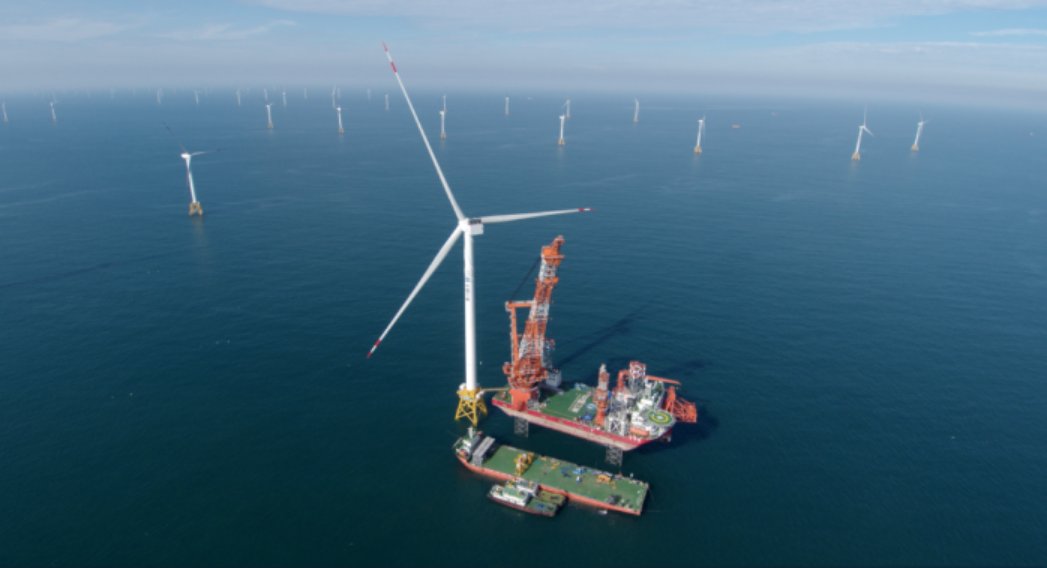
The World's largest Wind Turbine 26MW. In its lifetime it will produce the same energy as burning 750,000 tons of coal. That's 44,118 truck loads. And that's just 1 Wind Turbine.
BladeoftheSun tweet media
English
697
1.5K
6.6K
522K
David Turver
David Turver@7Kiwi·
Chief economist of Nesta demonstrates he has no idea how the grid works. We pay the full cost of renewables: subsidies, backup, grid balancing and expansion even if the marginal cost of production is low. We need much more baseload and dispatchable capacity, not less.
Tim Leunig@timleunig

Baseload is surely the last thing we need, given that much of the time either the sun is shining, or the wind is blowing, and prices will be close to zero for an increasing proportion of the time? (See Spain, as the leading example)

English
24
83
517
19.6K
Martin Heinrich
Martin Heinrich@SenatorHeinrich·
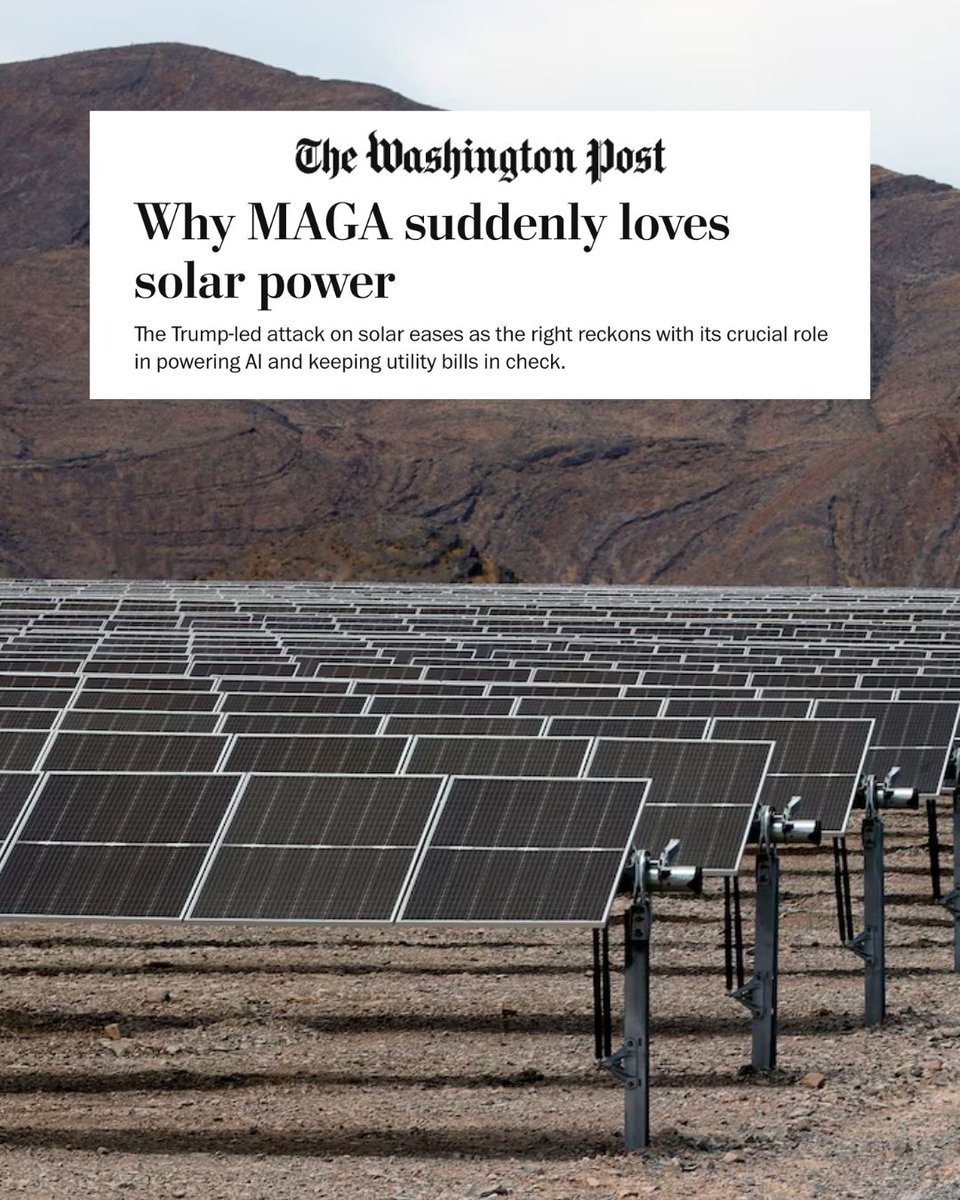
Math tends to win out when enough money is at stake. As I have said repeatedly, solar is the cheapest power on the grid and the fastest to build. And with storage growing in leaps and bounds, it’s basically all baseload power.
Martin Heinrich tweet media
English
203
263
1.3K
50.1K
Treasury Secretary Scott Bessent
Treasury Secretary Scott Bessent@SecScottBessent·
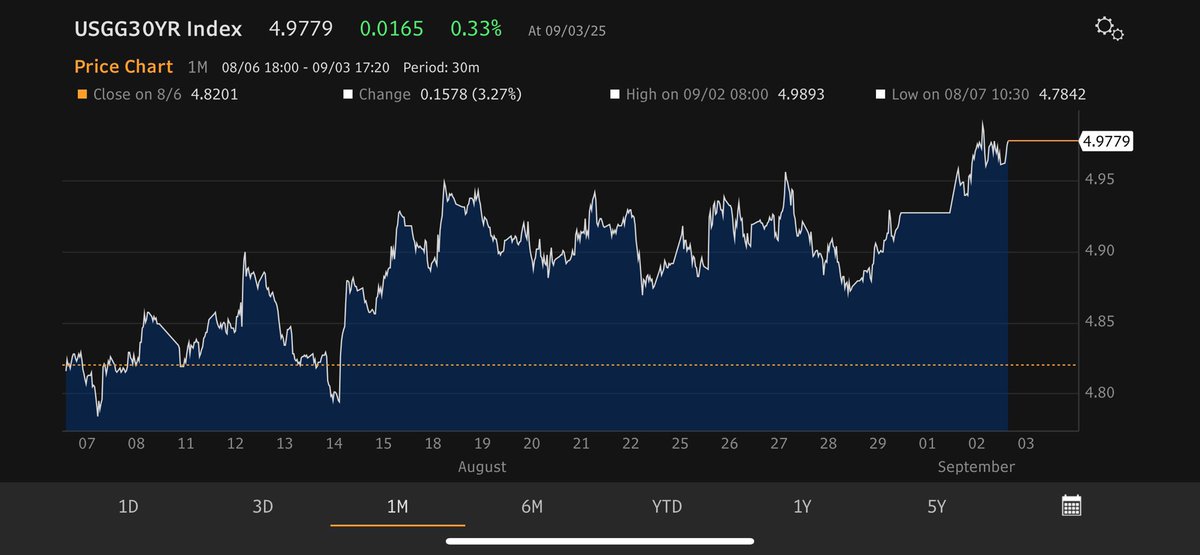
Tariffs are delivering historic results for the American people. Even the mainstream media is starting to admit it. I’ve said total tariff revenue could reach $300B this year, but it could be much higher. Every $300B adds 1% to GDP. With tariffs alone, growth could hit 5%.
English
4.7K
4.9K
23.9K
1.8M
B.F. Randall ⚛ ⛏ ⚡
B.F. Randall ⚛ ⛏ ⚡@Mining_Atoms·
@BasedMikeLee Deported after serving their sentence like all other convicted criminals. But wait - that’s how the government has been managing this issue for decades.
English
0
0
3
136
B.F. Randall ⚛ ⛏ ⚡
B.F. Randall ⚛ ⛏ ⚡@Mining_Atoms·
@SenMarkKelly The role of administrative agencies is to implement policy, determined by Congress, not to determine policy in and of itself. The endangerment finding is precisely the kind of policy that Congress needs to find, if at all. This is elementary administrative law.
English
1
0
5
183
Senator Mark Kelly
Senator Mark Kelly@SenMarkKelly·
Trump’s EPA just overturned what’s called the “endangerment finding.” This is the thing that allows the government to regulate greenhouse gases, the stuff that’s causing the planet to warm. I could see our planet changing with my own eyes in just the 10 years between my first and last space flights. We should be working together to protect our planet for future generations, not undermining science.
English
2.3K
1.6K
4K
126.6K
💎 ISODOPE
💎 ISODOPE@isodope·
nuclear electricity isn’t technically renewable like wind and solar, but the reason for that is mostly a semantics issue. 🧵
English
4
29
144
4.8K
Rod Adams
Rod Adams@Atomicrod·
When it was created in 1974, the NRC employed 1,970 people. There were 56 commercial reactors under construction. A recent Google search result says that the agency currently employs 4,211. There are 0 commercial and 3 research reactors under construction in the US.
English
12
26
106
9.3K