Moshi Alam

456 posts

Moshi Alam

Moshi Alam

@MoshiAlam

Labor Economist| AP @ClarkUniversity | PhD @UWMadison | cooking & cricket | https://t.co/NBn2L4jyB1

Worcester, MA Katılım Nisan 2010
850 Takip Edilen317 Takipçiler
Moshi Alam retweetledi

Grant Sanderson
Grant Sanderson@3blue1brown·
This video was a complete joy to make. Here's a short preview, but next time you're looking to sit down for 45 minutes of math and art, take a look at the full version on YouTube.
English
35
185
2.2K
98.3K
Moshi Alam retweetledi
Jesús Fernández-Villaverde
Jesús Fernández-Villaverde@JesusFerna7026·
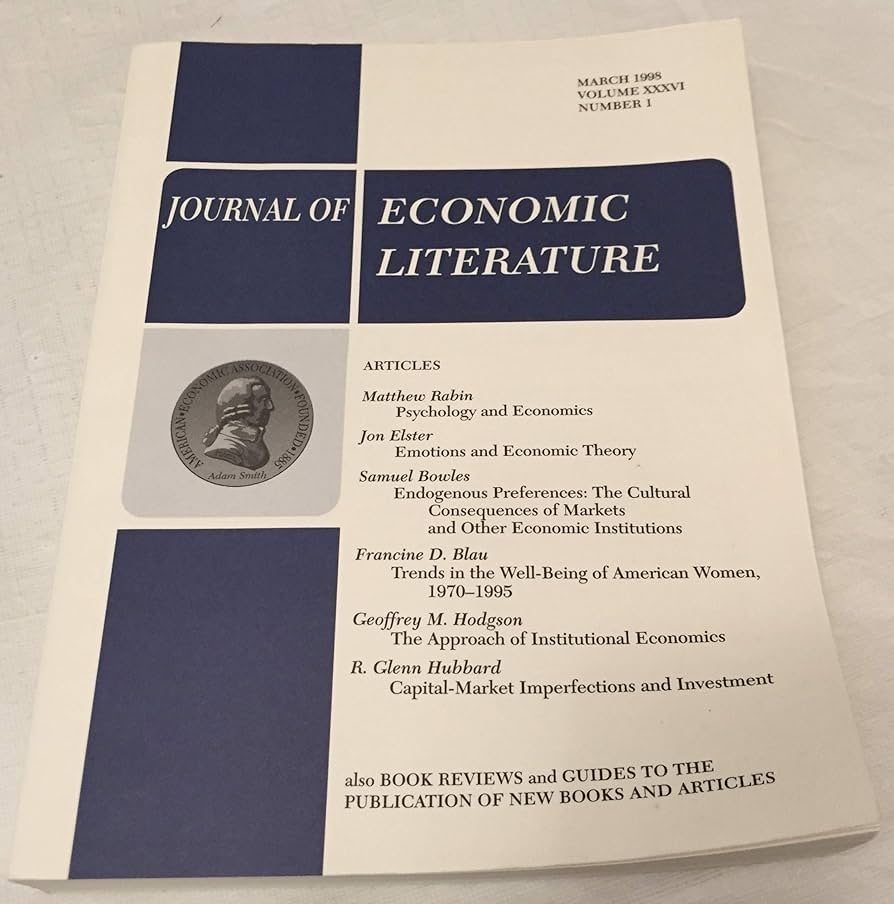
By now, I have published a fair number of papers, and one more acceptance would have close to zero marginal impact on anything that matters professionally. But getting my survey on “Deep Learning for Solving Models” accepted into the Journal of Economic Literature made me genuinely happy, for reasons that have nothing to do with my CV. I had the misfortune of studying my undergraduate degree in economics at a quite awful institution. Two professors, David Taguas and Alfredo Arahuetes, were outstanding, and I owe them a great deal. The rest were well below any reasonable professional level, and some violated the basic standards of ethical conduct. They had no business teaching economics at any level, let alone at a university that charged tuition and claimed to prepare students for professional life. I had to work out most of my education on my own. The surveys published in the Journal of Economic Literature were how I did it. I spent hours in the library’s reading room going through one survey after another on topics I had never been properly taught. Some helped more than others, but collectively they gave me a solid enough foundation that, when I arrived at Minnesota for my PhD, I discovered, to my considerable surprise, that I was ahead of nearly all the other first-year students, including some who held master’s degrees, despite the fact that I had finished my undergraduate degree just six weeks before. I owe the Journal of Economic Literature a debt I will never be able to repay. Publishing a survey there is the closest I can come to trying. So, the thought that some student somewhere, working on her own in a library or on a laptop, might find my survey useful gives me tremendous satisfaction. But there is a broader point worth making. Even in the world of AI, the profession has an important mission in making educational material widely available. Textbooks, surveys, teaching slides, these are public goods in the economist’s sense: high social value, insufficient private incentive to produce. This is also why I post all my slides and teaching material online: sas.upenn.edu/~jesusfv/deepl… We do not reward these activities nearly enough, and their supply is well below what any reasonable social planner would choose. I do not have a good proposal for changing this, and I would welcome suggestions. What I do find heartbreaking is that many of the great economists of the past couple of generations never wrote textbooks on their areas of expertise. I do not mean this as criticism. All of them maximize, and perhaps they all suffer from the same bias I suffer from: the belief that one can always do it next year. But I often think about the hours of pure intellectual pleasure I would have had reading “Time Series Econometrics: An Advanced Textbook” by Chris Sims or “Methods in Structural Estimation” by Pat Bajari. Those books do not exist. They should.
Jesús Fernández-Villaverde tweet media
English
34
201
1.3K
130K
Moshi Alam retweetledi
Jeff Denning
Jeff Denning@JeffDenning·
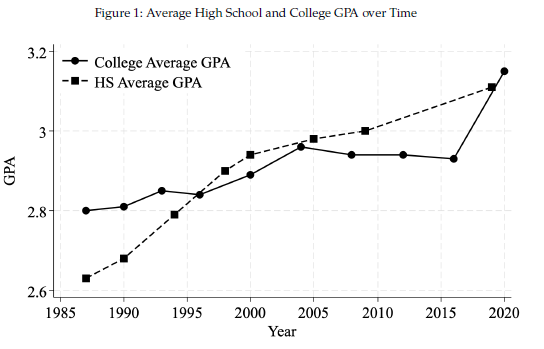
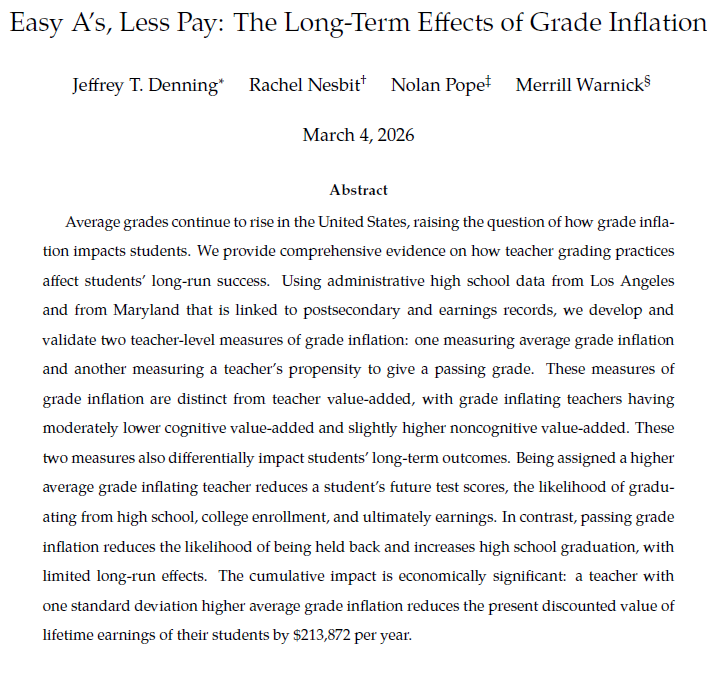
Today we released our new NBER working paper: "Easy A's, Less Pay: The Long-Term Effects of Grade Inflation." Joint work with Rachel Nesbit, Nolan Pope, and Merrill Warnick. Grades in U.S. high schools have risen steadily over the past several decades, but the effect is unknown
Jeff Denning tweet mediaJeff Denning tweet media
English
4
80
298
44.5K
Moshi Alam retweetledi
Econometrica
Econometrica@ecmaEditors·
Communicating uncertainty about our conclusions is an important scientific task. Is reporting a point estimate and standard error good enough? We propose a practical recipe for checking whether it is, and for improving our report when it is not. econometricsociety.org/publications/e…
Econometrica tweet media
English
0
25
115
18.4K
Moshi Alam retweetledi
The Review of Economics and Statistics (REStat)
High-frequency debit and credit transactions show that air pollution increases healthcare costs in China. In the January issue, by Panle Jia Barwick, Shanjun Li, Deyu Rao, Nahim Bin Zahur zurl.co/A6VqT
English
0
6
24
2.4K
Moshi Alam retweetledi
Econometrica
Econometrica@ecmaEditors·
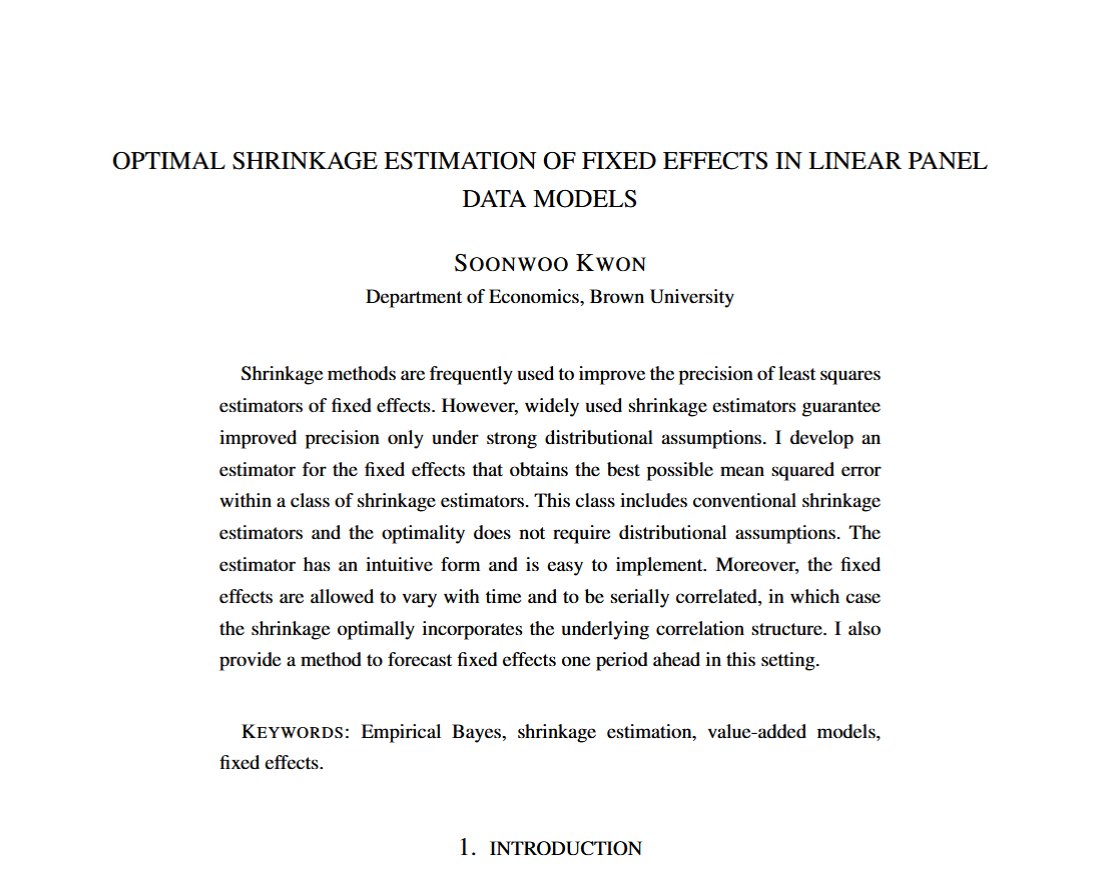
This paper proposes optimal shrinkage of fixed effects in linear panel models, yielding precision gains under weak assumptions—unlike standard methods. It accommodates time-varying or disaggregated effects without strong distributional assumptions. econometricsociety.org/publications/e…
Econometrica tweet media
English
1
25
155
13.2K
Moshi Alam retweetledi
Econometrics
Econometrics@eBlogs·
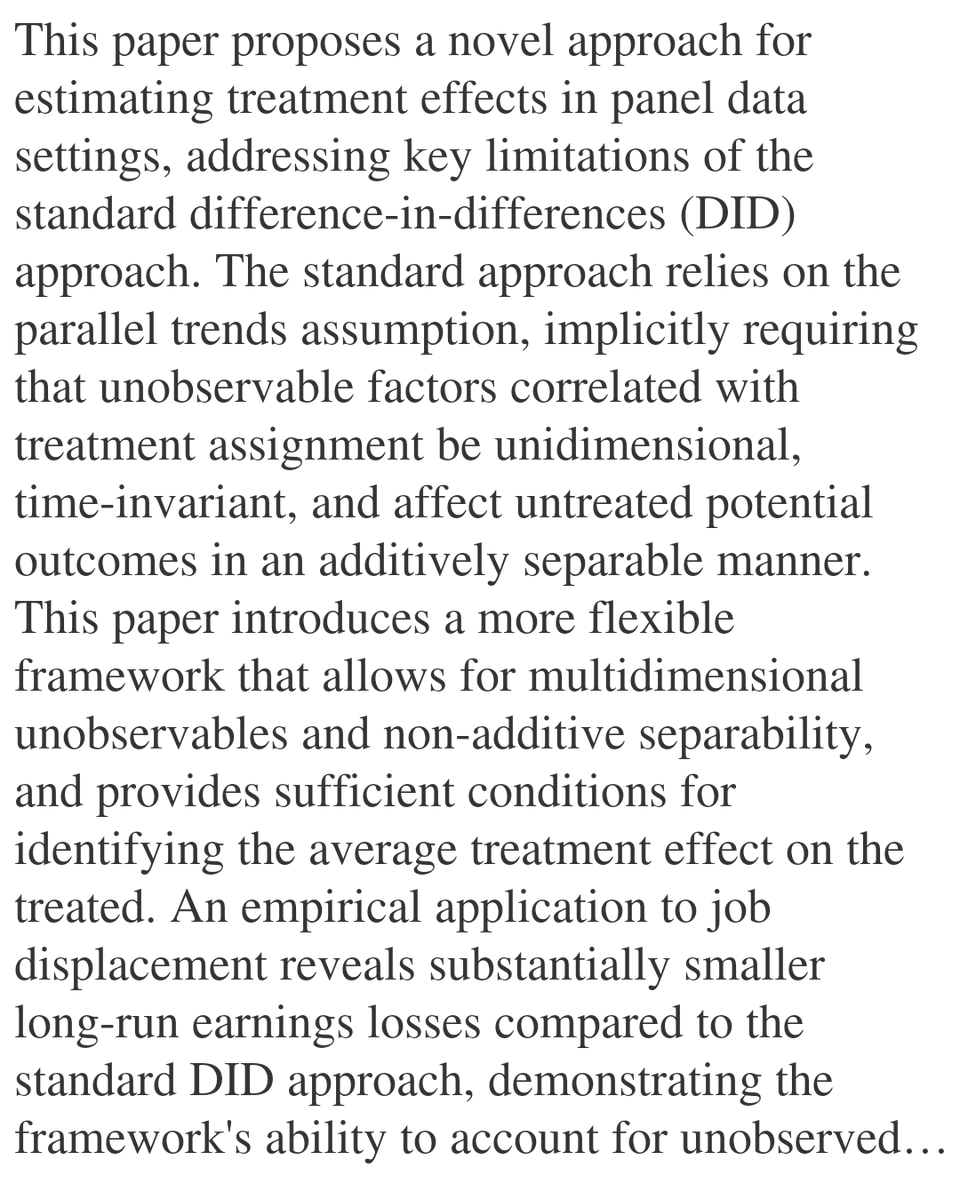
Estimating Treatment Effects in Panel Data Without Parallel Trends Shoya Ishimaru arxiv.org/abs/2601.08281 [𝚎𝚌𝚘𝚗.𝙴𝙼]
Econometrics tweet media
English
1
59
278
24.8K
Moshi Alam
Moshi Alam@MoshiAlam·
@nomadj1s A (naive) 2 step way is to manipulate the linearly separable equation: + & - b2x1 and then + & - b3(x1+x2). Do two independent one sided tests of b1-b2 and b2-b3. Then do a Bonferroni correction. I’d also look at the bootstrap CDFs of b1, b2, b3.
English
0
0
3
290
Damon Jones
Damon Jones@nomadj1s·
Q: There’s a regression with three coefficients: b1, b2, b3 A theory says b1 > b2 > b3 What statistical test should I perform to test this joint prediction? The point estimates are such that b3 > b1 > b2, if that matters
English
5
0
7
4.1K
Moshi Alam
Moshi Alam@MoshiAlam·
@BarbaraBiasi @SpeechifyAI It maybe because of the underlying encoding of the specific PDF. I was listening one on Speechify and it read “effects” correctly. I had once tried Eleven Labs but eventually switched to Speechify.
English
1
0
0
340
Barbara Biasi
Barbara Biasi@BarbaraBiasi·
What apps/websites do people use to listen to PDFs? I'm new to this and just tried @SpeechifyAI , but it skips all the "ff" and makes it really hard to understand.
English
7
5
32
9.7K
Moshi Alam retweetledi
Luis Garicano 🇪🇺🇺🇦
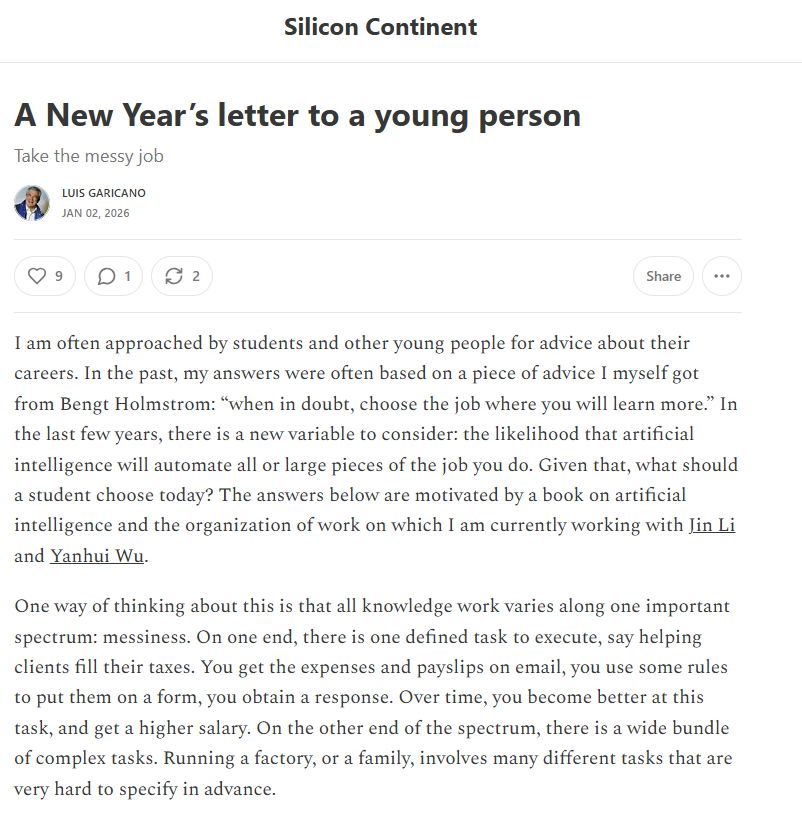
My New Year post is a letter to a young person trying to find their direction in a world disrupted by AI. My advice, in four words: take the messy job. I hope you enjoy it and find it useful. Happy New Year!
Luis Garicano 🇪🇺🇺🇦 tweet media
English
7
70
348
137.2K
Moshi Alam retweetledi
Raffaella Sadun
Raffaella Sadun@raffasadun·
🚨New NBER working paper out!🚨 “Unwilling to Reskill? Experimental Evidence from Real-World Jobseekers” (with A. Delfino, A. Garnero, S. Inferrera and M. Leonardi). We study why take-up of “good” reskilling opportunities is so low—even when jobs are in demand.
English
4
54
186
38.5K
Moshi Alam
Moshi Alam@MoshiAlam·
Happy new year!! 🎊 Please come to the Urban session at #ASSA2026 to hear about our work on identification issues and solutions to recover Optimal Place-Based Transfers with discussion by @TradeDiversion and other exciting papers. #econtwitter
Moshi Alam tweet media
English
0
2
15
1.4K
Moshi Alam retweetledi
Quantitative Economics
Quantitative Economics@qe_editors·
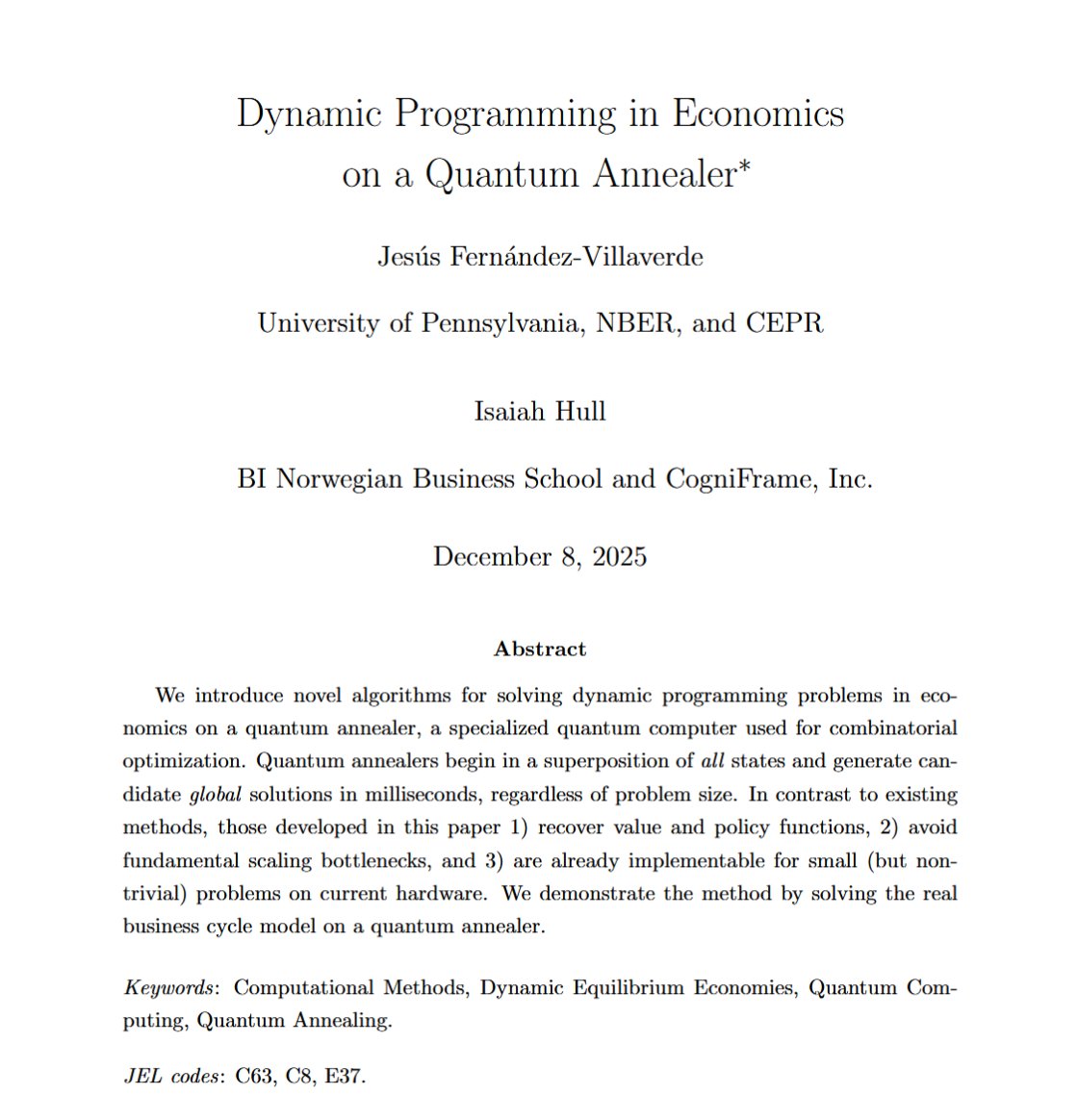
We show how to solve dynamic programming problems on a quantum annealer. Our new algorithms recover value and policy functions, avoid scaling bottlenecks, and already run on current hardware. We even solve the real business cycle model on a quantum chip. econometricsociety.org/publications/q…
Quantitative Economics tweet media
English
3
45
250
74.1K